avatarLisa Marie

Free AI web copilot to create summaries, insights and extended knowledge, download it at here

5079

Abstract

s like so: lattes cost anywhere from 2–5 each, so if someone were to buy one every weekday, this would mean they’re spending anywhere from 40–100 per month on coffee. Thus, he’s saying this money could instead be invested.</p><p id="0b96">Now, if you’re middle-class, this may seem reasonable to you. <i>“Wow! If I cut out my daily latte and drink coffee at home, I’ll save so much money! I should call my mother — she’s going to be so proud that I overcame poverty!”</i></p><figure id="006c"><img src="https://cdn-images-1.readmedium.com/v2/resize:fit:800/0*Jh54VXCvUdnHLdnI"><figcaption>“I ordered a coffee grinder, a French press, and these adorable Mason jar glasses with 2-day delivery so I can make coffee at home for FREE! I’m saving SO MUCH MONEY!” (Photo by <a href="https://unsplash.com/@minimalattitude?utm_source=medium&amp;utm_medium=referral">Alberto Bogo</a> on <a href="https://unsplash.com?utm_source=medium&amp;utm_medium=referral">Unsplash</a>)</figcaption></figure><p id="39c0">When you’re an in-betweener, however, this advice is laughably out-of-touch. Why? Because bold of you to assume I had the money to purchase a latte every day in the first place, sir. This example fails to see the world beyond a comfortable middle-class standard in which everyone can <i>already</i> afford to spend up to $100 per month on carryout coffees.</p><p id="7045">The sad thing is that this sort of tone-deaf “advice” is common when you’re an in-betweener. People who have always lived a middle-class lifestyle tend to be blind to their privilege level. In their mind, they’re not “rich” — they still blow their nose with a regular ol’ Kleenex, not ones made by Chanel! In their eyes, they are just “normal.”</p><p id="e574">The problem is: since they consider themselves “normal,” they mistakenly assume that everybody else is just like them. Thus, upon hearing their in-betweener friend has financial problems, they’ll give dumb advice like, “Brown bag your lunch every day” or “Give up your morning latte.” All while remaining blissfully unaware of how idiotic their advice may sound to an in-betweener.</p><figure id="9ec6"><img src="https://cdn-images-1.readmedium.com/v2/resize:fit:800/0*KTQb_z0Ho-SOe_2o"><figcaption>“Save money on a gym membership by working out at home! Check out my home gym! Of course, I never use any of it, but I got to cancel my gym membership!” (Photo by <a href="https://unsplash.com/@brianwangenheim?utm_source=medium&amp;utm_medium=referral">Brian Wangenheim</a> on <a href="https://unsplash.com?utm_source=medium&amp;utm_medium=referral">Unsplash</a>)</figcaption></figure><h2 id="a3e1">Please talk about your expensive vacations with someone else.</h2><p id="b407">Remember when Kim Kardashian posted <a href="https://theblemish.com/2020/10/kim-kardashians-40th-birthday-was-an-absolute-disaster/">tweets</a> on her 40th birthday about how it was a “simple luxury” to be able to travel? That post didn’t go over well for a reason. As Kim posted about her “hardship” of not being able to go on expensive vacations during a worldwide pandemic, the general public was dealing with <a href="https://www.bls.gov/opub/mlr/2021/article/unemployment-rises-in-2020-as-the-country-battles-the-covid-19-pandemic.htm">widespread unemployment</a>, <a href="https://www.edweek.org/leadership/the-coronavirus-spring-the-historic-closing-of-u-s-schools-a-timeline/2020/07">schools being forced online</a>, and watching their loved ones <a href="https://www.worldometers.info/coronavirus/">die</a>. Kim’s tweets added to a <a href="https://www.insider.com/celebrities-quarantine-social-media-distancing-have-been-completely-unrelatable-in-2020-4">growing list of examples</a> of how out-of-touch rich people are.</p><p id="1552">Kim’s statements are how it comes across when you, dear middle-class friend, talk to me about your expensive vacations.</p><figure id="a08c"><img src="https://cdn-images-1.readmedium.com/v2/resize:fit:800/0*k0kz0PBCnkvrWPoK"><figcaption>These are unprecedented times. Thank God I can still pretend I’m reading a book on the beach to liven up my Instagram! (Photo by <a href="https://unsplash.com/@chenhanozel?utm_source=medium&amp;utm_medium=referral">Chen Mizrach</a> on <a href="https://unsplash.com?utm_source=medium&amp;utm_medium=referral">Unsplash</a>)</figcaption></figure><p id="257e">Don’t misunderstand: I’m happy for you. I think it’s great that you can enjoy traveling and expanding your horizons. I don’t begrudge you for taking advantage of that opportunity at all.</p><p id="55d8">Just don’t make me talk about it.</p><p id="4d6b">When you’re poor or an in-betweener, going on vacation rarely (if ever) happens. Even if you <i>had</i> the money to afford to travel — which, let’s be honest, you probably don’t — taking the time off work to be able to go is another struggle. In the US, lower-income workers are <a href="https://www.cbsnews.com/news/one-in-four-workers-in-us-dont-get-any-paid-vacation-time-or-holidays/">less likely to receive</a> benefits like vacation time or time off on holidays. In thi

Options

s case, time off is not only unpaid but also has to be carefully orchestrated in advance. Not to mention the condemnation they’d receive for “not working hard enough” — never mind that going on vacation is something the white-collar workforce does regularly <i>without</i> guilt trips for taking the time off.</p><p id="c7a4">While my financial situation has been a little better than it used to be, I’m by no means “middle-class.” So, dear middle-class friends, keep this in mind next time you’re about to go away: I am <i>not</i> one of you. Please stop treating me like I am. I can’t relate to your stories, so hearing them is just awkward and uncomfortable. Please, for the love of God… talk about something else.</p><figure id="12b9"><img src="https://cdn-images-1.readmedium.com/v2/resize:fit:800/0*5xMp1RmolXmTb0f0"><figcaption>“Oh, you’re going to make me look at 500 pictures of your hotel’s pool? That’s why you wanted to hang out with me? Cool. By the way, I’m worried this cavity in my tooth may be infected. I don’t have dental insurance, but that’s okay, who needs teeth? Anyway, GREAT view!” (Photo by <a href="https://unsplash.com/@ly0ns?utm_source=medium&amp;utm_medium=referral">Li Yang</a> on <a href="https://unsplash.com?utm_source=medium&amp;utm_medium=referral">Unsplash</a>)</figcaption></figure><h2 id="b078">Don’t assume I want — or need — your assistance.</h2><p id="55e6">Picture this: I’ve agreed to go out with you to a restaurant. Knowing full well this will involve spending money, I prepare myself: I research the place, make note of prices, and set my budget for what I will order. I arrive fully prepared and financially able to enjoy our outing.</p><p id="9557">Then the bill comes. You insist that you’re going to cover my share. I decline, as I am perfectly capable of doing so and I do not want you to pay for me.</p><p id="e244">I am ignored. You pay my bill anyway, despite my protest. I am upset. You insist that you are “being nice,” that I shouldn't be “too proud” to accept “kind gestures” from my friends.</p><p id="6b99">Here’s the problem. You aren’t being “nice.” What you just did was insert yourself where you were neither wanted nor needed. You forced your way in, brandishing your wallet, and blatantly ignored the fact that I asked you <i>not</i> to do that. Worse, by implying I was being prideful for not wanting to accept it, you then belittled and dismissed my feelings.</p><p id="5670">As if I’m supposed to be grateful that you stuck your nose (or, in this case, your debit card) where you didn’t belong.</p><figure id="fdde"><img src="https://cdn-images-1.readmedium.com/v2/resize:fit:800/0*2ETDMtqVsk_jbsug"><figcaption>“Here you go, sir. What? Oh, don’t pay attention to my friend <a href="https://lisa-marie-15.medium.com/">Lisa</a>. She’s a pauper. Her payment will bounce!” (Photo by <a href="https://unsplash.com/@vantaymedia?utm_source=medium&amp;utm_medium=referral">Van Tay Media</a> on <a href="https://unsplash.com?utm_source=medium&amp;utm_medium=referral">Unsplash</a>)</figcaption></figure><p id="ce55">The unfortunate thing is that this sort of attitude is common with middle-class people. Without realizing it, they tend to assume in-betweeners are constantly in need of “help” and that it is their responsibility to provide said help.</p><p id="d995">And don’t misunderstand. Being charitable is wonderful. God bless you if you are a generous giver.</p><p id="e0f9">However, forcing “help” where it is <i>not</i> needed (or wanted) is not an act of generosity. It is meddling based on your assumptions about someone else’s situation, rather than taking the time to learn about their situation. You’ve ceased viewing your friend as a person and now see them as a charity project in need of your rescuing.</p><p id="aef8">So if you are middle-class, take note. If your less-privileged friend does not want your “help,” then don’t do it. Chances are, there’s a reason for their decline. One that, contrary to your assumption, has nothing to do with being “too proud” to accept your condescending imposition.</p><figure id="b40e"><img src="https://cdn-images-1.readmedium.com/v2/resize:fit:800/0*Ob10DXd9J9RAOlq8"><figcaption>Side Note: if you ever touch my nachos when we’re at dinner, you will lose a hand. (Photo b<a href="https://unsplash.com/@hero?utm_source=medium&amp;utm_medium=referral">y Herson Rodrigu</a>ez o<a href="https://unsplash.com?utm_source=medium&amp;utm_medium=referral">n Unspla</a>sh)</figcaption></figure><p id="3074"><i>Thank you for reading! If you would like to comment, refer to <a href="https://lisa-marie-15.medium.com/ground-rules-of-my-content-441b89380836">this post</a> first.</i></p><p id="fa4b"><i>If you would like my work to continue, please consider becoming a Medium member using <a href="https://lisa-marie-15.medium.com/membership">this link</a>. It would really help me out.</i></p><p id="e214"><i>If you’d like to encourage me to write more with a $2 cup of coffee, <a href="https://www.buymeacoffee.com/lisaluvskitties">click here</a>.</i></p></article></body>

Dear Middle-Class Friends: Please Stop Doing These Tone-Deaf Things

For the love of God, don’t show me any more of your vacation photos.

Photo by Priscilla Du Preez on Unsplash

NOTE: I wrote a follow-up to this article. You can find that here. I also wrote a “Part 2,” which you can find here.

Over the past few months, I’ve been writing on-and-off about growing up working-class — or, as I call it, an “in-betweener.” This is someone who is not rich enough to afford the comfortable lifestyle of the middle-class, but who is not quite poor enough to be considered “poor.”

Writing these articles has been a great experience. Not only have I seen a lot of fellow “in-betweeners” connect with it, but I’ve also had some middle-class people who are intrigued by a different way to experience existence.

And of course, since this is the internet, there have been a few jerks. Like the guy who insisted I was lying about being working-class just because I went to college. (I’m assuming he doesn’t know what student loans are.)

Beyond these fabulous conversations on Medium, I’ve also been doing a lot of reflection on my interactions with middle-class people. While I value them and their impact on my life, I think there are some things about me they are woefully ignorant about. Thus, I want to explore four areas I think some middle-class people could stand to improve.

Disclaimer: This article is a lighthearted piece written from my perspective as a working-class woman. Please do not take it as a treatise on class differences or as an indictment against privileged people. I wrote it for entertainment purposes.

Stop saying you’re “so broke.”

When a middle (or upper-middle) class person says they are “broke,” it is a hyperbolic statement. They technically have money — they just don’t have the amount of money they would like to have at the moment. Thus, they are waiting until their next paycheck to go back to their regular spending habits.

In particularly obnoxious cases, they are simply comparing themselves to rich people. While they live a fairly comfortable lifestyle, they can’t keep up with their rich friends, whose idea of “poor” means they drive an SUV as opposed to a Lamborghini.

“And here I am, wiping my butt with regular toilet paper like uncultured swine!” (Image via The Street.)

This is not the case for in-betweeners. When we say we’re “broke,” this could mean anything from “I have no money in my bank account” to “I can’t afford groceries this week, so I’ll be eating buttered saltines until Friday.”

Back in college, my husband and I got to know a middle-aged in-betweener woman who worked at a McDonald’s drive-thru. We didn’t eat out a ton, but on occasion, we stopped by for a cheap dinner; she was always there.

One day, she tearfully confided in us that her husband had died two days ago. Why was she at work, you ask? Simple: she couldn’t afford to take time off — they were already struggling financially as is, but now that he was gone, her income was about to get even smaller. Thus, with a heavy heart, she put on her uniform to face a barrage of angry customers and drunk college kids — all while going through the motions of grief and loss. She had no choice. Taking time to mourn meant she wouldn’t be able to survive.

Bottom line? No, you are not “broke.” Stop it.

“I can’t afford anything at Whole Foods until Friday, so I had to buy this from Trader Joe’s! I’m SO BROKE!” (Photo by Louis Hansel on Unsplash)

Some of your money-saving advice sucks. Be mindful of that.

Remember that dude who pushes the “latte factor” principle? His infamously simplistic advice goes like so: lattes cost anywhere from $2–5 each, so if someone were to buy one every weekday, this would mean they’re spending anywhere from $40–100 per month on coffee. Thus, he’s saying this money could instead be invested.

Now, if you’re middle-class, this may seem reasonable to you. “Wow! If I cut out my daily latte and drink coffee at home, I’ll save so much money! I should call my mother — she’s going to be so proud that I overcame poverty!”

“I ordered a coffee grinder, a French press, and these adorable Mason jar glasses with 2-day delivery so I can make coffee at home for FREE! I’m saving SO MUCH MONEY!” (Photo by Alberto Bogo on Unsplash)

When you’re an in-betweener, however, this advice is laughably out-of-touch. Why? Because bold of you to assume I had the money to purchase a latte every day in the first place, sir. This example fails to see the world beyond a comfortable middle-class standard in which everyone can already afford to spend up to $100 per month on carryout coffees.

The sad thing is that this sort of tone-deaf “advice” is common when you’re an in-betweener. People who have always lived a middle-class lifestyle tend to be blind to their privilege level. In their mind, they’re not “rich” — they still blow their nose with a regular ol’ Kleenex, not ones made by Chanel! In their eyes, they are just “normal.”

The problem is: since they consider themselves “normal,” they mistakenly assume that everybody else is just like them. Thus, upon hearing their in-betweener friend has financial problems, they’ll give dumb advice like, “Brown bag your lunch every day” or “Give up your morning latte.” All while remaining blissfully unaware of how idiotic their advice may sound to an in-betweener.
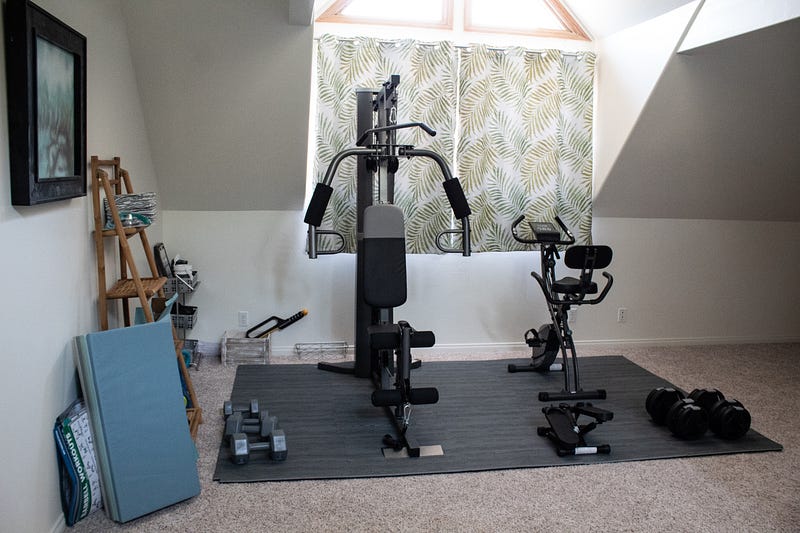
“Save money on a gym membership by working out at home! Check out my home gym! Of course, I never use any of it, but I got to cancel my gym membership!” (Photo by Brian Wangenheim on Unsplash)

Please talk about your expensive vacations with someone else.

Remember when Kim Kardashian posted tweets on her 40th birthday about how it was a “simple luxury” to be able to travel? That post didn’t go over well for a reason. As Kim posted about her “hardship” of not being able to go on expensive vacations during a worldwide pandemic, the general public was dealing with widespread unemployment, schools being forced online, and watching their loved ones die. Kim’s tweets added to a growing list of examples of how out-of-touch rich people are.

Kim’s statements are how it comes across when you, dear middle-class friend, talk to me about your expensive vacations.

These are unprecedented times. Thank God I can still pretend I’m reading a book on the beach to liven up my Instagram! (Photo by Chen Mizrach on Unsplash)

Don’t misunderstand: I’m happy for you. I think it’s great that you can enjoy traveling and expanding your horizons. I don’t begrudge you for taking advantage of that opportunity at all.

Just don’t make me talk about it.

When you’re poor or an in-betweener, going on vacation rarely (if ever) happens. Even if you had the money to afford to travel — which, let’s be honest, you probably don’t — taking the time off work to be able to go is another struggle. In the US, lower-income workers are less likely to receive benefits like vacation time or time off on holidays. In this case, time off is not only unpaid but also has to be carefully orchestrated in advance. Not to mention the condemnation they’d receive for “not working hard enough” — never mind that going on vacation is something the white-collar workforce does regularly without guilt trips for taking the time off.

While my financial situation has been a little better than it used to be, I’m by no means “middle-class.” So, dear middle-class friends, keep this in mind next time you’re about to go away: I am not one of you. Please stop treating me like I am. I can’t relate to your stories, so hearing them is just awkward and uncomfortable. Please, for the love of God… talk about something else.

“Oh, you’re going to make me look at 500 pictures of your hotel’s pool? That’s why you wanted to hang out with me? Cool. By the way, I’m worried this cavity in my tooth may be infected. I don’t have dental insurance, but that’s okay, who needs teeth? Anyway, GREAT view!” (Photo by Li Yang on Unsplash)

Don’t assume I want — or need — your assistance.

Picture this: I’ve agreed to go out with you to a restaurant. Knowing full well this will involve spending money, I prepare myself: I research the place, make note of prices, and set my budget for what I will order. I arrive fully prepared and financially able to enjoy our outing.

Then the bill comes. You insist that you’re going to cover my share. I decline, as I am perfectly capable of doing so and I do not want you to pay for me.

I am ignored. You pay my bill anyway, despite my protest. I am upset. You insist that you are “being nice,” that I shouldn't be “too proud” to accept “kind gestures” from my friends.

Here’s the problem. You aren’t being “nice.” What you just did was insert yourself where you were neither wanted nor needed. You forced your way in, brandishing your wallet, and blatantly ignored the fact that I asked you not to do that. Worse, by implying I was being prideful for not wanting to accept it, you then belittled and dismissed my feelings.

As if I’m supposed to be grateful that you stuck your nose (or, in this case, your debit card) where you didn’t belong.

“Here you go, sir. What? Oh, don’t pay attention to my friend Lisa. She’s a pauper. Her payment will bounce!” (Photo by Van Tay Media on Unsplash)

The unfortunate thing is that this sort of attitude is common with middle-class people. Without realizing it, they tend to assume in-betweeners are constantly in need of “help” and that it is their responsibility to provide said help.

And don’t misunderstand. Being charitable is wonderful. God bless you if you are a generous giver.

However, forcing “help” where it is not needed (or wanted) is not an act of generosity. It is meddling based on your assumptions about someone else’s situation, rather than taking the time to learn about their situation. You’ve ceased viewing your friend as a person and now see them as a charity project in need of your rescuing.

So if you are middle-class, take note. If your less-privileged friend does not want your “help,” then don’t do it. Chances are, there’s a reason for their decline. One that, contrary to your assumption, has nothing to do with being “too proud” to accept your condescending imposition.

Side Note: if you ever touch my nachos when we’re at dinner, you will lose a hand. (Photo by Herson Rodriguez on Unsplash)

Thank you for reading! If you would like to comment, refer to this post first.

If you would like my work to continue, please consider becoming a Medium member using this link. It would really help me out.

If you’d like to encourage me to write more with a $2 cup of coffee, click here.

Working Class
Privilege
Humor
Friendship
Life Experience
Recommended from ReadMedium