
Dear Cisters: Do good parents raise their kids to think of elephants? (Strict Fathers vs Nurturant Parents)
All NYT Best-selling Parents Answer This Question

Do good parents raise their kids to think of elephants?
It’s a big question. And yet who thinks to ask it? Even when that’s all being a parent is really about.
GUEST CONTRIBUTORS
This article owes just about every inch of gratitude I can spare to the phenomenal author, editor, and champion for moms and healthy families everywhere: Colleen Temple
Colleen is the founding team member of Motherly, where she worked as the essays editor for over four years for an audience of 30 million. She is married to Colin, who ALSO has the nickname Col. They live in Massachusetts with their three lively and hilarious kids (none of them are named any variation of Col).
After working together for the final year of Pitch Wars, I couldn’t deny Colleen’s talent — or how well we work together. When it came time for Transgender Soapbox to answer questions about parenting, I reached out to her for her insights. I’m happy to call her my friend and ally.
Join us below for our paradigm-shifting insight on parenting, elephants, and how to tell a story your readers will never forget. — Stephenie Magister and Colleen Temple
ELEPHANTS NEVER FORGET A PARENTING STYLE
It’s a silly trick that the more you try not to think about something, the more you have to think about it. The only way to let go is to surrender.
DON’T THINK OF AN ELEPHANT
Another silly trick — or maybe it’s called a metaphor — is to prove this by telling someone not to think of an elephant. The more they try…the more they think of a taxonomic outgroup to the assemblage of hyraxes.
That’s a fancy phrase for “elephants.”
Now here’s what’ll really blow your mind
As a kid, you were told different versions of “DON’T THINK OF AN ELEPHANT” every day of your life. All the way through when you went off to live as an adult. And even now, your parents still call to remind you that in order to live a good life, good people do not think of elephants.
DON’T THINK OF AN ELEPHANT
Wouldn’t it be nice if you’d had the OTHER kind of parent?
Hold on..there’s another kind?!
That’s right. There are (at least) two kinds.
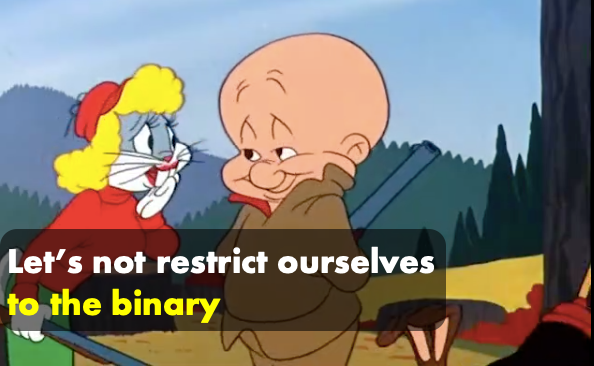
STRICT FATHERS vs NURTURANT PARENTS
In his outstanding book DON’T THINK OF AN ELEPHANT, George Lakoff divides parents by two styles: Strict Fathers vs Nurturant Parents
Strict Fathers believe people are inherently flawed and must be punished to repress their worst impulses.
Nurturant parents believe most people are good and will thrive if given adequate support.
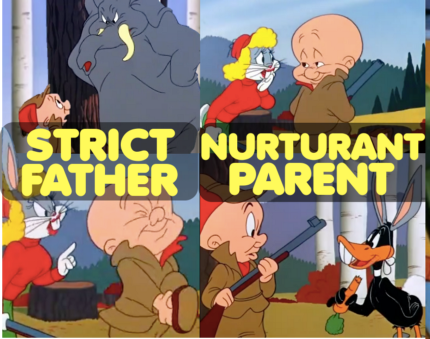
A Strict Father, for example, calls their kid to make sure they’re adhering to proper beliefs, proper behaviors. Don’t think of an elephant! Their kid’s internal experience is secondary to whether they are fulfilling a role essential to the stability of society. Resist, repress, obey — or else.

A Nurturant Parent calls their kid to make sure they have proper resources to face the conflict we all face over whether to think of an elephant. Indeed, whether any of us can CHOOSE not to think of one. Nurturant Parents don’t push their kids to maintain an eternal struggle against their inner nature.
Let’s take a closer look at the differences.
STRICT FATHERS
The Strict Father model is a binary system — in the real-world version of this ideology, people are separated into just two categories: male and female. Why is that important?
Because in the Strict Father system, if we don’t respect the established hierarchy of power, society falls apart. What is that order?
God->Father->Mother->Children->Nature
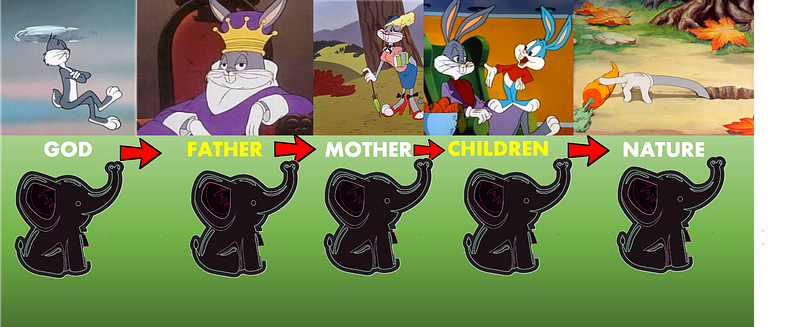
That’s the order. Patriarchy rules. God — a male figure — will always sit at the top. The father will always have more authority than the mother, the mother than the children, and on down the line.

You can quickly see how gender diversity and inclusivity would devastate the Strict Father worldview.
Do you write fiction? The Strict Father conundrum still applies. Even if your fictional world is a fantasy that allows you to remake the nature of reality from scratch, your story may manifest bigotry in its world building through some other equally absurd binary.
NURTURANT PARENTS
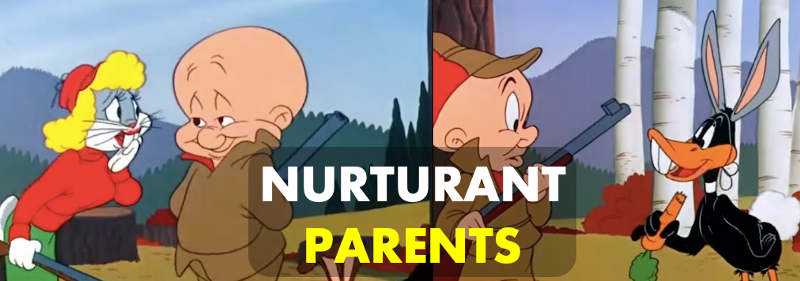
In the Nurturant Parent frame, no one’s gender (or lack of gender) privileges them with power. The whole approach is gender neutral. Man? Woman? Non-binary? Transgender? Gender-fluid? A-gender? Pan-gender? Neo-gender? We are all worthy.
The Nurturant Parent frame assumes we all have good intentions but are pushed to horrifying behaviors due to a lack of resources. Nurturant Parents provide a healthy, supportive environment for people to manifest their best selves. Children are born good and can be encouraged to be better.
We will all stumble and grow in fits and starts, but that’s not evidence we’re inherently flawed. Nurturant Parents pursue progress, not perfection.
But then again, it’s one thing to accept that your kids aren’t perfect. Never will be.
It’s another thing for them to flat out not listen to anything we say.
So what do you do when your kids refuse to obey?
BINARY VS NON-BINARY: obedience vs disobedience vs no obedience
The Strict Father view attracts those who prefer easy distinctions between who deserves power and who deserves to serve. Be a man and you have power. Be anything less — or anything less than clearly a man — and your lower place in the power hierarchy is assured.

For a Strict Father, it’s merely a coincidence if our authentic self matches up with who we must choose to be outside of ourselves. If that authentic self DOESN’T match up with the child’s proper role? Then the child must be disciplined and punished until they resist that authentic self.
For a Nurturant Parent, obedience isn’t everything — discovering and fulfilling your authentic self takes priority. For a Nurturant Parent, perfect obedience from their children loses all meaning if it costs their children their authentic selves.

SO WHY?
SOMEONE PLEASE EXPAIN IT.
Why does one set of parents believe discipline and punishment are how we teach children not to think of elephants?
Why does the other teach their kids that thinking of an elephant may not even be that bad?
Why does one set of parents think discipline and punishment are God’s finest tools to repress our wicked natures?
Why does the other set of parents think nurturing and caring are a parent’s finest tools to reveal the secretly worthy nature of a person that Strict Fathers try to repress?
THE PRICE OF DISOBEDIENCE
INHERENTLY GOOD
Because in the Strict Father frame, people are inherently flawed. We must be saved from ourselves.

God and the Father are required to use discipline and punishment to rear children. Or, if you’re royalty or the President or King or something, your duty is to use discipline and punishment — you may be familiar with the modern phrase “cruelty is the point” — Strict Fathers use pain to push people to do the right thing.
The idea is to make giving in to your sinful nature MORE painful than if you had just obeyed. Hurting people is justified — think of modern societies that use the threat of physical harm to control the behavior of anyone deemed deviant.
Think of punitive justice systems that hurt people who hurt people. An eye for an eye, a tooth for a tooth, let the punishment fit the crime. Rehabilitation is reserved for those who don’t need it.
INHERENTLY GOOD
Isn’t it strange how deceptively similar these two kinds of parents can appear?
The Strict Father believes discipline and punishment are necessary.
Does the Nurturant Parent therefore believe the opposite? Well, no. The Nurturant Parent will also utilize discipline and punishment. But the impact is as distinct as the intent.
SEE ALSO: Do Good Parents Raise Their Children to Write Sci-fi/Fantasy?
Nurturant Parents believe their kids are inherently good. Discipline and punishment aren’t used to train children to resist their inner impulses — but they ARE used. Rather, boundaries and limits form the foundation for how their kids learn healthy manifestations of their identity and ambition.
The inner self isn’t what must be defeated. It’s the obstacles from within (and without) that prevent equal access to resources.
ELEPHANTS HAVE TO EAT TOO
Even Nurturant Parents face limits on resources. The conflict your characters face — whether they are Strict Fathers or Nurturant Parents — comes in part from how the economy empowers those people to overcome economic obstacles.
These questions are helpful especially in contemporary fiction — an alpha asshole billionaire, for example, required to marry or lose their company is usually a Nurturant Parent in conflict with a Strict Father paradigm.
THE POINT OF THE STORY
Now that we’ve got you fired up —
If you leave a comment BEFORE you continue reading, we’ll understand as long as you Clap, Comment, and Come Back…
But if you’re like us, you can’t read those passages without relating HARD to certain pieces.
If you’re like us, you can’t read the other passages without immediately sitting up with the feelings and thoughts and visceral conflict you’ve always felt over this darkly mirrored parenting style of your own.
If you’re like us, you already know EXACTLY what you want to say.

The thing is…you can see advantages to both. Pros and cons. Reasons you’d nurture the hell out of your kid vs get stricter than the scorekeeping for the 1982 Donkey Kong Arcade Competition.
Which brings up an even bigger question…
You’re probably already asking it.
When it comes to these two parenting styles…
Is there a way to honor both?
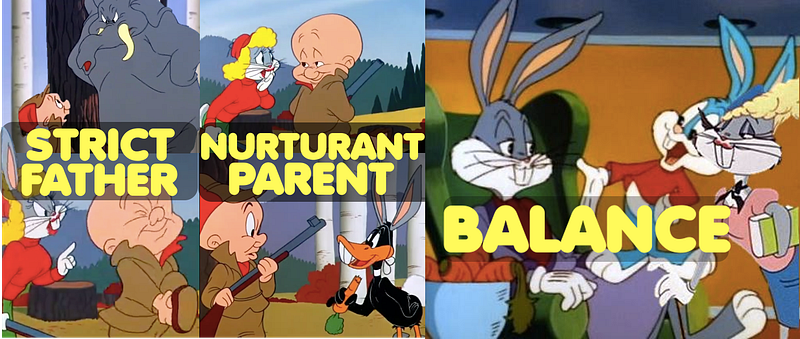
BRINGING BALANCE TO THE (parenting) FORCE
There are two mothers in this article. And though one of us is cisgender and the other is transgender, we’ve found as much in common as most moms.
Isn’t that so often the case? Trans vs cis experiences don’t make as much of a difference as we fear. Women are women. Moms are moms.
Let’s say you’re more like Colleen.

I understand the strict father bits as that’s how I was raised. And I identify with the nurturant parent bits because that is how I identify as a parent. — Colleen
Let’s say you’re more like Stephenie.

I identify with the nurturant parent parts because I was raised in an extreme Strict Father setting. It’s hard for me to see any value in harm and punishment, but I also don’t want to be an anything goes kind of mom. — Stephenie
WHEN MOMS CONNECT
We keep coming back to the same questions.
Boundaries are healthy. Boundaries are necessary.
But we were raised to express boundaries through discipline and punishment. For a lot of moms, that leaves us fearful of inflicting the parenting style that kept us from thriving for so many years.
OUR AWESOME READERS SAVE THE DAY
Then we began looking through the letters our readers sent in when they heard we were going to write about parenting. One or two of them turned into the conversations we most needed.
Did you know how much moms have in common in other parts of the world, too?
LETTER TO THE EDITORS
I like a strict parent who can set boundaries but nurture as well. I think strict parenting never works, but neither does permissiveness disguised as nurturing. Setting strict boundaries (within reason) is essential. But this is also because I’m an immigrant parent and want to inculcate my kids with certain cultural things they may not see the value in yet. — Anonymous Reader
And there it is. The answer to the same yearning in me and Colleen that you might be feeling, too.
What happens when you borrow philosophies, strategies, and concepts from both sides of the Parenting Paradigm?
WHY THINK OF ELEPHANTS WHEN YOU CAN SIT ON THEM?

The Nurturant Parent style only works if the person is willing to take an honest look at the impact of their actions. Just as our anonymous contributor said, “Strict parenting never works, but neither does permissiveness disguised as nurturing.”
Our awesome anonymous contributor said:
Good parenting doesn’t depend on the child necessarily understanding or agreeing to what their parent needs from them. We teach kids the value of empathy, discipline, respecting boundaries, and doing things that their younger brain doesn’t see value in at the moment. — Anonymous Reader
FINAL THOUGHTS ON THE VALUE OF EMPATHY, EVOLUTION, AND ELEPHANTS
Just as our anonymous contributors pointed out, research shows that our kids won’t have brains mature enough for sophisticated empathy until they’re teenagers. And boy does empathy bring its own set of challenges.
Are you familiar with how it goes?
Empathy leads to self-worth. Self-worth leads to vulnerability. Vulnerability leads to connection.
And you know what happens when teens start to connect??

They almost certainly think of elephants.
Sincerely,
The Two Best Moms to Ever Write About Elephants
PS. Which style of parent are you? Let us know in the comments or by writing to transgendersoapbox [at] gmail.com. We love insights from our fellow parents from all corners of the world.
THE END
Hi, it’s Stephenie!
Believe it or not, I do this for a living. Here’s how you can support me.


