
Deadly ‘Shane’ hombre Jack Palance punched out TV host Dennis Wholey
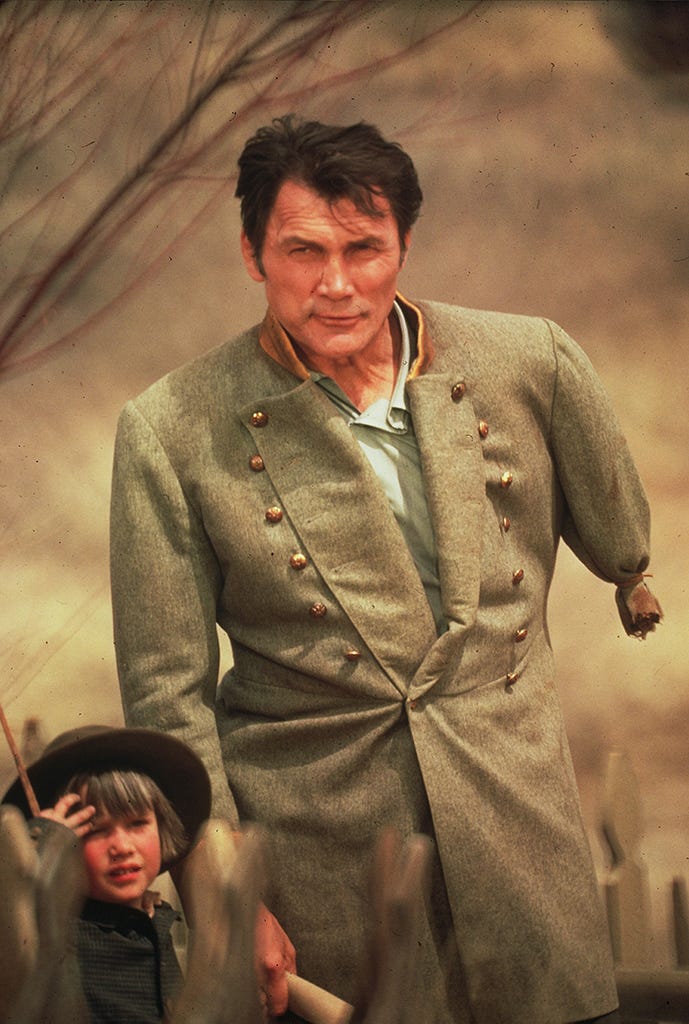
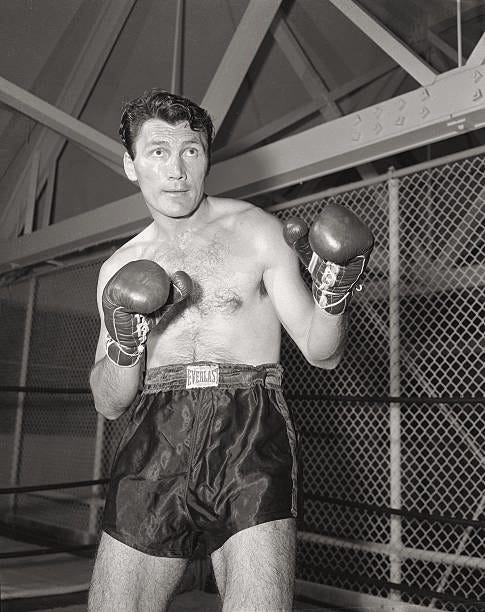
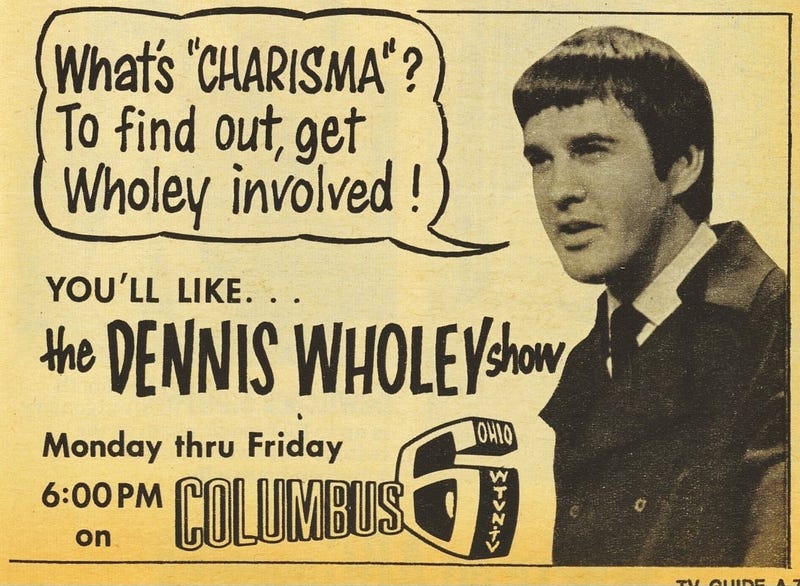
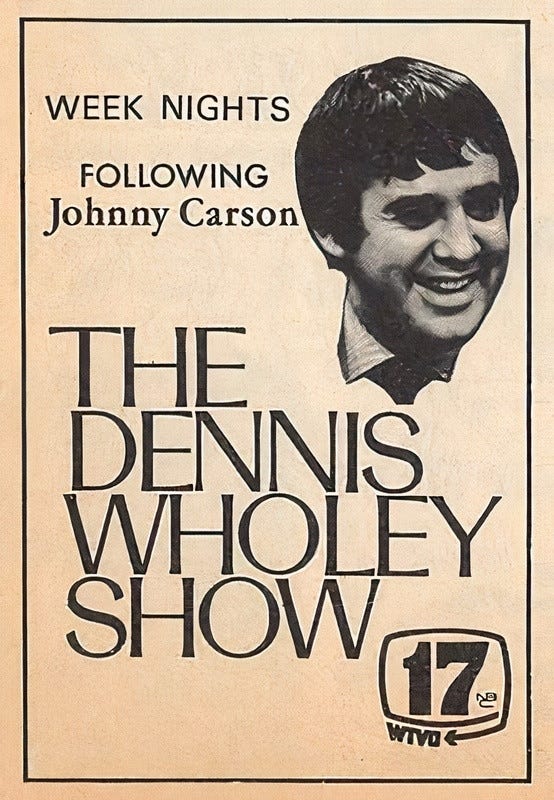
Heavyweight boxer, World War II Air Force veteran, and three-time Best Supporting Actor Oscar nominee Jack Palance came up with his apropos moniker in song, “The Meanest Guy That Ever Lived.” Sandwiched between the Italian Euro War knock-off Battle of the Commandos and the dreadful McMasters is an incredible Palance incident from The Dennis Wholey Show, a long-buried 1969–1970 series filmed inside Taft Broadcasting Studio in Cincinnati, Ohio. Actors, musical guests, deejays, comics, journalists, and politicians were all welcomed by Wholey, a former game show host of ABC’s The Generation Gap, self-improvement author behind The Courage to Change: Hope and Help for Alcoholics and Their Families, and current interviewer of This Is America & the World, a high brow international affairs program airing in certain PBS markets.
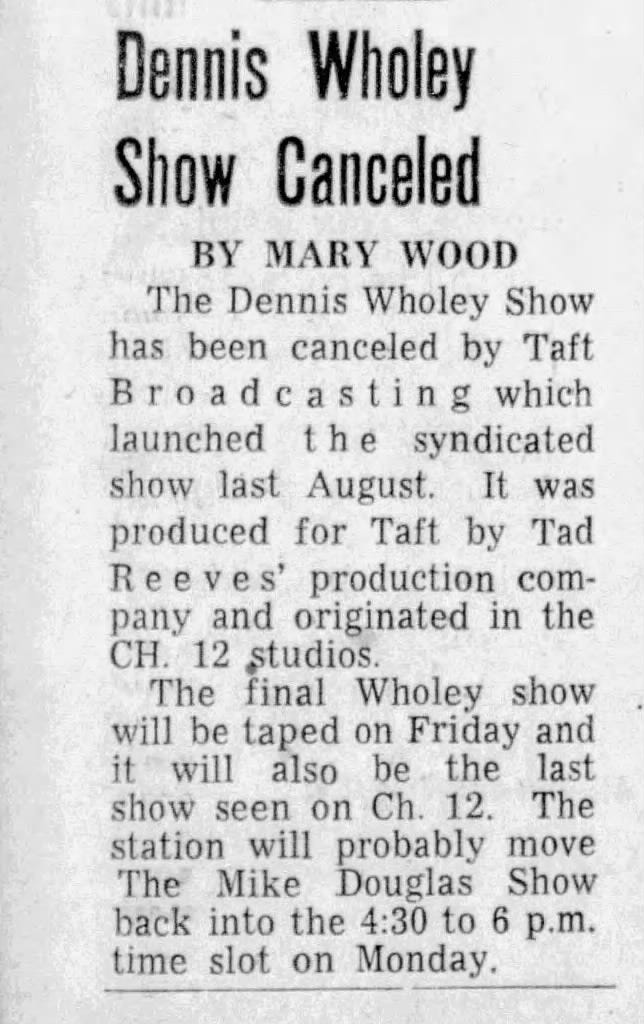
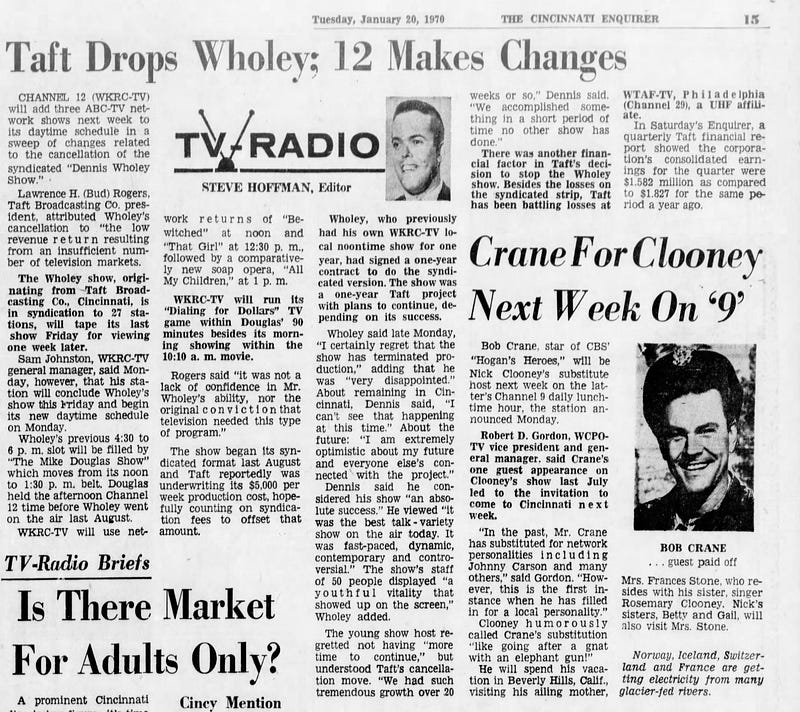
Palance, deadly with a six-shooter — just ask ill-fated homesteader Elisha Cook, Jr. in Shane — did not see eye to eye with Wholey and lost his cool. Their confrontation would have been lost if not for Mark Malkoff’s Carson Podcast, a treasure chest filled with behind the scenes anecdotes from The Tonight Show Starring Johnny Carson. For the July 29, 2021, podcast [skip to the 30:53 minute mark and listen until 36:36], Malkoff engineered a round table of three Tonight Show talent coordinators — Paul Block, Howard Papush, and Pat Silverman Bradford [married to Carson’s early head writer Hank Bradford]. Prior to Bradford’s 1970–1973 tenure on The Tonight Show, she worked with Wholey and was in the studio on Jan. 22, 1970, when the s**t hit the fan. Cancelled earlier that week by Taft CEO Bud Rogers due to “low revenue return resulting from an insufficient number of television markets,” Palance was coincidentally booked on The Dennis Wholey Show’s last episode, taped on Thursday and broadcast the next day in syndication.
Encouraged by Papush to spill the beans, Bradford recollected, “Jack Palance came on The Dennis Wholey Show and obviously had had several drinks before he got there. He didn’t like Dennis, didn’t like the questions that he was being asked, and didn’t like the attitude. Jack took offense by punching Dennis out and sending the host about 17 feet across the studio. Of course, there’s a whole audience there who gasped and were absolutely horrified.
“Those of us who were backstage immediately started to run toward the studio. There’s an airlock in studios. You have two doors so that the sound doesn’t get through. I was running in there and I got into the airlock as Jack was coming out. A very angry, inebriated actor of great size didn’t like me being in the way. He pushed me about 17 feet and sent me flying. The next thing I remember was watching the ancient security guard at this station, who was probably about 75 years old, now sounds young, coming toward me with his gun drawn.
“Guests don’t punch out the host. It was absolutely awful. They managed to corral Jack and get him aside. Cops showed up in about three minutes, and he was literally taken to the airport and put on whatever plane was leaving town. I don’t know where he went, but he was gone. Not easy being a television host — or talent coordinator.”
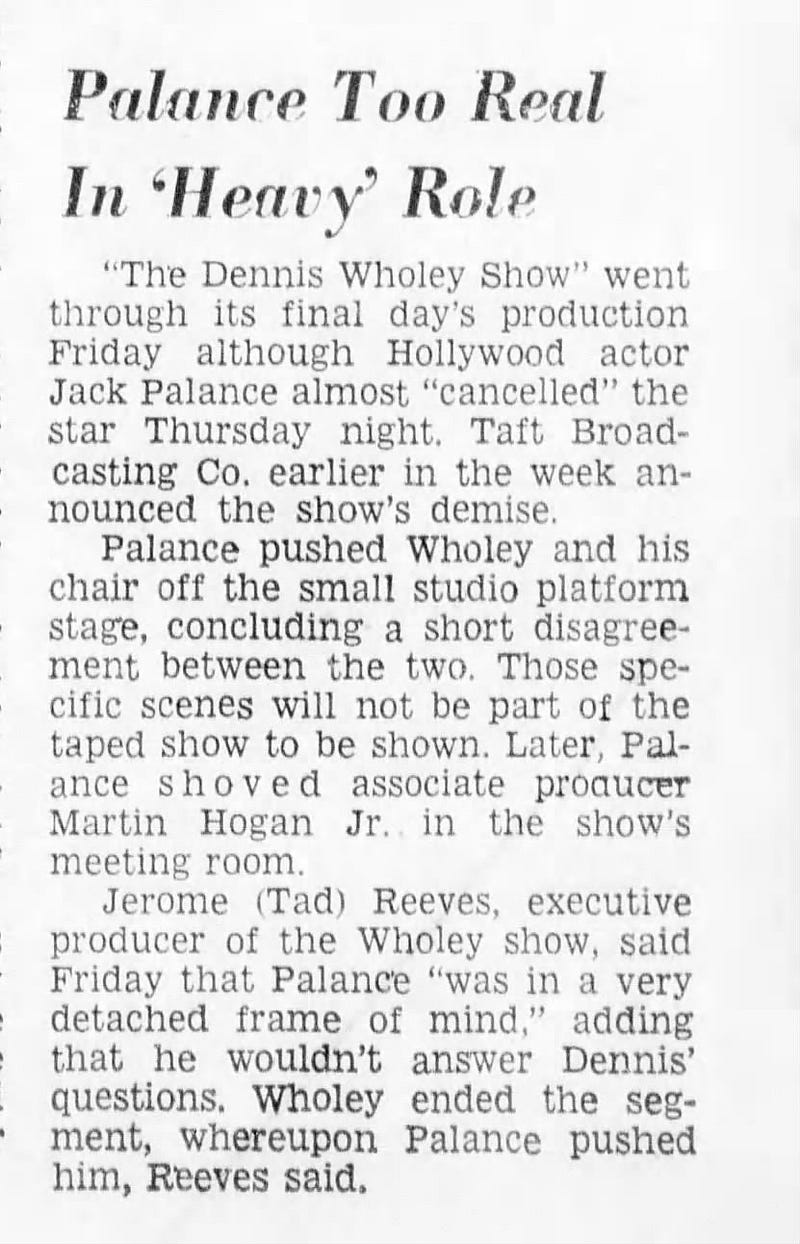
Hours after it transpired, Wholey executive producer Tad Reeves gave a brief quote to the Cincinnati Enquirer, judging Palance to be in a “very detached frame of mind” when he “pushed Wholey and his chair off the small studio platform stage” because the host opted to terminate Palance’s interview. Martin Hogan, Jr. later received a shove in the series’ meeting room. The altercation was edited out of the final 90-minute broadcast. None of the 114 episodes have been seen since.
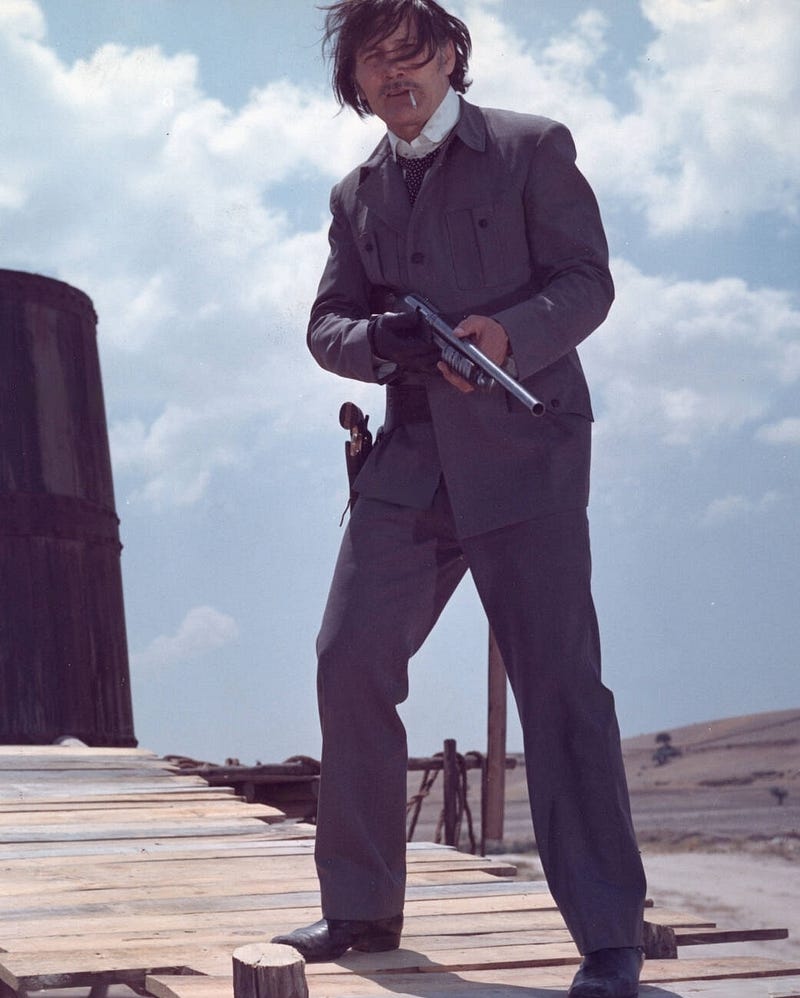
Papush proved to be a world-class raconteur on his solo Nov. 25, 2015, Carson Podcast episode [jump to 15:37 minutes and lend an ear until the 19:53 point] as well as the subsequent talent coordinator roundtable with Bradford. Turns out Palance was not banned from other talk shows. “I knew Dennis Wholey because I had started off my television career as an NBC tour guide in 1963,” clarified Papush. “Dennis trained me and always wanted to be a performer and interviewer. I joined The Tonight Show on Monday, Aug. 6, 1973 [and left in 1977]. The first guest assigned to me was a singer [the candidates would have been Lana Cantrell, Leslie Uggams, or Gerri Granger]. She was gonna do two songs, so I wrote Johnny’s introduction for her. On Thursday came my first speaking guest — Jack Palance. He was promoting Stanley Kramer’s Oklahoma Crude [George C. Scott and Faye Dunaway toplined the cast of this overlooked early 20th century western dramedy], and I wanted to do well.
“I had to connect with Jack for a pre-interview. We liked to do our interviews with guests a day or two before their scheduled appearance so that we could really ruminate over the notes. I tried to find Jack and couldn’t, even though I had been given his phone number. I finally had success the day of the show. I started asking Jack questions, and he didn’t wanna answer them. Our conversation was going nowhere. I realized, ‘I’m really better at this if I can see a person face to face.’
“Jack owned a ranch [bought in 1964 and named after Palance’s daughters, the 900-acre Holly Brooke spread is situated in Cummings Valley, 50 miles southeast of country music mecca Bakersfield]. I said, ‘When are you coming down to the Tonight Show studio area?’ ‘I have a meeting with my accountant about noon.’ ‘Can I come over to your accountant’s office and sit with you for a moment?’ In the back of my head I knew what Jack did to Dennis. Jack could be a surly guy, and that was also the reputation his villainous roles projected. If I asked Jack a question and he didn’t like it, he might punch me — or Johnny. If I can’t get a good pre-interview out of this, I’m gonna lose my job in the first week.
“Jack told me there was a bar downstairs from where his accountant’s office was on Wilshire Boulevard and that I should meet him there. I drove from Burbank into Midtown, and I went to this seedy bar. Jack was sitting in the back area. I walked over, introduced myself, sat down, and started talking. He was not very communicative. I didn’t know what to do. All of a sudden I noticed he had a leather-bound book, sort of a personal diary, on the table.
“I said, ‘What’s that book?’ ‘I do notes and I write poetry in it.’ ‘What?’ ‘Yeah, I write poetry.’ Jack Palance, this villain who punches people out, writes poetry? ‘You know something, I’d really be interested in hearing one of your poems.’ I was grasping at straws [laughs]. Jack read me a piece of poetry, which was terrific. I said to him, ‘Would you be willing to read this poem tonight on the show with Johnny?’ He thought for a moment and said, ‘Sure, why not?’ So that was the hook. I got him on the show, and he was a big hit because he played against type. Jack became a regular on the Tonight Show [as late as May 10, 1991, with Carson and then ultimately on March 31, 1992, with permanent guest host Jay Leno]. Jack and I also became friends. Tough, in a sense, but really a lovely guy.”
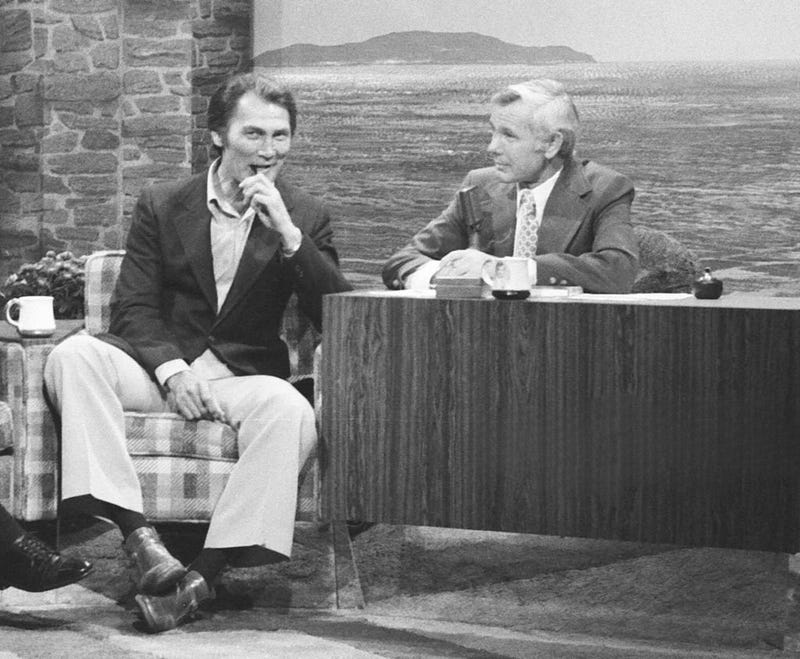
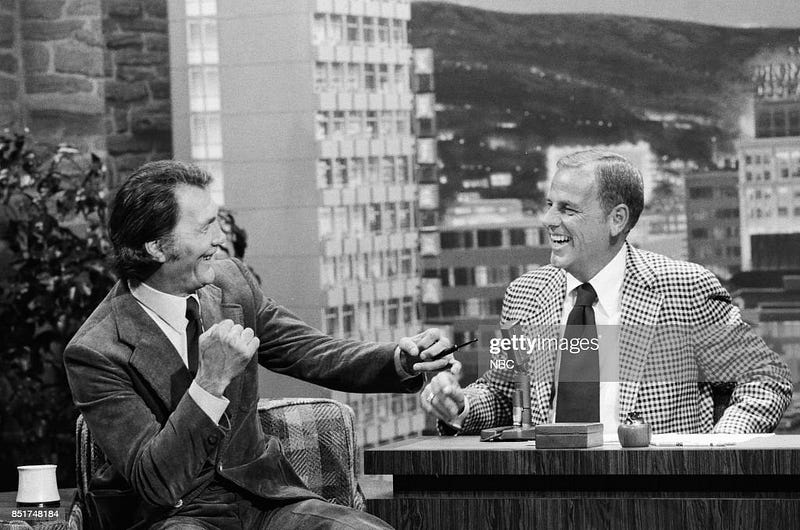
Palance did multiple poetry readings during his ‘70s Tonight Show segments. Not to cast shade upon Papush’s compelling reminiscence, but in scrutinizing the complete Aug. 9, 1973, episode in the official Carson clip licensing website that also included Victoria Principal, Gabriel Kaplan, tennis champ Bobby Riggs, and Linda Hopkins, Palance performs not a trace of poetry. He only sits for a 13-minute chat with Carson, dressed in an atypical white short sleeve shirt and shorts because of an earlier mock match with Riggs, and highlights Oklahoma Crude.
For the Nov. 23, 1973, telecast, Palance sang his delightfully campy composition “The Meanest Guy That Ever Lived.” Before leaving the couch for the stage, Palance admitted to Carson, “I’d rather do [Edgar Allan Poe’s] ‘The Raven,’ but if I have to sing, I will.” Carson divulged, “I remember when you came on and did ‘The Raven’ one night. You did it beautifully.” No such video of Palance’s “Raven” rendition exists in the Carson archive, but Palance is confirmed as being invited to the Tonight Show prior to 1973 on four separate occasions — July 20, 1964, July 8, 1965, Oct. 11, 1965, and May 1, 1967 — well before Papush was hired and during the program’s New York residency when episodes were woefully erased. On March 1, 1974, the Sudden Fear film noir lynchpin recites Poe’s “Annabel Lee” poem. Palance’s first original poem on The Tonight Show does not materialize until July 10, 1974, when he yearns for a “beautiful haunted being longing to find supreme reason for being.”
© Jeremy Roberts, 2023. All rights reserved. To touch base, email [email protected] and mention which story led you my way. I appreciate it sincerely.