
Day Tripping: June 6
Military Mishaps, Missed Summers, and Master Plans
Ill Timed Assault
After seizing control of Fort George a week earlier, American troops headed west in hopes of crippling British defences and take a stranglehold on Upper Canada in 1813. While camped at Stoney Creek, the US forces Generals Winder and Chandler were slow to act and fell victim to a surprise assault in the early hours of June 6. Seven hundred British soldiers followed Colonel John Harvey into the scarcely guarded American encampment at 40-Mile Creek and within minutes, Winder and Chandler were captured and taken prisoner.
The Americans who had gained the upper hand only a week earlier were forced to retreat to the safety of Fort George and wait for better opportunities to dispense with the British. For the men fighting for Upper Canada, the Battle of Stoney Creek was a major morale boost for the British side going forward in the War of 1812.
Weather Altering Eruption
In the Dutch East Indies, Mount Tambora erupted reaching a Volcanic Explosivity Index (VEI) of seven, the only recorded instance of an explosion on that scale in history. Forty-three kilometres of smoke and ash rose into the stratosphere, killing 10,000 people almost instantly. The effects were felt long after and worldwide as crops failed and created famines that killed an estimated 90,000 more.
On June 6, 1816, the state of New England experienced six inches fo snow and every month of that year saw frost in the American Northeast. The year without a summer was registered as one the coldest ever in the Northern hemisphere.
D-DAY
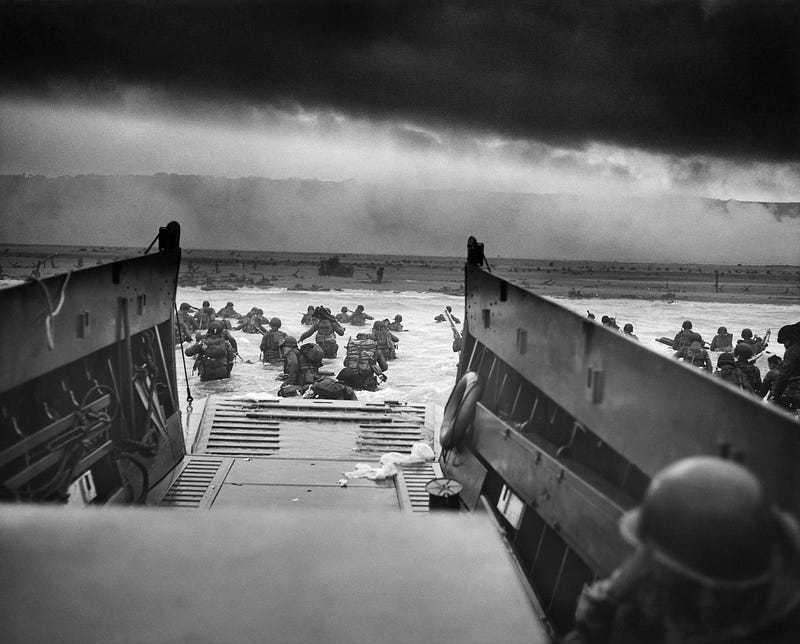
The skies above Normandy cleared and after years of strategic planning, Operation Overlord went into effect in 1944. The D-Day offensive was the largest amphibious assault in history with 160,00 allied troops crossing the English Channel and landing at five separate beaches, code-named Utah, Omaha, Gold, Juno, and Sword. During the night before, 24,000 airborne troops from the US, Britain, and Canada were dropped in behind enemy lines.
The liberation of France at first appeared doomed with Omaha beach taking heavy casualties from the German defence. Gradually, the Allies gained a foothold and began advancing inland, ultimately crumbling Hitler’s so-called Fortress Europe.
Musical Milestones
John Lennon appeared live in 1971 for the first time in two years after the breakup of the Beatles at the Fillmore East in New York. John and Yoko joined the headline act that night, Frank Zappa and the Mothers of Invention. A recording of the set was turned into a bonus disc called Some Time In New York City.
Narratives
After 23 years of being America’s favourite Sunday night entertainment, The Ed Sullivan Show aired for the final time in 1971. The guests that evening were Jerry Vale and Gladys Knight & The Pips.
Remembrance
Though an Oscar winner, Tony winner, and two-time Emmy winner, Anne Bancroft will always be remembered for her devilish role as Mrs. Robinson in The Graduate. Anne died in 2005 at age 73.
Notable Births
1946 — One of the supreme bass players of rock who has played with King Crimson and Peter Gabriel for years, Tony Levin.
1956 — Grand Slam-winning Swedish tennis player, Björn Borg
K. Barrett Katie Wallace Maria Rattray Maryam Merchant Dr Mehmet Yildiz Tree Langdon Myriam Ben Salem Phil Truman Chelsea Mandler MAT Terry Mansfield Hollie Petit, PhD. Terry Trueman Dr Preeti Singh John Gruber Bill Abbate James G Brennan ScienceDuuude Marcus Liam Ireland Claire Kelly Noorain Hassan, BMS Amy Pierovich David Acaster Nora Thewriteyard David Perlmutter Joe Luca
The Story Of Day Tripping Through History What’s Past Is Often Present
A comprehensive directory for Day Tripping


