
Davit
The life of lifeboats

Today’s New York Times Spelling Bee letters:
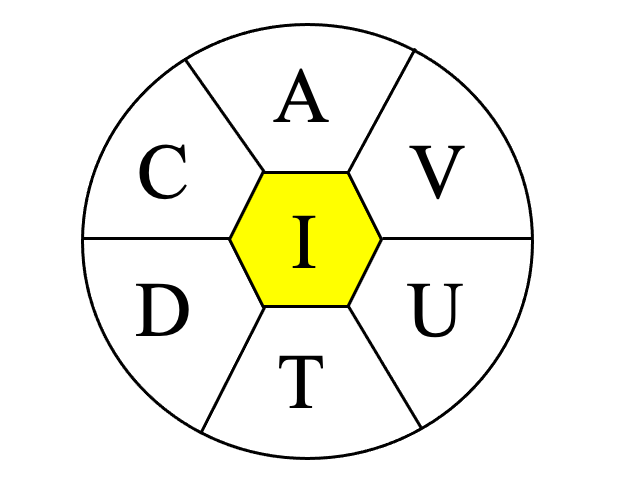
A, C, D, T, U, V, and center I (all words must include I)
Merriam-Webster says…
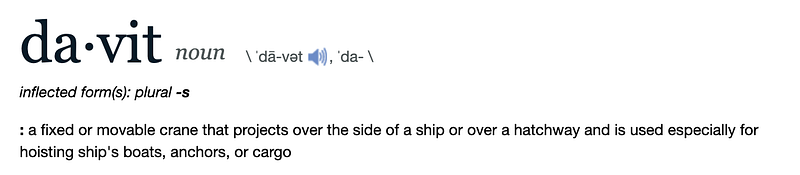
Silly little dictionary! Don’t you know that davit can’t possibly be a word if The New York Times says it ain’t?
For a complete list of rejected words, check out the Spelling Bee Master.
What’s your favorite dord* from today’s puzzle?
My Two Cents
I’ve been on only two cruises in my life; one was to fulfill the commitment of attending my best friend’s wedding in 2016. And no, there weren’t any type of romcom hijinks like in the movie. (As an aside… Wow! That Julia Roberts film will turn 25 in October. Geez, I’m old!) The worst thing that happened is I was forced-served ice in my whisky at the bar. I don’t judge people who like their single malts on the rocks, but I prefer mine neat and room temperature.
I remember one night walking on the ship’s deck and inspecting the lifeboats… pretending I knew what I was looking at. In reality, a group of us were there to partake in some bourbon I had managed to slip aboard the ship during a stop in the Bahamas. After all, no one could force me to put ice in my cup if I was pouring the whisky myself.
In any case, it was almost six years later ––and by that I mean today–– that I found out that the lifeboats I saw were attached to something called a davit. And now I get to write about it while reminiscing on my whisky-smuggling escapades. As some overly cheerful animal might say if this were The Lion King: That’s the circle of life!
David who?
Our friends at Merriam-Webster inform us that davit is an alteration of david, used originally to name this crane. And that it probably from the name David. So who was this David and how did he invent this lifeboat and anchor launching system? Well, according to the Online Etymology Dictionary, said David didn’t exist and the origin is…
apparently a use of the masc. proper name David on the pattern of applying common Christian names to useful devices (compare jack, jenny, jimmy).
(Just one snarky remark there, guys… David is originally a Jewish name.)
So here’s my creative theory about how the word davit came about: at one point there was a sailor named David who was quite skilled at operating the primitive davits that existed way back when. Davits hadn’t been given an official name yet, and most people referred to them as lifeboaty-thingamajig. On that ship where David sailed, the davit had an even longer moniker: lifeboaty-thingamajig-that-we-need-to-call-David-for. Eventually it was shortened to David, and after decades or centuries passed, it became davit.
And by the way, the a in the first syllable is long, as in, well David: DAY-vit.
In an article for Wikimotors, K.C. Bruning summarizes the functions of a davit thusly:
A davit is a type of metal structure, found most commonly on boats, with an arm that extends over the side of the craft so that it can lower items to the deck below. It can also be used in building construction. The term may also be used to describe a metal arm with a winch that mechanically raises and lowers items from one place to another. Davits are most commonly used to move boats, though they can also lift cargo and anchors. They can also be used to lower a maintenance trapeze over the side of the boat. There are four common types of davit: mechanical quadrantal, single pivot gravity, gravity roller track, and free fall.
Here are examples of a gravity roller davit…
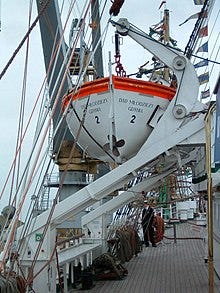
…and a free-fall one.
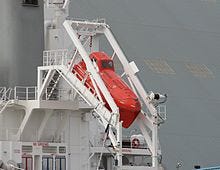
I don’t know about you, but I’d be pretty scared to get on that free-fall davit; it looks more like the starting point of one of those crazy rollercoaster rides.
The components of most davits are:
- Life raft or lifeboat, which can be fully or partially enclosed, or open.
- Frapping lines, which are not used on fixed and freefall davits. Frapping lines are used to pull the life raft to the embarkation deck.
- Gripes, which fasten the lifeboat while it’s stored on the ship, hopefully never to be used.
- Tricing pendants are used to initially pull the lifeboat to the embarkation deck, where the frapping lines are then connected.
- Falls, the wires used to lift or lower the lifeboat are known as falls. These used to be made from manila hemp, which you can read about here.
Older davits include the radial ones, early hand-powered devices in which the arms were rotated separately…
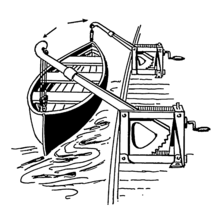
..and the mechanical ones, similar to the radial but with the advantage that both arms could be deployed simultaneously. This latter type was the one supposedly used on the Titanic…
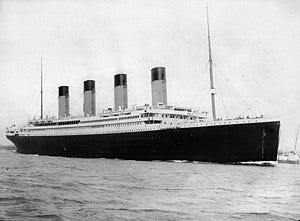
…clearly not easy to see in this tiny picture.
Ane who?
The biggest jump in davit development occurred thanks to Dutchman Ane Pieter, who happened to have the unfortunate last name of Schat. What was fortunate –-especially for sailors and ship passengers–– was Ane’s decision to not go into the baking profession like his father had done, but instead become a sailor. A few years after he did, the RMS Titanic tragedy happened. Then, during World War I, Schat witnessed three British ships get sunk by a German submarine.
These two key events inspired Ane to come up with a better and faster way of lowering lifeboats from ships at sea during emergencies. In the meantime, he sailed the seven seas, as they say, and even ended up working in the San Francisco shipyards in 1918. He returned to the Netherlands, but came back to the U.S. two years later having applied for patents to his new and improved davit. As Dirk Septer explains in the article “Ane Pieter Schat’s life boat davits and life boats improved shipwreck survival worldwide” for Nauticapedia:
In 1920 Schat returned to America where he demonstrated a full scale model of his first system on the Holland America Line’s Hoboken pier at the foot of 3rd and 4th Streets in New York City. The test surpassed all expectations and Steamboat Inspection Service Supervising Inspector General Uhler approved the system. Under a weight of 4,000 kg in the sloop even with half extended davits the brake continued to work properly… The American training vessel Iris was the first of many vessels to be equipped with his automatic device for safely lowering lifeboats. The standard became so common that shipyard specifications started calling for Schat–type davits, which soon became available from various sources. Schat’s first Gravity Davit patent model is now part of the collection of the Maritime Museum in Amsterdam.
Schat received a bunch more patents for new designs and improvements on existing ones. One obtained in 1926, the Schat Skate, allowed boats to slide life rafts over the hull of a ship and into the water in an efficient and stable manner.
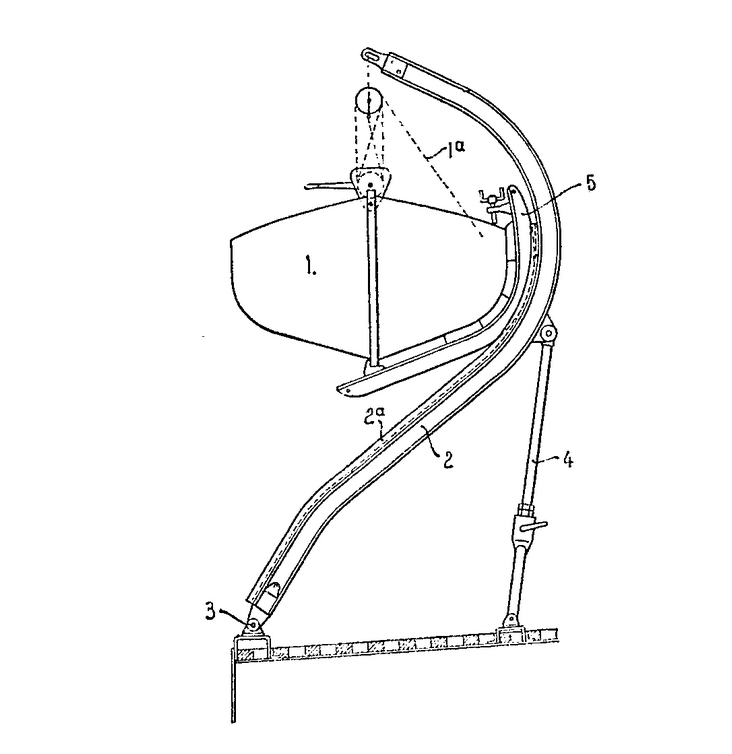
Everything was going well for Ane: fame, fortune, and honors bestowed by royalty. And then World War II began. Schat continued to work in the shipyards, providing his products to anyone who ordered them. And that included Nazi Germany. Ane’s was not the only Dutch company to do this; in fact, a few others directly supplied the Germans with minesweepers, for example. As Septer explains: “Compared to those aircraft which could be considered as direct war material, Schat’s davits and lifeboats were actually life saving equipment. Instead, having to produce some convictions, the tribunals went after the smaller fry, like Schat’s company.”
And so he was tried and found guilty, despite mitigating factors like employing redundant personnel so they would not be shipped off to the Nazis as forced labor, or sheltering three soldiers who had deserted the Italian army. Schat was jailed, and eventually ended up losing his company… and his wealth.
The Schat manufacturer of davits changed owners and locations several times, becoming Schat-Harding for many years. Today it seems to have been bought by the Austrian company Palfinger. They still keep the Schat-Harding name on LinkedIn, though, probably because of its fame.
Now you know. Next time you’re on a cruise ship or other large boat, and something terrible happens and you need to evacuate, you can tell the crew that need to operate the davits in a hurry. Don’t be surprised if they give you a weird look, though. Not because you’re in no position to bark out orders at them… but because the editors of the Spelling Bee decided that davit is a dord*.
You can check out my previous entry on another dord* here:
*What the heck is a dord, you ask? Here’s the answer: