avatarRuchi

Free AI web copilot to create summaries, insights and extended knowledge, download it at here

2231

Abstract

g?

  • What SMART goals do you have to achieve it?
  • What new experiences do you see yourself having based on the learning?
  • What does the best outcome look like?</li></ol><figure id="93bc"><img src="https://cdn-images-1.readmedium.com/v2/resize:fit:800/1*86N1jd2yBIEznn29h6-qRA.png"><figcaption>Kolb’s Reflective Model illustrated by Information Artist</figcaption></figure><p id="5af0">Using this model, <a href="https://learningfromexperience.com/">Kolb</a> further built a theory of <a href="https://en.wikipedia.org/wiki/David_A._Kolb">learning preferences</a> that can be described in two ways,</p><ul><li>Active experimentation ↔ Reflective observation</li><li>Abstract conceptualization ↔ Concrete experience</li></ul><p id="3df3">The result of the two ways led to four types of learners with individual learning preferences:</p><ul><li><b>Converger</b> (Active experimentation — Abstract conceptualization) This learner is a doer and a thinker.</li><li><b>Accommodator</b> (Active experimentation — Concrete experience) This learner is a doer and an empath.</li><li><b>Assimilator</b> (Reflective observation — Abstract conceptualization) This learner is an observer and a thinker.</li><li><b>Diverger</b> (Reflective observation — Concrete experience) This learner is an observer and an empath.</li></ul><figure id="6eee"><img src="https://cdn-images-1.readmedium.com/v2/resize:fit:800/1*KLWgOAWVkzSnQ2ILmaiDfA.png"><figcaption>Types of Learners illustrated by Information Artist</figcaption></figure><p id="2e72">According to the <a href="https://citt.ufl.edu/resources/the-learning-process/types-of-learners/kolbs-four-stages-of-learning/">University of Florida</a>, a profound practical application of Kolb’s learning cycle can be observed in student training for educational institutions. They mention exposing students to a variety of learning experiences that will also help them become more adaptable, versatile learners.</p><p id="4896">To have an optimal learning experience, one needs to go through the series of specific stages mentioned above. I highly recommend this model to all managers to develop their coaching stance.</p><p id="671a">Now, let me present you with a small activity to help you determine th

Options

e type of learner in you. Visualize that you bought a new innovative gadget which you never used before. What learning approach do you take?</p><ul><li>Do you quickly unbox and start using the gadget?</li><li>Do you read the user manual to get yourself acquainted with the features?</li><li>Do you think about consulting someone before using the gadget?</li><li>Do you start using the gadget and refer to the user manual side-by-side?</li><li>What type of learner did you explore within yourself with this exercise?</li></ul><p id="2d48">Thank you for reading and clapping! If you’d like to go the extra mile to <a href="https://bio.link/informationartist"><b>support</b></a><b> </b>my writing, please consider <a href="https://www.buymeacoffee.com/InformationArtist"><b>buying me a coffee</b></a> or <a href="https://medium.com/@ruchira.parchur/membership"><b>joining Medium using my referral link</b></a>.</p><div id="d586" class="link-block"> <a href="https://readmedium.com/gary-rolfes-model-of-reflection-what-so-what-now-what-4f0645e618b0"> <div> <div> <h2>Gary Rolfe’s Model of Reflection — What, So What, Now What</h2> <div><h3>A reflective model that works well to introspect a specific event or situation</h3></div> <div><p>medium.com</p></div> </div> <div> <div style="background-image: url(https://miro.readmedium.com/v2/resize:fit:320/1*NQGL4j3z__KcfIVBFr5qIA.png)"></div> </div> </div> </a> </div><div id="1dbf" class="link-block"> <a href="https://readmedium.com/12-coaching-quotes-to-inspire-the-coach-in-you-6405ac79a7c8"> <div> <div> <h2>12 Coaching Quotes to inspire the coach in you</h2> <div><h3>Inspirational Coaching Quotes for Motivation and Mastery</h3></div> <div><p>medium.com</p></div> </div> <div> <div style="background-image: url(https://miro.readmedium.com/v2/resize:fit:320/1*IkQB2cIMoc5Sh5f1ZqBWVg.png)"></div> </div> </div> </a> </div></article></body>

David Kolb’s Learning Cycle with Coaching Questions to Reflect

A reflective model designed to help people learn from their experiences.

In this article, I explain Kolb’s model of reflection and share a list of coaching questions to reflect upon. I use this model in my coaching practice to create space for clients to enable learning and insights between the coaching sessions.

David Kolb is a Professor of Organizational Behavior at Weatherhead School of Management, Case Western Reserve University, Ohio. He is an educational theorist whose research focuses on experiential learning and his popular work on reflective learning cycles.

Kolb’s reflective cycle is a model designed to help people learn from their experiences — it is therefore known as an experiential learning cycle. It can be used as a basis for the structure of a reflective essay, or as a way to structure your thinking.

Kolb’s model is based on four stages, requiring you to work through each one before the cycle leads to new experiences and loops back around. Through my series of research and practice of the reflective model, I have designed the below coaching questions for reflective analysis and optimal progress.

  1. Concrete Experience (feeling) Describe the experience as is, without adding any biases and opinions. - What did you experience? - What feelings did it evoke?
  2. Reflective Observation (learning) Learn about the experience and the hidden perceptions behind those thoughts. - What feelings were present but not observed? - What feelings were linked to your beliefs and values? - What were the links to prior knowledge, skills or experience? - What were you hoping to achieve?
  3. Abstract Conceptualization (thinking) Think and explain your experience. - What did you analyze from your observation? - What is the meaning of this reflection? - What went well? - What could be improved? - What areas can be explored further?
  4. Active Experimentation (doing) Practice what you learn. - What plans and actions translate from your learning? - What SMART goals do you have to achieve it? - What new experiences do you see yourself having based on the learning? - What does the best outcome look like?
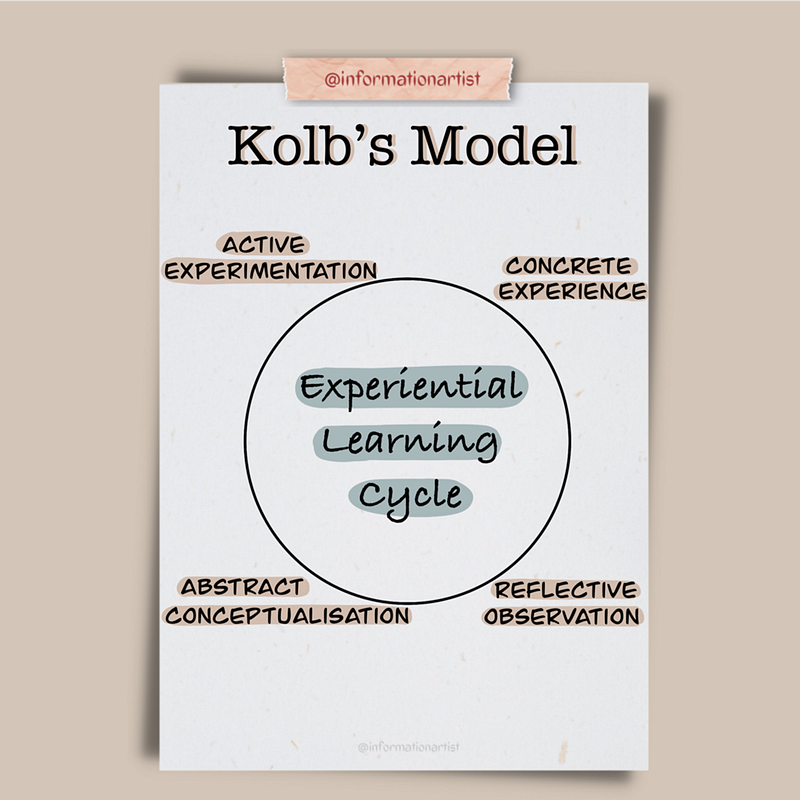
Kolb’s Reflective Model illustrated by Information Artist

Using this model, Kolb further built a theory of learning preferences that can be described in two ways,

  • Active experimentation ↔ Reflective observation
  • Abstract conceptualization ↔ Concrete experience

The result of the two ways led to four types of learners with individual learning preferences:

  • Converger (Active experimentation — Abstract conceptualization) This learner is a doer and a thinker.
  • Accommodator (Active experimentation — Concrete experience) This learner is a doer and an empath.
  • Assimilator (Reflective observation — Abstract conceptualization) This learner is an observer and a thinker.
  • Diverger (Reflective observation — Concrete experience) This learner is an observer and an empath.
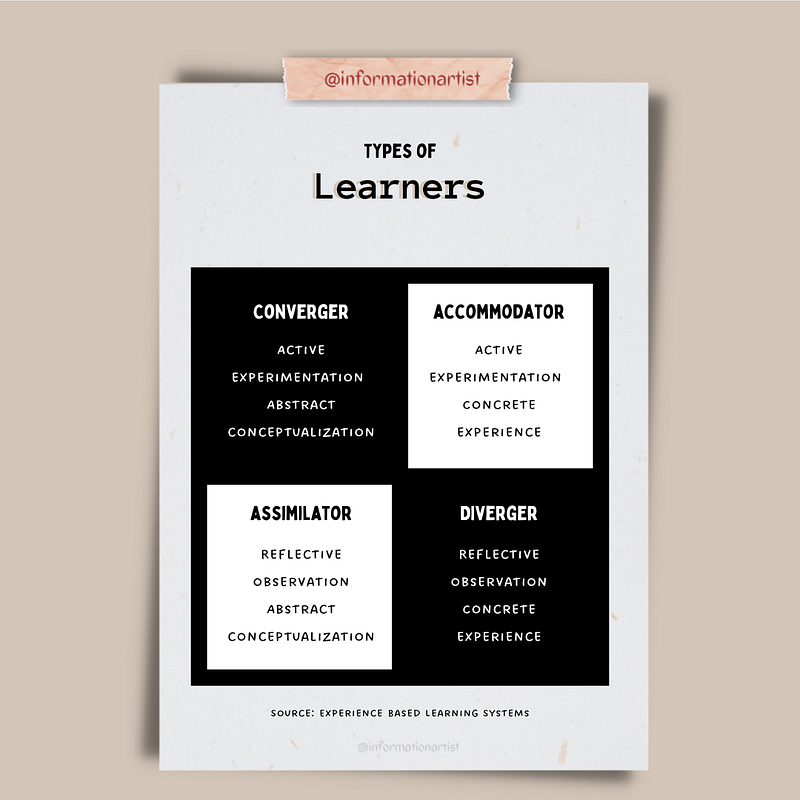
Types of Learners illustrated by Information Artist

According to the University of Florida, a profound practical application of Kolb’s learning cycle can be observed in student training for educational institutions. They mention exposing students to a variety of learning experiences that will also help them become more adaptable, versatile learners.

To have an optimal learning experience, one needs to go through the series of specific stages mentioned above. I highly recommend this model to all managers to develop their coaching stance.

Now, let me present you with a small activity to help you determine the type of learner in you. Visualize that you bought a new innovative gadget which you never used before. What learning approach do you take?

  • Do you quickly unbox and start using the gadget?
  • Do you read the user manual to get yourself acquainted with the features?
  • Do you think about consulting someone before using the gadget?
  • Do you start using the gadget and refer to the user manual side-by-side?
  • What type of learner did you explore within yourself with this exercise?

Thank you for reading and clapping! If you’d like to go the extra mile to support my writing, please consider buying me a coffee or joining Medium using my referral link.

Coaching
Management And Leadership
Management
Leadership
Facilitation
Recommended from ReadMedium