
Data Warehouse vs. Data Mart vs. Data Lake
What is what and where are the Differences?

In addition to Data Warehouses, which are now firmly established in the corporate world, Data Lakes are also becoming increasingly common, and one often hears of Data Marts, but what is actually what?
The Data Warehouse
The Data Warehouse is an analytical, usually relational database (SQL) or hybrid system (Mix of SQL and NoSQL) created from different data sources. The goal is usually to store historical data for later analysis. Data Warehouses often have extensive computing and storage resources for running complicated queries and generating reports. They are often used as data sources for business intelligence and machine learning systems. New approaches, technologies and especially the cloud are changing the field a lot and offer new opportunities. Data Warehouses are classic relational systems that work with structured data. Exceptions are new cloud-based Data Warehouse technologies such as BigQuery or Snowflake which can also work with unstructured data and are column-based.
The Data Lake
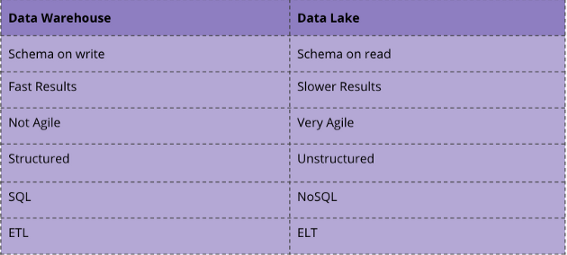
The Data Lake, on the other hand, is a large pool of raw data for which no use has yet been determined. A Data Warehouse is a repository for structured, filtered data that has already been processed for a specific purpose [1].While Data Warehouses use the classic ETL process in combination with structured data in a relational database, a Data Lake uses paradigms such as ELT and a schema on-read as well as often unstructured data [2].
A Data Lake can also be used as the basis for a Data Warehouse, so that the data is then made available in structured form in the Data Warehouse from there.
The Data Mart
The Data Mart contains data focused on a specific line of business. Normally they dependent on the Data Warehouse, but also could be indpenedent that is often when it’s originating from an operational database or system. They are therefore a subset of a Data Warehouse or a system. Data marts offer the advantage of faster data retrieval. Since they usually contain only a subset of the Data Warehouse, the amount of data in a data mart is consequently considerably smaller. This smaller amount of data provides a much faster result when queries are made [3].
Summary
I hope that the article has helped you and you now know where the differences lie in the systems and that they build on each other rather than that they compete with each other. A holistic approach is e.g. the Data Lakehouse, which connects all approaches with each other.
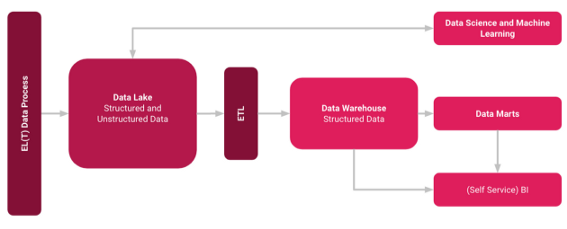
Data Lakehouses combine the Data Lake with a Data Warehouse to enable unified governance and ease of data movement [4]. From the Data Warehouse, the data can then be distributed to BI layers, ML services or even Data Marts. Read here more about Data Lakehouses.
Sources and Further Readings
[1] talend, Data Lake vs. Data Warehouse
[2] IBM, Charting the data lake: Using the data models with schema-on-read and schema-on-write (2017)
[3] Datenbanken Verstehen, Data Mart (2022)
[4] AWS, What is a Lake House approach? (2021)