
CALL for LIFE: Oliver Ding @ 2021 and Second-order Activity
How to use the AAS4LT framework to reflect on my life development activities in 2021?

The AAS4LT framework stands for “Anticipatory Activity System for Life Transitions”. As an 8-step practical framework for designing a life transition coaching program, the AAS4LT framework is an application of the Anticipatory Activity System (AAS) framework.
The AAS4LT is inspired by the following knowledge resources:
- Anticipatory Activity System: The center of the above diagram.
- Life Discovery Activity: It is a Second-order Activity.
- Developmental Project: It is a First-order Activity.
The Anticipatory Activity System framework (AAS) is an abstract model which aims to understand a special type of human activity that highlights “Self, Other, Present, Future”.
As an application of AAS, the AAS4LT was developed with eight steps for guiding a life transition coaching program. You can find more details about AAS4LT from the following links:
- CALL for LIFE: Anticipatory Activity System for Life Transitions
- CALL for LIFE: Modeling A Developmental Project
- D as Diagramming: Strategy as Anticipatory Activity System
- Linkedin hashtag: #AAS4LT
A friend of mine asked me two questions about the AAS4LT framework:
Can I use it without all eight steps? How to use it to reflect on Oliver’s life development?
Wow! I really like these two questions. As mentioned above, the AAS4LT framework is developed for designing a life transition coaching program. The coaching program is a 1:1 interactive activity. In order to build a social space for 1:1 conversation, we need a structure to define the settings.
I used the SET framework to guide the design. You can find more details here.
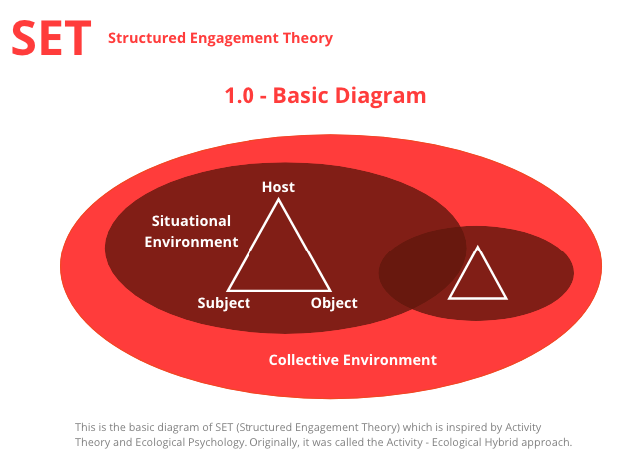
For the 1:1 coaching program, I adopted some models and heuristics as techniques to support the AAS4LT framework. Most of these tools are adopted from the three projects:
- The Life-as-Project Approach
- Life Discovery Toolkit (v1.0) and Life Discovery Canvas (v1.0)
- The Developmental Project Model
I am hosting the 1:1 coaching program on Milanote. The picture below is the homepage of the program. I also set up 8 sub-boards for each step.
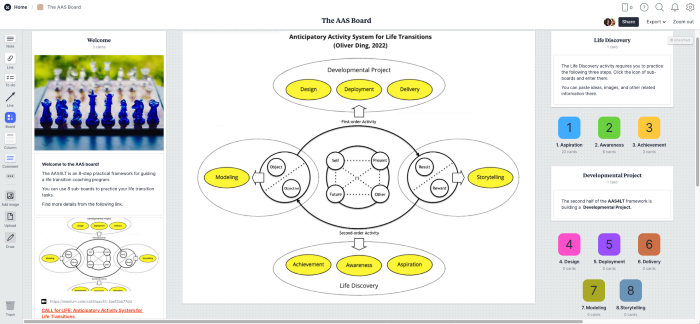
If you want to use the AAS4LT framework for self-reflection and self-development, you can do it with all 8 steps or some steps. You can find more details here. For each step, you can pick some techniques you are familiar with. Or, you can ask some friends to help you.
Today I’d like to answer the second question and use the answer as an example for Self-Reflection with the AAS4LT framework.
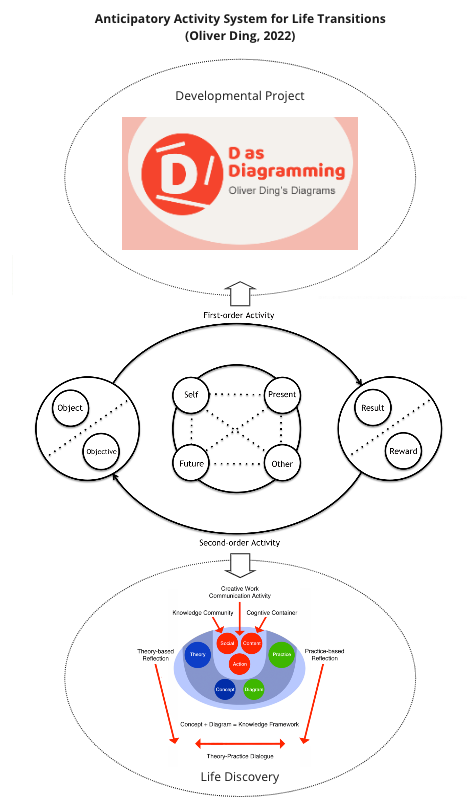
I designed the above diagram to model my 2021’s major life activities. It shows three things:
- The AAS framework: The Anticipatory Activity System framework
- The Second-order Activity: Personal Innovation as Career-fit
- The First-order Activity: The D as Diagramming Project
Though the AAS framework also has a core that is about the Self-Other Relevance, I don’t want to test it with the AAS4LT framework. The reason is simple, I want to validate the AAS framework in a bit-by-bit way.
This article will only focus on First-order Activity and Second-order Activity.
The Anticipatory Activity System framework
The Anticipatory Activity System framework is a hybrid theoretical framework that curates the following two theories together:
- Activity Theory
- Anticipatory System Theory
This hybrid approach is inspired by Clay Spinuzzi’s book Network: Theorizing Knowledge Work in Telecommunications. To understand a telecommunications company’s knowledge work, Clay Spinuzzi focuses on the concept of “Network”, and adopts the following two theories to build an abstract framework for theorizing “Network” of knowledge work:
- Activity Theory
- Actor-network theory (ANT)
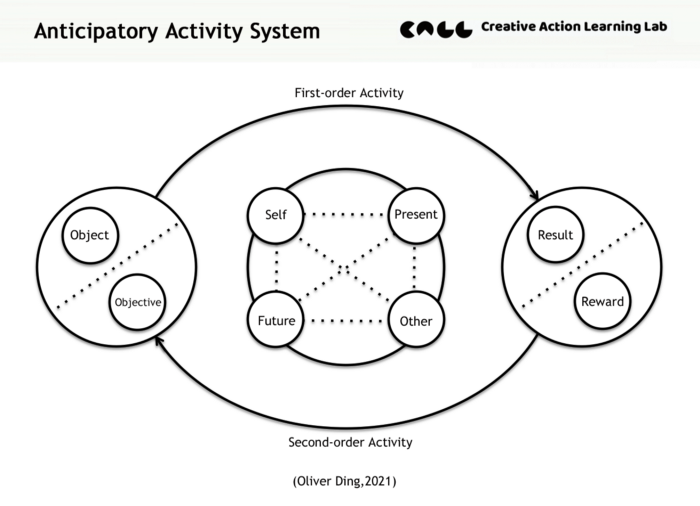
The above diagram is the standard model of the Anticipatory Activity System framework. It was formed by the following pairs of concepts:
- Present — Future
- Self — Other
- Object — Objective
- Result — Reward
- First-order Activity — Second-order Activity
You can find more details from D as Diagramming: Strategy as Anticipatory Activity System.
The term “System” for the Anticipatory Activity System framework has two meanings:
- Inspired by Anticipatory Systems Theory, the AAS framework considers an AAS as a self-referential system. You can find more details here.
- The AAS framework claims that an AAS is formed by two parts: First-order Activity and Second-order Activity.
What’s the difference between First-order Activity and Second-order Activity?
The major difference is the objective of Second-order Activity is all about defining objectives for the next activities while First-order Activity only focuses on producing results.
If you ask the following questions and you can easily answer them. Then, you can just do it.
What should I do with the rest of my life? What should we do next year?
If you can’t answer them easily, you probably need time to do something in order to figure out the answers. The something means Second-order Activity.
Personal Innovation as Career-fit
What were my Second-order Activities in 2021? I often reflected on my life activities. These self-reflections can be understood as Second-order Activities. If we focus on the major Second-order Activity making a significant impact on my 2021, I’d like to claim that it should be the writing of an article titled Personal Innovation as Career-fit.
The diagram below is quoted from the article Personal Innovation as Career-fit.
The article was published on May 25, 2021. See the screenshot of my archives on Medium. What do you find?
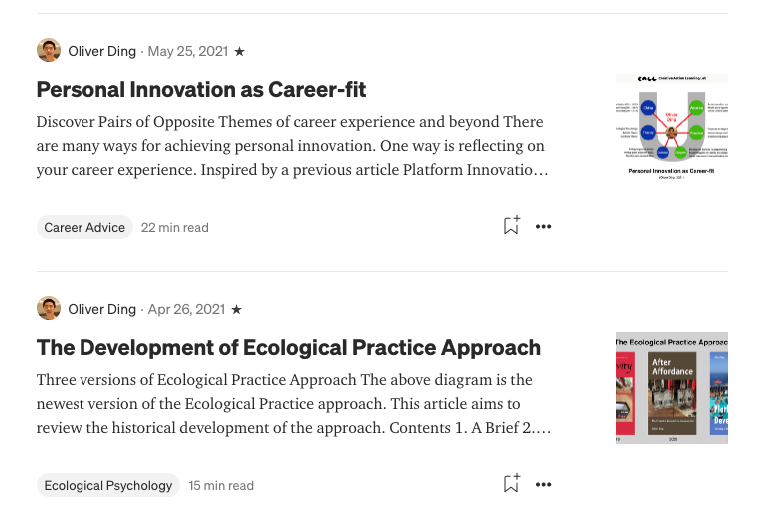
On April 26, 2021, I published an article titled The Development of Ecological Practice Approach and reviewed three versions of the approach.
From Sept 2018 to March 2019, I wrote a book titled Curativity: The Ecological Approach to Curatorial Practice in order to reflect on one of my life themes: Curation. The Ecological Practice Approach was born from the process of writing Curativity.
After March 2019, I continuously worked on revising Curativity and developing the Ecological Practice Approach as a new project. In May 2020, I wrote another book titled After Affordance: The Ecological Approach to Human Action in which I proposed several new theoretical ideas for expanding ecological psychology to the modern digital environment.
A major development of the Ecological Practice approach is the concept of Supportance. I have been searching for a concept for expanding Ecological Psychology from perception-centered psychological analysis to social practice analysis for about two years after I finished the draft of Curativity.
On March 31, I edited a book for Platform for Development: The Ecology of Adult Development in the 21st Century in which I introduced the concept of Supportance and the Infoniche framework which is also part of the Ecological Practice approach.
I considered the article The Development of Ecological Practice Approach to be a sign of the end of my theoretical work about the approach. Of cause, there are many things I can do with the project. However, I knew that the theoretical job was done.
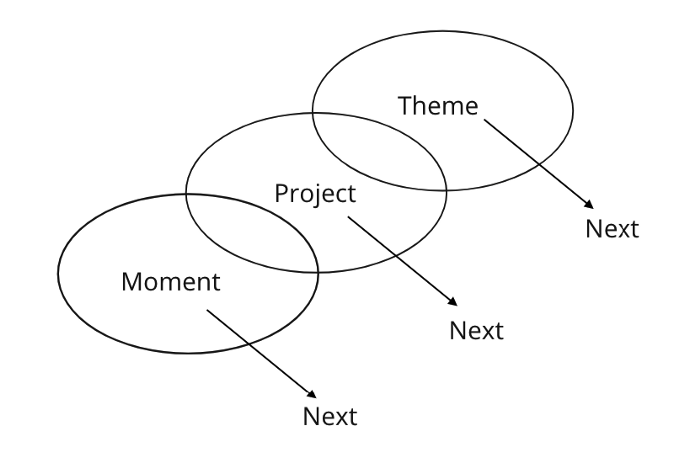
What should I do next?
The three-year journey was a large life container that contained my attention, energy, creativity, etc. After detaching from the container and ending the knowledge production project, I found myself in an unsettled situation.
Though I knew that I should move to Empirical Research to test my theoretical approaches, I did not go fast because 1) I didn’t know how to do it, and 2) I wanted to Play for a while. I considered Playing as a reward for the three-year journey.
What did Playing mean for me in May 2021?
It meant playing with the HERO U diagram which is the core of the HERO U framework. On March 24, 2021, I wrote an article titled Platform Innovation as Concept-fit and used the HERO U diagram to develop a framework called Concept-fit.
On May 25, 2021, I adopted the HERO U diagram to reflect on career development and developed the Career-fit framework. In order to develop the Career-fit framework, I needed at least one real case. Thus, I used my career experience as a case for the framework. See the diagram below.
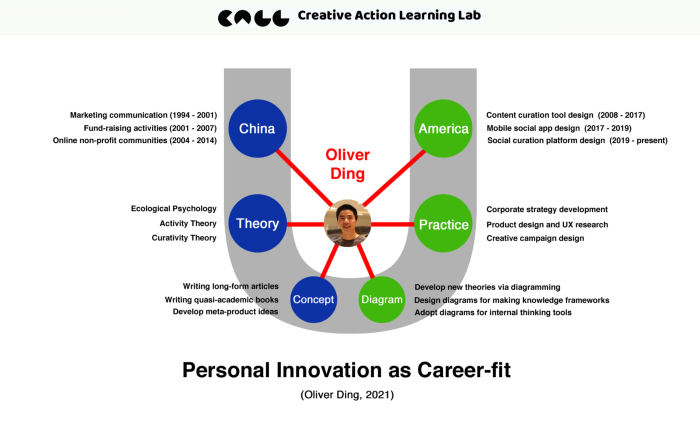
The Career-fit framework has four keywords: Experience > Themes > Projects > Opportunities. It roughly suggests the following five steps for personal innovation:
- Reflect on career experience
- Discover pairs of opposite themes
- Fit all pairs of opposite themes
- Join or initiate relevant projects
- Fit career themes with career opportunities
The above diagram shows three Pairs of Opposite Themes of my career experience.
- China v.s. America
- Theory v.s. Practice
- Concept v.s. Diagram
The core of the Career-fit framework is the Structure and Dynamics of career themes. The idea of Pairs of Opposite Themes refers to significant differences between career themes. The idea of Meta-themes refers to using one high-level theme to curate similar career themes. The idea of the Development of Themes refers to the transformation of career themes.
If we want to explore personal innovation, the great starting point is Pairs of Opposite Themes because they could lead to Structural Tensions such as boundary, distance, difference, heterogeneity, contradiction, and complementation. If we can turn one or more structural tensions into creative opportunities, then we could find a way of personal innovation.
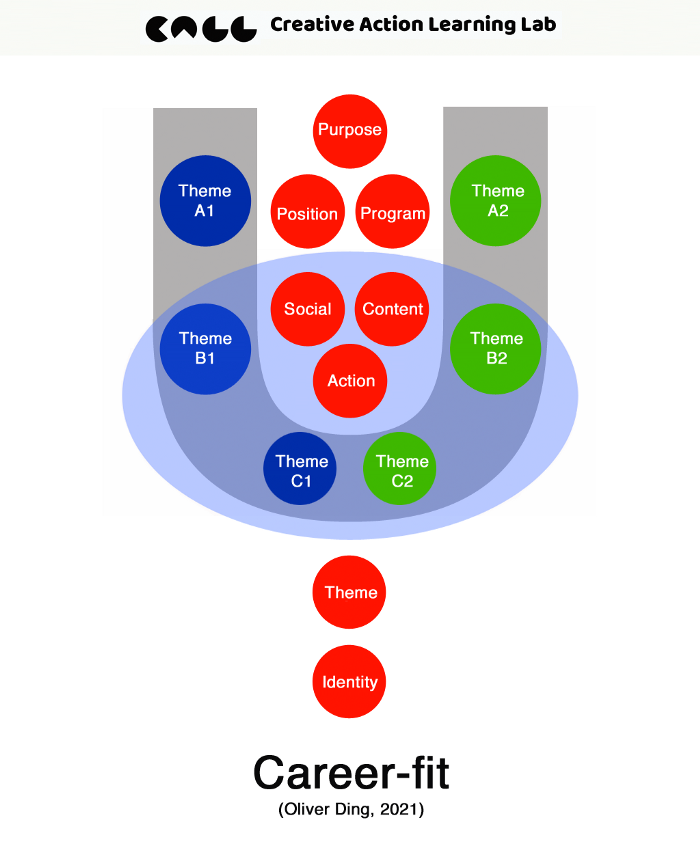
The above diagram is the final model of the Career-fit framework. You can find more details in the original article.
From the perspective of AAS, we can find two types of activities:
- First-order Activity: Developing the Career-fit framework
- Second-order Activity: Self-reflecting with the Career-fit framework
I consider “Self-reflecting with the Career-fit framework” as a Life Discovery Action. In general, an activity is an aggregation of a set of actions.
From the perspective of Activity Theory, an activity is a goal-oriented human activity. I didn’t intend to do a Life Discovery Activity when I was writing the article.
If a Life Discovery Action is not part of a Life Discovery Activity, it’s hard to find it because it should be part of some First-order Activities. For further discussion, see the last section of the article.
The D as Diagramming Project
The diagram is one of my essential three knowledge units. I love to dwell in thought with diagramming. I even wrote a 108-page thesis that develops a theory about diagrams and diagramming in 2018. I consider two groups of ideas for my theory about diagrams. The first group is “meta-diagram, diagram, and diagram system” and the second group is “diagramming as an activity of knowing, theorizing, and reflecting”.
I launched the D as Diagramming channel on Doowit in 2020. The channel displays several meta-diagrams I designed in past years. It is a great collection and exhibition! I also designed a logo for the channel. See the picture below.
My journey of diagramming was only about self-reflection before 2021. I didn’t run it as a project.
However, it dramatically changed after April 2021!
In April 2021, I wrote a book titled The ECHO Way in order to reflect on the Activity U project and the HERO U framework. I spent one chapter discussing diagrams and diagramming and knowledge curation.
In June 2021, I created a board about the historical development of a diagram for the Supportance model on Miro. In July, I repeatedly used my own meta-diagrams such as Tripartness and other diagrams.
On August 10, 2021, I officially announced the D as Diagramming project.
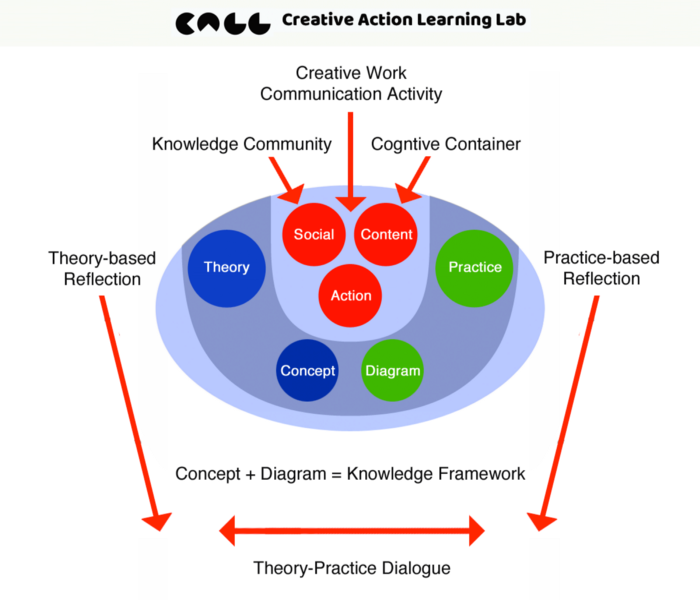
As mentioned above, I reflected on two pairs of opposite themes in May 2022. The above diagram presents fits of two pairs of opposite themes. The “Theory v.s. Practice” fit is described with three movements:
- Practice-based Reflection: building rough models with intuition.
- Theory-based Reflection: improving models with theoretical resources.
- Theory-Practice Dialogue: turn models into frameworks and test them with case studies.
The article Platform Innovation as Concept-fit offers a real example of these three steps. The Concept-fit framework was developed within three months.
The “Concept v.s. Diagram” fit is described with one formula:
- Concept + Diagram = Knowledge Framework
This formula is defined by the HERO U framework. I used the formula to guide my creative works in developing theoretical frameworks.
As a research project, the D as Diagramming project aims to explore the power of Diagrams and Diagramming. From the perspective of Activity Theory, Diagram means a tool while Diagramming means an activity. Thus, the D as Diagramming project is both about tools and activity. From the perspective of cognitive science, diagramming is about spatial cognition which is my favorite topic. From the perspective of Curativity Theory, Diagrams are knowledge containers for knowledge curation.
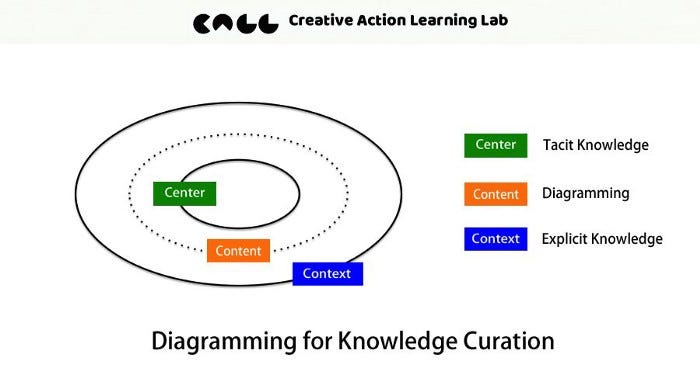
Moreover, what I really want to know is about the value of diagrams for turning tacit knowledge into explicit knowledge. Thus, I set this goal as the present objective of the D as Diagramming research project.
The D as Diagramming Project (Phase I) was closed in Dec 2021. The outcome is fantastic. I used the following meta-diagrams to reflect on my tacit knowledge.
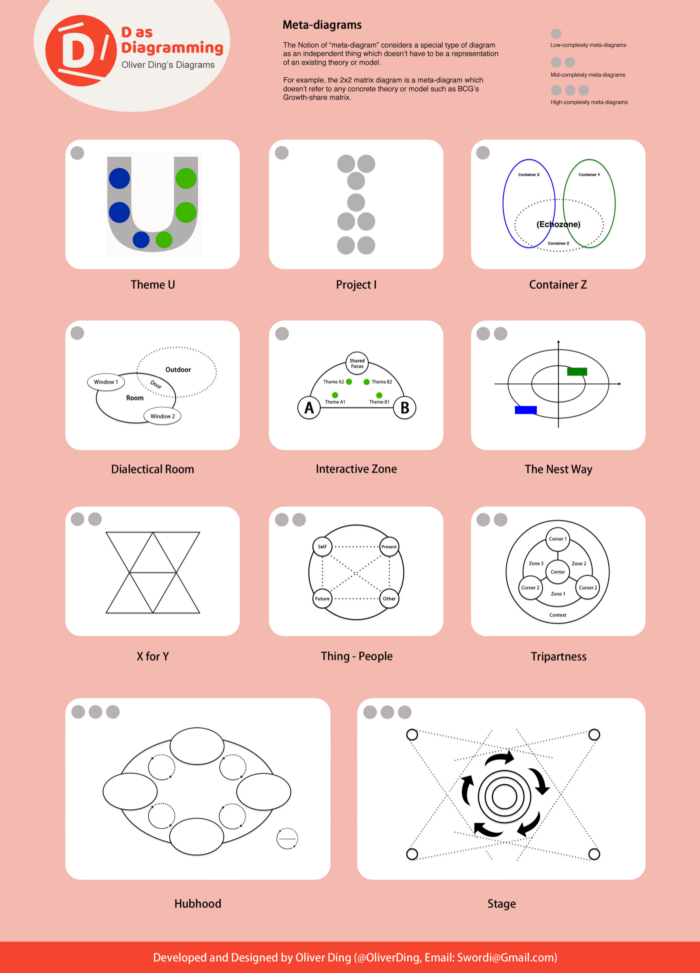
I developed a framework called Diagramming as Practice and edited two books. You can find more details from the following links:
- D as Diagramming: The Creative Work Canvas
- Diagramming as Practice (Book, version 1.0)
- Diagram Blending: Building Diagram Networks (Introduction)
- Diagram Blending: Building Diagram Networks (Table of Contents)
- Slow Cognition: A Meta-canvas for Developing Tacit Knowledge
A major by-product of the D as Diagraming project is the AAS framework. Originally, it was called iART framework. The name iART stands for i +Activity + Relationship + Themes.
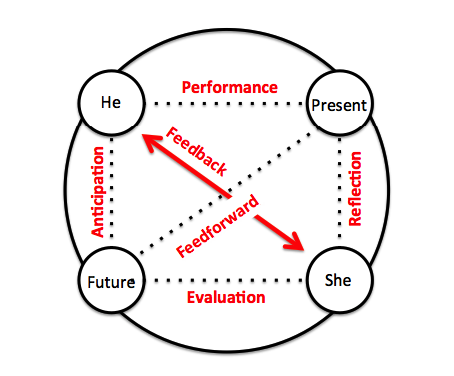
In August 2021, I joined an adult development program as an advisor. The program was initiated by a young girl who is a friend of mine. The program was designed with three components: 1) Life Purpose Awareness, 2) Personal OKR Practice, and 3) Peer Review and Feedback. My friend also adopted the Building In Public approach to sharing her goals, challenges, progress, and discussions with others on social media platforms.
I have been discussing various themes about the program with her for three weeks. On August 17, 2021, I realized it is possible to develop a framework for reflecting on her project and our conversation.
The Meta-diagram behind iART was developed in 2017. It was the outcome of my project “Activity as Container” which aims to discuss the Thing-People ecological structure.
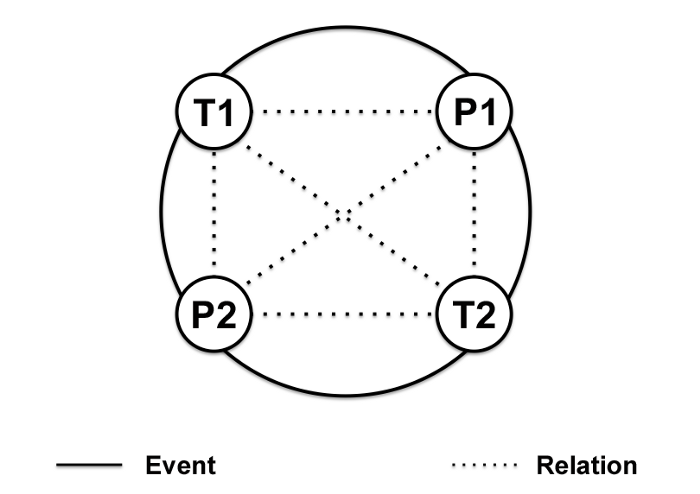
The above diagram is the final model of the Thing-People ecological structure. T means Thing while P means People. 1 means Here while 2 means There. The circle means one event.
I also use another version for this diagram: This (T1), That (T2), Self (P1), Other (T2), and Activity (Event). This version is close to the iART framework.
On Sept 15, 2021, I wrote an article titled D as Diagramming: Strategy as Anticipatory Activity System and expanded the iART framework to the Anticipatory Activity System framework.
After closing the D as Diagramming Project, I found that the Anticipatory Activity System framework is pretty cool. In Jan 2022, I decided to select the AAS framework as the primary project for my 2022.
The Hiddenness of Second-order Activity
As mentioned above, we can find two types of activities in my life activities in May 2021:
- First-order Activity: Developing the Career-fit framework
- Second-order Activity: Self-reflecting with the Career-fit framework
I consider “Self-reflecting with the Career-fit framework” as a Life Discovery Action. In general, an activity is an aggregation of a set of actions.
From the perspective of Activity Theory, an activity is a goal-oriented human activity. I didn’t intend to do a Life Discovery Activity when I was writing the article on May 25, 2021.
If a Life Discovery Action is not part of a Life Discovery Activity, it’s hard to find it because it should be part of some First-order Activities.
If several Life Discovery Actions distribute over a long duration or embed in several First-order Activities, can we consider these Life Discovery Actions as one Life Discovery Activity?
This issue leads to the Hiddenness of Second-order Activity. Some Second-order Activities are easy to perceive. For example, a person visits a career coach and discusses the future of career development, a strategic discussion meeting, etc. However, some actions of Second-order Activity are not obviously perceived.
For example, the Life Discovery Action of “Self-reflecting with the Career-fit framework” didn’t directly lead to a decision of working on the D as Diagramming project. I didn’t officially announce the D as Diagramming project in May or June.
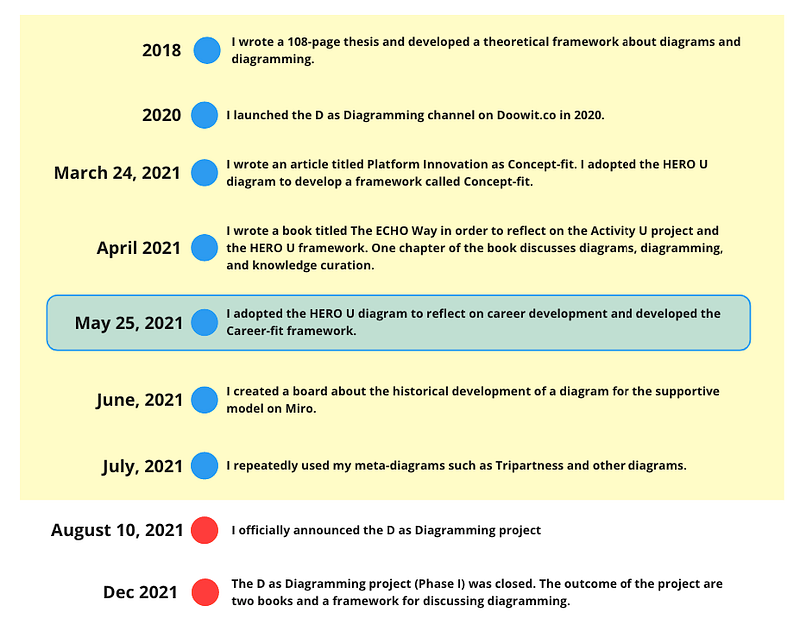
If we review the related actions in my life, we can find the root of the D as Diagramming project is the thesis I wrote in 2018.
Why did not I work on the D as Diagramming project from 2018 to 2021? Because I was busy developing the Ecological Practice approach. As mentioned above, the approach — at least its phase I — was closed on April 2021.
Thus, we should consider all blue dots and the whole yellow area in the above diagram as a Life Discovery Activity that leads to the D as Diagramming Project. In this way, we can understand a person’s transformation of life theme and identity in a broad context.
This is a new way to say connecting the dots.
You are most welcome to connect via the following social platforms:
Linkedin: https://www.linkedin.com/in/oliverding Twitter: https://twitter.com/oliverding Polywork: https://www.polywork.com/oliverding Boardle: https://www.boardle.io/users/oliver-ding


