
Hong Kong English/Cantonese (XIII)
Just Don’t Go Directly
How can we avoid an argument with an argument?
Admit it. There are some cases that people make you angry just by talking.
However, rather than confronting them, there should have been some ways that we can avoid the confrontation.
Here I am telling how Hongkongers usually do when this happens.
We love using a technique called “curved lines” (曲線, Jyutping: kuk1 sin3) to avoid any arguments.
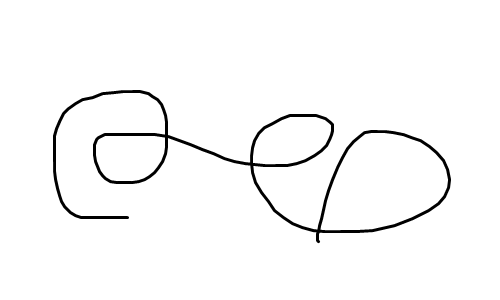
But first of all, let me talk about its opposite: “straight line” or “direct hit” (直線, Jyutping: zik6 sin3).
If it’s a “straight line”, it usually involves confrontations. People from opposite sides would use their own “facts” to argue with one another. This is how sharing of ideas is supposed to be done. However, it is well-known that people nowadays don’t love to listen to ideas opposite to their beliefs. Therefore, these kinds of “straight lines” often yield more arguments and confrontations. It may go violent as well.
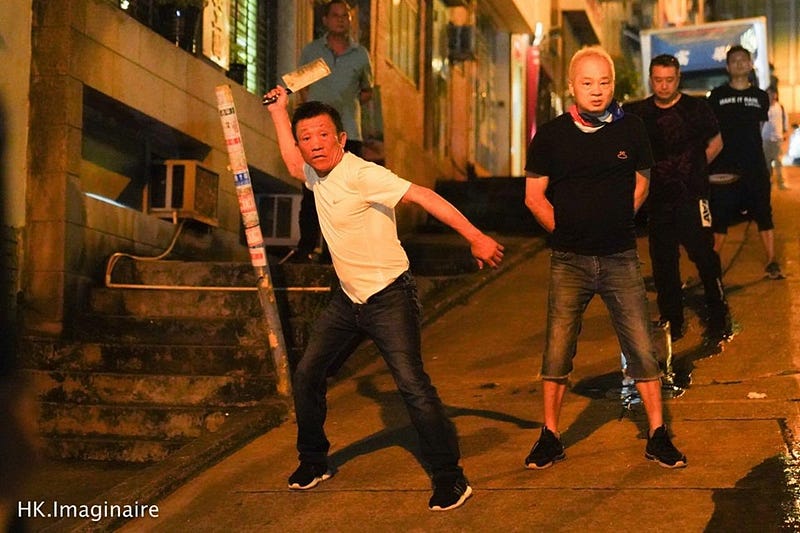
Of course, violence is quite often brought from bad use of “straight lines”. If they are well used, the other side will be short of words and eventually leave the conversation. Well, this is usually how a conversation ends, but this is also how it becomes violent for the reason that people always want to win.
To avoid disturbing scenes during/after conversations, Hongkongers start using “curve lines” to try to finish an argument.
A “curved line” is usually an argument or suggestion that is obviously illogical or un-doable, which is sometimes brought up from the logic of the other side. It can cause the ones on the other side to think you support them while those on the same side would condemn your idea such that there would be more people on your side to voice out their opinion against the opposite side of the argument, or just to laugh at them.
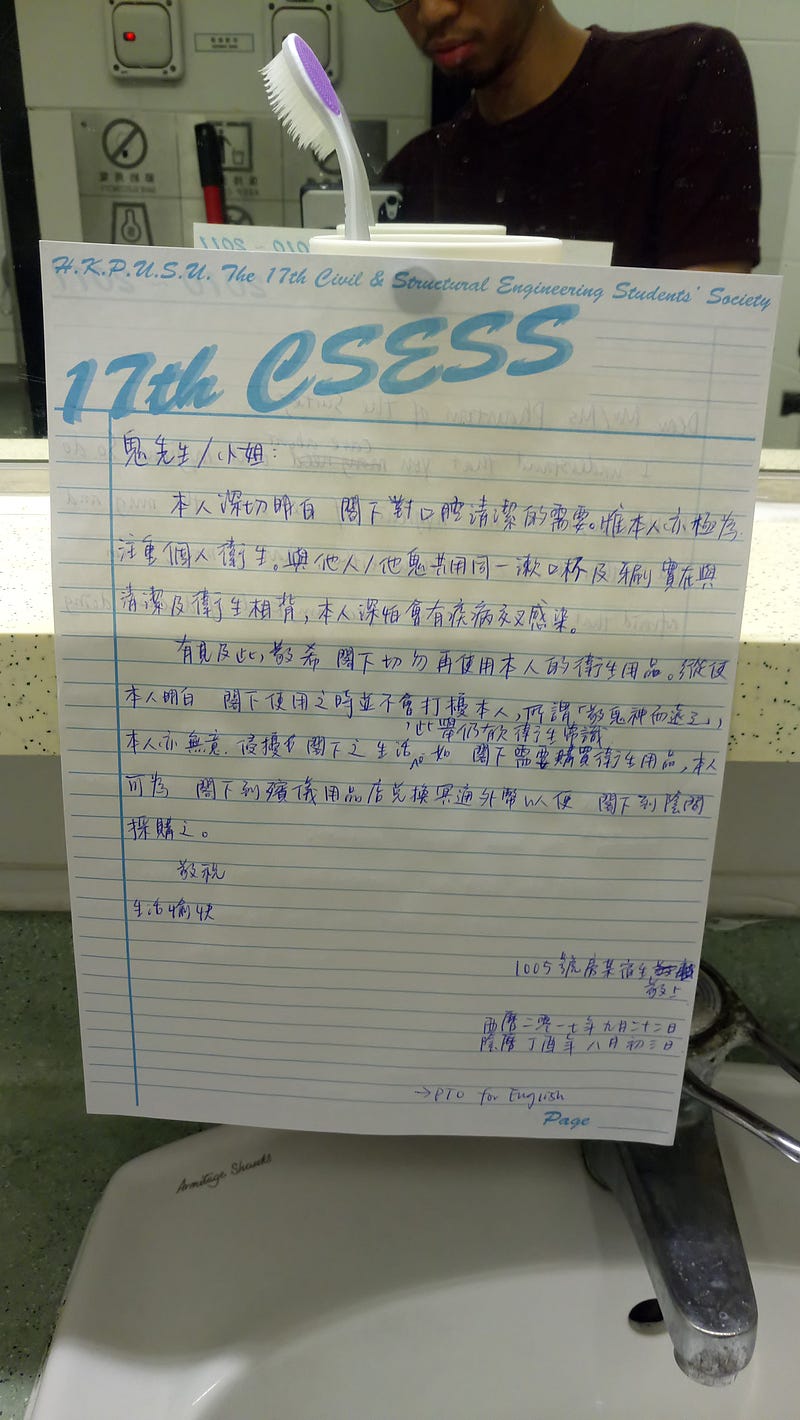
I once used the curved line technique to ask the boys next door with whom I shared the toilet not to use my own things in the toilet by asking the ghosts not to use my own things.
It was in Chinese but I can do a little bit of translation for you.
I understood their needs to keep their hygiene, but I also needed to keep mine. Therefore, sharing the same mug to gargle with other people/ghosts does not seem hygienic to me.
I did not intend to disturb their lives. I wished they hadn’t as well.
At the end, I wrote, “I could exchange some ‘hell money’ for you so that you would be able to buy those stuff yourself down under if you seriously need to use those stuff for hygiene.”
Yes, this prevented them from using my own stuff, and it freaked my roommate out because he is afraid of ghosts.
And yes, it sounded like I cursed them to death if they ever use my stuff anymore. But at least I didn’t confront anybody there.
The world is nonetheless a lot more convenient than before, we can communicate with complete strangers on the internet. They will not know if you are using a curved line or a straight one. They may also comment on how curved or exaggerated your suggestions/arguments are. It all depends on how they believe what you say.
First of all, we may need to tell people not to be serious about our idea because it already is a curved line. Therefore, we have a saying (kind of) which goes, “curved lines should be indicated” (曲線要講明, Jyutping: kuk1 sin3 jiu3 gong2 ming4). This phrase usually goes at the end of a post, a few lines after the curved lines and often comes with a hash tag. This can prevent any unwanted arguments with the strangers who get mad at your “idea”. Still, there are people who have too good an eyesight to read those 5 words and start arguing.
So, what are the extremes of a curve? Like a curve of y=tan x? A sinusoidal curve? In Hong Kong, we think that one of the most extreme curves is the one that touches itself (considering a vector). That is a circle. (Yes, we talk about efficiency: it has the shortest length to touch itself.) Therefore, a slang “too curved it became circular” (曲到圓, Jyutping: kuk1 dou3 jyun4) is made.
Well, when a curved line becomes circular, usually it is some ideas that is too exaggerated or too much that nobody would believe or do. That’s why the line just go round and round, infinitely, and does not hit anything.
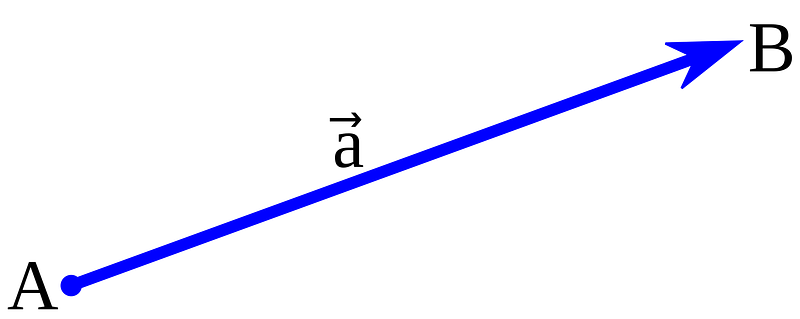
Another extreme of a curve is that it’s not curved at all. People all believe in your argument which is a curved line originally. A phrase “so curved it’s a direct hit” (曲到直, Jyutping: kuk1 dou3 zik6) comes along. It is to show that your curved line is so believable that they once thought you were hitting directly from the opposite side of the argument.
But how other people discover that you were using a curved line which is so straight? I have genuinely no idea.
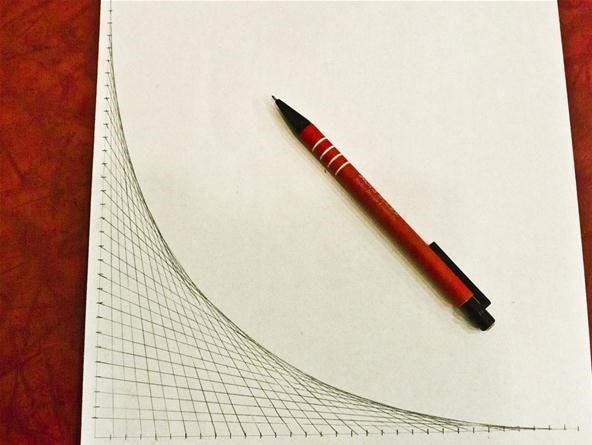
Sometimes, “curvature indistinguishable” (曲直難分, Jyutping: kuk1 zik6 naan4 fan1) is a comment on an idea that people cannot decide if they should believe it or not. If they should believe it, it will be a straight line. It will otherwise be a curved one if they decide not to believe it.
There are loads of information bombarding you every day. What we can do are to screen the unnecessary information and to think thoroughly if the information is real. There are a lot of curved and straight lines that we need to analyse them.
It’s hard to be a human.
Reference:


.png)
