
Curiosity has its own reason for existing.
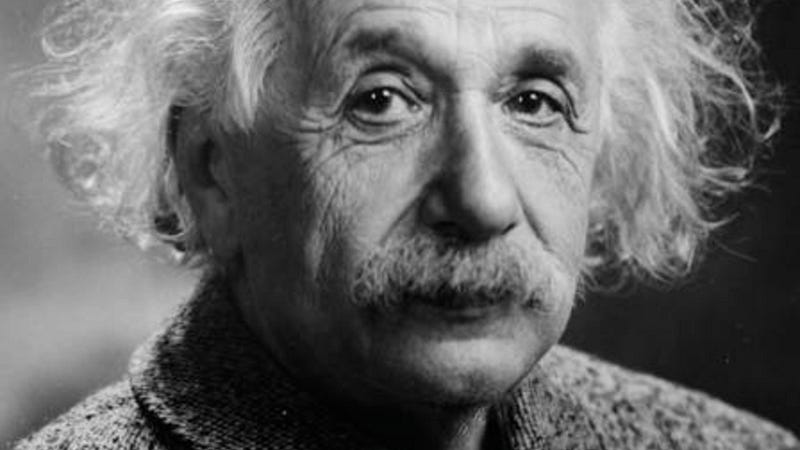
Albert Einstein on curiosity. (The Commonplace Book Project)
You can find all the posts in The Commonplace Book Project here:
“The important thing is not to stop questioning. Curiosity has its own reason for existing. One cannot help but be in awe when he contemplates the mysteries of eternity, of life, of the marvelous structure of reality. It is enough if one tries merely to comprehend a little of this mystery every day.” — Albert Einstein, Life magazine, May 2, 1955
The first time I fell in love, I fell hard for a complicated, brilliant boy who turned into an even more complicated, increasingly unpleasant young man.
After our marriage failed, he became a drug addict and it affected his mind. He is middle-aged now and brilliance has dimmed considerably now and that’s one of the saddest things I can think of.
Our son has autism and while I hate to armchair diagnose someone who has (as far as I know) never been evaluated for that disorder, it would not surprise me if I found out that my first husband was somewhere on that spectrum.
He has told me that it wouldn’t surprise him, either.
As I was researching for this post, I came across this article about a list of conditions that Einstein gave to his first wife, as they attempted to hold their marriage together at the end.
CONDITIONS
A. You will make sure:
1. that my clothes and laundry are kept in good order; 2. that I will receive my three meals regularly in my room; 3. that my bedroom and study are kept neat, and especially that my desk is left for my use only.
B. You will renounce all personal relations with me insofar as they are not completely necessary for social reasons. Specifically, You will forego:
1. my sitting at home with you; 2. my going out or travelling with you.
C. You will obey the following points in your relations with me:
1. you will not expect any intimacy from me, nor will you reproach me in any way; 2. you will stop talking to me if I request it; 3. you will leave my bedroom or study immediately without protest if I request it.
D. You will undertake not to belittle me in front of our children, either through words or behavior.
While there are plenty of speculations out there about whether or not Einstein was on the autism spectrum, I have no idea whether or not he was. This post isn’t about diagnosing anyone.
But I can tell you that a psychiatrist once told me that autism is essentially “extreme self-centeredness.” He was talking to me about my son. Nick wasn’t diagnosed properly until he was thirteen. At six, he was misdiagnosed with ADHD. At nine, he was misdiagnosed with bipolar disorder.
He’s twenty-five now and autism has stuck. It fits. He’s very high functioning. He works. He’s had his own apartment. He’s in a relationship. He makes friends easier than anyone I’ve ever met. He has some kind of truth-north instinct that leads him to his people wherever he goes.
And he is extraordinarily self-centered. Not on purpose. It’s not like he thinks to himself: I am the center of the universe, no one else matters as much as me. It’s just that the way his brain works puts him . . . well . . . at the center of the universe. He’s only (or at least most) capable of understanding things as they relate himself.
The list that Einstein left for his wife is the exact kind of thing I can imagine my son doing, if he was forced to try to stay in a situation he didn’t want to be in. His father, too, if I’m being honest. A completely one-sided understanding of what’s needed to make a bad situation liveable.
As I wrote this post, I watched NOVA: Inside Einstein’s Mind. It’s hard to imagine the depth of the scientist’s creativity. The program illustrates how his most important discoveries started with him asking himself the same two word question creative writers ask themselves all the time: What if?
What if a person standing on a platform sees the same thing as a person on a moving train — do they see it the same, or are time and space relative?
What if gravity and acceleration are the same thing?
What if there is a space-time continuum?
So, Einstein was an asshole to his wife.
But he was right about curiosity.
The important thing is not to stop questioning. Whether you’re actually trying to create the theory of relativity from scratch or you’re writing novels or you’re doing pretty much anything.
Curiosity is intensely important.
(Disclaimer: This post contains affiliate links. When you click one and buy something, Ninja Writers earns a small commission at no extra cost to you. Thanks!)
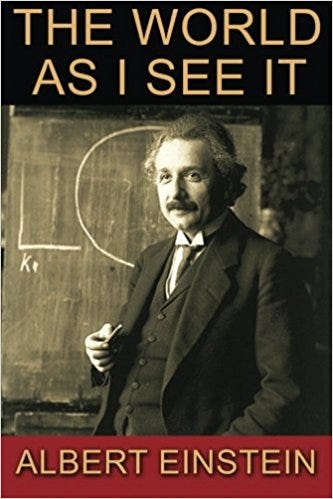
I’ve added Einstein’s book, The World as I See it, to my reading list.
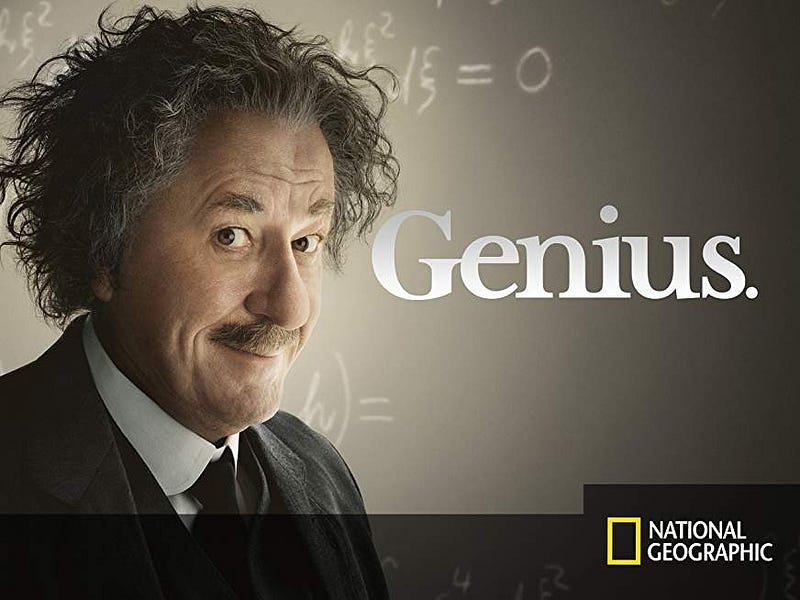
The first season of National Geographic’s series, Genius, focuses on Einstein.
Today’s Poem:
Solitude by Albert Einstein
Solitude is painful when one is young, but delightful when one is more mature. I live in that solitude which was painful in my youth, but seems delicious now, in the years of my maturity.
Now it gives me great pleasure, indeed, to see the stubbornness of an incorrigible nonconformist so warmly acclaimed . . . and yet it seems vastly strange to be known so universally and yet be so lonely.
Thanks for reading and clapping (to let me know you enjoyed it!) If you’d like to get these daily doses of inspiration in your inbox, fill out the form below.
Shaunta Grimes is a writer and teacher. She is an out-of-place Nevadan living in Northwestern PA with her husband, three superstar kids, two dementia patients, a good friend, Alfred the cat, and a yellow rescue dog named Maybelline Scout. She’s on Twitter @shauntagrimes and is the author of Viral Nation and Rebel Nation and the upcoming novel The Astonishing Maybe. She is the original Ninja Writer.


