
Essay
Cultivating the Inner Writing World
Where dream and waking collide
After reading an article of mine, where I fretted over using too many adjectives in my writing, my friend Rebecca Romanelli remarked how methodical and thoughtful was my approach to language. About her own writing, Rebecca confessed:
I launch into words with inner rebel teen peering over my shoulder.” Screw the rules. I’ll start this sentence with And if I feel like it.” I flout conventional grammar rules all too often and can even produce a cramp in my own brain. I self chastise, laugh at my antics and skip on without corrections. Tsk tsk.
Rebecca sees me accurately: I am left-brained, ordered, rational, logical, tidy. My favourite lesson at school was maths; equations on a Friday afternoon were like sinking into a warm bath, where x and y, after patient plodding, revealed themselves; they had no meaning, no relevance; they were pure patient and pleasing calculation. The logical, the reasoned, the lucid, the coherent, has always lulled me.
But to write is to create and to face the eternal challenge of summoning words. Such a challenge is far greater than a numerical equation, which is, after all, just a set of instructions one can mindlessly follow.
I’m not the type to talk airy fairy, illogical, irrational, so how shocked I was a few days after I published the above article, when making dinner, came a phrase unbidden and involuntary. A muttering at first, sotto voce, over and over, an echo, a tic…
This was not unusual; I frequently chant, but what was different was I noticed my chanting and brought the phrase to my lips, said it aloud:
…they will soon wave their silken flags…
What gibberish was this? I repeated my phrase, examined my phrase. It took a while before it dawned on me that the silken flags were adjectives; some part of me was still thinking about those adjectives and this phrase was an ending for my article.
For no matter how I might try to cull adjectives, suppress them, adjectives would surely, certainly, creep back into my sentences, and ‘wave their silken flags.’
The phrase delighted me. So apt, so visual, so sonic I could hear the adjectives in gold and scarlet snapping in the breeze. When I saw what a jewel, what a delicious phrase I had been handed, I was as delighted as I was surprised. For where did this phrase come from?
It sprang from within me. Certainly not the part of me that enjoys maths, that calculates, that likes order and tidiness. My mutterings of magic came from some other part of me that I do not control.
It is some part of me that I suspect, hitherto, I have dismissed, overrode, ignored.
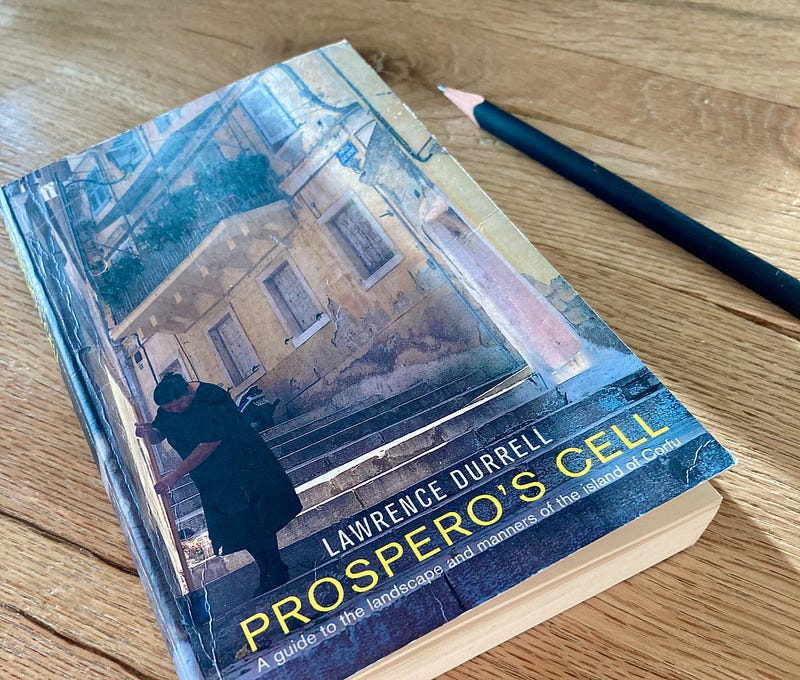
It is a sophism to imagine that there is any strict dividing line between the waking world and the world of dreams. N and I, for example, are confused by the sense of several contemporaneous lives being lived inside us; the sensation of being mere points of reference for space and time.
Lawrence Durrell, Prosper’s Cell
Sophism: noun: a clever but false argument, especially one used deliberately to deceive.
This all fits with something I’ve been mulling recently: what makes a good writer?
Craft of course. But beyond that, good writers seem to have a knack for eschewing the surface hackneyed stuff of convention. Their writing is fresh, unexpected and it delights with its originality.
And I can’t help thinking this is due to the ability of the writer to commune with that part of self that dwells between the waking world and dream world. Good writers plumb the place where honest responses dwell, the place where sensory truth resides.
For there is an unbounded, untrammelled, untamed part of self that can be so easily squashed, ignored, and denied when we write.
Virginia Woolf had a supreme ability to garner the dream-thoughts that gave her writing its infinite depth and layers. In To the Lighthouse, all the invisible stuff that quivers beyond the waking world is captured and laid out in all its potency.
It’s within every writer, this overlap where dream world meets waking world, where originality and truth reside. The rub is how to tap it and bring it to the pen.
I suspect Rebecca has the right idea. We writers must cultivate the wilder side of self, be alert for the seemingly nonsensical chants that rise from within and learn not to rebuff ideas and images that may seem the utterings of madness but are really our conversance with truth.
With practise we can become adept at welcoming our very own honesty. And maybe, just maybe, we will muster the silken flags of prose…


