
Essay
About Those Adjectives…
And Adverbs
Ultimately you write alone. The judgement that a work is complete…can be made rightly only by a writer who’s learned to read her own work.
Ursula K. Le Guin
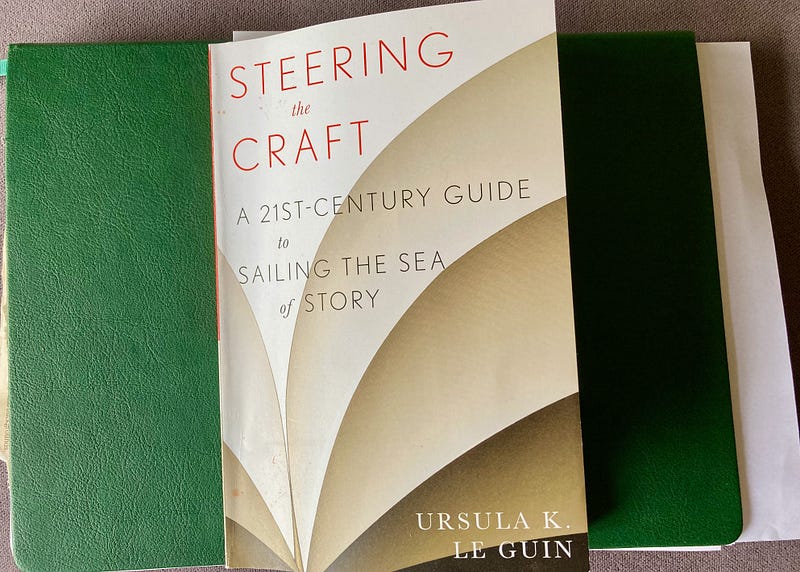
I’m always up for honing my writing. So, it was time I got round to Ursula K. Le Guin’s Steering the Craft.
When I came to the chapter on adjectives and adverbs—and we all know about those: road, hell, paved—I said to myself, ‘Yes, yes, been there, done that.’
Le Guin says: ‘I recommend… a watchful attitude and a thoughtful, careful choice of adjectives and adverbs because… English… needs more muscle than fat.’
Nothing new here. I moved swiftly on to that far more treacherous topic—point of view, which no matter how much one reads and practices always seems to be a trap for writers.
So, it was a shock when one morning shortly after reading the book I fell to my morning scribbles and wrote a paragraph about a vase of flowers in my kitchen:
I have some gorgeous speckled lilies in a vase with pale pink roses and rosy and yellow snapdragons and mute green eucalyptus and some tiger-striped alstroemeria. The vase is pale blue glass with a gold rim.
Le Guin must have been laughing over my shoulder, for in those two sentences I used thirteen adjectives. And there was I smugly believing that I was above such things. Yet here I was scattering adjectives like blossom from a cherry tree.
So, I took my paragraph, and I struck out all the adjectives:
I have lilies and roses and snapdragons and eucalyptus and alstroemeria. The vase is glass.
I like the directness of this paragraph. I can see the flowers much better now they are cleared of their adjectives. In my first paragraph my vase is cluttered and obscure; those adjectives hide the very things I seek to draw. As Le Guin would say, all those adjectives ‘cause obesity in prose.’
But that second paragraph. What colour are the lilies? And alstroemeria… does the reader know alstroemeria? And what about the roses? Surely, they want a colour? Eucalyptus needs no elaboration.
Mary Oliver springs to mind: ‘Use verbs of muscle, adjectives of exactitude.’ Perhaps if I focus on the verbs, I could make my paragraph stronger than a mere list. While I’m about it, I will ditch that adverb, some. Like its peers — very, just, great, suddenly — it’s a word that squats invisible to the eye, yet cluttered to the ear.
But first, that vase. Why mention it? To say it is glass is mere reportage. What is the truth of that glass vase?
I like a vase made of glass, like to see the stems criss-cross, watch the water cloud over the days.
This is better. But need I say I like the vase? Might not my observation show how I feel?
In the glass vase, stems criss-cross and the water clouds over the days.
I like the ambiguity of over; does it belong to clouds or the days, or both?
Now to the flowers:
The lilies are stars, each face freckled burgundy. Snapdragons bloom, blown, their petals are sails taut with scent. Alstroemeria are hats worthy of Ascot.
In avoiding adjectives, I have resorted to metaphors. A case of out of the frying pan, into the fire. Too much metaphor turns my flowers obscure again.
So, without adjectives, stripped of metaphor:
Eucalyptus sobers the lilies and roses and snapdragons and alstroemeria. In the glass vase, the stems criss-cross and the water clouds over the days.
Not sure about that verb sober. But pressing on, perhaps, I can inject a colour, just one colour. The roses can be left alone, everyone can picture their own rose and snapdragons can bask in their common name. But the alstroemeria? Ought I to resort to its common name, Peruvian lily? I already have a lily in the vase and besides, I like the oe digraph in that noun.
Perhaps this:
Eucalyptus sobers the lilies and roses and snapdragons and the tiger-striped bonnets of alstroemeria. In the glass vase, the stems criss-cross and the water clouds over the days.
I like tiger-striped bonnets, their suggestion of colour. Can the vase afford another colour? I once read that a colour is heightened in a sentence by the close proximity of a contrasting colour.
Here’s Waugh:
When we had drunk our port, I walked beside Sebastian’s chair through the pillared hall to the library, where we sat that night and nearly every night of the ensuing month. It lay on the side of the house that overlooked the lakes; the windows were open to the stars and the scented air, to the indigo and silver, moonlit landscape of the valley and the sound of the water falling in the fountain.
Evelyn Waugh, Brideshead Revisited
Waugh uses four adjectives: pillared, ensuing, scented, moonlit and one adverb: nearly. I don’t count indigo and silver, for they act more like nouns with that comma after them, as if indigo and silver were so manifest they were actually things. How clear and beautiful is Waugh’s paragraph. How those nouns stand unadorned and strong. What masterly use of colour.
Eucalyptus sobers the apricot and peach, lilies and roses and snapdragons and the tiger-striped bonnets of alstroemeria. In the glass vase, the stems criss-cross and the water clouds over the days.
Like weeds, adjectives sprout when we turn our back, even as we think we have them under control. Gorgeous, seductive sirens (those adjectives are superfluous), whispering to the writer, leading her to a quagmire of words.
Meanwhile, adverbs masquerade as utilitarian and indispensable, and they hoodwink the writer.
As for my vase of flowers, I’m still not happy with sober, but there’s more thought in my paragraph, it’s not just description, it’s moving in a better-crafted direction…