
Cultivating “I Can”
Strategies that can help build growth mindset
I was eleven years old when my English language teacher, Mr. Pawar, selected me to compère the annual showcase of our school. I was scared. Not due to stage fright, but because I thought I just can’t do it. It seemed to be a highly challenging task for me to accomplish then. My teacher persevered, and told me that with preparation I can ace the show. He made me believe in myself. We prepared, his feedback made me consistently improve, and I did pretty well. The experience has stayed with me for over 15 years now. Ever since, I have spoken on the stage over fifty times. This was my formal introduction to growth mindset.
Studies on students’ attitudes about failure by Dr. Carol Dweck and her colleagues debunked the myth that intelligence is fixed and that one can do only so much. These findings gave rise to the highly popular terms growth mindset and fixed mindset which, simply put, describe people’s beliefs about intelligence. In a growth mindset, the individual views challenges as opportunities to grow and believes that their ability can improve.
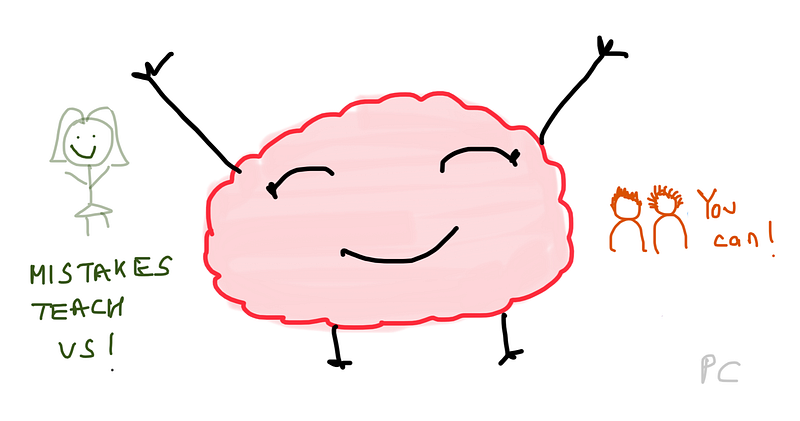
People with a growth mindset take more risks and are less worried as they know that mistakes are okay and with deliberate practice, they can achieve what they aim for (Just like the mini-me could!). Thus, building an “I can” attitude amongst children can help them perform better and greatly contribute to their growth and success.
They have themselves to fall back on. They have themselves to trust.
These abnormal times all-the-more call for cultivating a growth mindset amongst children, teachers and anyone else who needs to overcome the challenges of the pandemic. Simply saying, “You need to have a growth mindset” is not going to work, sighs. So, what can one do? Rest of the article talks about some strategies that can help teachers enable their students to build a growth mindset.
- Self-reflections: Reflections are a powerful way to internalize what we are doing, why we are doing what we are doing, our feelings, our learnings, goals, etc. As a teacher you can support student learning by regularizing reflection sessions after learning experiences. Students can journal their reflections in a manner that they like.
- Modeling: Children are highly impressionable and thus, embodying a growth mindset on your own can benefit your students a lot. This would entail actions like — i) having a growth mindset about your own students and believing that each of the students can be successful, ii) creating safe spaces in the classroom and letting your learners know that you are there to help them grow, iii) talking about own learning journey, iv) creating an environment where mistakes are celebrated by accepting your own mistakes, v) sharing stories of people who have exhibited growth mindset.
- Process vs outcomes: As a teacher, your lessons should focus on enjoying the process of learning and going deeper instead of focusing on surface level outcomes like syllabus completion or great learning scores. For instance, one starter way to give feedback on assessments is to move away from a score or grade to a “not yet”. Read more about this here. Similarly, you can annotate the worksheets by using indexes such — S — spelling, G — grammar, C — content instead of a red-pen cross or tick mark. This would give opportunities to the learners to work on their mistakes.
- Praise the process: Like above, teachers’ focus should be on praising the process instead of the person. For example, instead of saying “You are good at math!” you can say, “Great job, Ian! You have improved a lot in the way you simplify complex problems and solve them step-by-step. Great that you tried multiple times to get to a strategy that seems to sit well with you!”. Praising the person may steer learners towards easier challenges.
- Teach students about how the brain works and brain malleability — neurons make connections when we try. The brain can change with deliberate practice and effort.
- Peer learning — Pair students with a peer who believes that they have the power to learn. Learning from each other is a great way to learn, isn’t it?
The effect of “yes, you can” has often been understated. Enabling learners to believe that they can learn and grow, and that mistakes are pathways to learn can lead them to become more resilient, empowered, motivated, open to challenges and overall, more successful.
Yes, you can, too.
Gratitude to Mr. Pawar for believing in me.
References:
Project for Education Research That Scales (PERTS)
How Praise Became a Consolation Prize
The Growth Mindset — What is Growth Mindset (mindsetworks.com)