Cuba Diary, Part 4 of 5
Havana, trying to figure out the money
Tuesday, 1 March 2011
During breakfast with Maria Elena, Chris and I struck up a conversation with Lars, a German guy who had just arrived and is working for a German aid agency. He visits here frequently and lived in Cuba about fifteen years ago. He said that there have been many changes in the people during the last fifteen years. Principally, according to him, they are a lot more money-hungry now. Whereas, in his experience, fifteen years ago people did not approach foreigners to sell them things or ask for money, he says that there is significantly more of that now.
I can certainly see much of that for myself. Lots of people are out there selling their wares, asking if you need a taxi, hustling you into restaurants, or offering to sell you Cuban cigars.
The tour bus had passed the Necrópolis Cristóbal Colón the day before. This day, I wanted to get inside the grounds to see if I could find any unusual monuments. I furthermore decided that I wanted to go there by public bus.
After I passed the Parque Central, I saw a stop for the P-5 bus and asked some people standing there if it passed the cemetery. They said no, that the bus I needed was the P-4, and they pointed me in the right direction.
At a second inquiry further along, when I asked a bus driver who would, no doubt, know the system, he asked me if I wanted a seat on the bus. I said yes, I did. He then told me that I should go to the stop next to the railroad station.
At first, I thought that there may have been two kinds of buses: those with seats and those without. In fact, there are two signs in the areas of the bus stops: one that says it’s for passengers who are sitting and one for standees.
It was less than a ten-minute walk to the train station. A bus pulled up to the stop just before I got there, and I could see why it was that the other driver asked if I wanted a seat: everyone waiting at the bus stop filled all the seats on the bus before it started its route. This is quite a long bus, too, with an articulated central area between two long chambers. They call these buses “camels.”
As I mounted the bus, I could see that the fare was 40 centavos, and it was clear that that must be in MN, not in CUC. I didn’t have any MN coins, but I did have some one-peso notes, from which I would be entitled to get change. But the drivers don’t make change, as you need the exact amount.
The driver, seeing the one-peso note in my hand, simply took it from me and deposited into the fare box. It all happened too quickly for me to do the conversion between MN and CUC. Besides, I didn’t want to hold up the people behind me.
By then, there were only two seats left, and I got one of them. It didn’t take long for the bus to be packed to capacity. It would have been impossible for anyone to fall down if the driver had had to stop short. Besides that, the music was blaring inside. Folks here seem to need music on at all times, and the louder the better.
Here is some math for you concerning the currencies and the bus fare:
US$1 = .89 CUC = 22.25 centavos in MN 100 cents = 89 cents = 22.25 centavos
1 CUC = 25 pesos MN 100 centavos CUC = 2500 centavos MN
.04 CUC = 1 peso MN
So, the bus fare of 40 centavos MN = 1.6 centavos CUC = ???? (I can’t figure out the equivalence in US cents.)
After some lunch near the cemetery, I took another bus. It was the most crowded I have ever seen a bus. I got off near the Habana Libre Hotel, a landmark in the revolution for Cuban independence. (It was once named the Havana Hilton.)
From there I walked to the seafront, the Malécon, and then back to the apartment. It was a hot day and I had done a lot of walking. It was a relief to get into my room, turn on the air conditioner, take a shower, and lie down for a while.
The previous day, Chris and I had seen a place with lots of computers where the charge was 1.50 CUC per hour. By contrast, hotels and telephone company sell their access cards for anywhere from 5 to 10 CUC per hour.
Chris had said he was going to go back there today to use the Internet, since it was much cheaper. I asked him how it went. He said that they told him that the access was not Internet, but Intranet, only within Cuba.
It appears that the powers that be are doing their best to limit the amount of contact that the average Cuban has with the world outside its shores.
Chris and I were wondering what it will be like here after the Castros die. Do the Cubans know about what has happened recently in Egypt? There are signs everywhere lauding the Revolucion, meaning the original revolution that deposed Batista and brought Fidel Castro to power. With the government itself praising revolution, how would they respond if the Cubans fomented one against the current regime?
Wednesday, 2 March 2011
Chris and I began the day by going to the Hotel Florida in Habana Viejo. It is one of the more exclusive hotels here. I had seen a sign in there advertising a buffet breakfast for 7 CUC, so we thought we would give it a try.
The offerings were so-so, and very far from what you might imagine when you hear “breakfast buffet.” There was a decent variety of fruit, eggs, lots of meat options, several bread choices (all made with white flour), and a few salads that were ruined because they were sprinkled with pieces of either cheese or meat.
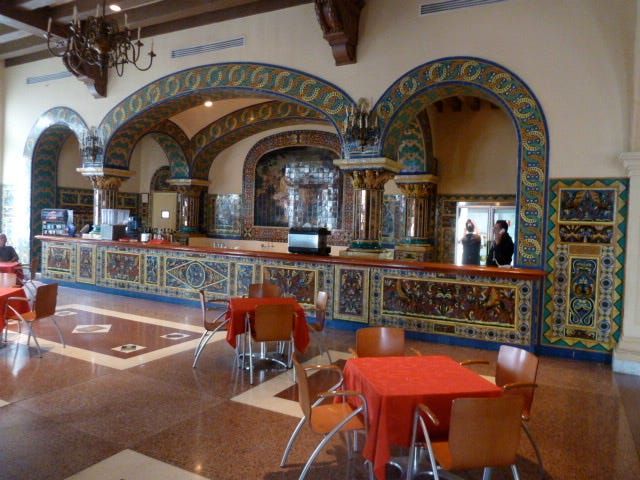
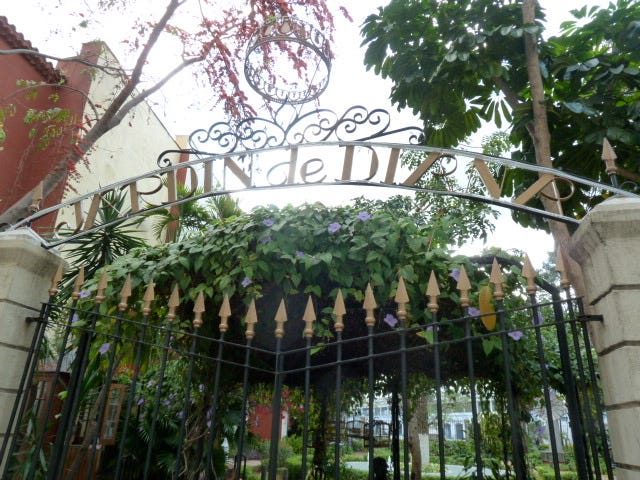
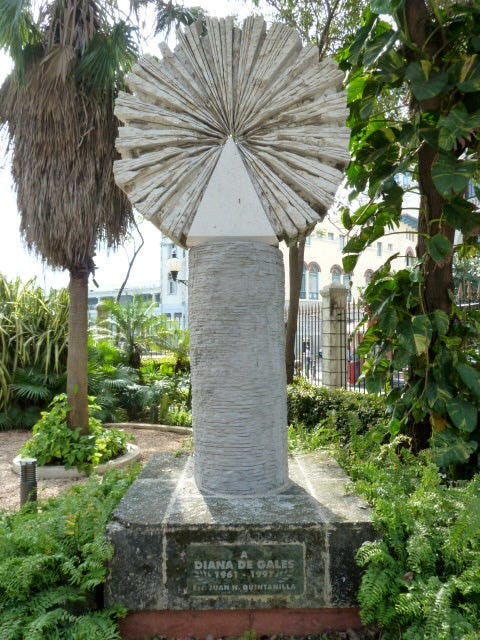
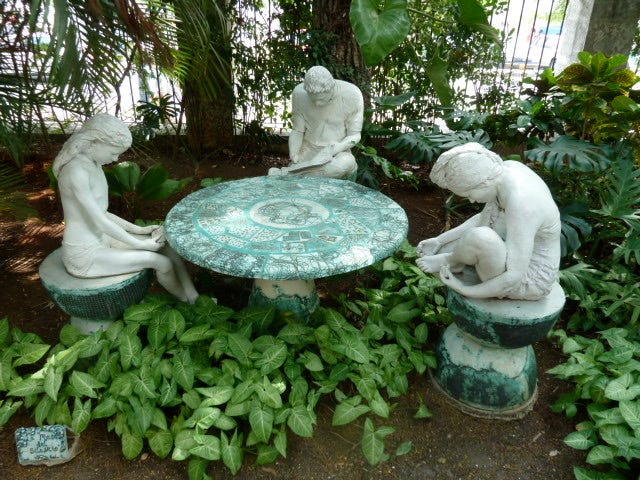
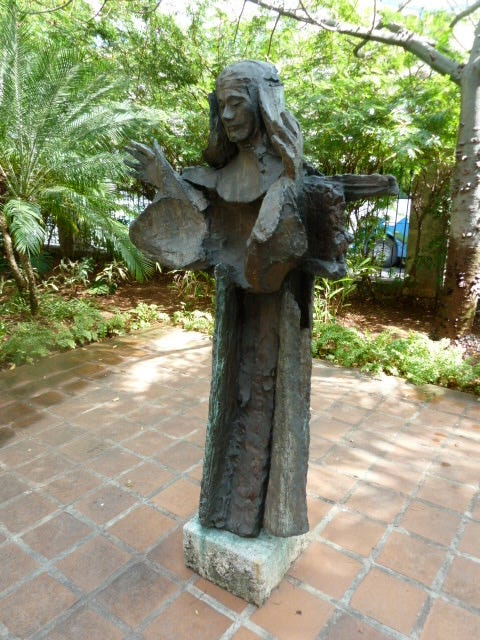
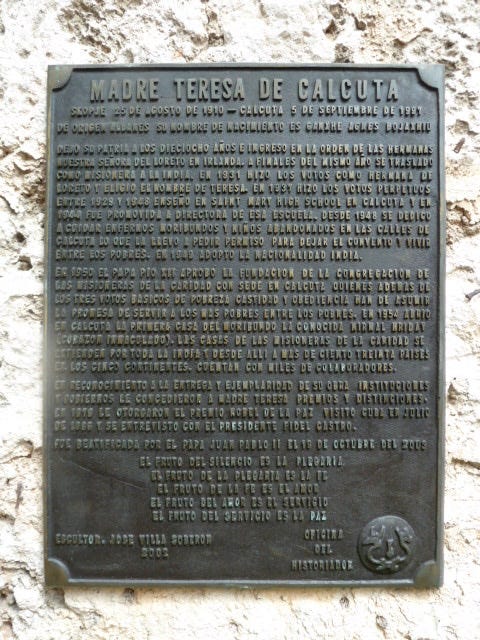
From there, Chris and I went our own ways. In walking around, I saw a garden dedicated to Princess Diana of Wales as well as one dedicated to Mother Teresa.
From there, I was wandering around and found a barber shop. I had been considering getting a haircut before I left here. When I went into the shop, the barber was extremely friendly. I even understood his Spanish (for the most part). Like everyone else, he asked where I was from. When I told him, he asked if I would like to change places with him.
I gave him instructions as to what I wanted to be done, showing him the spread between my thumb and forefinger of maybe half an inch. He nodded in agreement, got his electric clippers going, and in no time, he removed much more than I had indicated.
He was only following the Oath of the International Brotherhood of Barbers: “I promise to listen to the customer and then do as I damned well please. So help me God.”
I let him know that he had already taken off too much. He responded by telling me to relax.
There was really nothing else I could do. It was more than I wanted to be cut off, but it was not a crewcut. He also put on a lot of goopy stuff. When he went to get a razor, I told him I didn’t want it. He said okay and then proceeded to change the blade. I guess he thought I didn’t want him to use a used razor. That was not it. I didn’t want any razor at all. He came to me with the new razor and I said, No, I don’t want any razor. He desisted.
By the time we were getting close to being finished, a small group of locals had gathered in the shop, somewhat surprised to find a foreigner in there. They were all looking at the work the barber was doing and giving me the thumbs-up sign and a new gesture I had never seen before: taking two fingers to their mouth and making the motion of kissing them. I imagined that to be a positive sign similar to thumbs-up.
There was a prominent sign headed Lista de Precios, (price list of the services). It had only three prices on it: shaving for 1.50, normal haircut for 2.00, and special haircut for 3.00.
The question I had was whether the amounts were in CUC or MN. Had it been a neighborhood where there were lots of tourists, I would have guessed CUC, which would make the cost about $1.78 for a “normal haircut.” But this is the same neighborhood where I had paid 10 pesos MN (43 cents) for a plate of spaghetti the other day, so I assumed that what I really owed was 2 pesos MN (more than 8 cents, but less than 9 cents).
As I got out of the chair, I pointed to the sign and asked the barber if it were MN or CUC. I knew full well that he would not say MN. If I were already confused concerning currency, he might as well take full advantage of my ignorance.
It sounds ridiculously low, but at only 8.6 cents, could that possibly be right?
In response to my question, he told me that the cost was 5 CUC.
5 CUC?? Now I knew that he was ridiculously overcharging, trying to get whatever he could. I pointed to the sign and said I could see that a haircut was 2 and not 5. He played as if he were backing down, and now was willing to accept 2 CUC instead of 5.
(Later, when I got back to Rafael’s, he noticed that I had had my hair cut and so I told him the story. He had two women friends visiting at the time. They all chimed in, agreeing that it could only have been 2 pesos MN, and then they each had their own story about tourists being made to pay higher prices for everything.)