
Cuba Diary, Part 5 of 5
Final day in Havana, departure for Miami, observations and conclusions about Cuba
Thursday, 3 March 2011
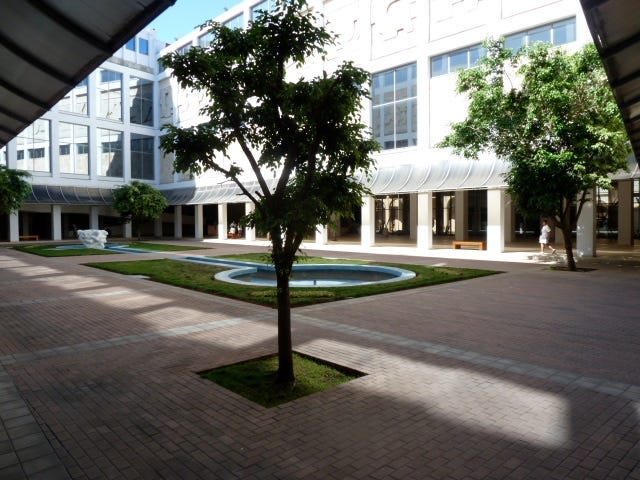
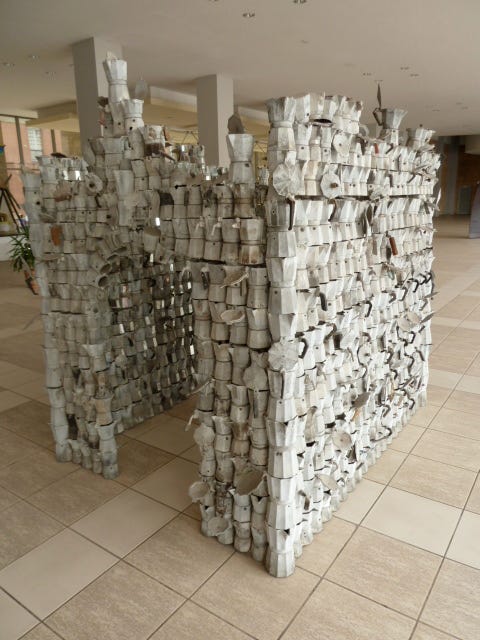
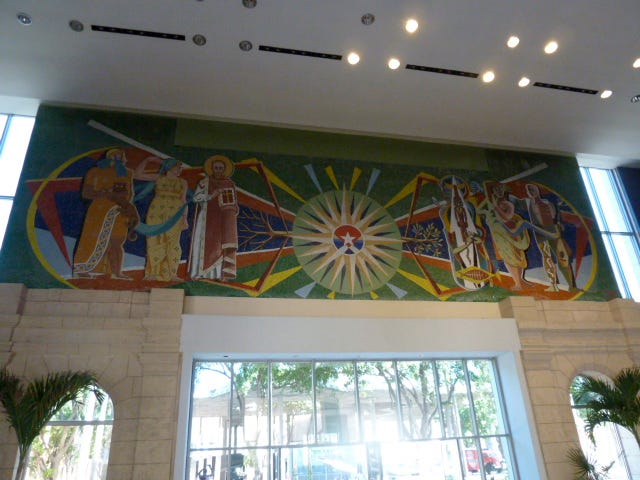
First thing after breakfast I visited the Cuban Art building of the Museo National de Bellas Artes. I was quite favorably impressed by every aspect of what I saw: the edifice itself, the range of art, its quality, and its display. Lots of pieces used innovative materials and were social commentaries about life in Cuba.
After that, while walking around, I saw many of the half-open-door “cafeterias” where locals get meals. As usual, prices didn’t indicate whether they were CUC or MN, but when it says “10.00” for a serving of spaghetti that you’re going to eat right there on the street, it’s a sure bet that it is 10 pesos of MN (43 cents) rather than 10 pesos of CUC ($8.90).
After I ate the spaghetti, I handed the server at the window 50 centavos in CUC coins. Everyone was happy.
In the afternoon, having run out of money, I went to the bank to change my last twenty-dollar bill into CUC. When I walked into the bank, I saw a few people sitting in chairs along the wall near the entry. My focus, though, was on the number of tellers available. Two of the four windows were staffed — the first and the fourth — with transactions in progress. There was no line of any sort, so I stationed myself in the center and stood there waiting for an opening.
After standing in place for more than ten minutes, I spotted a chair next to a nearby desk and sat in it. Very soon thereafter, a guard came to me and told me I could not sit in that chair.
A person waiting near the wall came over and informed me, “There’s a line here.” I looked around, seeing absolutely no line, and replied that I didn’t see one. He told me, “Everyone here is waiting in line.” He said, indicating all the people sitting in the chairs. He said that I was the last one.
I asked him how that worked. Whom did I follow? There was absolutely no way of knowing. He told me that I was to have asked when I arrived, but I had not done that. Anyway, whom would I have asked?
I looked around and saw about fifteen people in the chairs. I decided not to wait any longer. Never mind. I would find another bank later.
After walking around a bit more, I came to another bank. This one had a very definite line of people next to the window that had a sign displaying exchange rates, and then a cluster of people at the other end of the bank. I asked if this was the place to wait for exchanging money. The last woman in the queue said no, that the money exchange was “over there,” where the cluster of people was.
Now that I knew what to do, I walked over to the area and asked, to nobody in particular, “Who is the last person?” Immediately, a man identified himself as the last one, and then pointed out the woman who preceded him.
So that’s how it’s done!
There was otherwise no way to have known who followed whom, as everyone was simply standing around in groups that were more reminiscent of a cocktail party than a bank. Only the drinks were missing.
Now that I knew who preceded me, and I saw an empty seat, I was able to sit rather than stand. All I had to do was keep my eye on the guy ahead of me and the woman ahead of him.
It didn’t take long before somebody else walked over to the area and called into the crowd, “Ultimo?” I told him it was I, and I pointed out the man ahead of me.
It’s all so easy if you know what to do!
One young guy was taking a lot of money from one teller and then moving over to the next one. In seeing this I wondered, could each one have a different function, since he couldn’t get all his business taken care of in one place? Just to be sure, I asked a guard if I was in the right place for changing money. He said yes, I could do that at any window from 1 through 4 (though at the moment, #4 was vacant). The line I was in seemed to be moving toward teller #3.
When I had my turn, I went to teller #3, who, seeing the bill in my hand, promptly told me, “I can’t change that. I don’t have American dollars.”
I explained to her that the guard had told me I was in the right place. She called him over and said something that I didn’t understand. He then told me to wait behind the person at window #2, which I did, and I finally got the bill changed into a little more than 16 CUC.
On the way back to Rafael’s I saw a restaurant where prices were listed in MN. They had salad (5.00), rice and beans (2.00) and beer (10.00). That total of 17.00 MN would be less than one dollar.
I sat down and told a waiter what I wanted. He told me that the prices would be in CUC. I thought that he meant he would convert the 17.00 MN price into the equivalent amount of CUC. But he explained that every price I saw would be exactly the same, but in CUC, which meant that I would have to pay 17.00 CUC for the meal instead of 17.00 MN. The difference would be astounding: less than $1 in MN or more than $15. in CUC.
There was no sense in arguing with him. I wondered, though, if I had walked in there with a Cuban person, and we sat at the same table and ate the same meal, if we would pay the wildly different prices. What if the Cuban person, in response to the comment, “All foreigners pay in CUC,” had told him, “My friend (the foreigner) is not paying. I am taking him out for this meal”?
I was also wondering why it was that the local self-employed “cafeteria” ladies are willing to accept the equivalent of MN in CUC, but this place would not.
No sense fretting over it.
On the way back from the hotel to the apartment, I saw some taxicab drivers and arranged to get picked up in the morning for the trip to the airport. Rafael had advised me not to take the old US cars to the airport, as they are not allowed to enter there.
Friday, 4 March 2011
My flight documentation said I should check in at 7:00, but I thought that that would be ridiculous for an 11:00 flight. I told the driver that I wanted to get picked up at 8:30. He said he would be early, no later than 8:20.
As I was waiting in front of the building at 8:15, two men from the building across the street hand-signaled to me that they had seen me running around in the area while I was there. They showed signs of approval for that.
By 8:30, the taxi driver had not shown up. I wondered if he would. I gave him a few minutes and then walked to the area where I had spoken to him last night. I took a different taxi.
In Miami, the customs agent asked where I was coming from. I told him Havana. He asked the purpose of my trip. I told him I was a tourist. He told me I wasn’t allowed to travel to Cuba for tourism.
He called over another agent and they both questioned me. I told him that I had gone through an American company, filled out the paperwork, got a visa, and went to and from Cuba directly from Miami on American Airlines.
He said that that was not allowed. He then stamped my entry documentation and told me not to do that again.
Observations and conclusions about Cuba
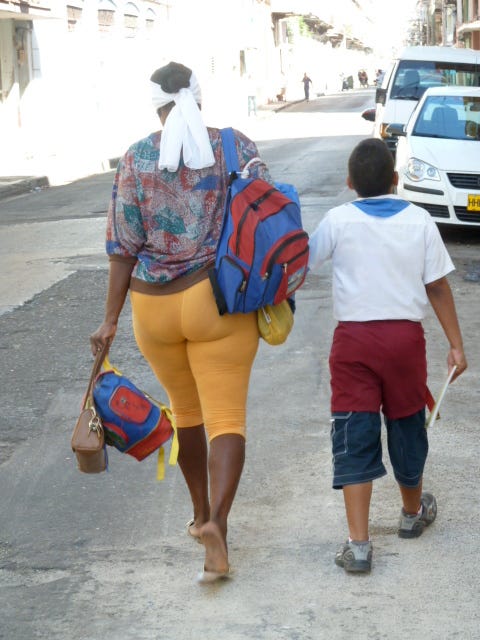
Tight and skimpy clothing for women and girls must be part of the culture. Even the girls’ school uniforms worn this way make them look like young streetwalkers or like actresses in a “barely legal schoolgirls” porno video. There is also an abundance of overweight women in tight and skimpy clothing: Flaunt it, whether you got it or not.
Many teenage boys and young men walk around shirtless — not a bad look on some of them, though others could use covering up. Many of the men give a very sculpted facial appearance, with plucking or possibly shaving around their eyebrows.
Vegan and vegetarian food is not easy to find, but when I explained my needs to people they were usually able to come through with something edible. The fruit was usually very good: papaya, pineapple, and small bananas, as well as guava. I like the guava juice but not the fruit itself.
Smoking is permitted in many places, including hotel lobbies and restaurants; many of the people smoke. I saw a sign in a restaurant indicating that it was illegal to sell tobacco and alcohol to those younger than sixteen.
There are not a lot of beggars in the streets. I saw a postcard of a sign that was placed along the highway: “200 million children sleep in the streets every night. Not one of them is Cuban.”
By contrast, there are a lot of street hustlers trying to drum up business for their restaurant, taxi, or other product (mostly cigars).
The sidewalks are narrow — usually about three feet wide or so. If you want to pass somebody walking slowly, you have to go into the street. There is not much danger of being run down, as there are relatively few cars.
With the narrow sidewalks, homes have very little setback from the street. Many people leave their front doors or windows open all day, and you can see them right there in their parlors. This seems to facilitate socializing, which is continuous and also quite noisy, as nobody speaks in low voices.
The sidewalks are riddled with holes, cracks, uneven surfaces, and protrusions that make them tenuous for walking. The narrow width doesn’t lend them to being harmonious places for planting street trees. As a result of the lack of greenery, most blocks looking barren. There are, however, wide boulevards with planted medians, parks and paseos that are lined with trees, often providing a canopy of shade over the area.
I rarely saw women driving. The entire time in Cuba, I saw two.
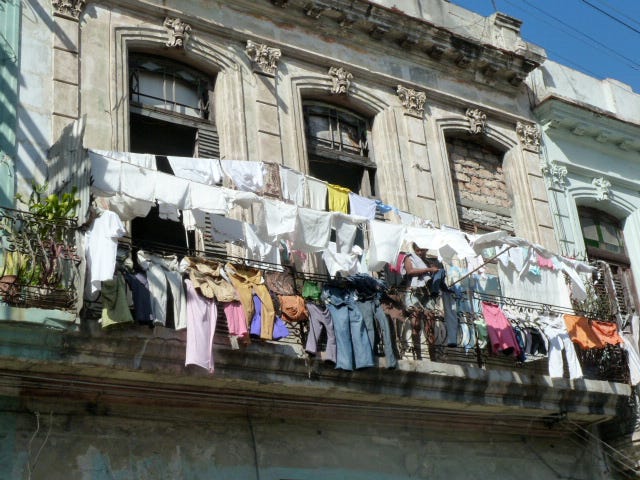
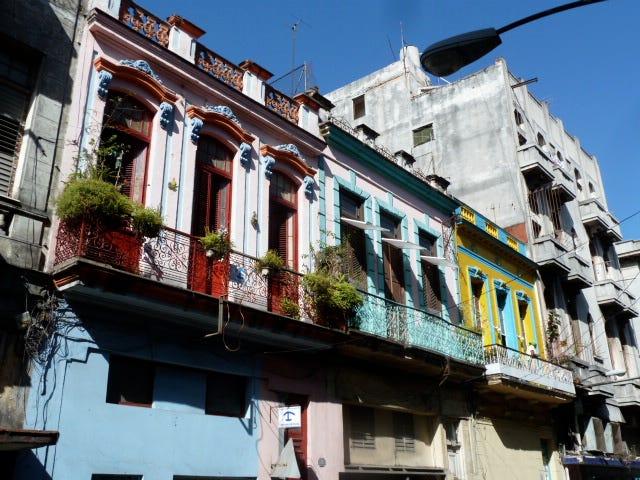
Everywhere I went had beautiful colonial-style buildings. Some of them are in good condition and a lot of them are not well maintained. In several places in Havana, scaffolding has been erected in front of the gorgeous facade of a building where the interior has been demolished, ostensibly so that a new structure can be built behind the original exterior. At many of these sites, the work has totally stopped, as there are vines growing up through the scaffolding, with no sign of any recent work being done. Yes, there is tremendous potential, but what is it going to take in order for it to be achieved?
This is probably the noisiest country I have been to, what with loud voices in the streets, the old car engines, motorcycles, and music blaring everywhere. Many of the restaurants oriented to tourists have either recorded music or live bands. Frankly, I don’t see this as a benefit, so if there are musicians playing at a restaurant I am considering, I continue looking for another one.
The breed of dog that I have seen the most is the dachshund. Almost every street has at least one. Most of them seem to belong to people, but there are also lots of dogs running around loose in the street. There is no culture of picking up after dogs, so it really is important to watch where you step.
People of different races seem to be working and living well side-by-side. All the workforces and neighborhoods appear to be well integrated. I have not seen blacks-only or whites-only areas or work staffs.
Almost all toilets, including those in restaurants, museums, and bus stations are pay toilets. There is a cleaning person who takes tips when you enter or leave. Though you pay for the service that does not mean there is always a toilet seat, toilet paper, a toilet that flushes, running water for cleaning hands, or soap.
The first question most people ask is, “Where are you from?” (Though it almost always comes out sounding like, “Where you frong?”) I always told people the name of my country and never once did I get anything other than an enthusiastic welcome. As in other places where I have traveled, people truly seem to ignore political and governmental relations in favor of positive interchange with those they meet face-to-face.
Everyone always wants to know about the weather. It was totally sunny every day but one, when it was partly cloudy. Temperatures were probably in the range of 75ºF/24ºC to 82ºF/28ºC most days. I never felt too hot, but there were a few days when the humidity must have been higher, as I was sticky and a bit uncomfortable then. It rained only once, in the evening, which was rather light and not a bother at all.
Summary in 17 words: Cuba is noisy, has crappy food for vegans, and stinks like cigars. Other than that, it’s great.