
Cuba Diary, Part 1 of 5
Departure from Miami, arrival in Cienfuegos
Monday, 21 February 2011
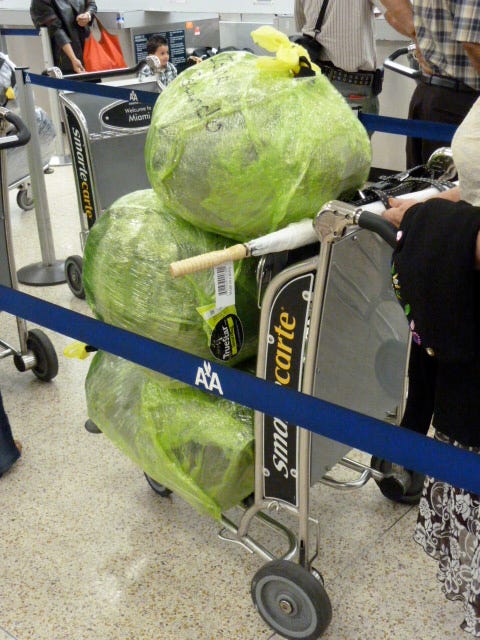
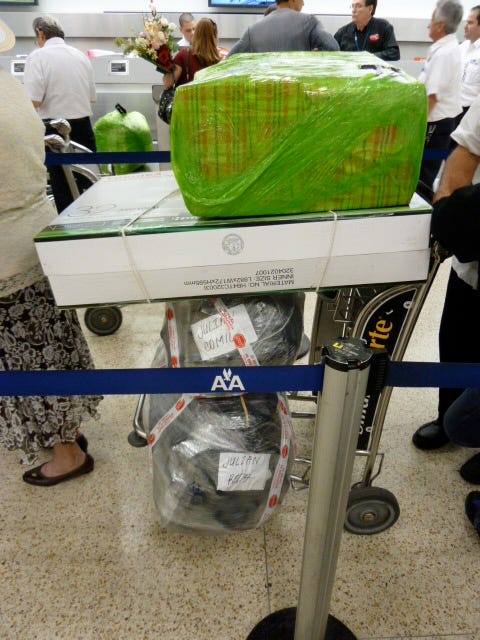
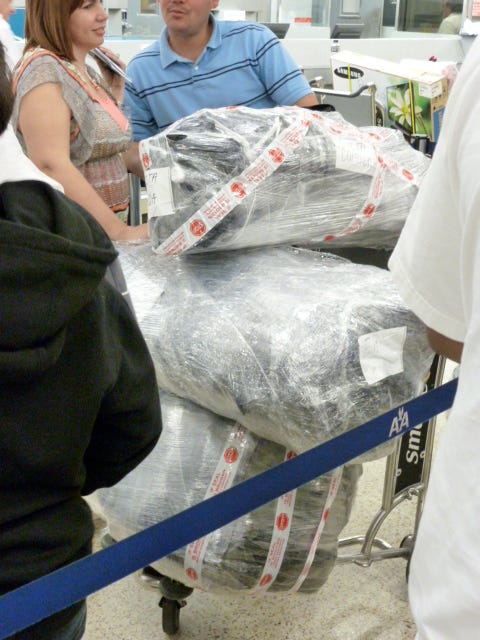
The first thing I noticed when I arrived at the Miami airport was that people had huge amounts of heavy bundles that they were taking with them to Cuba. Many of the plastic-wrapped items were labeled with their names and either “comida” (food) or “ropa” (clothing). Some people were bringing along huge flat-screen televisions and other electronic equipment. There were lots of bicycles as well as baby strollers, both new and used.
American Eagle, from whom this charter was leased, was woefully understaffed with regard to checking in all these packages.
My boarding information from the agency that booked the trip (Cuba Travel Services. www.cubatravelservices.com) informed me that I would be limited to forty-four pounds of luggage, which included both checked and carry-on pieces.
Most people were obviously way above their forty-four-pound limits, and I saw several of them hand over multiple hundred-dollar bills to the agent who was checking them in.
Once off the plane, I was the first one to get to the customs agents, but that didn’t mean I was the first one through customs. Maybe it was a mistake, but when it came to the part of the entry form that indicated where I would be staying, I left that blank. This evidently was a red flag to the agents.
The woman who would otherwise have let me pass through sent me to a guy who took me into a room with another guy to question me. I was in there for five minutes of interrogation, which included asking me about my religion. I decided to tell them I had none, thinking that that would be the best way to avoid any possible controversy. They finally decided I was all right, and they allowed me to go through customs to the area where the luggage was arriving.
I went through the gate of another agent, who started the what-hotel-are-you-staying-in? questioning all over again. She asked me my profession and I told her that I was an English professor. In response, she reached down and pulled out an English workbook to show me. Sweet!
Upon entering the luggage claim area, I could see that one of the hold-ups was that everyone had to go through a security screening just like the one that we had done in Miami, except for the fact that we were able to leave our shoes on. The other hold-up was that though there were two conveyor belts only one of them was working. One of the agents asked me, “Do you have lacktock?”
“Lacktock?” What’s that??
It turned out to be the Spanglish pronunciation for “laptop.”
He wanted to know if I was leaving it here or taking it home with me. I assured them that I would be taking it with me, which apparently was the proper reply.
When I entered the luggage area, I could see that the conveyor belt was empty and lots of people were gone. I didn’t have time to look into where my luggage was because I was taken into yet another room for even further questioning.
One of the guys this time explained to me that it was not “normal” to have a norteamericano get off here in Cienfuegos. They usually go to Havana.
I explained the method to my madness: that I wanted to see this area, including Trinidad, an old colonial town, and that if I flew into Havana, I would have to make the round trip on a bus, whereas this way, flying into Cienfuegos, I would have only a one-way trip to Havana.
The questioning over, I went back to the room, only to learn that there was not enough cargo space for all the luggage on our plane, so the excess would be coming on another plane, all by itself.
Around 18:00, our flight arrived with the final luggage, and I got to see lots of plastic-encased blobs pass by me as I awaited mine. These were the norm, as there were very few standard suitcases.
By the time I left the terminal building, it was close to 18:30 and starting to get dark. I asked a taxi driver not only about the trip into town, but also if he knew anything about renting a room in a private home, a casa particular. I had long ago decided that that is what I wanted to do everywhere I went in Cuba, but thought better about telling the airport officials that that was my plan.
I had several reasons for preferring to stay in casas particulares: (1) it gives direct financial assistance to local people; (2) it allows for more personal and direct insight into the lives of the locals; (3) it would be a good way to be able to get the vegan meals I prefer to eat, as I would be negotiating my wishes directly with the person who would be purchasing and cooking the food, rather than having to go hit or miss in local restaurants; (4) eating in private homes would be a good way to avoid eating in restaurants, where diners are allowed to smoke, and it’s always good to be able to eat where people are not smoking; (5) it’s a lot cheaper — less than a third of the price — than the tourist-approved hotels.
As we made our way into town and the driver stopped at several casas particulares to inquire about available rooms, I could see that they were all filled.
We finally found a place where the owner said that she definitely had a private room for tomorrow night, but I would have to sleep in the living room tonight. That didn’t sound appealing to me, but I told her I would keep it in mind if I didn’t find another place.
After driving around some more and still coming up short, I finally told the driver to take me back to that first place. We negotiated different prices for the two nights: the higher one for the private room, of course.
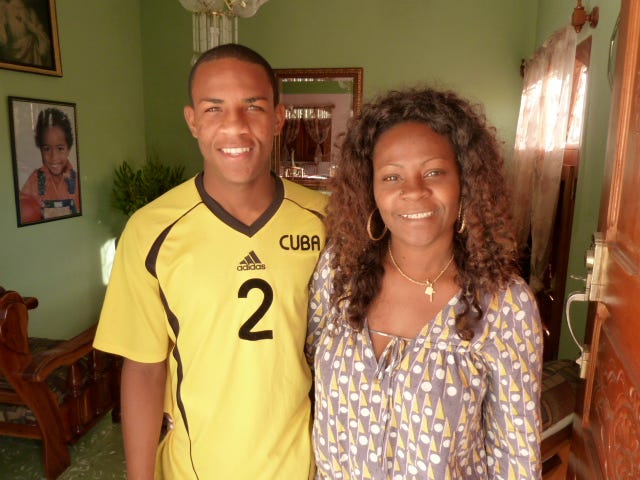
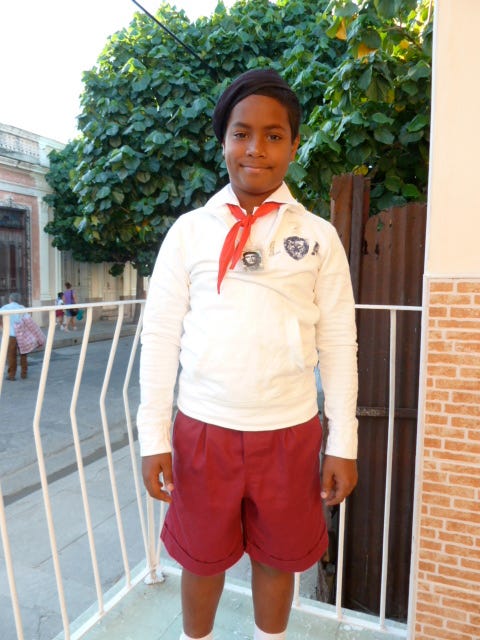
The owner, Milagros, lives there with her sons Pablo, 15, and Fernando, 8. She showed me where she would put a bed for me — next to the dining room table. Yes, the sofa was too short for me.
I thought I understood her to say that breakfast and dinner were included in the price. I told her that I preferred only fruit for breakfast and I explained my vegetarian preferences for dinner. I think she got it.
After Milagros brought me a glass of wine, I asked her if she knew anyone who did sewing. I showed her two small jobs I needed done: shortening some shorts that were too long and narrowing the wide legs of some light cotton trousers.
She took me directly across the street to one of her neighbors. That was easy!
With all that taken care of, I decided to go out for a stroll. I found Cienfuegos to be pleasant and was already looking forward to seeing it in the light. During my walk, I found one of the tourist hotels that the airport workers told me I could stay in. Their daily rate was close to $90 US, whereas the private rooms in the casas particulares are just over $22.
Even if I wanted to stay at one of the hotels, I would not be able to, as they do not accept American credit cards and there is no way for me to obtain more money here.
When I got back to the Milagros’ house, I found my bed had been set up next to the dining room table. It was certainly not the best setup, but would have do for the night.
Tuesday, 22 February 2011
I didn’t have the best night’s sleep, considering where the bed was located. The other tourists staying at Milagros’ place were a bit noisy when they came in and went out. There were also roosters crowing and dogs barking all night long.
In the morning, I did my stretching exercises and went out for a short run. When I came back to the house, I saw Pablo disassembling the bed in which I had slept. I asked him if it was his. He said yes. I didn’t like having kicked him out of his bed, but I guess this is what he has come to expect so that his mother can make ends meet.
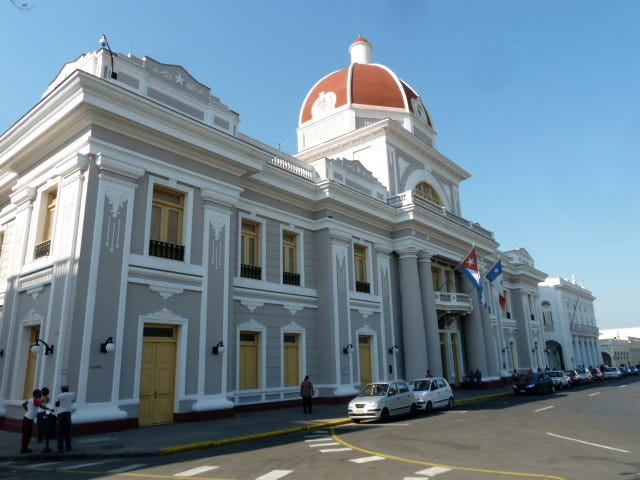
During the morning I took a walk to see the sights in the center of the town: the buildings around the Parque Jose Marti, including the Catedral de la Purisima Conception and the Teatro Tomas Terry. These buildings and the park are lovely. I also enjoyed the pedestrian mall and the Paseo del Prado, which is also Calle 37.
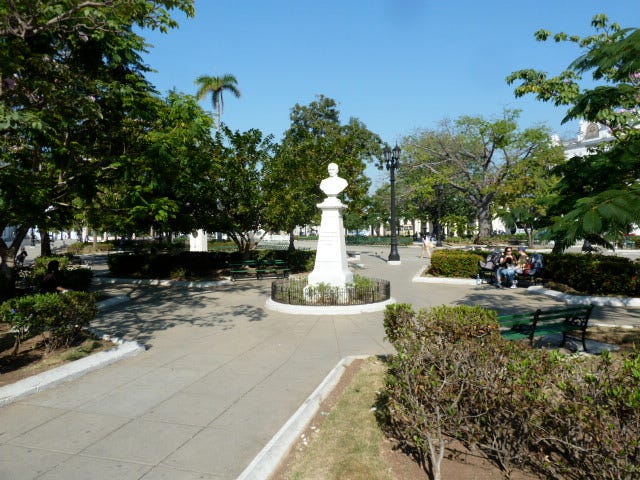
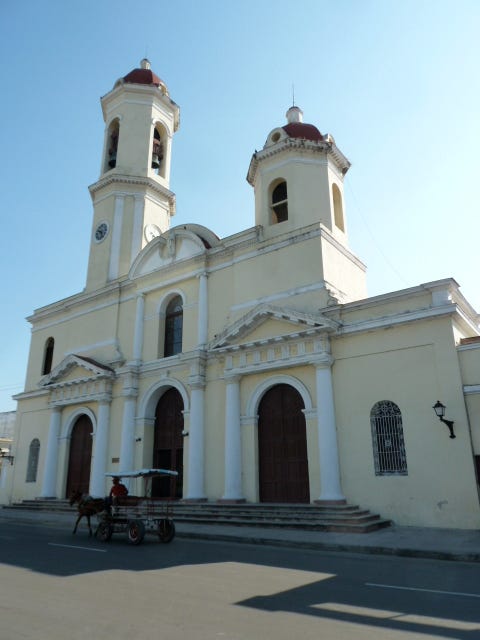
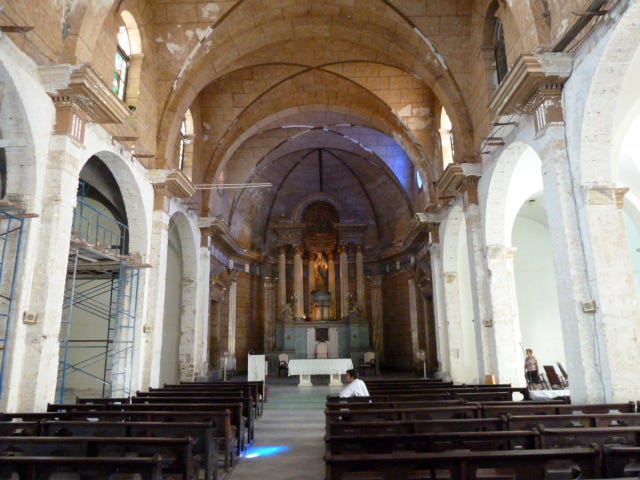
I found Cienfuegos to be kept very clean. Not all buildings are freshly painted, so it has an air of having seen better times. But there is no question that there is a lot of effort being put into maintaining the city as well as possible.
I was also able to exchange some of my euros at one of the banks. In doing so, I was not surprised to have to show my passport and have the number recorded by the bank. What I did see for the first time, though, was that the teller recorded the serial number of every bill that I exchanged. I imagine that this is done in order to check for counterfeit bills. Fortunately, all of these bills are from a bank, so I should be all right.
The money is confusing here. First of all, I had already exchanged my dollars for euros, so that is one conversion I had made. Furthermore, there are separate currencies here for tourists and locals. The tourists are required to change money into convertible pesos, referred to as CUC, and most of the time pronounced “kook,” but sometimes it sounds like “koo.” The locals use pesos, referred to as the moneda national, written as MN.
(In my limited formal Spanish training, I had learned that the word “moneda,” though it looks like “money,” usually means “coins,” and that the word for “money” is “dinero.” At the same time, I understand that Spanish, like any other language, varies according to the country where it is spoken.)
The Cienfuegos streets have a numbering system that I have also seen in San Jose, Costa Rica: the Calles are odd-numbered and run north-south, with the lowest numbers to the east and progressing westward. The Avenidas are even-numbered and run east-west, with the lowest numbers in the south and progressing northward.
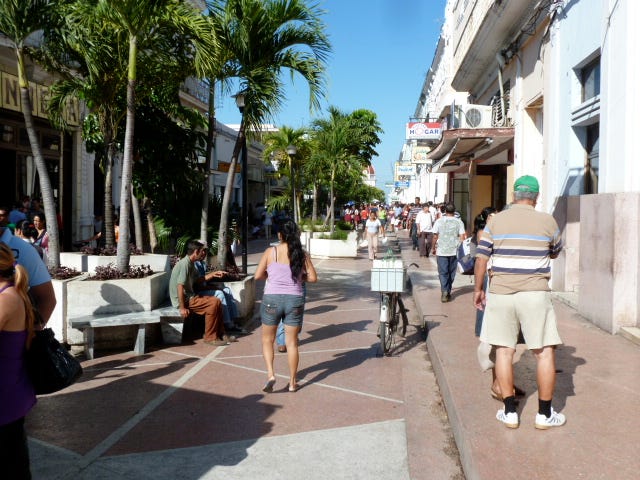
When I returned from my walk to Milagros’ place, my new room was in the last stages of being cleaned. It was nice to get settled in and have some privacy.
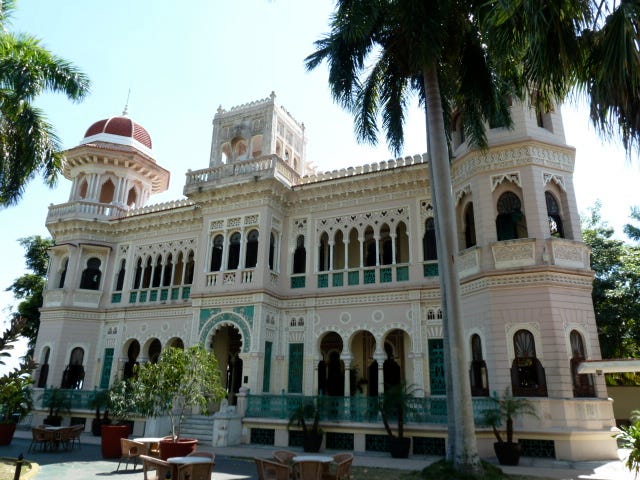
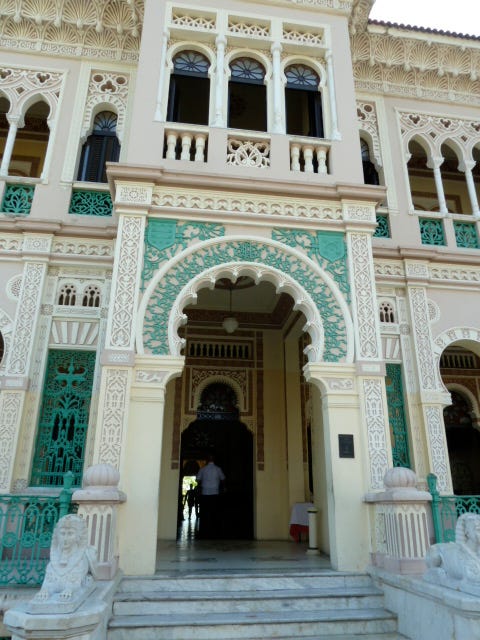
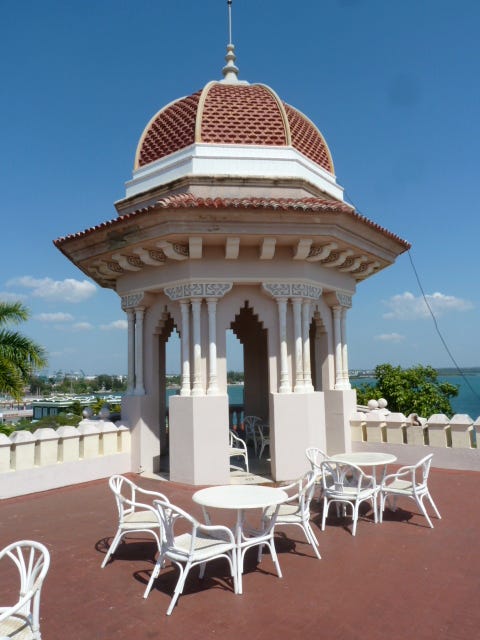
For the afternoon I took a long walk south along Paseo del Prado and then the waterfront to the Hotel Jagua and the Moorish-style Palacio del Valle adjacent to it. I don’t know what the temperature was, but it was the warmest day I have had so far — probably in the low eighties — and a little humid, but not unbearably so.
When the evening came, I was looking for a place to buy a bottle of red wine. I saw that there was some in a bar. I didn’t expect to buy it there, but I thought that the bartender would be able to tell me where it was possible to obtain it.
He told me that I could buy one of their bottles, and that it was eighty pesos in MN. I explained that I had only CUC. He said that it was about three pesos in CUC. I gave him a three-peso bill (the only bill I have ever seen for three of any currency) and he gave me change in MN, which amounted to one bill for twenty pesos and one for five. I was happy to get these, as it helps me in my collection of world currencies for the countries I visit. I didn’t know how I would otherwise get them, but now they seemed to be easy enough to acquire.
For dinner, Milagros prepared a meal that included rice with beans (cooked without meat) and vegetables. The tomatoes were the best I have tasted in quite some time. (I had also had some in a salad for lunch at one of the hotels, and found the tomatoes there to be as tasty.) This was not part of the fee for the room, so we negotiated a price of $6 (they use the dollar sign here for their pesos, both CUC and MN).
I slept a lot better than I had the night before. The room was equipped with an air conditioner, which I placed on the fan setting, thus creating just enough background noise to overpower the sounds of the television, the talking within the household, the barking dogs, and the neighbors’ loud music.