
Cuba Diary, Part 2 of 5
Departure from Cienfuegos, Trinidad, arrival in Havana
Wednesday, 23 February 2011
When I woke up and left my room (in Cienfuegos), I saw that Milagros had slept in the room where two of the Czech tourists had stayed the night before. She evidently gives up her own room when she can rent it out to travelers. I guess this is what it takes to keep things going.
I took another walk around town in the morning since my bus didn’t leave until 12:30. I used the Internet at the main office of ETECSA, the telecommunications company. Internet is available in very few places. The only ones I have seen so far were this ETECSA office and two tourist hotels. The connection is slow and also expensive, at about $4.45 to $5.34 an hour.
When I got to the bus station, I was approached by people asking if I would rather take their car to Trinidad. I said I already had a bus ticket. One of them informed me that his sister rented private rooms in Trinidad and that I could have one, including a bath, for $15. Sounded good to me. I gave him my name so that he could call ahead to his brother-in-law Diego, who would be waiting for me with a sign. This seemed to be a better choice than being besieged at the Trinidad bus station by people who are trying to rent their rooms to travelers.
I explained to the man who sold me my ticket yesterday that I couldn’t find it. I had looked in my wallet, where I thought I had put it, and it was not there. He told me, “You put it in your passport.” That was one place I had not looked.
I opened up my passport, and there it was!
The trip to Trinidad took only an hour and fifteen minutes, which was fifteen minutes less than anticipated. I love when that happens.
As we rolled into the bus station, there was the expected throng of local people waiting to capture those of us who got off the bus. I spotted Diego, holding a sign with my name on it. Isn’t it great when these things work out?
Before I retrieved my luggage from the bus, I went into the office to buy my ticket to Havana for Friday. If all goes well, I will be able to stay in the home of Agustin, a friend of my friend Nello in San Francisco. I just needed to know the schedule so that I can tell Agustin when I will be arriving.
Diego took me to his house, which is about four blocks from one of the town parks. When he proposed that I purchase meals in the house, I explained my dietary needs and he said that his wife, Lisandra, would be able to oblige.
Dinner consisted of a salad with beans and rice. The rice was white, which is not the best, but there is no sense in quibbling when so much else is lining up well. (I doubt that people here know much about brown rice anyway.)
When I was walking around in the town, I saw a shop that advertised shoe repair. I entered and asked if they could also repair my luggage, hoping that I might be able to find somebody who could replace the zipper that had been broken on my bag. They told me to bring it in and that they would take a look.
I went back to the house to get it and brought it over to the shop, only to find that they would not be able to fix it.
When I returned to the house with it, Lisandra asked me what the problem was with the luggage. I showed her and she told me that she would be able to fix it. In less than half an hour, she summoned me to show me that there was now a new zipper pull on the broken zipper! Best of all, the pull bears the legend CubaBella: a nice souvenir of my visit here.
Right after that, Diego showed up with somebody he had gotten from the latest bus: Hide from Japan. It was fun being able to speak a little Japanese with him.
Thursday, 24 February 2011
Once again, there was no shortage of barking dogs and crowing roosters all night long. I imagine that the local people have conditioned themselves to sleep through this racket.
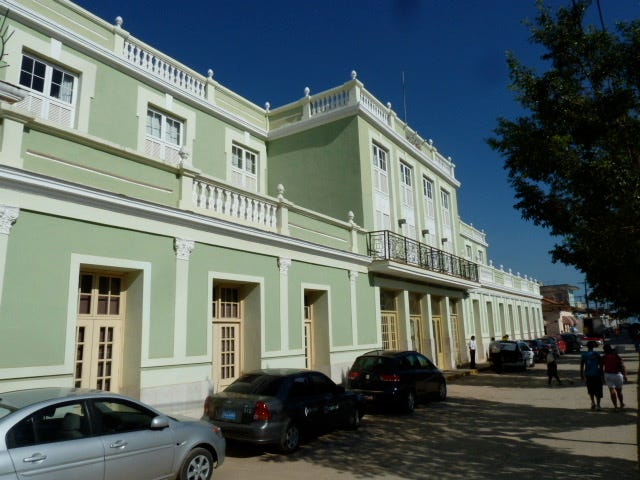
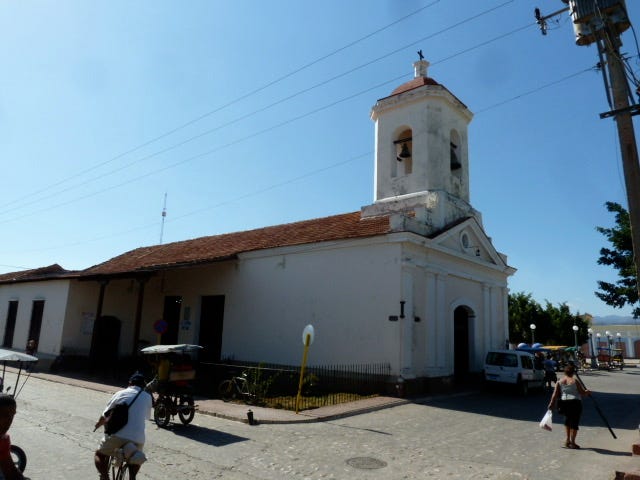
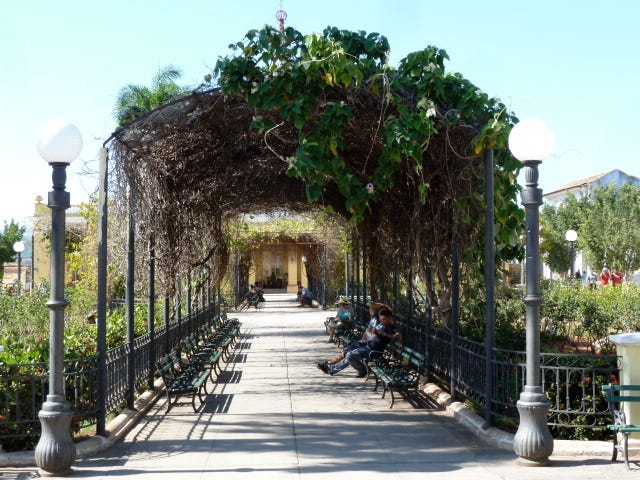
I enjoyed my time walking around the colonial town, which is a UNESCO World Heritage Site.
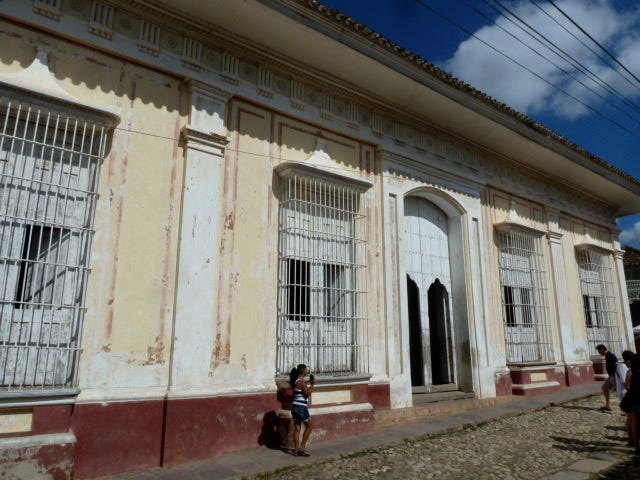
One highlight was the Museo Historico Municipal, which used to be a mansion in private hands. It had a stately courtyard as well as some rooms furnished to show the style in which the family lived.
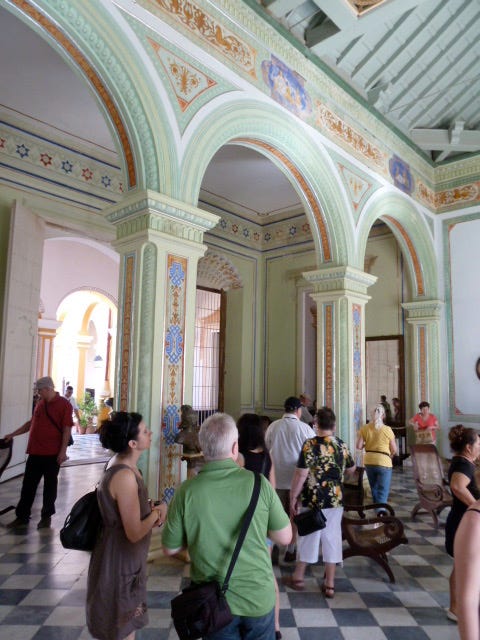
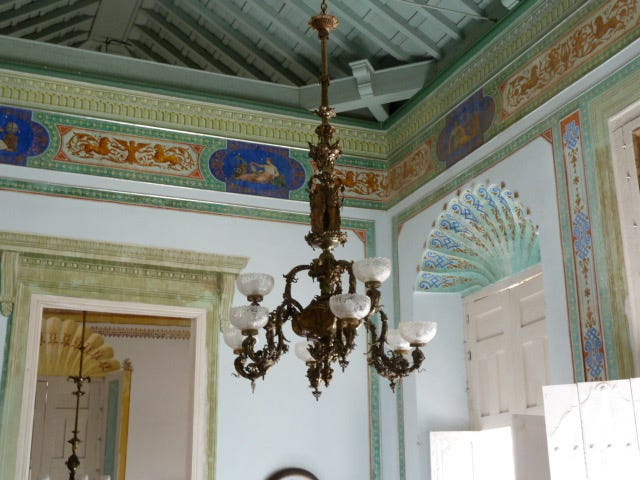
Inside the building, one of the security guards made eye contact with me and opened up a folder that contained a collection of the Moneda national, the money that only Cubans use. She wanted to sell it to me in exchange for 2 CUC, which has a higher value to her. The collection included coins in values of one, two, five, and twenty centavos, coins of one and three pesos, and bills of one and three pesos. The three-peso coins and bills are supposedly hot items, as they bear the likeness of Che Guevara. My guidebook says, “Although the export of Cuban currency is officially prohibited, Cuban customs won’t bother about a few coins.” I expect to have them all well hidden in my checked luggage, and hope that they don’t set off any alarms. In talking to this woman and one of her colleagues, she also showed me two US dollar bills that she had with her. She wanted to know if I could exchange them with her for CUC, because she is not allowed to go into a bank with them. I told her I would be willing to take them to a bank for her and give her the proceeds, but she declined. At first, I gave her one CUC for the three-peso bill featuring Che Guevara, but then I thought that I may as well spend another CUC and get the whole set. (At the time, I didn’t know the corresponding values between the MN and the CUC. Nor did I know how easy it would be for me to obtain the MN on my own. So I decided that I would go for the exchange. I realized later, when I learned these values and correlations, that I paid her about $1.78 to get money valued at less than $.50. I didn’t regret it, though, as I am sure that this little industry of hers — mounting the bills on a piece of paper and lining up the array of coins — is a good way to augment her meagre salary as a museum guard.) It was obvious that these two women knew that they were doing something illegal, as they kept watchful eyes on all entrances of the gallery in which we stood. Talking about money, in looking ahead, I realized that I would be on a bus most of Friday, and I imagine that the banks are closed during the weekend, so it seemed to be a good idea to get some more changed. This time, instead of a bank I went to an official exchange office, called a cadeca, which is an abbreviation of casa de cambio. The difference was that at the cadeca they didn’t ask to see a passport and they didn’t write down the serial number of every bill I exchanged. Diego, who runs the family home where I was staying, asked me if I could help do some publicity for him when I get home. He wants his guesthouse to be able to show up on Google searches, and there are many functions that are blocked from his end of the Internet. He offered to give me 10 CUC to place ads that will show up when people enter certain keywords into the Google search box. I told him I would do the best I can with that, once I get home.
Friday, 25 February 2011
I found out at the bus station when I arrived from Cienfuegos that there were two choices for buses to Havana: 7:30 or 13:00. I chose the latter, thinking it would be better not to have to get up so early and rush to the bus.
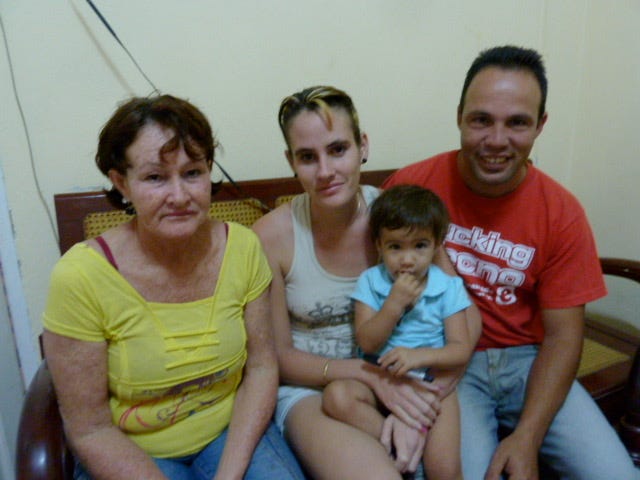
That way I had a relaxing morning, just walking around town and taking my last photos, including that of the host family: Diego and Lisandra, their daughter Maria Fernanda, and Lisandra’s mother.
The bus ride was reasonably uneventful, but there were a few unusual stops en route. At one point, in the middle of nowhere, we stopped so that the drivers of our bus (there were two so that they could take turns driving) could chit-chat with the two guys from a bus coming from the opposite direction. There was also a stop to change drivers, and immediately after that the new driver stopped at a roadside stand so that he could buy bananas. Before we entered Havana, there was yet another stop at a roadside stand so that the driver could buy onions and garlic. When we arrived in Havana, Agustin, a friend of my friend Nello from San Francisco, was not at the station to meet me, which necessitated my having to make a phone call. I had purchased a calling card the other day but had no idea how to work the system. One of the taxi drivers at the bus station helped me to make the call and speak on it, only to have one of Agustin’s neighbors answer the phone (I had thought it was a cell phone, but it wasn’t), and he explained to the taxi driver that Agustin was on his way. I had thought I was renting a room in Agustin’s place, but he took me to the apartment of Rafael, which is where Nello stays when he comes here. In the meantime, I realized that I had a financial crisis on my hands. There was no way for me to get any more money than what I had with me already. This is because Americans can’t use US credit cards or ATM cards in Cuba. I had enough money to pay for my room for the week, and also had to reserve some for a taxi to the airport and the departure tax. Once all of that is accounted for, I had a total of about $3 a day for food and all other expenses! Not much! (I imagine that there are many Cubans who live on less than that per day, but it was going to hamper me considerably if I had to do that myself.) I thought I might be able to swing it if I got the help of Rafael and Agustin to buy food with MN. Everything is significantly cheaper with local currency. I explained the situation to them, so we will have to see how this shakes out in the morning. Rafael said he could go shopping with me for some food. Shortly after that conversation, I was in my room when I heard other voices in the apartment. I went out there and met Markus and Remo from Switzerland, who were staying in the room next to mine. The four of us were sitting around and talking. Markus’s Spanish is excellent. I was noticing how much better I understand the Spanish of non-native speakers than that of the locals. I asked Markus and Remo if either of them, by chance, had a PayPal account. I was thinking that if either of them could advance me some money, then I would reimburse them immediately online. Neither of them has a PayPal account, but Markus was very quick to tell me that if I needed any money, he could give it to me and we could work out some way to reimburse him. He added that he had traveled quite a bit and that people were always so nice to him, that this was the least he could do to help out a fellow traveler. Wow! How wonderful is that? (In subsequent talking with Markus, I learned that we have been in many of the same places. He has even been to Mauritania. I don’t often meet people who have even heard of Mauritania, let alone spent time there.)
I went to sleep with a renewed sense of calm, knowing that this situation was taken care of. My wellbeing didn’t last too long, as my room had a window facing the street, and the noise outside was horrendous: car and motorcycles engines, music, dogs barking, and people talking loudly, shouting, and singing made for an extremely difficult time in trying to fall asleep. The only improvement over Cienfuegos and Trinidad was that roosters were not as prominent, although there were some of those, too.


