avatarShantanu Kulkarni

Free AI web copilot to create summaries, insights and extended knowledge, download it at here

3140

Abstract

nd. Some may even call it the “safe” end of the biohacking spectrum. But that’s for the individual to decide.</p><p id="4fd3">Let’s get into it!</p><h1 id="c482">Cryotherapy</h1><h2 id="4f37">The Concept</h2><p id="d6b2">Have you ever stubbed your toe on the leg of your dining table? What did you do after you winced in pain and held the toe tightly to prevent it from swelling up?</p><p id="033b">You iced it didn’t you? Icing reduces inflammation.</p><p id="c6a0">Well, that’s <i>cryotherapy</i>; also known as cold therapy.</p><p id="c88e">This fancy-sounding term is not a new concept. We humans have used cold temperatures to reduce pain, support healing, and elevate moods for hundreds of years. People all over the world use cold packs and ice baths to promote recovery.</p><p id="41d0">When it comes to biohacking though, a very specific type of cryotherapy is usually being referenced. It’s called <i>Whole Body Cryotherapy </i>— WBC for short. It involves exposure to extremely cold and dry air inside a special chamber or cabin and usually comes from liquid nitrogen or refrigerated air.</p><p id="2e4a">Before I move into the details I want to make sure I address this:</p><div id="362d"><pre>The Food <span class="hljs-keyword">and</span> Drug Administration (FDA) does <span class="hljs-keyword">not</span> currently regulate <span class="hljs-keyword">the</span> use <span class="hljs-keyword">of</span> <span class="hljs-keyword">whole</span> body cryotherapy offered <span class="hljs-keyword">at</span> cryotherapy centers, nor does <span class="hljs-keyword">it</span> recognize <span class="hljs-keyword">any</span> <span class="hljs-keyword">of</span> its medical benefits. The concern lies <span class="hljs-keyword">in</span> <span class="hljs-keyword">the</span> lack <span class="hljs-keyword">of</span> standardization <span class="hljs-keyword">in</span> temperature <span class="hljs-keyword">and</span> exposure protocols.</pre></div><div id="cc72"><pre>Medical science is also still catching up, so <span class="hljs-keyword">the</span> data is very limited about treatments <span class="hljs-keyword">of</span> <span class="hljs-keyword">any</span> medical conditions <span class="hljs-keyword">using</span> <span class="hljs-keyword">whole</span> body cryotherapy. If you <span class="hljs-built_in">do</span> choose <span class="hljs-built_in">to</span> <span class="hljs-keyword">try</span> cryotherapy, be aware that there are some potential risks involved. Be sure <span class="hljs-built_in">to</span> understand these risks <span class="hljs-keyword">and</span> <span class="hljs-built_in">get</span> <span class="hljs-keyword">a</span> medical opinion <span class="hljs-keyword">before</span> proceeding.</pre></div><p id="36c3"><b>Please read the above statement again.</b></p><p id="d7c3"><a href="https://www.aad.org/public/cosmetic/safety/cryotherapy">The risks are real!</a></p><figure id="a817"><img src="https://cdn-images-1.readmedium.com/v2/resize:fit:800/0*-IGKDGcszqVOo_dX.jpg"><figcaption><a href="https://draxe.com/health/cryotherapy/">Source</a></figcaption></figure><h2 id="41e1">The P

Options

rocess</h2><p id="f864">To go through a cryotherapy session you will first need to find a local cryotherapy center — a simple search on Google Maps will get you there.</p><p id="883e">Once you are at the center for your appointment, you get to stand in a small cylindrical chamber. This would remind you of that extremely small shower in your college dormitory! The top of this chamber is open so your head stays out and you can see the world. Why? Because claustrophobia is real, my friends!</p><p id="fac2">Oh, and no clothes!</p><p id="b973">Just kidding! Inside the chamber, you will wear minimal clothing, i.e., underwear only. Usually, gloves, socks, and ear coverings are provided to reduce frost related injury.</p><p id="ca8e">From your neck down a very cold gas is released in the chamber. You will feel the chill instantly. It likely gets close to -100 °F. Sometimes colder!</p><p id="2cb3">Based on the individual needs, the operator sets the appropriate temperature and length of the session. A session is usually no longer than 2–5 minutes.</p><h2 id="7879">The Science</h2><p id="db54">This part is controversial. Mainly because there aren’t enough studies and therefore not enough data to prove or disprove the claims of benefits. When a technology is new this is usually the case and is a very healthy thing to happen to any new idea especially if it pertains to the health and safety of the human body.</p><p id="450d">The claim is that whole-body cryotherapy has anti-inflammatory, analgesic, and antioxidant effects. Which means that proponents of cryotherapy say that the benefits include:</p><ul><li>Reduction in inflammation and muscle soreness</li><li>Improved recovery after exercise or injury</li><li>Mood enhancement</li><li>Increased energy and reduced fatigue</li><li>Reduction in pain from arthritis</li><li>And to top it all — increased libido!</li></ul><p id="7a7e">That last bullet point got your attention, didn’t it?</p><p id="2438">Cryotherapy is believed to work by reducing inflammatory processes, improving blood flow, and releasing feel-good endorphins. As a biomedical engineer I am here to tell you that yes, there is some truth to these claims and some truth to the science. But I cannot stress enough that there are risks, especially if you have an underlying medical condition.</p><h1 id="efa7">Should you try Cryotherapy?</h1><p id="1f74">When it comes to any new science, idea, technology, or process initially the risks always are high! Can you imagine when first people started flying in airships? The risks were huge! Remember the Hindenburg accident?</p><p id="468c">When airplanes became common, risks were enormous — they still are.</p><p id="a535">However, these new technologies reach a phase of standardization and regulation where the risks are much lower and they reach mass acceptance.</p><p id="a0e2">Cryotherapy is not there yet.</p><p id="729e">Talk to your doctor. Do your research. Visit a cryotherapy center and see what they do and learn about it. Get to a point where you have enough information to know if this is something that you would benefit from.</p></article></body>

Cryotherapy — A Beginner’s Guide

Biohacking Part-1

Photo by Simon Migaj from Pexels

A short while ago in one of my articles, I referenced the concept of biohacking. I was talking about achieving peak mental performance.

The idea of biohacking garnered some interest among readers, so I am here to share more. This article is likely going to become the first in a series of articles for the biohacking beginner.

One of the processes used for biohacking that are commercially available and getting more and more popular these days is called Cryotherapy.

The goal of this article would be to provide some information about the science and the technology behind it, why it works, and how it works.

First the basics!

What is Biohacking?

I would like to attempt to define Biohacking without creating a remake of the movie Minority Report! Sorry, no implanting chips in the brain. So forgive me for being super generic.

Biohacking is the idea of leading the human body toward a higher level of performance. This could be a higher level of physical or mental abilities. It is also used to create a faster recovery time — especially for athletes.

Image by Gordon Johnson from Pixabay

For those who are familiar with diets and weight loss solutions, I’m sure you have heard of intermittent fasting. That is a form of nutritional biohacking.

People with cognitive heavy careers swear by life hacks that allow them to perform at a higher mental capacity. For the tech-heads from silicon valley, a dopamine-fast is water-cooler talk in most companies. Both of these concepts are forms of mental biohacking.

We’ll talk more about nutritional and mental/cognitive biohacking in a later article.

The term biohacking is a very broad term that applies to a range of activities: Tracking your sleep being at one end of the range and injecting yourself with stem cells on the other end of it!

Cryotherapy is somewhere near the lower end. Some may even call it the “safe” end of the biohacking spectrum. But that’s for the individual to decide.

Let’s get into it!

Cryotherapy

The Concept

Have you ever stubbed your toe on the leg of your dining table? What did you do after you winced in pain and held the toe tightly to prevent it from swelling up?

You iced it didn’t you? Icing reduces inflammation.

Well, that’s cryotherapy; also known as cold therapy.

This fancy-sounding term is not a new concept. We humans have used cold temperatures to reduce pain, support healing, and elevate moods for hundreds of years. People all over the world use cold packs and ice baths to promote recovery.

When it comes to biohacking though, a very specific type of cryotherapy is usually being referenced. It’s called Whole Body Cryotherapy — WBC for short. It involves exposure to extremely cold and dry air inside a special chamber or cabin and usually comes from liquid nitrogen or refrigerated air.

Before I move into the details I want to make sure I address this:

The Food and Drug Administration (FDA) does not currently regulate the use of whole body cryotherapy offered at cryotherapy centers, nor does it recognize any of its medical benefits. The concern lies in the lack of standardization in temperature and exposure protocols.
Medical science is also still catching up, so the data is very limited about treatments of any medical conditions using whole body cryotherapy. If you do choose to try cryotherapy, be aware that there are some potential risks involved. Be sure to understand these risks and get a medical opinion before proceeding.

Please read the above statement again.

The risks are real!

Source

The Process

To go through a cryotherapy session you will first need to find a local cryotherapy center — a simple search on Google Maps will get you there.

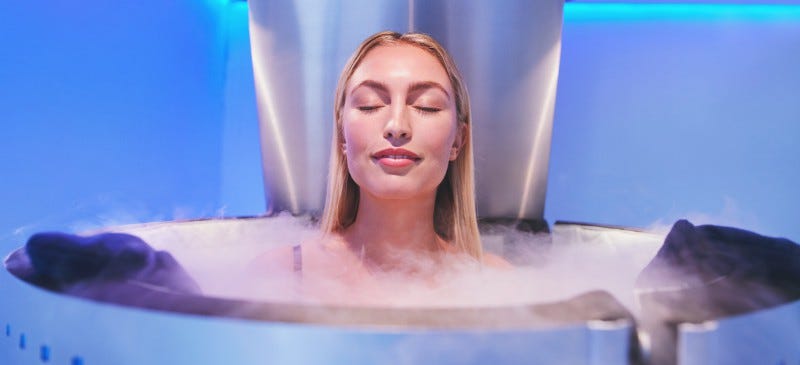
Once you are at the center for your appointment, you get to stand in a small cylindrical chamber. This would remind you of that extremely small shower in your college dormitory! The top of this chamber is open so your head stays out and you can see the world. Why? Because claustrophobia is real, my friends!

Oh, and no clothes!

Just kidding! Inside the chamber, you will wear minimal clothing, i.e., underwear only. Usually, gloves, socks, and ear coverings are provided to reduce frost related injury.

From your neck down a very cold gas is released in the chamber. You will feel the chill instantly. It likely gets close to -100 °F. Sometimes colder!

Based on the individual needs, the operator sets the appropriate temperature and length of the session. A session is usually no longer than 2–5 minutes.

The Science

This part is controversial. Mainly because there aren’t enough studies and therefore not enough data to prove or disprove the claims of benefits. When a technology is new this is usually the case and is a very healthy thing to happen to any new idea especially if it pertains to the health and safety of the human body.

The claim is that whole-body cryotherapy has anti-inflammatory, analgesic, and antioxidant effects. Which means that proponents of cryotherapy say that the benefits include:

  • Reduction in inflammation and muscle soreness
  • Improved recovery after exercise or injury
  • Mood enhancement
  • Increased energy and reduced fatigue
  • Reduction in pain from arthritis
  • And to top it all — increased libido!

That last bullet point got your attention, didn’t it?

Cryotherapy is believed to work by reducing inflammatory processes, improving blood flow, and releasing feel-good endorphins. As a biomedical engineer I am here to tell you that yes, there is some truth to these claims and some truth to the science. But I cannot stress enough that there are risks, especially if you have an underlying medical condition.

Should you try Cryotherapy?

When it comes to any new science, idea, technology, or process initially the risks always are high! Can you imagine when first people started flying in airships? The risks were huge! Remember the Hindenburg accident?

When airplanes became common, risks were enormous — they still are.

However, these new technologies reach a phase of standardization and regulation where the risks are much lower and they reach mass acceptance.

Cryotherapy is not there yet.

Talk to your doctor. Do your research. Visit a cryotherapy center and see what they do and learn about it. Get to a point where you have enough information to know if this is something that you would benefit from.

Biohacking
Cryotherapy
Science
Technology
Biotechnology
Recommended from ReadMedium