
SOMETHING DIFFERENT
Creatures Made of Felt Come Alive Under the Needle of Chris Armstrong
This Boomer gave up working on death row cases to design raccoons sipping margaritas
When I first saw Chris Armstrong’s work displayed at a local gallery I burst into laughter.
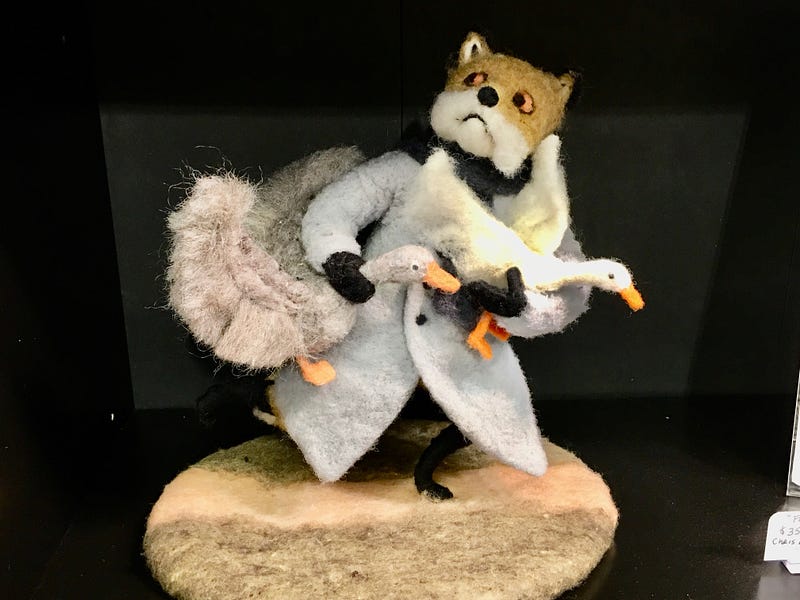
I’d never seen anything as comically endearing as this guilty looking raccoon making off with two geese.
The expression on the fabric-faced thief and the posture of his body leaning into his escape added to the absurdity of Armstrong’s work.
In the same display were other unlikely anthropomorphic scenes populated by Armstrong collection of felt fabric animals.
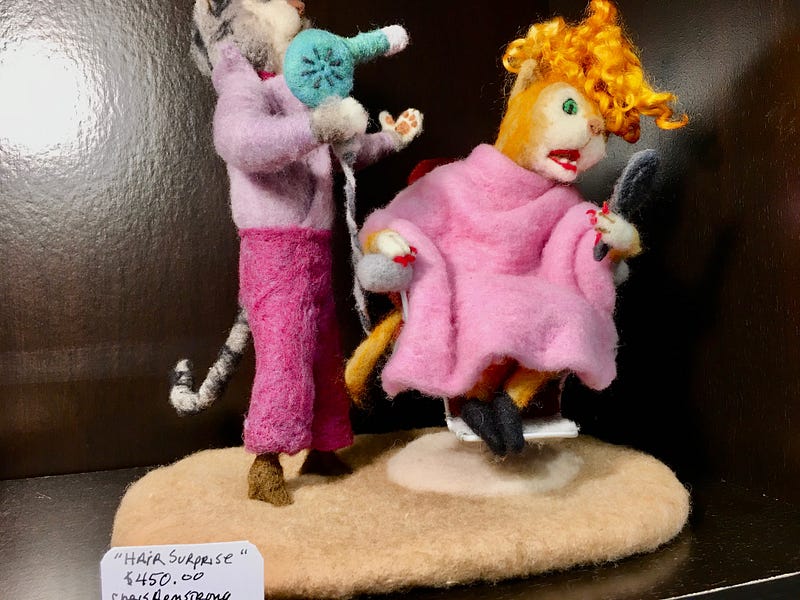
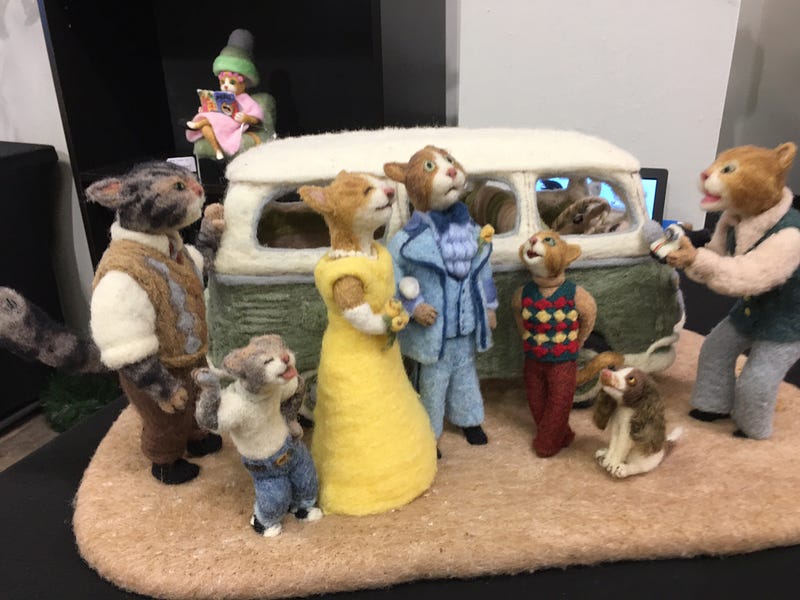
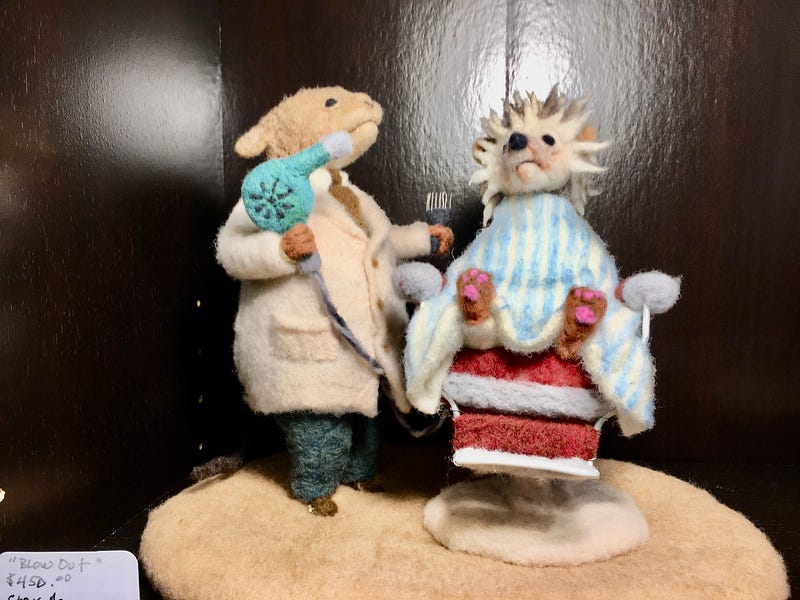
Sunbathing cats, a family of traveling creatures being photographed before their journey, a cat beneath a beauty shop hair dryer, a rabbit barber and his client, another cat enjoying a spa day and more.
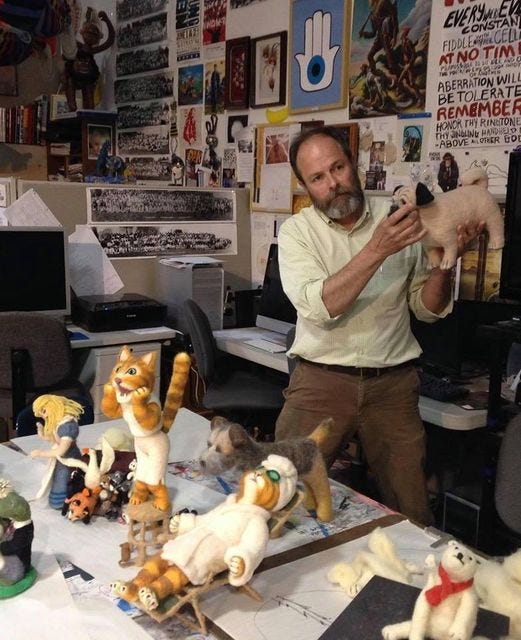
I was delighted to learn that Chris Armstrong is a Tennessee artist who lives midway across the state in Centerville.
Although he’d been playing around with stitchery for years, it wasn’t until 2003 that he turned his art into a business.
He’d taken a sabbatical from his job as an investigator — working on Death Row cases for the Federal Public Defender — when the school his child attended announced a fundraiser they were hosting called Elves Faire.
One of the features of the fair was the “Angel Room,” in which only small children were allowed to shop for small gifts. Parents with handicraft talents were asked to help stock the room with small items made from natural materials.
To help out with the event, Armstrong took up his needle again — this time to create some felted sculptures out of wool. His first creations included a whimsical wizard with a long beard, an owl and a quail.
The reaction to his art was so positive he began making more felt creatures — cats, mice, bears, otters, raccoons and squirrels. Almost overnight his company Whippoorwool was born, and 20 years later he is a regular at art shows and festivals throughout the United States.
Armstrong says he gets inspiration from children’s books, and said he loved reading Wind in the Willows when growing up.
He began doing needlework with felt because it doesn’t have hard edges or parallel lines. Made from raw wool, Armstrong described his attraction to felt needlework due to its “meditative and calming” qualities.
He told FeltMatters, the magazine of the International Feltmakers Association, “The wool also lends itself to furry animals.”
In working to create a world of animals wearing clothes and interacting in human poses he added, “I also love what I call the moment of animation, when I add something or make a small change that makes the character come alive in my hand. It almost always when I do the eyes.”
I’ve also noticed that the eyes of his creations, whether they are badgers, frogs, foxes, walruses, or mice, are generally its most animated feature.
What’s fascinating to me is watching him work.
Tennessee Crossroads, which is a program produced by Nashville Public Television, featured Armstrong in one of its segments when they were covering artists in Hickman County, Tennessee.
A memorable line from the video below is: “It takes a lot of patience and a current tetanus shot.”
These days Armstrong is branching out into the world of myths and legends.
He says he’s started making fairies, and is creating human-like figures with wings and is using his daughter’s face from when she was a child.
It’s easy to be inspired by Chris Armstrong’s work — on several levels.
He breaks the stereotype of your typical fabric artist. Most are women — many are quilters — but we’re seeing more needle felt artists drawing attention in the art world. He just draws a bit more being a male needle felter.
He also emphasizes that his craft is one that can be learned and practiced, it’s not necessarily an artistic gift one is born with although he obviously possesses a natural talent.
In the Tennessee Crossroads video he explains that patience and repetition is what molds his art. “After poking wool a couple of million times you can turn a piece of wool into a raccoon,” he says.
Armstrong started his business, Whippoorwool, after retiring from his job with the Federal Government, proving that one can transform into a completely new life and career at any age.
For anyone who has considered taking up a long forgotten talent or starting a new endeavor at midlife or beyond, look to Chris Armstrong and his whimsical woodland creatures and know that you too might find a creative niche to pursue.
You might also enjoy reading about Ethel Wright Mohamed, another fabric artist who started her career late in life while breaking norms in the Old South.


