
FOLK ART
A Baptist and a Muslim — Mississippi Folk Artist Ethel Wright Mohamed’s Marriage Defied Old South Norms
But it did not prevent her from becoming the Grandma Moses of stitchery
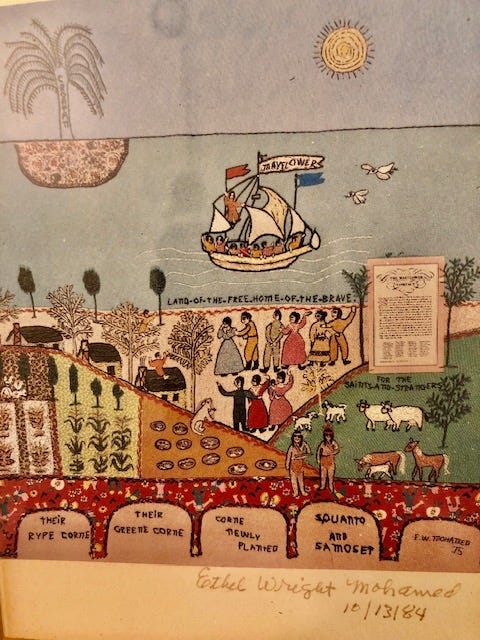
In October of 1984 I attended one of the regional art festivals held annually throughout the Mississippi Delta. This one was in Belzoni, Mississippi — a tiny hamlet of less than 3,000 residents and known as the catfish capital of the world.
It looked like there were more festival goers than residents that Saturday afternoon. Belzoni’s Main Street was dotted with tables, vendor booths, and food stands for as far as the eye could see.
The town was also the home of Ethel Wright Mohamed, the embroidery artist I drove 160 miles to see.
I’d heard her recent interview on National Public Radio, and as a novice folk art collector I was interested to see her work. She was attracting the attention of people in the art world and some were calling her the Grandma Moses of embroidery art.
Ethel Wright Mohamed only began stitching her life stories after the 1965 death of her beloved husband Hassan Mohamed. As an artist, like Grandma Moses, she started late in life.
For almost twenty years she created numerous scenes depicting the early days of her marriage, the dry goods store she and her husband ran, and events ranging from her church’s sacred harp singing to sharing a single bathroom with a family of ten.
It didn't take long to find her booth at the Folk Arts & Catfish Festival. Ethel Wright Mohamed sat alone in a folding chair surrounded by boxes of note cards with images of her embroidered works on them. There was also a large display of her embroidered handicrafts.
I learned that she didn’t sell any of her stitchery. It was too personal, she said. It’d be like selling her family members. Every scarf, lap blanket, pillowcase, wall hanging and stitched coverlets had deeply personal stories associated with every thread.
What she did sell that day were delightful 5" x 7" note cards with prints of her embroidered stories. The cards were made of sturdy, high quality paper and sold for $3.00 a card. Each came with an envelope so they could be mailed to someone with a greeting penned on the inside.
I picked out ten and told Ms. Mohamed I had no intention of using them as greeting cards. I was going to go home and frame each one of them, which I did.
“Would you mind signing a few of these?” I asked shyly. It was unseasonably warm that afternoon and she was fanning a few lingering flies away from her glass of melting lemonade. I didn’t want to unreasonably task her for the meager $30 I spent.
But she graciously uncapped her pen and signed and dated every one of the ten cards I purchased.
Ethel Wright Mohamed passed away in February of 1992 at 86 years old. The previous year she received the Governor’s Lifetime Achievement Award for Excellence in the Arts from the Mississippi Arts Commission.
She lived to see her work included in permanent exhibits at the Smithsonian, and the cards — like the ones I bought 40 years ago — featured on UNESCO greeting cards.
There have been numerous articles published in national magazines, newspapers and journals about the artist. She also illustrated My Life in Pictures, a book published by the Mississippi Department of Archives and History.
Film director William R. Ferris featured Mohamed in his documentary “Four Women Artists,” which included luminaries like writer Eudora Welty, quilter Pecolia Warner, and painter Theora Hamblett.
Life in the rural south
Ethel Lee Wright was born in 1906 in a tiny Mississippi town called Fame. She once described it as “the size of a bird’s nest.” She was the oldest of three daughters and one son to parents of Scotch — Irish ancestry.
Her father was a farmer and a lay minister in the Primitive Baptist Church. Her mother was artistic, and taught Ethel how to embroider pictures from drawings at an early age.
Studious and well-behaved, Ethel attended a one-room schoolhouse taught by a teacher whose pupils ranged from grade one through grade eight. She divided the class with boys on one side and girls on the other.
When Ethel was fifteen her father moved the family to Shaw, Mississippi. Although he was initially against it, she persuaded him to let her work part time job at a local bakery.
Soon she noticed one particular customer who dropped by daily for fresh bread and sugar cookies. Often he lingered — munching on a few cookies while watching her wipe the counters.
One day Ethel teased him about his regular visits, suggesting he must enjoy homemade cookies. The young, handsome merchant named Hassan Mohamed confessed what he really enjoyed was seeing her.
Soon a courtship developed. Hassan persisted until she allowed him to visit her home. That first evening when he came for Sunday dinner he arrived bearing gifts for everyone in the family.
Although her parents liked the affable, ambitious young man, they were concerned about their religious differences. Hassan was a Muslim, and Ethel and her family were devout Christians.
In the end, Ethel’s father gave the couple his blessing to marry.
Hassan Mohamed — an Arab peddler who defied segregationist laws
Hassan Mohamed arrived at Ellis Island in 1911 from Saraain, a tiny village in Lebanon near the Syrian border.
Like other Middle-Eastern immigrants in the American South in the late nineteenth century — Hassan was referred to as an “Arab.” He was a dry goods peddler who traveled the region and sold his merchandise to white farm families — and also to Blacks.
Although segregationist laws prohibited this kind of commerce Hassan sold across the color line, relying on Black patronage and ignoring laws that facilitated racial discrimination.
Even though Hassan thrived economically in the Jim Crow South, he had to carefully navigate racial boundaries. At that time “Arab” populations occupied a precarious racial position somewhere between white and non-white.
The US Naturalization Act of 1790 made American citizenship contingent on whiteness. And, court cases such as Dow v. United States in 1915 designated Syrians as white — in contrast to the non-white status of Iranians.
Although born in Lebanon, Hassan consistently referred to himself as Syrian. In the South’s racially charged climate, he clung to any advantage he could.
Over the years, court cases in the caste-based Delta began to construct legal consensuses that affirmed racial hierarchies —which could have affected Hassan’s movement throughout the segregated South.
An intercultural marriage
Despite the major religious difference, Ethel Wright married the Lebanese salesman Hassan Mohamed in 1924. They had eight children together, and were married forty-one years.
After several years of hustling sales in the Mississippi Delta Hassan moved his growing family to Belzoni and with a partner built the H. D. Homod and H. Mohamed General Store. He had become a successful businessman.
When the Great Depression hit, Hassan worked even harder, doing everything he could to bring in any extra dollars to maintain the comfortable lifestyle he’d built for his family.
Just as the decade ended and World War II began, the Mohamed family managed to survive without their business failing or losing any of their life savings.
During the war Ethel began working in the business. With the youngest ones now older, and with the help of a dedicated housekeeper, Ethel figured she could be useful.
She enjoyed trips to St. Louis and New York where she made purchases for what was now the H. Mohamed General Store.
All the while, her own world widened. She saw sights she’d never imagined and shopped in stores that displayed goods she had only heard about.
After the war ended, in the spring of 1949, Ethel and Hassan finally fulfilled a life-long dream.
For their 25th wedding anniversary they sailed to Europe for a six-month trip that would take them through the Mediterranean and end at Sarhine, Lebanon — Hassan’s hometown.
She would finally meet the people her husband had told stories about for years and see that part of the world he grew up in.
As one life ends, a new life begins
Ethel and Hassan enjoyed many more years together — watching their kids grow, marry and raise their own families. They witnessed their oldest son, Ollie Mohamed, enter politics and later become a Mississippi state senator.
But in the early sixties Hassan began dealing with a debilitating illness. In March of 1965 — surrounded by family — he passed away.
Grief stricken, Ethel Wright Mohamed returned to embroidery as a way to cope with her loss. In 1992 she told the Tuscaloosa News, “There is a soothing music as the needle comes through the cloth.”
For the next 27 years the artist recreated scenes from her life — many of them based on her late husband’s storytelling.
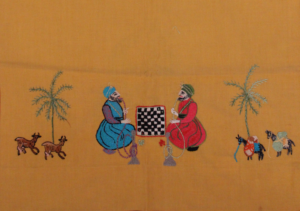
One of her outstanding pieces is a flat sheet bearing scenes from what she called The Arabian Nights. Stitched on gold fabric, her work depicts ten vignettes that are separated by date trees and embroidered in shades of green — suggesting the moving sun and a passing day.
The vignettes were created side-by-side, like illustrations in a book. She portrays men dancing, a woman playing a tambourine, wandering sheep, individuals prostrating themselves, gift giving, and two girls listening to an adult lecture.

She stitched two gold pillowcases that were part of the flat sheet set. The first shows a woman lounging in aqua blue pants holding her pipe. Another woman — in a pink dress and lilac veil stands over her with brightly colored fingernails and lipstick.
The second pillowcase depicts two seated men enjoying a game while smoking their pipes. Two little brown cows and saddled horses are tied to the trees nearby.
Green and red dots from the game are scattered below the motif. The two women and date trees are repeated throughout the scenes, uniting the scenes in a continuous echo.
Ethel’s artistry reveals how her husband retained and transmitted his background through storytelling — a process that Ethel duplicated through her craft.
Scenes from The Arabian Nights are imbued with intimate significance, reflecting how Hassan’s culture took new forms in the Delta diaspora and how they were reinterpreted by his wife.
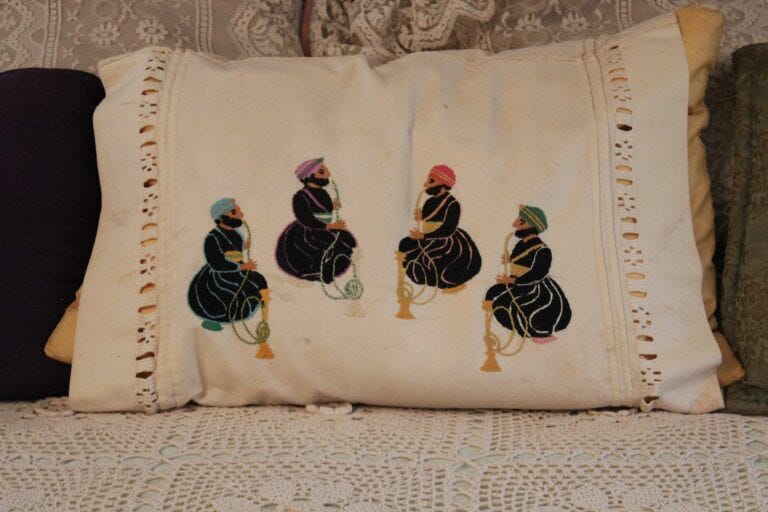
Another piece of her stitchery on pillowcases is called 4 Arab Men Smoking Pipes. This piece she embroidered shortly before her husband’s death and is located in the museum, in Hassan’s bedroom, where he spent his final days.
How the artist worked her craft
Embroidery isn’t usually improvisational. Imagination and improvisation is what sets the artists’ stage ahead of the needle.
Ethel Wright Mohamed’s process began with a pencil sketch on paper which she filled with notes on ideas for colors and figures she wanted to stitch.
From there, she’d copy her work on larger sheets of paper, fleshing out her figures and then filling it in with color.
This sketch she would then use to transfer her image to cloth, where she’d often add additional flourishes.
Her creative process was informed by her ability to seemingly visualize her completed works before she ever sewed the first stitch.
Mama’s Dream World today
Today, visitors can tour the Ethel Wright Mohamed Stitchery Museum, also called Mama’s Dream World, in Belzoni, Mississippi. The museum was opened to the public in her former home, with her youngest Carol Mohamed Ivy serving as curator.
The house is preserved as it was during her lifetime. Ethel’s studio still contains her genealogy research, her library, and even her embroidery frames and floss.
As was her tradition for decades, a piece of her stitchery is donated yearly to an art auction for Art for Hearts in Jackson, Mississippi. None of her original works are sold.
Ethel Wright Mohamed’s embroidery art can also be found at the Smithsonian American Art Museum, William Carey University, the Renwick Gallery, the Museum of Mississippi History, and other traveling exhibits.


