niverse is your playing field</h3></div>
<div><p>medium.com</p></div>
</div>
<div>
<div style="background-image: url(https://miro.readmedium.com/v2/resize:fit:320/0*NIKcU2s8eaEXBjJc)"></div>
</div>
</div>
</a>
</div><p id="77d2"><b>3. Imagine you can be part of any fantasy universe</b></p><div id="9001" class="link-block">
<a href="https://readmedium.com/imagine-you-can-be-part-of-any-fantasy-universe-ee9d5a4c7c66">
<div>
<div>
<h2>Imagine you can be part of any fantasy universe</h2>
<div><h3>From Westeros to Narnia, you can choose any fantasy setting, movie, or novel</h3></div>
<div><p>medium.com</p></div>
</div>
<div>
<div style="background-image: url(https://miro.readmedium.com/v2/resize:fit:320/0*t6dEujA9tuqRXaro)"></div>
</div>
</div>
</a>
</div><p id="8856"><b>4. Imagine you can travel back to any period in world history</b></p><div id="9f8f" class="link-block">
<a href="https://readmedium.com/imagine-you-can-travel-back-to-any-period-in-world-history-5fda34e8326a">
<div>
<div>
<h2>Imagine you can travel back to any period in world history</h2>
<div><h3>Which period would you choose? Ancient Rome, Greece, Egypt, or else?</h3></div>
<div><p>medium.com</p></div>
</div>
<div>
<div style="background-image: url(https://miro.readmedium.com/v2/resize:fit:320/0*oyr1zaoOYnQmPryG)"></div>
</div>
</div>
</a>
</div><p id="8847"><b>5. Imagine you can travel to the future (any future period and location)</b></p><div id="10c9" class="link-block">
<a href="https://readmedium.com/imagine-you-can-travel-to-the-future-any-future-period-and-location-10334bcf61f3">
<div>
<div>
<h2>Imagine you can travel to the future (any future period and location)</h2>
<div><h3>Choose the year you would like to travel to: 2030? 2040? 2045 or 2050?</h3></div>
<div><p>medium.com</p></div>
</div>
<div>
<div style="background-image: url(https://miro.readmedium.com/v2/resize:fit:320/0*gQllW3T6Q25633pu)"></div>
</div>
</div>
</a>
</div><p id="483c"><b>6. Imagine you will go on six adventures in six countries</b></p><div id="2071" class="link-block">
<a href="https://readmedium.com/imagine-you-will-go-on-six-adventures-in-six-countries-43d53675a947">
<div>
<div>
<h2>Imagine you will go on six adventures in six countries</h2>
<div><h3>From New Zealand to France, you can choose any country and immerse yourself in it</h3></div>
<div><p>medium.com</p></div>
</div>
<div>
<div style="background-image: url(https://miro.readmedium.com/v2/resize:fit:320/0*jOEsqoHOhTITPSoZ)"></div>
</div>
</div>
</a>
</div><figure id="942a"><img src="https://cdn-images-1.readmedium.com/v2/resize:fit:800/1*5HpYgY_P5zVXZj1Vhr2auw.png"><figcaption>Slide Created by Author</figcaption></figure><h1 id="e124">Method 2: Develop Your Creativity Through Benchmarking Inspiring and Innovative Ideas Around You</h1><figure id="7b4a"><img src="https://cdn-images-1.readmedium.com/v2/resize:fit:800/1*196kJADPsI7G_V3mowg41A.png"><figcaption>Slide Designed by Author</figcaption></figure><p id="9f98">In this section, I ask my students to share all the creative and inspiring ideas that they have come across with one another. I ask them the following question:</p><p id="b121"><b>What are the inspiring, innovative ideas that you have recently come across?</b></p><p id="ae35">These might be videos, films, books, products, shows, apps, web sites, talks, or anything that inspired and excited you recently.</p><p id="352c">I start this section by sharing the things that inspired or excited me recently. For example, I am currently reading a great novel titled “<a href="https://www.amazon.co.uk/Machines-Like-Me-Ian-McEwan/dp/1787331660">Machines Like Me</a>” by Ian McEwan.</p><p id="3749">I have also come across this Korean café which makes visitors feel as if they have stepped into a cartoon:</p><div id="cb38" class="link-block">
<a href="https://mymodernmet.com/cartoon-world-coffee-shop-seoul/">
<div>
<div>
<h2>This Korean Café Makes Visitors Feel Like They've Stepped Into a Cartoon</h2>
<div><h3>The interior of Cafe Yeonnam-dong 239-20 in Seoul, South Korea makes customers feel as though they've stepped into a…</h3></div>
<div><p>mymodernmet.com</p></div>
</div>
<div>
<div style="background-image: url(https://miro.readmedium.com/v2/resize:fit:320/0*QOhcJMnvZoMOWEwH)"></div>
</div>
</div>
</a>
</div><p id="5f46">I also remember this amazing London theatre titled “The Curious Incident Of The Dog In The Night-time” — it was very inspiring and innovative:</p>
<figure id="a106">
<div>
<div>
<img class="ratio" src="http://placehold.it/16x9">
<iframe class="" src="https://cdn.embedly.com/widgets/media.html?src=https%3A%2F%2Fwww.youtube.com%2Fembed%2FGBiWvkJBRIQ%3Ffeature%3Doembed&display_name=YouTube&url=https%3A%2F%2Fwww.youtube.com%2Fwatch%3Fv%3DGBiWvkJBRIQ&image=https%3A%2F%2Fi.ytimg.com%2Fvi%2FGBiWvkJBRIQ%2Fhqdefault.jpg&key=a19fcc184b9711e1b4764040d3dc5c07&type=text%2Fhtml&schema=youtube" allowfullscreen="" frameborder="0" height="480" width="854">
</div>
</div>
</figure></iframe></div></div></figure><p id="62d3">Innovations do not need to be all new. Another innovation that has been running for more than 20 years is the Mamma Mia musical:</p>
<figure id="df49">
<div>
<div>
<img class="ratio" src="http://placehold.it/16x9">
<iframe class="" src="https://cdn.embedly.com/widgets/media.html?src=https%3A%2F%2Fwww.youtube.com%2Fembed%2FD32x3Y6_Sbw%3Ffeature%3Doembed&display_name=YouTube&url=https%3A%2F%2Fwww.youtube.com%2Fwatch%3Fv%3DD32x3Y6_Sbw&image=https%3A%2F%2Fi.ytimg.com%2Fvi%2FD32x3Y6_Sbw%2Fhqdefault.jpg&key=a19fcc184b9711e1b4764040d3dc5c07&type=text%2Fhtml&schema=youtube" allowfullscreen="" frameborder="0" height="480" width="854">
</div>
</div>
</figure></iframe></div></div></figure><p id="4a5c">During this part, I have asked students which shows they were watching and found really exciting. A couple of my students recommended Amazon Prime’s superhero drama series titled “The Boys”.</p><p id="057a">What are the things that you have come across that have inspired or excited you? Document them. Write about them in your diary and capture your reflections.</p><h1 id="fe65">Method 3: Develop Your Creativity Through Combining Unrelated Things</h1><p id="a15e">Creativity is a mindset: It involves a playful attitude to problem-solving and a willingness to explore multiple solutions. We do not need to be artists to be creative. We can be more creative in our work as professionals.</p><p id="3b78">Everyone can be creative. We were wildly creative when we were children. We were always playing, experimenting, imagining, and fooling around. Through an unfortunate exposure to uniformity and standardization in our educational lives, we lost our creative souls. We lost that open, foolish, curious sense of play in our lives. We need to reclaim our own creativity. It all starts with a simple decision and some small actions that we can take in our daily lives.</p><p id="6ec7">We should not wait for inspiration for great ideas. Creating great ideas is a function of creating lots of ideas and connecting them together. It is not magic — it is just a lot of hard work.</p><p id="c0ad">To avoid mediocrity, we need to go beyond obvious and conventional answers. We need to practice generative thinking and open up the solution space as far as we can. To do this, we need to approach a problem from at least 10 different angles and perspectives. Can we reframe or restructure or redefine the problem we are trying to solve? In how many unique ways can we solve it?
How can we get free of our bias towards what is familiar and conventional?
What are some of the less obvious alternatives? How can we deepen our understanding and get to the essence of the problem? How can we connect different perspectives to arrive at a holistic solution? We are in search of varied and rich perspectives. We are searching for what is non-linear, interesting, and novel. We are also searching for a huge volume of ideas because we know that originality emerges from the sheer quantity of ideas.</p><p id="fae4">Thomas Edison was immensely productive and he held more than a thousand patents. He tried to come up with a minor invention every week. Mozart composed more than 600 pieces of music. If you want to be a genius, you should try creating at least 30 ideas every day.</p><p id="646b">Most of your ideas can be crap — it is totally fine. In order to create a diamond idea, you need to deal with hundreds, thousands of charcoal ideas. Massive quantity means more chances for cross-fertilizations and novel combinations. You just randomly combine lots of ideas with other ideas. It is pure probability theory, and you are increasing your chances.</p><h2 id="4334">Exercise: Write a short story by connecting unrelated things</h2><p id="cc79">Creativity is about connecting unrelated things. Here is an exercise for you below.</p><figure id="e8f7"><img src="https://cdn-images-1.readmedium.com/v2/resize:fit:800/0*5PutrSPjx6dZTLJU.png"><figcaption>Image Created by Author</figcaption></figure><p id="8fef">You will write a short story using the following words:</p><ul><li>Cinnamon</li><li>Ladder</li><li>Soap</li><li>Cat</li><li>Pencil</li></ul><p id="f7a6">Please make sure you use all the words in your story. You will be essentially connecting these unrelated things — and that is the very definition of creativity.</p><p id="fff1">Second, after you write your story, I want you to illustrate your story.
You can use doodles, diagrams, sketch work, cartoons, concept maps, or pictures — as you like. What matters is you use a visual language to share your story. This will help you to move into a different mode of thinking. Shifting among diverse methods, and experimenting with different media will help you to get more creative.</p><h2 id="7731">Exercise: Create as many ideas as possible by connecting ‘pencil’ and ‘sleep’</h2><p id="62fb">In this exercise, you will create as many ideas as possible by connecting a pencil and sleeping. You can design new products or services, for example. Or you
Options
can create business ideas that combine these two. Your goal is quantity. Do not judge the quality of your ideas — just try to maximize them.</p><figure id="01bb"><img src="https://cdn-images-1.readmedium.com/v2/resize:fit:800/1*WnJZA6l_-OUoE6LoqWC2Hg.png"><figcaption>Image created by Author</figcaption></figure><h1 id="97d9">Method 3: Develop Your Creativity Through Applying Design Thinking</h1><p id="9edc">Design Thinking has recently become very popular in companies as a method to advance innovation. Design thinking is used to apply human-centered techniques to solve problems in a creative and innovative way. Design Thinking is an iterative process to understand users, challenge assumptions, and redefine problems. Some of the world’s leading companies, including Apple and IDEO, are using design thinking in their approaches.</p><p id="f131">A great video to learn about design thinking is the one below. At IDEO, they use design thinking to transform and re-design the shopping cart in just five days:</p>
<figure id="189b">
<div>
<div>
<img class="ratio" src="http://placehold.it/16x9">
<iframe class="" src="https://cdn.embedly.com/widgets/media.html?src=https%3A%2F%2Fwww.youtube.com%2Fembed%2FM66ZU2PCIcM%3Ffeature%3Doembed&display_name=YouTube&url=https%3A%2F%2Fwww.youtube.com%2Fwatch%3Fv%3DM66ZU2PCIcM&image=https%3A%2F%2Fi.ytimg.com%2Fvi%2FM66ZU2PCIcM%2Fhqdefault.jpg&key=a19fcc184b9711e1b4764040d3dc5c07&type=text%2Fhtml&schema=youtube" allowfullscreen="" frameborder="0" height="480" width="640">
</div>
</div>
</figure></iframe></div></div></figure><p id="61e5">If you are interested in learning more, here is a longer version of this video:</p>
<figure id="212f">
<div>
<div>
<img class="ratio" src="http://placehold.it/16x9">
<iframe class="" src="https://cdn.embedly.com/widgets/media.html?src=https%3A%2F%2Fwww.youtube.com%2Fembed%2Fizjhx17NuSE%3Ffeature%3Doembed&display_name=YouTube&url=https%3A%2F%2Fwww.youtube.com%2Fwatch%3Fv%3Dizjhx17NuSE&image=https%3A%2F%2Fi.ytimg.com%2Fvi%2Fizjhx17NuSE%2Fhqdefault.jpg&key=a19fcc184b9711e1b4764040d3dc5c07&type=text%2Fhtml&schema=youtube" allowfullscreen="" frameborder="0" height="480" width="640">
</div>
</div>
</figure></iframe></div></div></figure><p id="4f8a">It is all based on developing an understanding of the people for whom we are designing products or services. Design Thinking is useful in tackling problems that are ill-defined or unknown, as it helps us to re-frame problems and experiment in new ways to try out fresh ideas. It is based on the following stages:</p><ol><li>Empathize with your clients or users by immersing yourself in the field (observe and listen),</li><li>Define your client/user needs and problems, reframe them, and make sense of the issues,</li><li>Develop new insights by divergent thinking, ideating, visualizing, brainstorming, challenging assumptions, and creating ideas for innovative solutions,</li><li>Use convergent thinking to reduce ideas and experiment with them, iterate, prototype, and create solutions,</li><li>Refine and test solutions based on feedback and suggestions of users/stakeholders, and assess viability, feasibility, and desirability.</li></ol><figure id="e9b8"><img src="https://cdn-images-1.readmedium.com/v2/resize:fit:800/1*bpGMvunLulNvNYasHmznow.png"><figcaption>The Process of Design Thinking, Image Created by Author</figcaption></figure><p id="0952">At the heart of design thinking is to improve the experience of users. You can best do this by making sure that they have fun. Below are great examples of how they use this principle in action:</p>
<figure id="815f">
<div>
<div>
<img class="ratio" src="http://placehold.it/16x9">
<iframe class="" src="https://cdn.embedly.com/widgets/media.html?src=https%3A%2F%2Fwww.youtube.com%2Fembed%2FSByymar3bds%3Ffeature%3Doembed&display_name=YouTube&url=https%3A%2F%2Fwww.youtube.com%2Fwatch%3Fv%3DSByymar3bds&image=https%3A%2F%2Fi.ytimg.com%2Fvi%2FSByymar3bds%2Fhqdefault.jpg&key=a19fcc184b9711e1b4764040d3dc5c07&type=text%2Fhtml&schema=youtube" allowfullscreen="" frameborder="0" height="480" width="854">
</div>
</div>
</figure></iframe></div></div></figure>
<figure id="3d13">
<div>
<div>
<img class="ratio" src="http://placehold.it/16x9">
<iframe class="" src="https://cdn.embedly.com/widgets/media.html?src=https%3A%2F%2Fwww.youtube.com%2Fembed%2FqRgWttqFKu8%3Ffeature%3Doembed&display_name=YouTube&url=https%3A%2F%2Fwww.youtube.com%2Fwatch%3Fv%3DqRgWttqFKu8&image=https%3A%2F%2Fi.ytimg.com%2Fvi%2FqRgWttqFKu8%2Fhqdefault.jpg&key=a19fcc184b9711e1b4764040d3dc5c07&type=text%2Fhtml&schema=youtube" allowfullscreen="" frameborder="0" height="480" width="854">
</div>
</div>
</figure></iframe></div></div></figure><p id="4663">A similar example comes from Montreal, where they have installed 21 musical swings at the heart of the city:</p>
<figure id="e2bb">
<div>
<div>
<img class="ratio" src="http://placehold.it/16x9">
<iframe class="" src="https://cdn.embedly.com/widgets/media.html?src=https%3A%2F%2Fwww.youtube.com%2Fembed%2FUoOffpFAkpw%3Ffeature%3Doembed&display_name=YouTube&url=https%3A%2F%2Fwww.youtube.com%2Fwatch%3Fv%3DUoOffpFAkpw&image=https%3A%2F%2Fi.ytimg.com%2Fvi%2FUoOffpFAkpw%2Fhqdefault.jpg&key=a19fcc184b9711e1b4764040d3dc5c07&type=text%2Fhtml&schema=youtube" allowfullscreen="" frameborder="0" height="480" width="854">
</div>
</div>
</figure></iframe></div></div></figure><h2 id="9b9c">Design Thinking Exercise: Design a New Wallet</h2><p id="3622">In the final part of this workshop, I ask my students to design a new wallet in teams of four. They apply the principles of design thinking to design and market a new wallet. Below is the prompt for this exercise, and you can easily apply this yourself. If ‘wallet’ does not do it, you can also do this exercise for shoes, umbrellas, or hats.</p><p id="7729">“You are the younger generation and heir of a traditional family business. Your company produces and sells wallets.</p><p id="413d">The sales have recently dropped and the company needs to come up with innovations in this product line in order to survive.</p><p id="afc2">Your task is to use design thinking principles, methods, and practices to come up with a new conception of a wallet.</p><p id="f507">Think about both form and functionality of a wallet: Why and how do we use it? How can you innovate in this product line?</p><p id="c010">Think about your target segment. Who are your customers? How will you reach them? What is the story you will tell them?</p><p id="3743">What is the brand name? What is your slogan?</p><p id="96f5">How can you market and sell it? Imagine that you are selling this idea on Shark Tank. Please prepare a 3-minute pitch for your idea.</p><p id="8e3c">What is the price? Why should we buy it?”</p><p id="55bf">Students then prepare a pitch and try to sell their products to the class, using their posters and ideas.</p><h1 id="54cf">Conclusion:</h1><p id="b150">As you see, we have come up with a lot of exercises and resources to develop your own creativity. Now, it is up to you. Think about the power of being able to generate 100 ideas every day. You can dramatically increase the quality of your life if you train your brain as an idea generation machine. Try to make it a habit to create 100 ideas every day — this is immensely powerful. The sheer volume of what you create matters. For example, if you are passionate about creating doodles, try to create hundreds of them.</p><p id="5f33">The best innovations always come from the outside, not inside a discipline. The best ideas always come from the outside of your organization, not inside. Build new bridges and imagine new connections. To keep doing this, you need to keep learning new things every day. You can tap into diverse sources of inspiration, including films, books, animation, comics, dance, performance, visual arts, paintings, theatre, improvisation, fashion, design, sports, pop culture, entrepreneurship, brands, magazines, trend reports, science fiction, start-ups, innovation, and technology.</p><h1 id="0bc5">Take-aways:</h1><ul><li>In order to find fresh ideas, try to be a hunter and learner of the most interesting things.</li><li>Cross boundaries — there are no borders.</li><li>Go out of your comfort zone. Learn outside your discipline. Think and act wider.</li><li>To solve the wicked problems of the 21st century, you need to think beyond borders and disciplines.</li><li>Invest in yourself and your learning every day. This is the biggest investment you can ever make.</li><li>You can get inspiration from 100 different people and 100 different fields. And then imagine you are a farmer and you are growing 100 creative projects: Let 100 flowers bloom at once.</li><li>You need sheer volume and sheer diversity in your ideas. In order to achieve this, you need to read hundreds of books and articles beyond your narrow domain.</li><li>Be a polymath: An individual whose knowledge spans a significant number of subjects, known to draw on complex bodies of knowledge to solve specific problems.</li><li>Be an autodidact: A self-taught person individual who initiates and manages his/her own learning and reads voraciously.</li><li>Try combining your polymath skills with autodidact skills. Then, you will be a renaissance person.</li><li>Capture all your ideas in your diary. Your diary is a seed catalog of all your ideas. Write, draw, reflect, capture your ideas every day.</li><li>We live in an imagination economy. Ideas are the new currency. Your attention (i.e. your time) is the most precious thing in the world.</li><li>To manage yourself and your energy, you need to regularly write down your ideas and keep a journal.</li><li>You need to combine your ideas and cross-pollinate them.</li><li>Think of yourself as a gardener. You are growing lots of ideas in your mind (soil). Each of your ideas is like a seed. You need diverse ideas (seeds) — you will plant them all in your garden (diary/journal).</li><li>You will record all your emerging ideas, thoughts, and reflections. You will then try to combine and grow them into bigger ideas. You will iterate your ideas and solutions into prototypes.</li><li>Sharpen your skillset and keep experimenting. Keep producing the best work you can. Work hard. Be consistent. Repeat.</li><li>Aim for fruitfulness and abundance. Produce more ideas than you need.
Combine them with other ideas. And then share your creations with the world. Connecting things together is a super-power. Claim yours.</li></ul><h2 id="23f7">Fahri Karakas is the author of Self-making Studio. You can explore more here.</h2></article></body>
Creativity Begins With Small Steps
But Here Is A Mega Workshop To Help You Develop Your Creativity and Design Thinking Skills

Creativity - once seen as marginal, eccentric, mysterious, luxurious, and elusive — has now become the mainstream. Creative talent is now the most critical engine of production and growth in the new economy. If you have a laptop, a cell phone, and an Internet connection, you can instantly share your ideas, products, and services with the world.
Creativity has already become the main engine of world economies. Entrepreneurs, artists, scientists, engineers, and technologists who pursue a creative vision against all the odds and risk factors are respected worldwide. We have entered a new golden age for dreamers, inventors, creators, makers, designers, builders, programmers, and content creators.
As robots are on track to take over blue-collar jobs and as machines take over white-collar jobs, we are left with creativity and emotional intelligence. What differentiates us from machines? The best parts of human nature including our hearts, souls, creativity, imaginative capacity, and emotions.
Creativity, once again, has become the key ingredient of who we are and what we stand for. We humans are not machines of productivity — we are organisms of curiosity. We are not optimized for efficiency and productivity — we can leave these goals to artificial intelligence. Let machines, robots, and algorithms crunch numbers, analyze problems and carry out repetitive tasks. We need to flourish 7 things which represent what is uniquely human in our lives:
Finding our own voice and expressing our emotions to the world,
Following our hearts, desires, interests, and curiosity,
Using our imagination to bring new and fresh things to the world,
Spending time for learning, experimenting, playing, and exploring,
Building sustainable relationships and empathy with other people,
Sharing our creative passions and excitement, and
Sharing our unique stories and experiences with the world.
In this post, I would like to share a lecture/workshop from my module “Employability, Creativity, and Personal Development”. It provides a lot of exercises and perspectives on developing creativity. I have recently taught this online lecture, and I thought it might be a good resource for young individuals interested in developing their own creativity. Below are the slides of this lecture:
This lecture is about developing your creativity and design thinking skills. It addresses the following questions:
How can we develop creativity through imagination experiments?
How can we come up with innovative ideas?
How can we develop our creative skills and perspectives?
How can we think outside the box?
Why is connecting unrelated things together such an essential component of creativity?
How can we apply and develop design thinking skills? Why are these skills so crucial for advancing innovation?
The lecture provides practical tips and exercises for developing your own creativity through 4 different methods:
Applying a set of challenges, exercises, imagination experiments,
Benchmarking inspiring and innovative ideas around you,
Connecting unrelated ideas and things together, and
Applying design thinking methodology.
The overall thread that connects this lecture is to learn and apply practical methods, tools, and frameworks to develop your own creativity.
Below, you will find a multidisciplinary visual tour that includes videos, slides, exercises, articles, and suggestions on creativity and design thinking.
The video of the session
You can find video segments from the recording of this lecture session below. It is a bit long, but it might be relevant and rewarding if you are interested in creative skill development as a young professional.
Method 1: Develop Your Creativity Through Creative Challenges and Imagination Experiments
Imagination has become one of the most successful critical success factors for success and happiness today. We can use imagination to tap into rich worlds of possibility, to dream about our lives, to invent new things, to create new theories, and to share our stories with the world.
Imagination allows us to act like children, be foolish and curious, let it go, have fun, mess things up, get out of the rut, and invent new ways of thinking. These actions will increase our neuroplasticity, and enable us to come up with a constant stream of fresh ideas.
The fascinating thing about imagination is that it is unlimited. The more you use it, the more you will have it. Imagination is your blueprint, your compass, and your map navigating the future. Imagination allows you to communicate with your subconscious mind and create positive mental imagery.
Imagination is like a muscle and it can be strengthened through practical exercises and experiments we can easily apply in our daily lives.
How do we exercise our imagination regularly? We can give our brain puzzles, adventures, problems, questions, experiments, visualization exercises, and challenges every day.
Here are some imagination experiments and challenges I have created for my students. My students choose from 11 challenges I created for them.
I will share three of these challenges in this article. You can use them to get started on exercising your own creativity:
Imagination Experiment 1: Connecting Dots and Storytelling
You will write down a story using the following random words. Please write down your story in 15–20 minutes.
Pepper
Fashion
Journey
Chaos
Lawyer
Bird
Disgust
Dancing.
After you create the story, here is the next part of the challenge:
Can you doodle or draw the story in 10–15 minutes? You can create a comic strip or a storyboard.
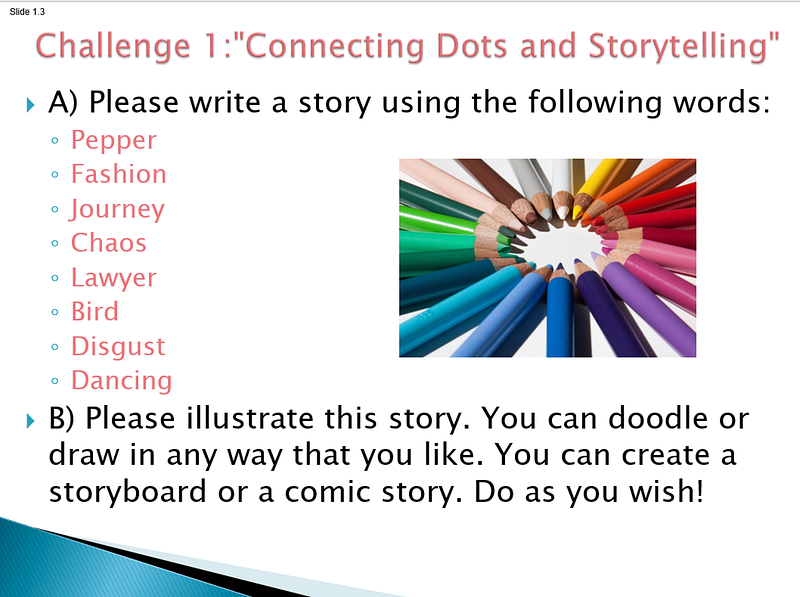
Slide Created by Author
Imagination Experiment 2: “Your Secret Gift: The Eighth Day of the Week”
Imagine that you are given an 8th day every week. This day will be your secret gift. However, this cannot be just another day. You have to do something unusual or remarkable on this day.
A) Please design this day as your ideal day. How would you make these 8th days memorable, creative, and full of adventure? You can write or draw or doodle on this as you wish.
B) This will also be a day where you have an artist’s date with yourself (See Julia Cameron’s “The Artist’s Way” to learn more about this method). Fill your day with lots of inspiration. Get inspiration from lots of sources. What could be some of these sources? Brainstorm below. You can consider places, people, films, books, artwork, travel, hobbies, theatre, museums, cafes, nature, and more.
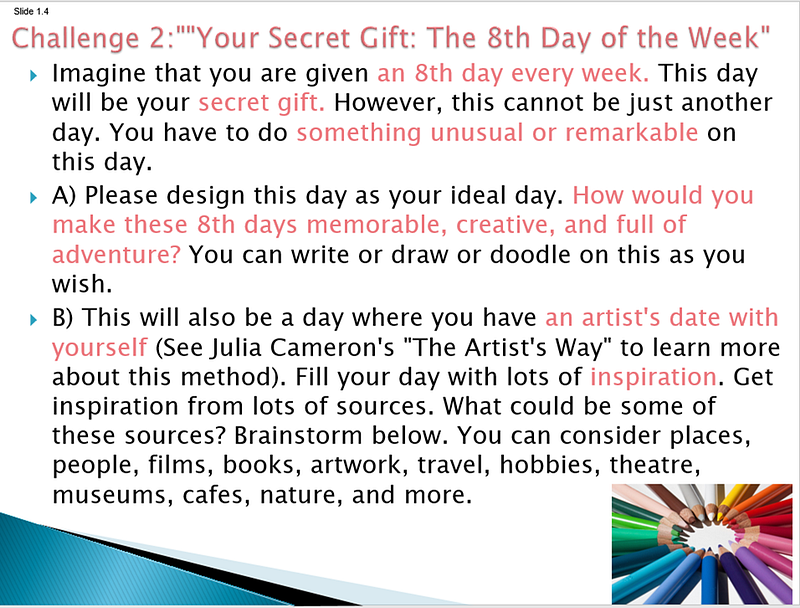
Slide Created by Author
Imagination Experiment 3: “Medium 6*6 Fantasy Adventures”
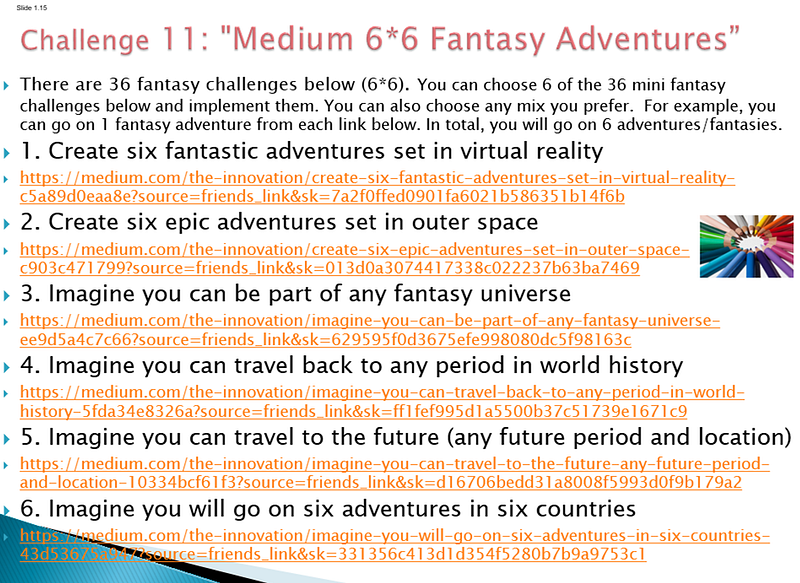
There are 36 fantasy challenges below (6*6). You can choose 6 of the 36 mini fantasy challenges below and implement them. You can also choose any mix you prefer. For example, you can go on 1 fantasy adventure from each link below. In total, you will go on 6 adventures/fantasies.
1. Create six fantastic adventures set in virtual reality
Method 2: Develop Your Creativity Through Benchmarking Inspiring and Innovative Ideas Around You
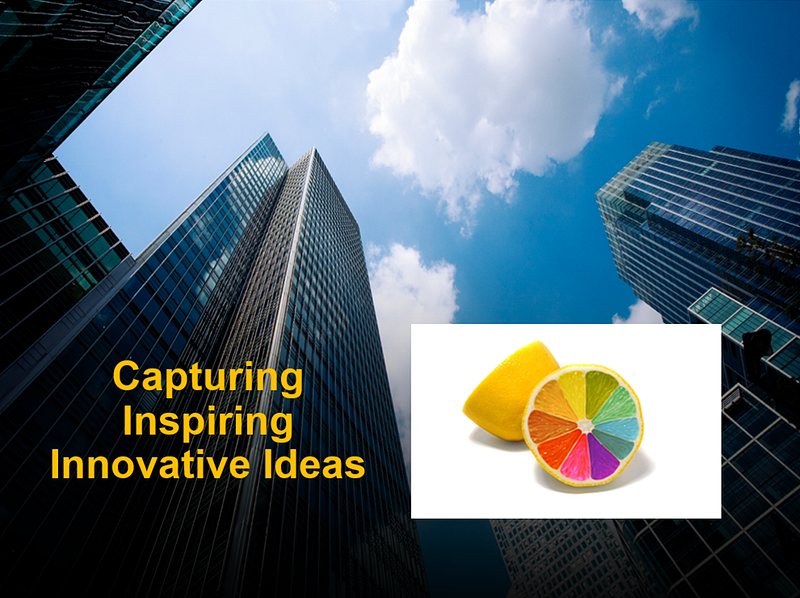
Slide Designed by Author
In this section, I ask my students to share all the creative and inspiring ideas that they have come across with one another. I ask them the following question:
What are the inspiring, innovative ideas that you have recently come across?
These might be videos, films, books, products, shows, apps, web sites, talks, or anything that inspired and excited you recently.
I start this section by sharing the things that inspired or excited me recently. For example, I am currently reading a great novel titled “Machines Like Me” by Ian McEwan.
I have also come across this Korean café which makes visitors feel as if they have stepped into a cartoon:
I also remember this amazing London theatre titled “The Curious Incident Of The Dog In The Night-time” — it was very inspiring and innovative:
Innovations do not need to be all new. Another innovation that has been running for more than 20 years is the Mamma Mia musical:
During this part, I have asked students which shows they were watching and found really exciting. A couple of my students recommended Amazon Prime’s superhero drama series titled “The Boys”.
What are the things that you have come across that have inspired or excited you? Document them. Write about them in your diary and capture your reflections.
Method 3: Develop Your Creativity Through Combining Unrelated Things
Creativity is a mindset: It involves a playful attitude to problem-solving and a willingness to explore multiple solutions. We do not need to be artists to be creative. We can be more creative in our work as professionals.
Everyone can be creative. We were wildly creative when we were children. We were always playing, experimenting, imagining, and fooling around. Through an unfortunate exposure to uniformity and standardization in our educational lives, we lost our creative souls. We lost that open, foolish, curious sense of play in our lives. We need to reclaim our own creativity. It all starts with a simple decision and some small actions that we can take in our daily lives.
We should not wait for inspiration for great ideas. Creating great ideas is a function of creating lots of ideas and connecting them together. It is not magic — it is just a lot of hard work.
To avoid mediocrity, we need to go beyond obvious and conventional answers. We need to practice generative thinking and open up the solution space as far as we can. To do this, we need to approach a problem from at least 10 different angles and perspectives. Can we reframe or restructure or redefine the problem we are trying to solve? In how many unique ways can we solve it?
How can we get free of our bias towards what is familiar and conventional?
What are some of the less obvious alternatives? How can we deepen our understanding and get to the essence of the problem? How can we connect different perspectives to arrive at a holistic solution? We are in search of varied and rich perspectives. We are searching for what is non-linear, interesting, and novel. We are also searching for a huge volume of ideas because we know that originality emerges from the sheer quantity of ideas.
Thomas Edison was immensely productive and he held more than a thousand patents. He tried to come up with a minor invention every week. Mozart composed more than 600 pieces of music. If you want to be a genius, you should try creating at least 30 ideas every day.
Most of your ideas can be crap — it is totally fine. In order to create a diamond idea, you need to deal with hundreds, thousands of charcoal ideas. Massive quantity means more chances for cross-fertilizations and novel combinations. You just randomly combine lots of ideas with other ideas. It is pure probability theory, and you are increasing your chances.
Exercise: Write a short story by connecting unrelated things
Creativity is about connecting unrelated things. Here is an exercise for you below.
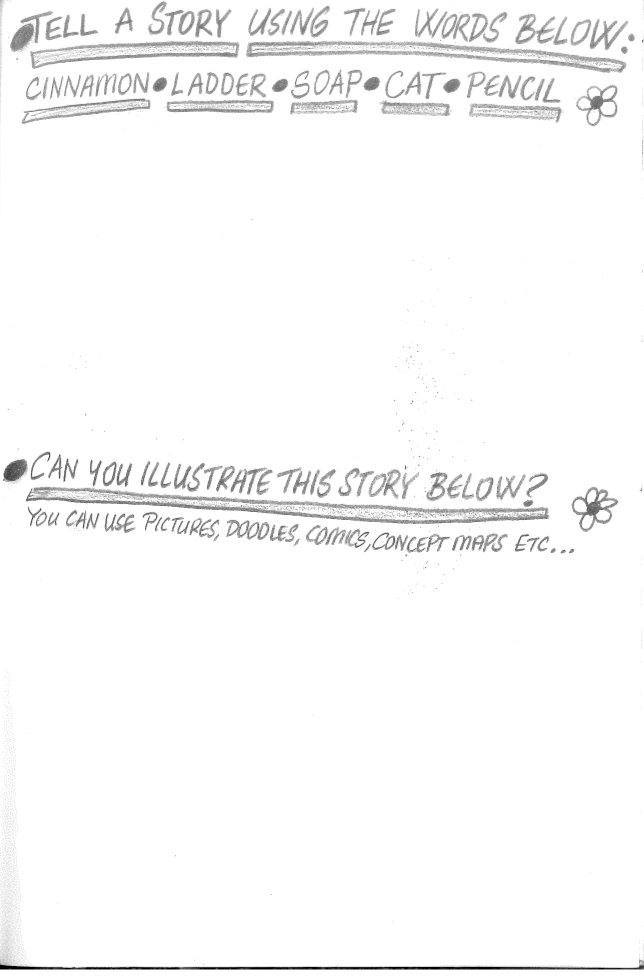
Image Created by Author
You will write a short story using the following words:
Cinnamon
Ladder
Soap
Cat
Pencil
Please make sure you use all the words in your story. You will be essentially connecting these unrelated things — and that is the very definition of creativity.
Second, after you write your story, I want you to illustrate your story.
You can use doodles, diagrams, sketch work, cartoons, concept maps, or pictures — as you like. What matters is you use a visual language to share your story. This will help you to move into a different mode of thinking. Shifting among diverse methods, and experimenting with different media will help you to get more creative.
Exercise: Create as many ideas as possible by connecting ‘pencil’ and ‘sleep’
In this exercise, you will create as many ideas as possible by connecting a pencil and sleeping. You can design new products or services, for example. Or you can create business ideas that combine these two. Your goal is quantity. Do not judge the quality of your ideas — just try to maximize them.

Image created by Author
Method 3: Develop Your Creativity Through Applying Design Thinking
Design Thinking has recently become very popular in companies as a method to advance innovation. Design thinking is used to apply human-centered techniques to solve problems in a creative and innovative way. Design Thinking is an iterative process to understand users, challenge assumptions, and redefine problems. Some of the world’s leading companies, including Apple and IDEO, are using design thinking in their approaches.
A great video to learn about design thinking is the one below. At IDEO, they use design thinking to transform and re-design the shopping cart in just five days:
If you are interested in learning more, here is a longer version of this video:
It is all based on developing an understanding of the people for whom we are designing products or services. Design Thinking is useful in tackling problems that are ill-defined or unknown, as it helps us to re-frame problems and experiment in new ways to try out fresh ideas. It is based on the following stages:
Empathize with your clients or users by immersing yourself in the field (observe and listen),
Define your client/user needs and problems, reframe them, and make sense of the issues,
Develop new insights by divergent thinking, ideating, visualizing, brainstorming, challenging assumptions, and creating ideas for innovative solutions,
Use convergent thinking to reduce ideas and experiment with them, iterate, prototype, and create solutions,
Refine and test solutions based on feedback and suggestions of users/stakeholders, and assess viability, feasibility, and desirability.
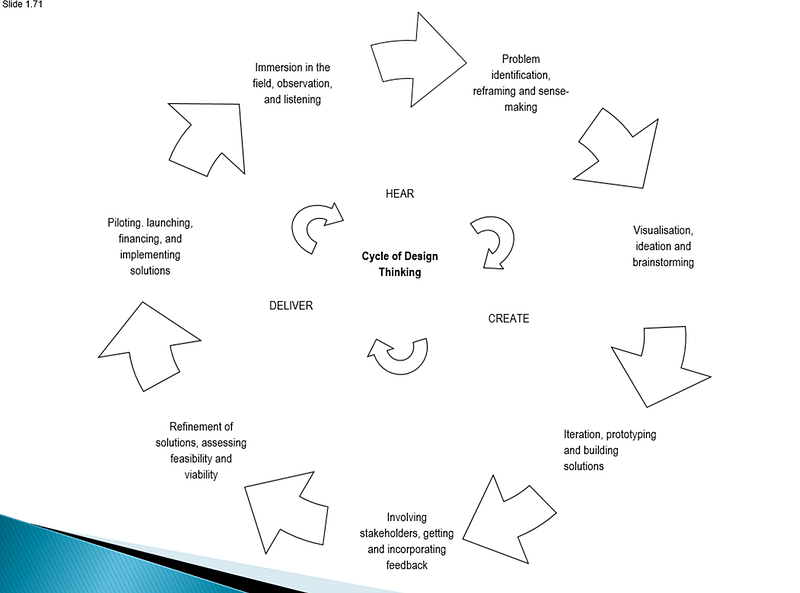
The Process of Design Thinking, Image Created by Author
At the heart of design thinking is to improve the experience of users. You can best do this by making sure that they have fun. Below are great examples of how they use this principle in action:
A similar example comes from Montreal, where they have installed 21 musical swings at the heart of the city:
Design Thinking Exercise: Design a New Wallet
In the final part of this workshop, I ask my students to design a new wallet in teams of four. They apply the principles of design thinking to design and market a new wallet. Below is the prompt for this exercise, and you can easily apply this yourself. If ‘wallet’ does not do it, you can also do this exercise for shoes, umbrellas, or hats.
“You are the younger generation and heir of a traditional family business. Your company produces and sells wallets.
The sales have recently dropped and the company needs to come up with innovations in this product line in order to survive.
Your task is to use design thinking principles, methods, and practices to come up with a new conception of a wallet.
Think about both form and functionality of a wallet: Why and how do we use it? How can you innovate in this product line?
Think about your target segment. Who are your customers? How will you reach them? What is the story you will tell them?
What is the brand name? What is your slogan?
How can you market and sell it? Imagine that you are selling this idea on Shark Tank. Please prepare a 3-minute pitch for your idea.
What is the price? Why should we buy it?”
Students then prepare a pitch and try to sell their products to the class, using their posters and ideas.
Conclusion:
As you see, we have come up with a lot of exercises and resources to develop your own creativity. Now, it is up to you. Think about the power of being able to generate 100 ideas every day. You can dramatically increase the quality of your life if you train your brain as an idea generation machine. Try to make it a habit to create 100 ideas every day — this is immensely powerful. The sheer volume of what you create matters. For example, if you are passionate about creating doodles, try to create hundreds of them.
The best innovations always come from the outside, not inside a discipline. The best ideas always come from the outside of your organization, not inside. Build new bridges and imagine new connections. To keep doing this, you need to keep learning new things every day. You can tap into diverse sources of inspiration, including films, books, animation, comics, dance, performance, visual arts, paintings, theatre, improvisation, fashion, design, sports, pop culture, entrepreneurship, brands, magazines, trend reports, science fiction, start-ups, innovation, and technology.
Take-aways:
In order to find fresh ideas, try to be a hunter and learner of the most interesting things.
Cross boundaries — there are no borders.
Go out of your comfort zone. Learn outside your discipline. Think and act wider.
To solve the wicked problems of the 21st century, you need to think beyond borders and disciplines.
Invest in yourself and your learning every day. This is the biggest investment you can ever make.
You can get inspiration from 100 different people and 100 different fields. And then imagine you are a farmer and you are growing 100 creative projects: Let 100 flowers bloom at once.
You need sheer volume and sheer diversity in your ideas. In order to achieve this, you need to read hundreds of books and articles beyond your narrow domain.
Be a polymath: An individual whose knowledge spans a significant number of subjects, known to draw on complex bodies of knowledge to solve specific problems.
Be an autodidact: A self-taught person individual who initiates and manages his/her own learning and reads voraciously.
Try combining your polymath skills with autodidact skills. Then, you will be a renaissance person.
Capture all your ideas in your diary. Your diary is a seed catalog of all your ideas. Write, draw, reflect, capture your ideas every day.
We live in an imagination economy. Ideas are the new currency. Your attention (i.e. your time) is the most precious thing in the world.
To manage yourself and your energy, you need to regularly write down your ideas and keep a journal.
You need to combine your ideas and cross-pollinate them.
Think of yourself as a gardener. You are growing lots of ideas in your mind (soil). Each of your ideas is like a seed. You need diverse ideas (seeds) — you will plant them all in your garden (diary/journal).
You will record all your emerging ideas, thoughts, and reflections. You will then try to combine and grow them into bigger ideas. You will iterate your ideas and solutions into prototypes.
Sharpen your skillset and keep experimenting. Keep producing the best work you can. Work hard. Be consistent. Repeat.
Aim for fruitfulness and abundance. Produce more ideas than you need.
Combine them with other ideas. And then share your creations with the world. Connecting things together is a super-power. Claim yours.
Fahri Karakas is the author of Self-making Studio. You can explore more here.