_source=medium&utm_medium=referral">Unsplash</a></figcaption></figure><p id="07c1">In this challenge, imagine that you are a game designer. You will create six fantastic adventures in computer games or virtual worlds. You can decide to create an adventure in virtual reality or augmented reality worlds, for example.</p><figure id="7988"><img src="https://cdn-images-1.readmedium.com/v2/resize:fit:800/1*hTiNwSjqJZ0n2FepgJO1GA.png"><figcaption>Image created by Author</figcaption></figure><p id="5777">How will you do this?</p><p id="89d0">First, you need to loosen up. Do not judge your ideas. Make sure you do this for fun. You can be naive, goofy, and foolish as you experiment with ideas. No one will judge you (including yourself).</p><p id="a185">Second, you can benefit a lot from a crash course on creating video game stories and scenarios. Please check out the following resources for guidance and inspiration:</p><div id="fdb9" class="link-block">
<a href="https://www.polygon.com/features/2019/1/10/18165611/how-to-write-a-video-game-story-narrative-building-tips">
<div>
<div>
<h2>How to write a video game story</h2>
<div><h3>My first attempt at writing a video game script begins with the socialist journalist and activist Marina Ginestà, a…</h3></div>
<div><p>www.polygon.com</p></div>
</div>
<div>
<div style="background-image: url(https://miro.readmedium.com/v2/resize:fit:320/0*0LIWlLpwIdqFxNnQ)"></div>
</div>
</div>
</a>
</div><div id="8dde" class="link-block">
<a href="https://www.gamedesigning.org/gaming/game-ideas/">
<div>
<div>
<h2>10 Tips for Coming Up With Awesome Game Ideas</h2>
<div><h3>Time to start your first game! Let's go! You need good ideas for a video game. What? Don't you know where to start…</h3></div>
<div><p>www.gamedesigning.org</p></div>
</div>
<div>
<div style="background-image: url(https://miro.readmedium.com/v2/resize:fit:320/0*IWKKxCiYDiKjymV8)"></div>
</div>
</div>
</a>
</div><div id="9262" class="link-block">
<a href="https://www.wikihow.com/Design-a-Video-Game">
<div>
<div>
<h2>How to Design a Video Game</h2>
<div><h3>Now is pretty much the best time there's ever been to be a game developer. The market is extremely open to newcomers…</h3></div>
<div><p>www.wikihow.com</p></div>
</div>
<div>
<div style="background-image: url(https://miro.readmedium.com/v2/resize:fit:320/0*drsuEMOn04Kpx4cU)"></div>
</div>
</div>
</a>
</div><div id="6cba" class="link-block">
<a href="https://www.gamedesigning.org/learn/storytelling/">
<div>
<div>
<h2>The Ultimate Guide to Video Game Storytelling</h2>
<div><h3>Coming up with a story is a deceptively complex challenge. You're developing a game and your game needs a story. Ok…</h3></div>
<div><p>www.gamedesigning.org</p></div>
</div>
<div>
<div style="background-image: url(https://miro.readmedium.com/v2/resize:fit:320/0*wYYrOqJCHwnPa9A6)"></div>
</div>
</div>
</a>
</div><div id="8872" class="link-block">
<a href="https://paladinstudios.com/2012/08/06/how-to-write-a-good-game-story-and-get-filthy-rich/">
<div>
<div>
<h2>How To Write A Good Game Story</h2>
<div><h3>Stories are an essential part of games. Surely there are games that don't seem to have a story - but if you look…</h3></div>
<div><p>paladinstudios.com</p></div>
</div>
<div>
<div style="background-image: url(https://miro.readmedium.com/v2/resize:fit:320/0*K-o85YNHAle98yvW)"></div>
</div>
</div>
</a>
</div>
<figure id="cbe5">
<div>
<div>
<img class="ratio" src="http://placehold.it/16x9">
<iframe class="" src="https://cdn.embedly.com/widgets/media.html?src=https%3A%2F%2Fwww.youtube.com%2Fembed%2FwNNXdoj7cCQ%3Ffeature%3Doembed&display_name=YouTube&url=https%3A%2F%2Fwww.youtube.com%2Fwatch%3Fv%3DwNNXdoj7cCQ&image=https%3A%2F%2Fi.ytimg.com%2Fvi%2FwNNXdoj7cCQ%2Fhqdefault.jpg&key=a19fcc184b9711e1b4764040d3dc5c07&type=text%2Fhtml&schema=youtube" allowfullscreen="" frameborder="0" height="480" width="854">
</div>
</div>
</figure></iframe></div></div></figure>
<figure id="4719">
<div>
<div>
<img class="ratio" src="http://placehold.it/16x9">
<iframe class="" src="https://cdn.embedly.com/widgets/media.html?src=https%3A%2F%2Fwww.youtube.com%2Fembed%2FZQTQSbjecLg%3Ffeature%3Doembed&display_name=YouTube&url=https%3A%2F%2Fwww.youtube.com%2Fwatch%3Fv%3DZQTQSbjecLg&image=https%3A%2F%2Fi.ytimg.com%2Fvi%2FZQTQSbjecLg%2Fhqdefault.jpg&key=a19fcc184b9711e1b4764040d3dc5c07&type=text%2Fhtml&schema=youtube" allowfullscreen="" frameborder="0" height="480" width="854">
</div>
</div>
</figure></iframe></div></div></figure>
<figure id="edec">
<div>
<div>
<img class="ratio" src="http://placehold.it/16x9">
<iframe class="" src="https://cdn.embedly.com/widgets/media.html?src=https%3A%2F%2Fwww.youtube.com%2Fembed%2FQrvdEJElyVQ%3Ffeature%3Doembed&display_name=YouTube&url=https%3A%2F%2Fwww.youtube.com%2Fwatch%3Fv%3DQrvdEJElyVQ&image=https%3A%2F%2Fi.ytimg.com%2Fvi%2FQrvdEJElyVQ%2Fhqdefault.jpg&key=a19fcc184b9711e1b4764040d3dc5c07&type=text%2Fhtml&schema=youtube" allowfullscreen="" frameborder="0" height="480" width="854">
</div>
</div>
</figure></
Options
iframe></div></div></figure>
<figure id="7bb1">
<div>
<div>
<img class="ratio" src="http://placehold.it/16x9">
<iframe class="" src="https://cdn.embedly.com/widgets/media.html?src=https%3A%2F%2Fwww.youtube.com%2Fembed%2FRwlnCn2EB9o%3Ffeature%3Doembed&display_name=YouTube&url=https%3A%2F%2Fwww.youtube.com%2Fwatch%3Fv%3DRwlnCn2EB9o&image=https%3A%2F%2Fi.ytimg.com%2Fvi%2FRwlnCn2EB9o%2Fhqdefault.jpg&key=a19fcc184b9711e1b4764040d3dc5c07&type=text%2Fhtml&schema=youtube" allowfullscreen="" frameborder="0" height="480" width="854">
</div>
</div>
</figure></iframe></div></div></figure>
<figure id="e9c6">
<div>
<div>
<img class="ratio" src="http://placehold.it/16x9">
<iframe class="" src="https://cdn.embedly.com/widgets/media.html?src=https%3A%2F%2Fwww.youtube.com%2Fembed%2FNyMndWpihTM%3Ffeature%3Doembed&display_name=YouTube&url=https%3A%2F%2Fwww.youtube.com%2Fwatch%3Fv%3DNyMndWpihTM&image=https%3A%2F%2Fi.ytimg.com%2Fvi%2FNyMndWpihTM%2Fhqdefault.jpg&key=a19fcc184b9711e1b4764040d3dc5c07&type=text%2Fhtml&schema=youtube" allowfullscreen="" frameborder="0" height="480" width="854">
</div>
</div>
</figure></iframe></div></div></figure><h1 id="1c6f">Today’s Challenge</h1><p id="9e4c">Now, it is your turn to create your own ideas.</p><p id="db72">You will now create fantastic adventures in computer games or virtual worlds.</p><p id="4f10">Imagine that you are a game designer. You will be building fictional universes that are compelling and exciting.</p><p id="821c">You will create a story where the player will be the hero and this hero will go on a transformative journey.</p><p id="4c43">To create a compelling journey, you can use Joseph Campbel’s “<i>The Hero’s Journey</i>” framework in his famous classic <a href="https://www.amazon.co.uk/Thousand-Faces-Collected-Joseph-Campbell/dp/1577315936/"><i>The Hero with a Thousand Faces</i></a><i>. </i>In this framework, the hero:</p><ul><li>responds to a call of adventure,</li><li>departs the familiar world behind,</li><li>ventures into an unfamiliar world of adventure,</li><li>experiences failures and hits rock bottom,</li><li>goes through a series of tests and trials,</li><li>sacrifices the self,</li><li>proves own character, and</li><li>comes back to the hometown after experiencing all the adventures and bringing back the wisdom/learning from the journey.</li></ul><figure id="690b"><img src="https://cdn-images-1.readmedium.com/v2/resize:fit:800/0*qMTcVn0_EsJoX5X-.png"><figcaption>Image Credit: <a href="https://commons.wikimedia.org/wiki/File:Heroesjourney.svg">Heroesjourney.svg</a></figcaption></figure><p id="a908">As you design your game, think of the player as the hero. There is a call to adventure in your game — what is it?</p><p id="d27c">How does the player leave familiar territory behind and set sail to new horizons which are full of unknowns and surprises?</p><p id="ce7f">How does your player/character grow? Growth comes from leaving comfort behind and navigating uncertainty.</p><p id="c60a">You can use the following points to create your game:</p><ol><li>Describe the fictional universe and the context.</li><li>Think about the overall storyline and how it progresses.</li><li>Describe the journey: What is the problem? Where is the call to adventure?</li><li>Describe the unknowns and the challenges the player needs to go through.</li><li>Describe the overall goal/mission of the player. Define success and failure.</li><li>Incorporate surprises and twists along the way — create a compelling story. Create some risks and rewards.</li><li>Describe different characters the player will come across during the journey.</li><li>What happens when the player fails? What are the lessons to be learned? How can the player improve in the next attempt? How will you give feedback during the game?</li><li>Think of a compelling and satisfying finale to the game.</li></ol><p id="254a">Are you ready?</p><p id="27da">This is now your turn.</p><p id="cc58">You will create 6 different game ideas and sketch an outline of key ideas for each game.</p><p id="a372">You do not need to aim for fully developed games. You just need to write a minimum viable game idea. Do not judge or evaluate your ideas — just keep writing. Keep writing for about 5 minutes to create your game ideas.</p><p id="1af4">Do not stop writing. Imagine that your hands have their own imagination and trust them. Keep your hands moving. Do not think too hard. Make it fast and practical. Do not aim for perfect games. Good enough is fine. Just an overall idea is fine.</p><p id="832d">Remember: You are doing this just to have fun. This is meant to be for fun. Just play and mess around. Improvise. Try to surprise yourself and your brain.</p><figure id="a4e9"><img src="https://cdn-images-1.readmedium.com/v2/resize:fit:800/1*hTiNwSjqJZ0n2FepgJO1GA.png"><figcaption>Image created by Author</figcaption></figure><p id="b138">Whatever it is you want, you can use your imagination to achieve it.</p><p id="27d9">Life is all about creating your own games and playing these games.</p><p id="186b">Create the games that you will really enjoy.</p><p id="9f67">Let me finish with two quotes on games:</p><p id="9b52" type="7">“Games were not just a diversion, I realized. Games could make you feel. If great literature could would its power through nothing but black squiggles on a page, how much more could be done with movement, sound, and color?”</p><p id="5c5a" type="7">― Sid Meier, Sid Meier’s Memoir: A Life in Computer Games</p><p id="8a58" type="7">“A game is an opportunity to focus our energy, with relentless optimism, at something we’re good at (or getting better at) and enjoy. In other words, gameplay is the direct emotional opposite of depression.”</p><p id="4909" type="7">― Jane McGonigal, Reality is Broken: Why Games Make Us Better and How They Can Change the World</p><p id="aa75">Sincerely;</p><p id="f526">Fahri</p><h2 id="d0cd">Fahri Karakas is the author of the Self-making Studio. You can explore more here.</h2></article></body>
6*6 Fantasy Series — 1
Create six fantastic adventures set in virtual reality
Creating your own computer game or universe is your super-power
As we move away from our childhood, we lose a lot in our lives, including:
our sense of wonder and curiosity,
our sense of play,
our sheer power of creativity and imagination,
the willingness to try out new things (experimentation), and
the ability to take ourselves less seriously.
How do we regain these capabilities in our adult lives?
We need to establish our own game in our lives.
If we approach our lives as a game, we can increase our rates of experimentation and success.
Gamifying our lives will increase our quality of life. When we lose, we will start again. When we make mistakes, we will try again and get better. We will not be so fearful of failure.
Gamers do not give up. We will not give up — we will try harder after failures. We will double down and learn from our mistakes before attempting the same scenario again.
When we play games, we feel that we are on the verge of learning, discovery, and victory. This gives us momentum. We try many times more when we are playing — that should also be our real-life attitude.
Look at the life of Tyler Blevins or Ninja. He is a professional gamer and YouTuber. Ninja makes 500 thousand dollars every month through playing games, entering tournaments, and live streaming his games on Twitch and YouTube. Time Magazine has chosen him as one of the most influential people (Time 100).
When we approach life as a gamer,
we will focus on our larger vision and goal to make progress on the game,
we will not be obsessed with other metrics such as status but focus on the larger meaning or calling or the quest of life,
we will work intensively and passionately towards our goals and spend hours to reach them,
we will get right into the action instead of planning.
As we reach our goals, we get rewarded by dopamine and try harder to continue our journey. In life, we can also celebrate our small wins to make further progress. As we level up, we gain experience and challenge ourselves to be better. We adapt to new circumstances in each level as things get harder.
Approaching life as a game has its own advantages after all.
Even more significant is the ability to dream and design your own game in life. This requires courage and imagination in high-resolution. It is important that we dream big dreams at 1080p or higher.
It is not sufficient to want to be rich, for example. You need to think about a specific amount of money (such as $2 million) and what you would like to do with it. Then, you would start thinking of various ideas, methods, and actions on how to get there. You would start with the minimum viable actions that are practical, such as saving from your salary, paying off your student debt, creating multiple streams of income, and creating your own assets for the longer term.
All of this comes to the sheer power of your imagination and play. You need to increase your capacity for imagination 10 times, and then 100 times more. Imagination is the multiplier force that you need to create amazing things in your life and your career. You need to start your own game and get better at playing that game every day.
Kickstarting 6*6 Fantasy Series
I am excited to introduce a new series bridging the worlds of creativity, games, fantasy, and imagination.
It is called 6*6 Fantasy Series.
In this series (6*6), I will design and present you 6 imagination adventures or fantasy challenges. I will be developing these challenges in real-time during the month of August.
The goal of these adventures is to help you expand your muscles of imagination through designing new games, worlds, universes, or stories.
Adventure 1: Create six fantastic adventures set in virtual reality

In this challenge, imagine that you are a game designer. You will create six fantastic adventures in computer games or virtual worlds. You can decide to create an adventure in virtual reality or augmented reality worlds, for example.
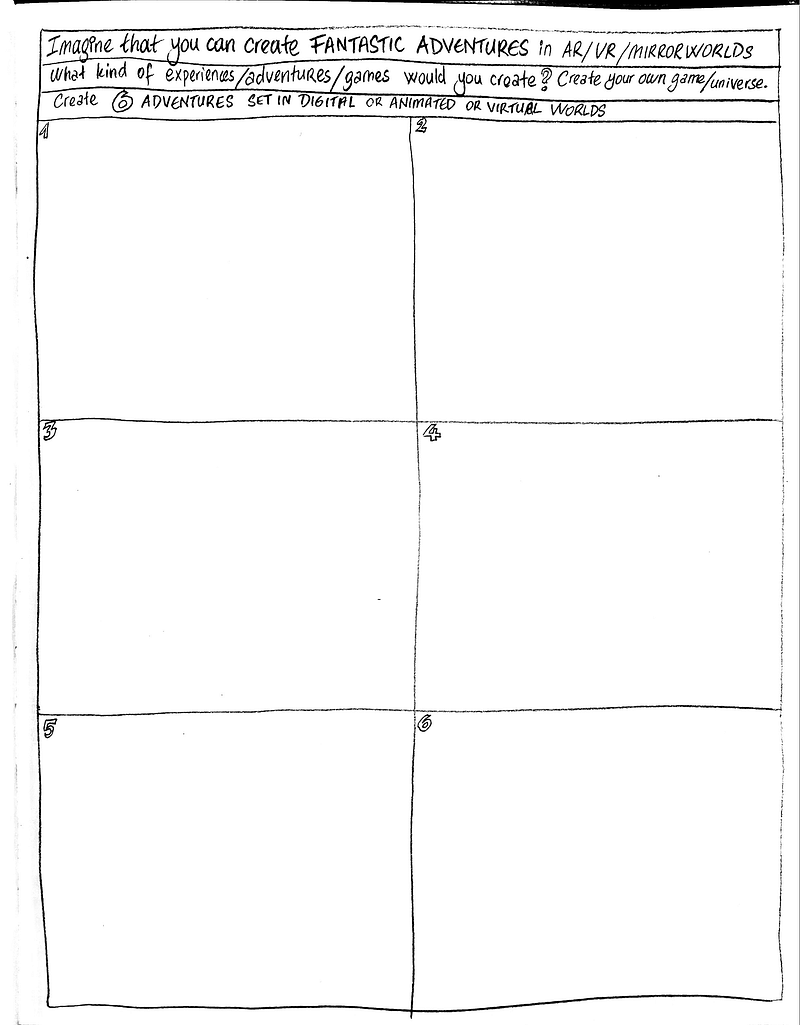
Image created by Author
How will you do this?
First, you need to loosen up. Do not judge your ideas. Make sure you do this for fun. You can be naive, goofy, and foolish as you experiment with ideas. No one will judge you (including yourself).
Second, you can benefit a lot from a crash course on creating video game stories and scenarios. Please check out the following resources for guidance and inspiration:
You will now create fantastic adventures in computer games or virtual worlds.
Imagine that you are a game designer. You will be building fictional universes that are compelling and exciting.
You will create a story where the player will be the hero and this hero will go on a transformative journey.
To create a compelling journey, you can use Joseph Campbel’s “The Hero’s Journey” framework in his famous classic The Hero with a Thousand Faces. In this framework, the hero:
responds to a call of adventure,
departs the familiar world behind,
ventures into an unfamiliar world of adventure,
experiences failures and hits rock bottom,
goes through a series of tests and trials,
sacrifices the self,
proves own character, and
comes back to the hometown after experiencing all the adventures and bringing back the wisdom/learning from the journey.

As you design your game, think of the player as the hero. There is a call to adventure in your game — what is it?
How does the player leave familiar territory behind and set sail to new horizons which are full of unknowns and surprises?
How does your player/character grow? Growth comes from leaving comfort behind and navigating uncertainty.
You can use the following points to create your game:
Describe the fictional universe and the context.
Think about the overall storyline and how it progresses.
Describe the journey: What is the problem? Where is the call to adventure?
Describe the unknowns and the challenges the player needs to go through.
Describe the overall goal/mission of the player. Define success and failure.
Incorporate surprises and twists along the way — create a compelling story. Create some risks and rewards.
Describe different characters the player will come across during the journey.
What happens when the player fails? What are the lessons to be learned? How can the player improve in the next attempt? How will you give feedback during the game?
Think of a compelling and satisfying finale to the game.
Are you ready?
This is now your turn.
You will create 6 different game ideas and sketch an outline of key ideas for each game.
You do not need to aim for fully developed games. You just need to write a minimum viable game idea. Do not judge or evaluate your ideas — just keep writing. Keep writing for about 5 minutes to create your game ideas.
Do not stop writing. Imagine that your hands have their own imagination and trust them. Keep your hands moving. Do not think too hard. Make it fast and practical. Do not aim for perfect games. Good enough is fine. Just an overall idea is fine.
Remember: You are doing this just to have fun. This is meant to be for fun. Just play and mess around. Improvise. Try to surprise yourself and your brain.
Image created by Author
Whatever it is you want, you can use your imagination to achieve it.
Life is all about creating your own games and playing these games.
Create the games that you will really enjoy.
Let me finish with two quotes on games:
“Games were not just a diversion, I realized. Games could make you feel. If great literature could would its power through nothing but black squiggles on a page, how much more could be done with movement, sound, and color?”
― Sid Meier, Sid Meier’s Memoir: A Life in Computer Games
“A game is an opportunity to focus our energy, with relentless optimism, at something we’re good at (or getting better at) and enjoy. In other words, gameplay is the direct emotional opposite of depression.”
― Jane McGonigal, Reality is Broken: Why Games Make Us Better and How They Can Change the World
Sincerely;
Fahri
Fahri Karakas is the author of the Self-making Studio. You can explore more here.