
Machine Learning Art / Diffusion models
Create unique portraits using the power of AI (FREE)
the current state-of-the-art generative models. DEMO + CODE
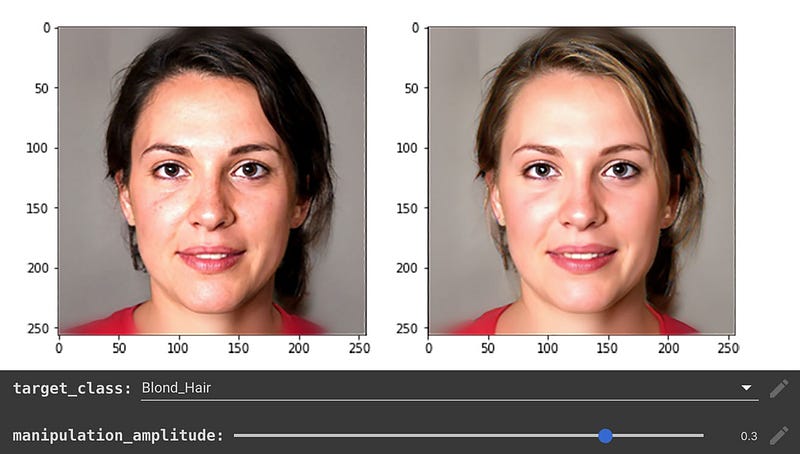
- April 2022 — AI art tools update can be found ➡️ HERE ⬅️
In recent years, generative models have improved their capacity to produce human-like natural language GPT3 and limitless high-quality synthetic pictures. wavenet; jukebox; biggan; stylegan3; and very diversified human speech and music wavenet. These models may be used to generate graphics from text prompts DALL-E 2 or to learn valuable feature representations bigbigan; among other things. While these models can already produce realistic visuals and sounds, there is still a lot of space for development beyond the present state-of-the-art. Improved generative models might greatly influence graphic design, gaming, music creation, and many other industries.
AI image generator online (FREE)
Diffusion Models Beat GANs
While GANs are the most advanced, they have limitations that make them difficult to scale and apply to new areas. As a result, much work has gone into developing likelihood-based models like vqvae2; ddpm; dctransformer; vdvae to obtain GAN-like sample quality. Diffusion models are a type of likelihood-based model that has recently been proven to create high-quality photos. dickstein; ddpm; scorematching while providing desirable features like distribution coverage, a fixed training target, and simple scaling. The training target of these models is a reweighted variational lower-bound ddpm, and they create samples by gradually reducing noise from a signal. The authors discovered that these models improve reliably with more computing and that by employing an upsampling stack, they can provide high-quality samples even on the challenging ImageNet 256x256 datasets.
the article is a summary of the paper — Project Page (scroll down)
AI portrait generator
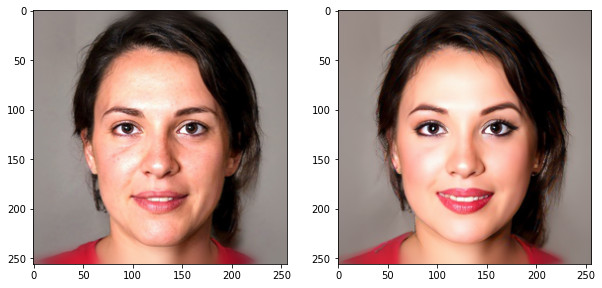

AI created art
Using a new diffusion model, the timesteps required to obtain high-quality samples were decreased. According to the authors, diffusion autoencoders can extract both semantics and stochastic information from an input picture. These qualities make it possible to solve various real-image editing problems without the need for GANs or their error-prone inversion. In addition, their system enhances denoising efficiency while maintaining competitive unconditional DPM sampling.
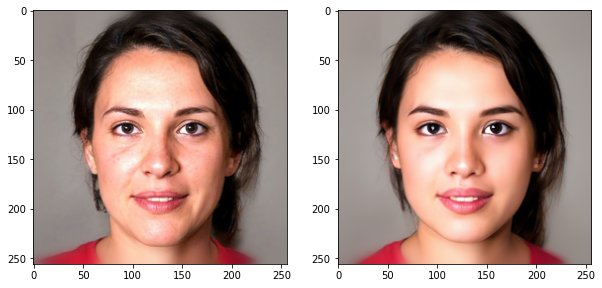

Attribute manipulation on real portraits
Local aspects, such as the mouth, can be changed while the remainder of the image and details remain unchanged. The researchers’ findings appear to be highly credible and practical for global qualities that entail modifying numerous traits, such as aging.
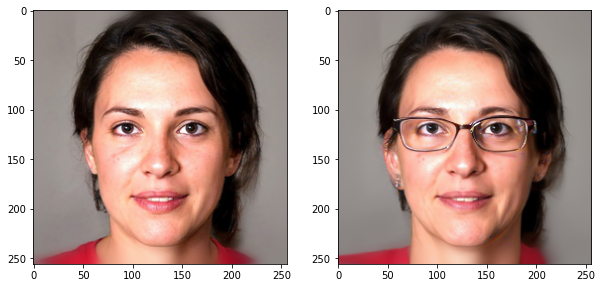

Synthetic media, such as deepfakes, can be created with the ability to produce image patterns and alter the properties of an actual image. I am aware of the possible negative consequences; in my case, inevitably, I will never wear glasses as they would age me prematurely; but I will consider blonde hair ; )
@inproceedings{preechakul2021diffusion,
      title={Diffusion Autoencoders: Toward a Meaningful and Decodable Representation},
      author={Preechakul, Konpat and Chatthee, Nattanat and Wizadwongsa, Suttisak and Suwajanakorn, Supasorn},
      booktitle={IEEE Conference on Computer Vision and Pattern Recognition (CVPR)},
      year={2022},
}
Project Page:
https://arxiv.org/pdf/2111.15640.pdf
DEMO for Colab:
https://github.com/phizaz/diffae
Keywords: computer vision, Artificial Intelligence, image for manipulation, datasets, Machine Learning, AI art, art, digital art, Manipulate the uploaded image, generative art, diffusion model, Pattern Recognition, Diffusion Autoencoders, Synthetic media, deepfake
I invite you to explore the concept of “AI creativity” by reading and learning from the many articles found on 🔵 MLearning.ai 🟠
- Check out my instagram with new material every week
- If you enjoyed this, follow me on Medium for more
- Want to collaborate? Let’s connect on LinkedIn
- https://linktr.ee/evartology
Data Scientists must think like an artist when finding a solution when creating a piece of code. Artists enjoy working on interesting problems, even if there is no obvious answer.
All our writers (members) receive the opportunity to be promoted on our social media, which increases the popularity of articles published on MLearning.ai


