
Create More Professional Freedom with 3 Simple Lifestyle Shifts
#2. Determine what spending actually feels right.

Laying on my bed on a Tuesday afternoon, my head felt dizzy. My boss wanted to promote me. I would gain more money, social status, impressive projects, and excellent benefits. An hour later, I sent in my resignation notice.
Despite having worked hard for that promotion, I knew what I really needed was a break. I had been burning out, and deep down, I knew I needed time to reflect, reconnect with myself, and do inner work.
Through a minimalist lifestyle and intentional finances, I had saved enough money to take at least eight months off.
One-by-one, I had that last conversation with different coworkers, and to my surprise, many of them seemed jealous: “Good for you! I wish I could do that.” “But you can…” I wanted to say.
Leading up to that choice, I have been pursuing simplicity for seven years, starting with clearing out my closet in college and reading minimalist blogs to exploring personal finance books. I wanted my life to feel more intuitive.
“Hard choices, easy life. Easy choices, hard life,” said Jerzy Gregorek. The decisions to let go or make counter-cultural choices are not easy. This journey has forced me to be honest with myself, and it’s worth it.
What if you could feel happier and more whole with less? What if you could determine exactly how much money you actually need to feel fulfilled? What if you could spend tons of money on what you love without feeling guilty?
You can.
Here’s a step-by-step guide to intentional living for financial freedom.
- Clear out your unnecessary things. You can use and enjoy things without feeling guilty or overwhelmed by them. I’ll share expert-backed questions that help me to feel aligned with my physical possessions.
- Determine what spending actually feels right. Our time is our most precious resource, and we trade most of it for money. By reflecting on the actual cost of our purchases, we can align spending to personal fulfillment.
- Increase spending on what you love. Sometimes money does buy happiness, and that path looks different for each person. Increasing spending in these categories is easier than you’d imagine.
Like me, many of you have been burned out or over-worked. We take jobs to prove ourselves or finally believe that we’re enough. Our capitalist culture convinces us that we’d be prettier, smarter, and more loved with more things.
The message of “less is more” feels counterintuitive, yet the minimalist trend is growing, helping people feel happier and fulfilled. We’re not trying to be “cheap” or “frugal.” We are pursuing a life full of authenticity and clarity.
#1. Clear out your unnecessary things.
When we live more intentional, simple lives, we let go of the pressure to impress others with our things or to match celebrity lifestyles.
Instead, we create time, space, and clarity to fill our lives with what resonates the most. Whether you want a more fulfilling career path, time to reflect, or energy to finally start playing tennis, decluttering will help.
We attach a lot of emotions to our items, and we all have different reasons for accumulating them in the first place. Maybe you kept that shirt because your mom bought it for you — even though you secretly hate it. Maybe you keep this massive sewing kit because you convinced yourself that you would eventually start knitting.
I think of decluttering as removing the unnecessary so that we have more space for the necessary. It’s not about having a perfect white home with one plant and an empty desk. It’s about being intentional about what you do own and giving everything a home.
When it comes to getting started, Marie Kondo — a Japanese organizing consultant, author, and TV show host — suggests clearing up your space category by category, i.e., clothes, books, papers, kitchen supplies.
Here are some questions I use to remove the unnecessary:
- Is this something I could buy for under $20 in 20 minutes?
- Have I used this in the last 6 months?
- Does this spark joy? (holding the item to your heart helps)
- Is this beautiful or useful?
- Do I already have multiple of this item?
- Would I repurchase this if I didn’t already own it?
- What is this item actually costing me? (i.e., maintenance cost, space cost, storage fees, etc.)
- Can this serve multiple purposes?
- Is it light and travel-friendly?
This quote from The Minimalists puts it into perspective for me: “Love people and use things because the opposite never works.” Your items are here to support the lifestyle you love, not to hold you back.
Make the journey your own. There are many fun and social ways to get started, i.e., challenging your friends to get rid of more things or doing Courtney Carver’s Project 333 capsule wardrobe challenge. You can also get ideas and regular inspiration from Matt D’Avela, Minimalist Filmmaker, and Joshua Becker, founder of Becoming Minimalist.
#2. Determine what spending actually feels right.
A few years ago, I read the classic personal finance book “Your Money or Your Life” by Vicki Robin, and it completely reframed my relationship with time and money. We didn’t always work 40-hour workweeks, and it’s absurd that it’s an expectation now.
Though the book includes seven steps, I found that these two tools are staples for me. I have been doing these two things for over one year, and I feel far more fulfilled in my purchases. Plus, I know what monthly income I need to experience fulfillment. That’s huge! This knowledge has already created opportunities for me to choose work that feels more authentic.
1. Track every penny you spend.
I use a Google Sheet with a tab for each month. I put spending categories in vertical columns with sums at the bottom, and I put reflection questions in horizontal rows. Here’s what that might look like:
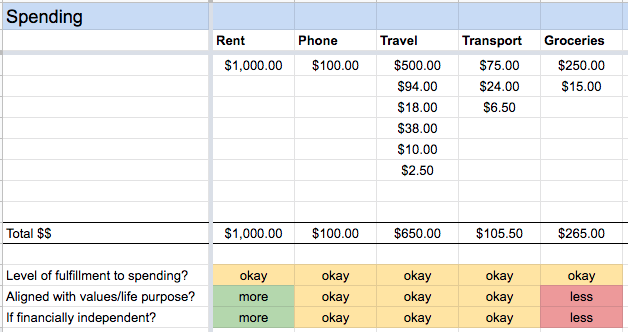
Seeing your spending in black and white can bring up feelings. For example, I felt really embarrassed about all the convenience spending I was doing one month. Pretty sure I cried. The emotional journey is part of the process. Tracking your spending helps you see what feels aligned and what doesn’t, and it feels rewarding to watch that change with time.
2. Reflect monthly on your spending.
By reflecting regularly, you can develop an internal yardstick for fulfillment. How do you feel about this purchase? Does this spending align with your values?
I’ve been doing this for over a year, and I still ask these three questions each month:
- What was my level of fulfillment from this spending?
- Does this spending align with my personal values and life purpose?
- If I was financially independent, how would that impact this spending? (having income without having to work full-time)
Then, as shown above, I fill them in with a simple “more,” “less,” or “okay.” I often include comments and ideas in the spreadsheet during this process.
Using these two tools, I gained clarity on what spending actually feels right for me. I know exactly how much I need and want per month, and I avoided the lifestyle creep that often happens when you get that high-paying job.
Peter Adeney, known for his website “Mr. Money Mustache,” wrote a blog about the “Your Money or Your Life” book, highlighting in more detail how the tools of this book can move you towards financial independence.
#3. Increase spending on what you love.
Once you know what you’re spending money on and what feels authentically fulfilling, you can create more excitement in your spending.
Bestselling author Ramit Sethi suggests an approach called “Money Dials” in his book “I Will Teach You To Be Rich.” The tool helps you to “spend extravagantly, guilt-free.”
Here are the basic steps for using “money dials”:
- Figure out which categories you love spending money in: Maybe you absolutely love spending money on travel, convenience, or health/ fitness. If you’re unsure, evaluate your spending records and calendar plans. I mistyped myself originally, then realized I genuinely love spending money on self-improvement and relationships.
- Reduce spending in all other categories: Spending money should be about expressing and enjoying our lives, not about impressing other people. For example, if you’re not excited about going to fancy restaurants or having name-brand clothes, cut costs there. I realized I had been spending money on going out to eat because I felt like that’s what everyone else does. Getting clear about what I actually enjoy spending money on gave me the courage to get creative and make adjustments.
- Brainstorm ways to 10x spending on what you love: Each month, I imagine I had 10 times more money to spend on self-improvement and relationships. Then, I make a list of specific ideas for expanding these categories. You often find ways to start doing and having what you dream about right now. For example, I dreamed about having 1:1 guidance for several skills I was working on, and then I found Masterclass — For $180 per year, you get direct guidance and feedback from A-list celebrities and experts in hundreds of topics. (Not affiliated)
Your dreams are often more accessible than you realize. When we focus on what feels most exciting to us, we remove the guilt and negative feelings often associated with spending.
These money dial realizations helped me be more consistent with financial tracking and recognize the value of setting aside fun money. I started taking more dance classes, enjoying more educational programs, and planning trips. All the while, I was also paying off loans and setting aside money to give myself peace of mind. It turns out I needed it.
Closing Thoughts
Professional freedom is a journey, not a destination. None of these adjustments were easy for me. Each new phase came with waves of painful emotions. Why was I spending so much on convenience? Why am I such an impulsive buyer? Why do I care so much about what others think of me?
We need to make peace with the past, forgive ourselves, and celebrate the progress we make. We know what we know, and every step of the journey is essential. You are exactly where you need to be.
This personal sabbatical has been game-changing for me, and I wish you similarly meaningful experiences in your journey to professional freedom.
Thank you for reading! If you aren’t already a Medium member, join with my referral link — Alice Crady. A portion of your fee goes to writers you read. Subscribe to my account if you’d enjoy regular inspiration and empowerment along your self-actualization journey.
More on self-actualization: