
COVID: … Why Variants Keep on Coming … An explanation:
This is my COVID Bulletin №7: ‘Why the variants keep on coming’

On November 29th 2021 in my COVID Bulletin №6 I had a headline that stated: ** “OMICRON is Here … I Warned You” ** . That was just three days after WHO (The World Health Organization) declared OMICRON ‘A Variant of Concern’.
Today, my COVID Bulletin No7 takes a look at other COVID-19 variants.
Did you know that there have been many more variants than the three that have become most familiar to us (Alpha, Delta, and Omicron)? Truth is, they are emerging all the time; always beating us as if in a game of hide and seek; always one-step ahead, and when we think that ‘we’ve got it!’, a new variant comes along!
Just the other day, my wife said to me: “We’ve had COVID now for about two years. Why has it not been defeated?” That question led to me write this episode of my COVID Bulletin series, with the title: “COVID … Why Variants Keep on Coming … An explanation”
The clue to answering my wife’s question: “Why has it not been defeated?” is found in the title words: ‘Variants Keep on Coming’. It is all about numbers.
It’s all about numbers:
Note: As before, I write from a science background. I have access to updated real COVID information via my membership of The Royal Society of Biology, but the following views and explanations are entirely my own, but they are firmly based on knowledge, experience, and research.
As in previous COVID Bulletins I attempt to make my views and findings readable, in the hope that they will add to your own on-going knowledge.
But first let me stress that I won’t be going into complex deep-science explanations that might require my reader to have a degree in Biology. No … my explanation will be a simplified, but never-the-less accurate exposition of how viruses produce vast numbers of progeny to get from one generation to the next very very quickly … because: it’s all about numbers!
I want this to be a helpful lesson for those who otherwise would be ‘in-the-dark’. If that’s you … read on. If you want to by-pass this ‘lesson’ (because you already know how they replicate), then just scroll through quickly until you reach the end of this explanatory article, where you will find links to all my published COVID Bulletins.
Whatever you decide, I hope your read today proves interesting, and helpful.
My explanation to the Q: ‘Why do viruses keep coming?’ is in two parts: Part 1: Known Variants to-date Part 2: The Production of Generations
1: Known COVID-19 Variants at end of December 2021:
The modern Greek alphabet has 24 letters. In upper & lower case they are: Α α, Β β, Γ γ, Δ δ, Ε ε, Ζ ζ, Η η, Θ θ, Ι ι, Κ κ, Λ λ, Μ μ, Ν ν, Ξ ξ, Ο ο, Π π, Ρ ρ, Σ σ or ς, Τ τ, Υ υ, Φ φ, Χ χ, Ψ ψ, and Ω ω … Alpha to Omega. * * * * * * * * * * * * * * * * * * * * * * * * * * * * * * * * * * * * * * * * * * From Beginning to End: 1:Alpha; 2:Beta; 3:Gamma; 4:Delta; 5:Epsilon; 6:Zeta … 8:Omicron …10:Kappa; 11:Lambda … etc. >>>> 24:Omega * * * * * * * * * * * * * * * * * * * * * * * * * * * * * * *** * * *** * * * * * The WHO uses these letters to name each variant, but only a relative few have been designated as ‘Variants of Concern’ . You will be familiar with Alpha, Delta, and Omicron, but did you know that there has already been Beta, Theta, Gamma, Epsilon, Zeta, Kappa, Lambda, Eta, and Iota, … and several more; some with non-names like R1; B.1.1.207; and B.1.620.
Right now, at this point in time … lots and lots of variants already. Let’s revisit my title: “Why variants keep on coming? An explanation”. As I’ve already suggested: ‘It’s all about numbers’ And here’s how they do it:
2: The Production of Generations
What is it about viruses (and not just the COVID virus) that gives them the edge over us? What enables them to mutate and multiply faster than we can keep up? What makes them so successful? Is it simply that they reproduce faster and change their characteristics faster than any of us humans do? Well, yes it is. And thereby lies the explanation to ‘Why they ‘keep on coming’. It’s all about numbers. Let me explain:
What follows is a basic lesson in microbial replication and how these organisms beat us … hands down … at creating new generations and variants to match. But don’t worry ... as I said earlier: You won’t need a science degree!
Question: How long does it take for one human generation to produce the next generation? Better still, see if you can work out how many generations of humans will be produced in a period of 100 years. Go on … give it a go! The Answer: You are unlikely to come up with a number much more than 7. For my own family, I can get to 7. Over the past 100 years (1922 to 2022) starting with my great grand parents, I can count the following: 1. My great grandparents (born late 1800s, but alive in 1922) 2. My grandparents 3. My parents 4. Me (and my sister) 5. My children 6. My grandchildren 7. My great grandchildren (first one due 2022!)
In 100 years, only 7 human generations are produced! Not many at all.
Now, let me tell you about Bacteria … simple organisms that absorb their nutrients from their surroundings in order to grow, then replicate (by dividing into two). Some bacteria, like Escherichia coli (a common gut bacterium causing various gastrointestinal illnesses) can replicate very quickly. In a lab situation, growing on a nutrient gel in a petri dish, E.coli can produce the next generation in 20 minutes! * * * * * 20 minutes to make a new generation!
So, in 100 years how many generations? Well, you can work it out yourself … 1>2>4>8>16>32>64>128>256>>> … 1,048,576. That’s over I million generations in just 21 replications. But that’s only after 7 hours!! (20 mins x 21 = 7 hours)
If you want to carry on for 100 years, please do so, but I think the point has been made: Bacteria produce new generations many millions of times faster than we do!! (The actual answer (after 100 years) is: billions/trillions!).
To replicate, a bacterium first needs to absorb nutrient building blocks from its surroundings (like sugars and minerals), then manufacture them to make their own bodily components, enabling them to grow, then split into two. A complex process, but even so, some can do this in 20 minutes!
And viruses replication? A little different to bacteria, but in some instances (with ideal conditions), it can be even quicker. This is because viruses live inside the cells of living organisms (their host), where the building blocks that they need (sections of chromosomes in the form of DNA or RNA) already exist within the nuclei of the host cells. They are ready-made and quick-copying is relatively ‘easy’. So, the next virus generation is almost there already!
I’ve described this process thus far without going into details, but you don’t need to know a great deal. Here’s just a little ‘background’ for you:
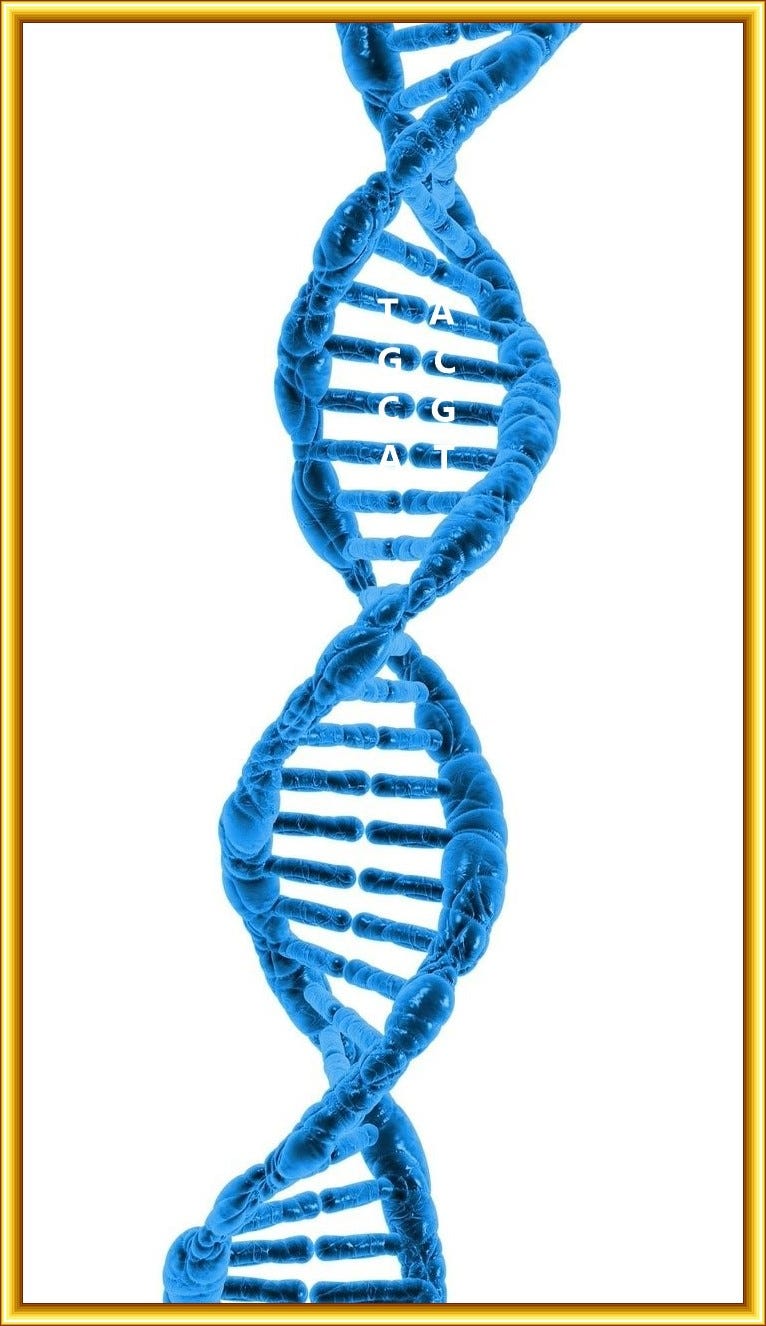
DNA (the stuff of chromosomes) is strings of genes found in the host-cell nucleus. Genes are sequences of code-units. There are only four (see labels A,T C & G ), with each unit matched against a partner code in a twisted double helix formation. (always A with T; and C with G) as shown here.
In the diagram I’ve added labels to show four sets of matching partner-code-units. There can be thousands of units in one DNA chromosome (and they can be in any order e.g. ATTTGACTCCAGG … going on and on & on !), each single DNA strand being mirror-matched to a strand of coded opposites, to complete the double helix with AtoT & CtoG
Extra info (to make you think): The 4 coded units ... full names: Adenine; Thymine; Cytosine and Guanine are basic units of life in almost all living organisms. Think about it … every living thing; all the progeny of the world, all of them; produced via just four units of chromosomal coding!
RNA consists of much shorter sections of gene-string material with code sequences that don’t have partner-code units. You might say that they are ‘waiting’ to match up with a partner-code. The simplified diagram of a coronavirus below, shows a short twisted single RNA strand i.e. no double helix. But Note: The RNA codes are A, U, C, & G, (the U replacing the T in DNA). But like the T in DNA it too matches with an A code, so, in effect, it’s much the same.

This over-simplified diagram of a coronavirus (with host cell chromosomes in the background) shows only 8 code units. A real RNA strand would have several more, but nothing like the thousands that DNA can have. Note: There are no matching partner units, but the RNA strand is built on the same principle as that of each DNA strand ... but with ‘U’ replacing ‘T’.
Coronaviruses are a class of viruses that only contain RNA. They are called: ‘single-stranded positive-sense viruses’
Now you can see just why a virus can replicate so quickly … once it is ‘in’ a host cell, and has penetrated its nucleus, everything it needs to replicate itself is right there … immediately at hand … it only needs to make quick copies of its own RNA, by cross-matching sections of the host DNA with quick mirror-copies, and adding any essential material (like sugars, phosphates and nitrates that are all there in the cell). In short … it is surrounded by virtually ready-made components.
One replication produces a new generation in quick-quick time, and with further duplications to follow-on (right there inside the host cell) the end result, in no-time-at-all is … progeny in the millions!
Remember our key question?: ‘Why do variants keep on coming’?
Well, now you know … It really is ‘all about numbers’. Thanks for reading … Fred
If you’ve enjoyed this simple lesson about variation production you might like to know how these variants get to be different to each other. How a simple replication of a DNA or RNA coding section can alter the characteristics of each progeny (so that uncle Sam is different to uncle John though they both have the same mother and father, and similarly, how the COVID Variants can be so different to each other yet retain their overall COVID similarity).
Well, the answer again is quite simple … at least, I think I can explain it simply … but accurately. And that’s what I will do in my next COVID Bulletin: Bulletin №8. In it I will show how mutations are basic variations that occur during the replication process.
My Bulletin №8 will tackle the question: “What is a ‘Successful’ Variant?”, and also ask a more significant question: “Which Variant is ‘The Best’?” It will give the answer … and the answer might surprise you!
“COVID: … Which Variant is The Best? … The Answer!” (Bulletin №8) can be found by clicking on this link , but before you click please scroll down to the end of this post and give a clap & comment for the story you’ve just read. Thank you.
This article is one of my series of COVID Bulletins. To read the whole series, just click on this link
* * * * * * * * * * * * * * * * * * *
“Why Variants keep on Coming” * written by Fred: writer on Medium * * * * * © Fred Ogden 2021 * * * * *
Thank you for reading … Hope you enjoyed the read.

* * * (Feel free to share it on social media if that’s your scene) * * *
You can also Clap & Comment (via icons at top or bottom of this article)
******************************************
NAVIGATION PANEL: TO EVERYTHING FRED: (clickable links)
- All You Need to Know About Fred (including an Index to Fred’s Stories)
- New Index to ALL Fred’s Story Collections
- Get Fred’s new stories delivered to your email inbox … There’s no charge
- Fred’s Email: [email protected]
******************************************
- Follow Fred on Medium: 👉 Fred’s Follow-button (top of all his stories), and he’ll click YOUR ‘follow’ button if he finds your stories appealing.


