Covid -19, Coronavirus: Herbal Classes based on the Viral Process
A Collaboration between Bre Lembitz, an herbalist, and Deanne Lembitz M.D., a family physician
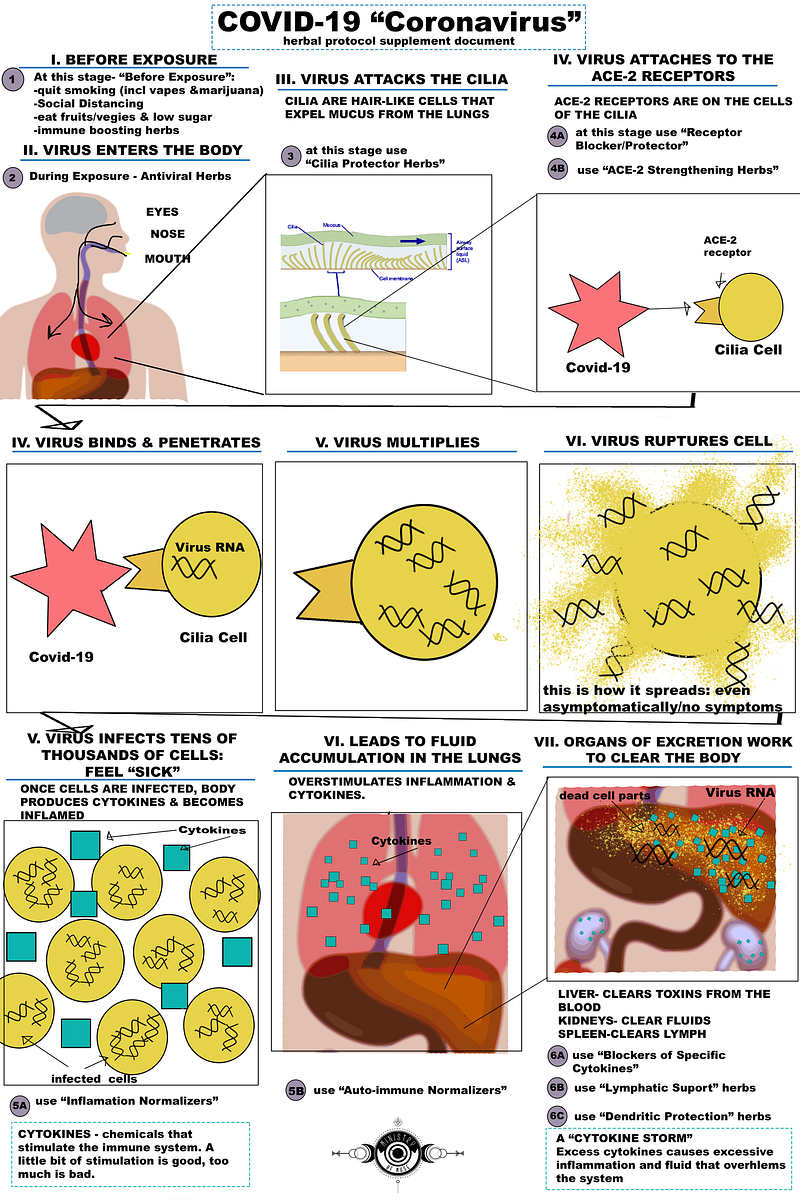
Understanding how to help those who are sick begins with understanding how the virus attacks. As you can see from the infographic above, support begins before exposure with behavioral changes like: not smoking, cutting out sugar, and immune-boosting herbs and supplements like Quercetin. And because the virus enters through the eyes, nose, and mouth, it is recommended not to touch your face and practice social distancing
VIRAL PROCESS
A verbal description of the info-graphic above.
As After entering the body, the virus attacks the cilia of the lungs; binding to the ACE-2 receptors on the cells there and penetrating the cell. The virus then multiplies within the cell, eventually causing the cell to rupture and die.
This leads to cytokine release which leads to inflammation and fluid build-up especially in the lungs The organs of excretion then have to work to remove the fluid and toxic cell breakdown products. These organs can become overwhelmed.
MEDICINAL HERBS & SUPPLEMENTS
This article is divided into the following sections: I. A Description of the Classes of Herbs — use the info-graphic above to follow along. Pro-tip, open the info-graphic in a separate window. II. Flow Outline — a flow-outline to educate how these herbal treatments could be used for illness. III. List of Herbs Divided by Safety & Class — A list of herbs that can be chosen for the protocol- sorted by: “Food Safe”; “Use with Caution”; & “Use with the Support of an Herbalist”; and Classes outlined in I.
I. DESCRIPTION OF THE CLASSES OF HERBS
Throughout this process, there are different medicinal herbs and supplements that can potentially hinder the virus’s progress. As shown in the infographic, we can divide these into categories based on their methods of action. These categories are as follows:
1 — Before Exposure 2 — Anti-virals 3 — Cilia Protectors 4A — Receptor blocker/protector 4B — ACE-2 Strengthening 5A — Inflammation Normalizer 5B — Autoimmune Normalizer 6A — Blockers of Specific Cytokines* 6B — Lymphatic Support* 6C — Dendritic Protection* *use during acute illness, will be addressed in an update to this article.
1- BEFORE EXPOSURE
A- Media Recommendations Follow recommendations in the media about social distancing, washing your hands, and not touching your face.
B- Avoid Weakening the Lungs Anything that weakens the lungs will make it harder on the body to fight off the virus. Any amount of smoke in the lungs can damage the cilia, be it from cigarettes, marijuana or e-cigs/vapes. Exposure to airborne chemicals in home/air-pollution/industry-related air-toxin exposure can weaken the cilia and the lungs, making the cells more susceptible to attack.
C- Remove Toxins that Decrease Immune Strength Toxins that decrease your immune strength should ideally be removed. This includes alcohol, smoke of all forms, and other various environmental chemicals. No NSAIDs, see D below. You want your immune system to be using all its energy to fight off the virus if it becomes exposed, not diverted to recovering from toxin exposure.
D- Decrease the Body’s Baseline Inflammation This can be done by making changes to the diet which boosts the immune system and strengthens the body’s support organs: a diet high in fruits and vegetables, low in sugar and “bad” fats (trans-fat). Additionally, NSAIDs (pain killers like Advil and Aleve) are called “anti-inflammatory” but are stressful to and can damage the organs of excretion even when healthy. Avoiding these except with extremely high fever is optimal. Supplements like Quercetin and Luteolin are anti-inflammatory. Due to the wealth of knowledge available on immuno-supportive herbs, we’re choosing not to cover those here. Any herbs found to be immune supportive would fall under this class.
2- ANTI-VIRALS
Symptoms for use: asymptomatic and any symptoms; with exposure
Function: During exposure, which we should probably all assume we’re at at this point in the US, anti-viral herbs could be started.
Of these, the most commonly known is Licorice Root. Some people have found that making it into a tea and drinking that tea 2–3 times a day can be beneficial. Gargling with it, even adding it to a neti-pot solution is said to help to get it’s anti-viral properties to the most at-risk cells.
However, licorice does have the potential to increase blood pressure in some people. If someone is drinking licorice tea, it has been recommended to monitor their blood pressure.
3- CILIA PROTECTORS
Symptoms for use: asymptomatic and any symptoms; with exposure
Function: The cilia are little hair-like structures that work to move debris and mucus out of the lungs. As outlined in 1B there are many behaviors we can take to protect our cilia in our lungs. Additionally, there are also herbs that function as cilia protectors. These are things like Berberine (found in Oregon Grape and Agarita), and Cordyceps.
4A — ACE -2 RECEPTOR BLOCKER/PROTECTOR
Symptoms for use: asymptomatic and any symptoms; with exposure
Function: To be able to infect, a virus must enter the cell. In the case of Covid-19, it binds to and uses the ACE-2 receptor sites on the cells as a port to enter. Herbs in the 4A class make it hard for the virus to bind to the receptor sites. Think of them as forming a protective film on the receptors. If the virus cannot bind to the receptor, it cannot use it as a port enter the cell.
4B — ACE -2 STRENGTHENING HERBS
Symptoms for use: fever and beyond
Function: At this point, the virus is in the lungs, on the cilia, trying to attach itself to the receptors on the cells of the cilia. The herbs in part 4A have thwarted some of the virus’s attempts to bind to the receptor sites on the cilia. Though they are not binding, they are still causing dysfunction of the ACE-2. This means that the cell is unable to correctly regulate fluid balance. However, each cell has multiple ACE-2 receptors, thus if we strengthen the ACE-2 receptors, the cell is better able to regulate fluid.
5A- INFLAMMATION NORMALIZER
Symptoms for use: asymptomatic and beyond
Function: After the virus has infected cells, the body responds by sending an inflammatory/immune response. This response is sent via the chemicals called cytokines. Cytokines are helpful in “normal” amounts as it stimulates the body to heal, but in large amounts, they can be harmful; in the way that too much of any good thing can be harmful.
The role of herbs in category 5A is to normalize the over-stimulation caused by the virus, in order to decrease the potential toxicity of the cytokine response
List: Those herbs can be found on the living document — link here.
5B-AUTOIMMUNE NORMALIZER
Symptoms for use: fever and beyond
Function: For those individuals with auto-immune conditions, inflammation levels may already be higher than normal. Their immune system is functioning in some aspects “too” well. Their immune-systems need to be balanced. Thus, autoimmune adaptogenic and support herbs can help those with autoimmune conditions.
As individuals with auto-immune conditions may tell you, herbs with strong immune-supportive properties can sometimes trigger their symptoms. The herbs in class 5B should help to normalize the immune response.
Adaptogens or normalizers are herbs that serve to balance systems. At this stage of the viral infection, they may be helpful for those with auto-immune conditions. Additionally, they can also be added to the protocols of all individuals as they may be able to balance the overproduction of cytokines that leads to fluid accumulation.
The role of herbs in category 5B is to calm and balance the immune response to prevent the potential toxicity of the cytokine response.
List: Those herbs can be found on the living document — link here.
6A-BLOCKERS OF SPECIFIC CYTOKINES*
*use during acute illness, will be addressed in an update to this article.
6B-LYMPHATIC SYSTEM*
*use during acute illness, will be addressed in an update to this article.
6C- DENDRITIC PROTECTION*
*use during acute illness, will be addressed in an update to this article.
HERBAL MEDICINE
Finally, we’d like to make a point about herbal medicine. The herbs listed in this protocol are probably not the herbs you’re used to seeing. Some of them would require a prescription if you were to buy them through a Chinese pharmacy.
Due to the power behind the pharmaceutical industry, we are often led to believe that herbs are horribly dangerous. Or, we hear that herbal medicine is bogus and has no science behind it. From the other side we hear that it’s perfectly safe. The truth is somewhere in the middle. Herbal medicine, especially the herbs outlined in this protocol, can have side-effects. They are usually mild and can be mitigated with other herbs or stopped by simply stopping usage.
Side Effects
The truth is that anything that pushes the body’s systems in one direction, is simultaneously pulling in another direction. In individuals who already lean that direction, this could be problematic. For the majority of the population this is not an issue. When comparing herbal side-effects to the side-effects experienced by most pharmaceuticals, the difference is staggering. According to an article by “LiveScience” the average drug label lists 70 side-effects. Herbs will have one or two. Often herbalists argue that although most pharmaceuticals began as plants, their now super-powered strength can have serious side-effects because they “over-do” things.
This brings up another point about herbal medicine. Herbs are not super-charged pharmaceuticals. Therefore, they have fewer side-effects overall. However to be effective, one needs to be consistent with usage. This means, for example, if you are taking herbal anti-virals, you may receive the recommendation to take them 3 times a day, for a baseline; or 6 times a day to fight symptoms. This allows enough of the herb to be circulating in your system at any time.
With pharmaceuticals, you’re often taking a time-release capsule or medications that have been created with a long half-life so that the medication in your system until you take it again the next day. Herbs are not functioning the same way, so they are recommended in a more consistent dosage stream, such as; taking a little bit more often, rather than a lot very rarely.
Disclaimer
This article is a joint effort between my mother, an MD family physician, and myself, a trained, but not licensed, herbalist. We have spent the last two weeks researching herbal remedies, spurred by the work of Stephen Harrod Bruhner. We will continue to research and add to the living document referenced within this article, as well as updating this article as more information becomes available. Additionally, please feel free to send any questions/research you’ve found our way.
The information created in this article is for informational purposes only. This content is not intended to be a substitute for professional medical advice, diagnosis, or treatment. It is not intended to be a prescription. Always seek the advice of your physician or other qualified health provider with any questions you may have regarding a medical condition. Never disregard professional medical advice or delay in seeking it because of something you have read here.