Covid-19, Coronavirus: Herbal Protocol Flow-Chart
A Collaboration between Bre Lembitz, an herbalist, and Deanne Lembitz M.D., a family physician
INTRO:
This is an outline to educate how herbal treatments could be used for illness with Covid19. It is not meant to take the place of medical care.Please contact your medical provider when you are ill
PRINCIPLES:
The outline uses the following principles:
- SAFETY is our main focus. “Do no harm” We relied on herbs which have the lowest risk/highest safety profile. They are considered ‘food safe” because people in some areas of the world eat them as food.
- Taking two herbs in one category may give a better overall effect. Since each person is different, one herb may not be as effective as another herb. Taking two herbs in one category helps to assure some effectiveness. Sometimes two or more herbs are both effective. At other times a second herb may amplify or multiply the effect of the first herb. Ginger, Licorice and sometimes Chinese Skullcap multiply effects of other herbs.
- Taking lower doses when well or less ill, higher doses when more ill.
- The greater the quantity and the more substances we take, the more we risk a reaction or side-effect. This is true of anything we take. ‘Safe’ things can sometimes cause problems in large quantities. For example, cabbage. Cabbage is a safe food, but eaten in large quantities, it can cause problems.
- There are always trade-offs. It may make more sense for a very sick person to take more herbs and risk more side effects than for a healthy person or a person who is less ill.
- The number of days of illness and the corresponding severity of symptoms are based on the reports coming over the internet. Each individual’s situation may/will differ. Use this only as a guide.
- Nothing, NOTHING is better than: - Not touching your face - Washing your hands after you touch anything - Keeping a Social Distance of 6 feet - Staying at home
STAGES of ILLNESS
The best way to use the information included in the outline is to first choose the particular stage of health/illness right now in regard to Covid-19. These are symptoms during a timeline.
Note stages do not always progress. For example, Stage 2 doesn’t have to progress to 3. It could stay at stage 2 for a long time, or get better, or jump to stage 4
STAGE 1: Before symptoms appear. STAGE 2: Early illness: Mild symptoms (such as sore throat, runny nose, body aches and low-grade fever and chills, seen in the first few days of the illness). STAGE 3: Continued illness. Mild cough, increasing or continued fever, headaches (usually seen in days 3–10 of the illness) STAGE 4: Increasing illness: More than 6 days of illness without improvement, especially with a strong cough. VERY worrisome stage.
TREATMENT OF THE STAGES BY CLASSES OF HERBS
Once the stage of illness is known, different classes of herbs are used together. Each class is named for the effect it has on the body, such as: Cilia Protectors, ACE2 Protectors, Immune Normalizers and Blockers of Specific Cytokines. Below are the stages and a list of the classes of herbs used for each stage. More information on the classes of herbs and the specific herbs they contain are in a later section.
STAGE 1:
The focus here is on building the body, blocking the virus and testing reactions to herbs that can help now and that might help later.
For most people :
1–2 Antivirals 1–2 ACE2 Protectors Don’t Smoke Cut back on alcohol and sugar Eat well: especially colorful vegetables Eat foods high in lectins and procyanidins Consider trials of Autoimmune Normalizers
For underlying illness or older age or possible exposure to the virus:
Add 1–2 Cilia Protectors
For autoimmune condition:
Add Autoimmune Normalizer These are adaptogens which work to help normalize the immune system. Some people with autoimmune diseases, when they are not fighting a virus, have found through trial and error that one or more of these adaptogens are particularly helpful at calming their system down so that it reacts against what it is supposed to and not what it shouldn’t. Some of these people have found they don’t feel good on others in this list of auto-immune normalizers. When one is well it is a good time to test these in small amounts to get an idea of how each body reacts.
STAGE 2:
Contact a medical provider Time to jump on the virus, block its entrance, disable it, throw it out and keep strengthening the body.
For most people :
Ginger Tea — chop/slice/blend ginger root steeped with hot water — 1–3lbs Start drinking this aggressively at the first sign of illness, with the,“I got hit by a truck!” or a scratchy throat, and the “I feel under the weather.” Can use honey & lime to make more palatable 2–3 Antivirals 1–3 Cilia Protectors 1–3 ACE2 Protectors Autoimmune Normalizer ABSOLUTELY: DON’T SMOKE, DON’T DRINK ALCOHOL Get enough sleep Stay hydrated Control fever with tylenol/acetaminophen (a fever over 101 degrees burns off three times as much fluid as normal) Eat fruits and vegetables, healthy proteins, food high in lectins and procyanidins.
For underlying illness or older age:
Add Immune Normalizer (in addition to the Auto-Immune Normalizer) This may be most the most important action at this point for those with multiple underlying illnesses, as it ramps down the cytokine spiral (inflammation) which might be starting ACE2 Strengthener Rhodiola (increase oxygen diffusion and utilization) Lymph/Spleen/Dendrite protectors Back DOWN on licorice. — It could counter the positive effects of the ACE2 Strengtheners
For autoimmune condition:
Immune Normalizer Auto-Immune Normalizer is important
STAGE 3:
Make sure a medical provider has been contacted At this time in the disease, cell destruction and inflammation are increasing. The goal is to keep this looking like a very bad cold and not let it increase to anything which could lead to a cytokine storm. A cytokine storm is an immune overreaction with an overproduction and imbalance of chemicals called cytokines. It’s the cause of the scariest parts of this disease. Need to keep continuing the treatments of Stage 1 and 2 and add treatments to prevent the spiral of inflammation and support deeper.
For most people :
Inflammation Normalizer — very important at this stage 2–3 Antivirals 2–3 ACE2 Protectors 2–3 Cilia Protectors ACE2 Strengtheners Back DOWN on Licorice. It could counter the positive effects of the ACE2 Strengtheners Rhodiola (increases oxygen diffusion and availability) Dendrite protecting herbs Lymphatic support herbs
For underlying illness, autoimmune disease or older age:
Inflammation Normalizer is especially important Autoimmune Normalizer Consider Blockers of Specific Cytokines
STAGE 4:
Definitely contact your medical provider with progression into this stage.. BE AWARE that after moderate illness, the next step in the disease progression may be to develop the severe illness. This includes: shortness of breath, pain with breathing, fast heart rate, rapid breathing rate (normal is about 20 a minute), labored breathing. chest pain
When any of these symptoms occur medical personnel have sometimes seen people get very sick, very quickly. That means they so rapidly deteriorate that they require mechanical support for their breathing.
If these symptoms occur, CALL 911 or GO TO THE HOSPITAL NOW.
SAFETY OF HERB CLASSES
Herbs split up into 3 safety categories: Food Safe, Herbs to Use with Caution, Herbs to Use with Support of an Herbalist
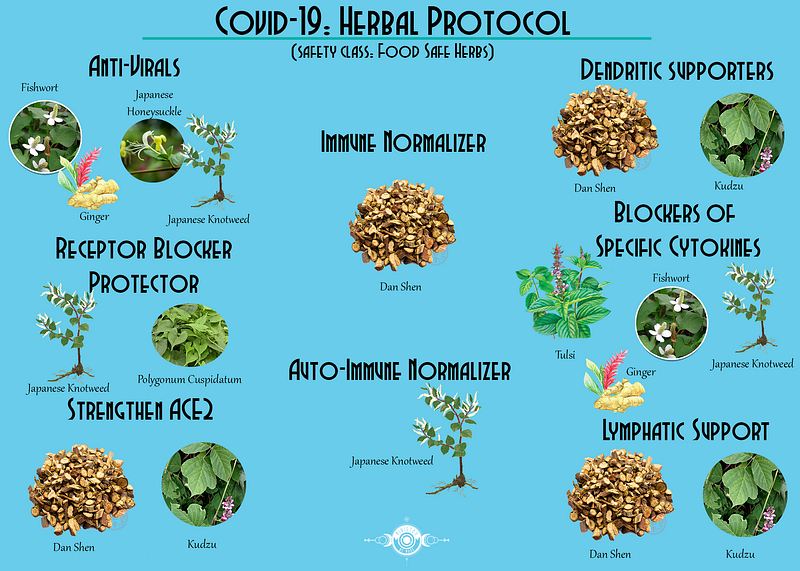
Then by Use-Class: Anti-virals, Receptor Blocker/Protector, Strengthen ACE2, Immune Normalizer, Auto-Immune Normalizer, Dendritic Supporters, Blockers of Specific Cytokines, Lymphatic Support
FOOD SAFE- HERBS
ANTI-VIRALS
Fish Wort -Houttuynia cordata- Yu Xing Cao Japanese Knotweed — Polygonum cuspidatum — Hu Zhang Japanese Honeysuckle — Lonicera japonica — Jin Yin Hua General antivirals: Quercetin Ginger — only fresh juice on contact with virus
RECEPTOR BLOCKER/PROTECTOR
Japanese Knotweed — Polygonum cuspidatum — Hu Zhang Polygonum multiflorum — Fo ti Dietary Changes Luteolin supplement High Lectin Diet Foods high in procyanidins: Apples, maritime pine bark, cocoa beans, grape skin, grape seeds, cranberry, green tea, black tea, acacia palm
STRENGTHEN ACE2
Red Root Sage — Salvia miltiorrhiza — Dan Shen Kudzu — Pueraria montana
IMMUNE NORMALIZER
Red Root Sage — Salvia miltiorrhiza — Dan Shen Quercetin (less so)
AUTO-IMMUNE NORMALIZER
Japanese Knotweed — Polygonum cuspidatum — Hu Zhang
DENDRITIC SUPPORTERS
Red Root Sage — Salvia miltiorrhiza — Dan Shen Kudzu — Pueraria montana normal doses of zinc
BLOCKERS OF SPECIFIC CYTOKINES
Japanese Knotweed — Polygonum cuspidatum — Hu Zhang Holy Basil -Ocimum tenuiflorum — Tulsi Fish Wort -Houttuynia cordata- Yu Xing Cao Ginger — Zingiber officinale — Sheng Jiang
LYMPHATIC SUPPORT
Red Root Sage — Salvia miltiorrhiza — Dan Shen Kudzu — Pueraria montana
HERBS TO USE WITH CAUTION
ANTI-VIRALS
Chinese Skullcap -Scutellaria baicalensis — Huang Qin Forsythia — Forsythia suspensa — Lian Qiao Licorice Root -Glycyrrhiza glabra- Gan Cao
CILIA PROTECTORS
Berberine (Agarita, Oregon Grape Root, etc) Spanish Needles -Bidens pilosa- Zhen Cao Olive Leaf- Olea Europaea
RECEPTOR BLOCKER/PROTECTOR
Chinese Skullcap -Scutellaria baicalensis — Huang Qin Horse Chestnut — Aesculus hippocastanum — Qi Ye Shu
STRENGTHEN ACE2
Hawthorn — Crataegus — Shan Zha
AUTO-IMMUNE NORMALIZER
Astragalus — Astragalus propinquus — Huang Qi Cordyceps Rhodiola- Rhodiola rosea
IMMUNE NORMALIZER
Licorice Root -Glycyrrhiza glabra- GanCao
BLOCKER OF SPECIFIC CYTOKINES
Cordyceps Astragalus — Astragalus propinquus — Huang Qi Chinese Skullcap -Scutellaria baicalensis — Huang Qin Boneset — Eupatorium perfoliatum Elder — Sambucus Licorice Root -Glycyrrhiza glabra- Gan Cao Chinese Senega Root- Polygala Tenuifolia
LYMPHATIC SUPPORT
Chinese Skullcap -Scutellaria baicalensis — Huang Qin Spanish Needles -Bidens pilosa- Zhen Cao Ceanothus
HERBS TO USE WITH THE SUPPORT OF AN HERBALIST
These can have some serious risks associated with them.
ANTI-VIRALS
Ku Shen — Sophora Flavescens Red Spider Lily — Lycoris radiata Woad — Isatis tinctoria — Ban Lan Gen
RECEPTOR BLOCKER/PROTECTOR
Chinese Rhubarb — Rheum palmatum — Da Huang
STRENGTHEN ACE2
Ginko — Ginkgo biloba
AUTO-IMMUNE NORMALIZER
Angelica Root — Angelica Sinensis — Dong Quai
IMMUNE NORMALIZER
Angelica Root — Angelica Sinensis — Dong Quai
BLOCKERS OF SPECIFIC CYTOKINES
Angelica Root — Angelica Sinensis — Dong Quai
HERBAL MEDICINE
Finally, we’d like to make a point about herbal medicine. The herbs listed in this protocol are probably not the herbs you’re used to seeing. Some of them would require a prescription if you were to buy them through a Chinese pharmacy.
Due to the power behind the pharmaceutical industry, we are often led to believe that herbs are horribly dangerous. Or, we hear that herbal medicine is bogus and has no science behind it. From the other side we hear that it’s perfectly safe. The truth is somewhere in the middle. Herbal medicine, especially the herbs outlined in this protocol, can have side-effects. They are usually mild and can be mitigated with other herbs or stopped by simply stopping usage.
Side Effects
The truth is that anything that pushes the body’s systems in one direction, is simultaneously pulling in another direction. In individuals who already lean that direction, this could be problematic. For the majority of the population this is not an issue. When comparing herbal side-effects to the side-effects experienced by most pharmaceuticals, the difference is staggering. According to an article by “LiveScience” the average drug label lists 70 side-effects. Herbs will have one or two. Often herbalists argue that although most pharmaceuticals began as plants, their now super-powered strength can have serious side-effects because they “over-do” things.
This brings up another point about herbal medicine. Herbs are not super-charged pharmaceuticals. Therefore, they have fewer side-effects overall. However to be effective, one needs to be consistent with usage. This means, for example, if you are taking herbal anti-virals, you may receive the recommendation to take them 3 times a day, for a baseline; or 6 times a day to fight symptoms. This allows enough of the herb to be circulating in your system at any time.
With pharmaceuticals, you’re often taking a time-release capsule or medications that have been created with a long half-life so that the medication in your system until you take it again the next day. Herbs are not functioning the same way, so they are recommended in a more consistent dosage stream, such as; taking a little bit more often, rather than a lot very rarely.
Disclaimer
This article is a joint effort between my mother, an MD family physician, and myself, a trained, but not licensed, herbalist. We have spent the last two weeks researching herbal remedies, spurred by the work of Stephen Harrod Bruhner. We will continue to research and add to the living document referenced within this article, as well as updating this article as more information becomes available. Additionally, please feel free to send any questions/research you’ve found our way.
The information created in this article is for informational purposes only. This content is not intended to be a substitute for professional medical advice, diagnosis, or treatment. It is not intended to be a prescription. Always seek the advice of your physician or other qualified health provider with any questions you may have regarding a medical condition. Never disregard professional medical advice or delay in seeking it because of something you have read here.
For a description of the viral process and how each of these herbs works at each stage of the virus, take a look at our previous article here: