
Courage Under COVID-19
A prayer for nurses, alcoholics, and plague doctors
I know I shouldn’t look at my phone in bed. There have been studies about how bad it is for one’s quality of sleep. And yet, I still scroll. I scroll on the couch, I scroll in the bath, I scroll tucked under covers. It’s one of the ways I control anxiety and it is not a healthy way to control anxiety. If you’re feeling scared about the coronavirus — also known as COVID-19 — then I highly suggest limiting the time you spend on social media. For instance, Facebook is a sewer of hysteria and misinformation.
The news is nonstop but the important facts haven’t changed: wash your hands and self-quarantine. It’s crazy-making to stay inside but it will save lives. Read a book instead or stare out a window, longingly.
In fact, I just deleted Twitter off my phone (but I still find myself checking it on my laptop browser.) Right now, the only social app on my phone is TikTok.
I am obsessed with TikTok, the popular short video social media platform. It’s a source of positivity. The app is powered by the creativity of millions of teenagers, twentysomethings, and a few celebrities. I find it endlessly amusing, video after video of dancing, musical theater lip syncs, and grassroots absurdist comedy. I mean there’s more variety than those three basic genres I love.
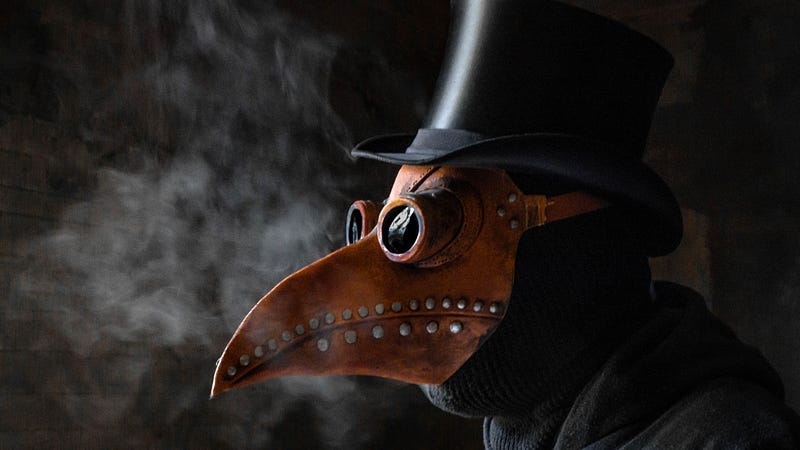
And then there are the plague doctors.
I do not know why TikTok’s algorithm served me short videos of historical cosplayers dressing up as the creepy medieval physicians who wore masks with long beaks. (There’s even a #plaguedoctor hashtag!) Maybe TikTok’s robot brain thought since I watched videos of people dressed as Marvel characters and various Satanic monsters I would want to watch the most obscure cosplay imaginable.
And you know what? TikTok was right. I have always been fascinated with plague doctors and I am pleased that the younger generation shares my interests. My interests include comic books, show tunes, and hypochondria.
I am also pleased that history still remembers these men who visited those dying of the Bubonic Plague in the 14th Century. The plague, or the Black Death, was a gruesome disease that swelled the bodies of its victims before the fatal septic shock. Plague doctors could do very little for these poor souls except show up dressed like a nightmare and just bear witness.
The Dark Ages was not Western civilization’s finest couple-few centuries. The ‘dark’ part was not hyperbole: Europe was an ignorant and superstitious shithole. The Catholic Church was a secretive priesthood that hoarded all the knowledge and wealth. If you were a peasant who wanted the world explained to him you had to go to Mass, which was basically the internet. Those who weren’t part of Big Church worked, in one way or another, for lords who considered themselves one rung below the Son of Man. It was also a time when men thought the shadows were full of evil spirits. A long-ago era when nature was all-powerful and mankind puny.
The plague doctor’s iconic costume — consisting of an overcoat, a wide-brimmed hat, and a mask with glass eye holes — was like a primitive Hazmat suit that did absolutely nothing for its wearer except freak out villagers.
They carried a cane used for poking patients in their deathbeds. Their beaks were stuffed with herbs and aromatics like cloves and juniper berries because it was thought, at the time, that bad smells transmitted disease, a maddening theory when you consider everyone lived in a vast open grave. The suffering often thought the plague was a punishment from God and begged the plague doctors to beat them with their walking sticks as a form of repentance.
The plague doctors were often actual men of medicine, although I probably have more actual medical knowledge than a Middle Ages MD. For instance: skip the leeches! But many of these so-called doctors recorded data that actually helped the study of a pestilence that would wipe out almost two-thirds of Europe. Some of these plague doctors were opportunists though — struggling merchants and wanderers willing to make a buck risking their lives.
Plague doctors were usually employed by towns or churches and their services were available to the rich and poor. Even the Pope hired them. But these plagues doctors were useless. Their cures did nothing. They frequently caught the disease. Their primary job was walking into places that healthy people avoided. That was it. Yes, a few did it for the money. Others because they swore an oath to heal.
But no one walks into the unknown like that without a little faith and a little courage.
The last time I took the New York City subway was four days ago. I had decided to visit my therapist for our weekly sessions. Normally, I make this trip without thinking. It’s second nature.
I just make sure I’m on the downtown 1 train at 6:30 PM so I can make my shrink’s office by 7. Then I just sort of zone out: I listen to music or a podcast or just think about the day.
But this recent trip felt like a calculated risk. The news had been warning of a growing global pandemic. The government was struggling to respond to an unprecedented public health crisis. The ‘coronavirus,’ or COVID-19, a highly-contagious and aggressive respiratory illness, was slowly spreading throughout America, after sickening, and killing, thousands in Europe and Asia.
The last time I had been nervous on the subway train was one week after the 9/11 terrorist attacks when envelopes of powdered anthrax spores, a deadly disease with an 80% mortality rate, were mailed through the US postal service to various politicians in DC and media companies in New York, killing 5 and infecting 17. I recall a local news anchor breathlessly reporting that anthrax spores can live for decades and wouldn’t it be terrible if the terrorist dusted the subway with them?
Uh, yes, news dude. It would suck, majorly.
At the time, I was still in shock from the destruction and death at the World Trade Center so the idea that a terrorist could sprinkle invisible death all over the public transport system I used every morning and evening was terrifying. That was an awful week. I remember riding the N train to Queens when The New York Post got an envelope full of anthrax and thinking “You’ve got to have courage, John.”
I do not think commuting home made me a hero. But I did decide to take the train. I am not a hero but I can slowly drag my fear behind me like Jacob Marley’s heavy chains. That’s good enough.
Earlier this week, the medical community had offered one solution to dealing with COVID-19 other than routinely washing hands: avoid crowds, stay inside, voluntarily quarantine yourself. Only go out of it’s important. I thought it was important to see my therapist. The coming weeks are going to be tumultuous. The society that we’ve known is going to change. And, I’m afraid, more and more people are going to exhibit coronavirus symptoms and require hospitalization. Some might not come home.
I didn’t know when I would see him in person again and the virus was only getting worse. I wanted one last human moment with him before we move to video chat. It was a risk but I wanted to take it because of my mental health. I have this feeling it’s going to be a long time until I see many friends and my family in the flesh again.
The train wasn’t crowded but I made suspicious eye contact with a man about my age. We looked at each other like the other was a Trojan Horse full of millions of tiny germs.
The coronavirus can survive on physical surfaces for 2–3 days. That means every pole in every subway car was potentially dripping with the disease. I kept my hands in my pockets as much as I could. I did not touch my face. A formally normal ritual was now an anxiety-producing horror movie called Death Train To Infection City.
A few hours earlier I swallowed a sip of coconut-flavored seltzer wrong and after clearing my throat I thought: “I am dead.”
When I told my shrink about my journey he was sympathetic. He has a low tolerance for my bullshit but he understands this is a time of great confusion. Happy events like concerts and sporting events are suddenly dangerous. A comforting hug between two friends could mean contracting a potentially lethal cough. The internet was full of Baby Yoda GIFS one moment and is now full of frightening stories from Italy and China and Washington State.
He and I talked about rational reactions to unprecedented events. I told him my fears about having an elderly mother living far away. I was open about my attempts at being a supportive boyfriend. He told me that empathy is listening to someone and holding their feelings with them, sometimes in silence. It doesn’t mean offering advice or talking tough or filling the silence with smart and reassuring words. Empathy is sharing someone’s time and space and emotions. That’s not easy for me to do.
At the end of the session, he told me to pray. This took me off guard and not because he’s Jewish and I’m a little bit Catholic and a little bit Baptist. It surprised me because I knew I needed to hear that since I’m a recovering alcoholic. There is a step in Alcoholics Anonymous, the eleventh, that says alcoholics should pray or meditate to God in the hope that he’ll let them know what His plan is and how to carry that out. In AA, any talk of God is quickly followed by the disclaimer “as you understand him.” Do you believe in Jesus? Great. Galactus? Fine. It’s your call.
Your higher-power shouldn’t be your own asshole, though, even if you can fit your entire head in it.
The eleventh step is a reminder that you are not the center of the universe. Your woes and joys are not special. I don’t believe in God but I like to think I’m spiritual. Spirituality is just the realization that you are part of an eternal whole. There is something bigger than you in this life. That could be Mother Nature or The Force or an omnipotent old man in a robe who lives in the clouds. That could also be love or the energy that fires up the stars. I have hippie-like tendencies.
My therapist wanted me to pray to my higher power because he wanted me to keep doing the things I do to stay sober. He wanted me to ask God as I know him or her or them for answers that won’t come which is the entire point. No one knows anything. All you, or anyone, knows for sure is that every so often you get to make a choice: pick up another drink or ask for help, wash your hands or wipe them on your pants, get on the train or stay home.
The eleventh step doesn’t specify the best prayer to say. You can also just sit quietly or reflect if you want. The shortest prayer I know is “Thy will be done.” My dad taught it to me and he recited it right up until the coma. I suppose it was selfish of me to beg a God I didn’t believe in to spare him. But at least I was able to find the strength to walk into a hospital room filled with death and bear witness.
Prayer isn’t an Amazon order. It’s an unselfish way of asking for help that will not come not, then standing tall and doing the heartbreaking work of living anyway. You have your work and your higher power has theirs. The universe is chaos, mostly. There’s very little you can do about that. So keep your eyes on what’s in front of you.
Right now, as an infectious disease haunts our hospitals, there are doctors and nurses who are marching into battle with science on their side. They are armed with masks and gloves, training and experience, faith and courage.
These are days of acts of faith and courage, both big and small. And we are all walking into the unknown together.