
Could Magic Mushrooms Be The Key To Treating Depression ?
How psilocybin could gradually replace anti-depressants in the future
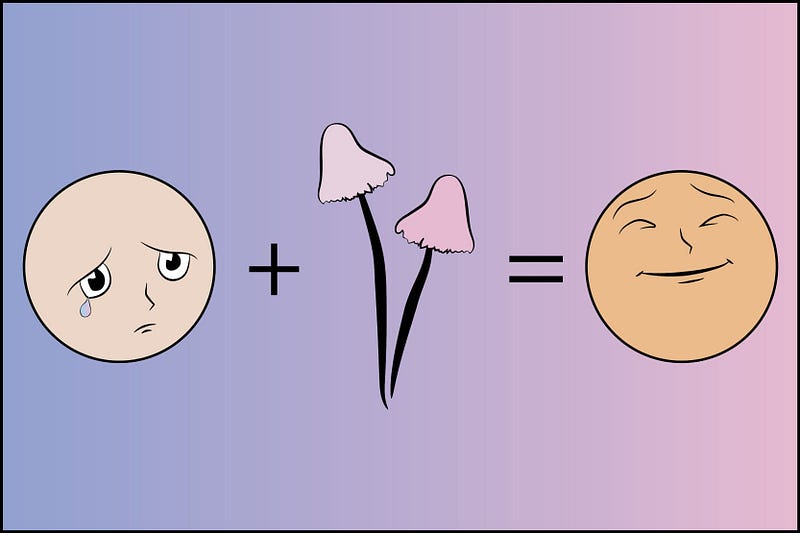
Today, the usage of psychedelics, such as LSD, DMT, and the like, is mainly associated with an out-of-body experience. They are primarily consumed for their strong mind-altering effects on the user, which, most of the times, lead to “divine experiences.” Not to confuse you, unlike other non-hallucinogens, such as MDMA, cocaine, and cannabis (which could possibly fall into the “party drug” category), psychedelics are a bit different and affect the brain in a different way.
They are psychoactive drugs, which trigger non-ordinary states of consciousness. This all means that you see stuff, experience stuff, and hear stuff. Basically, your whole consciousness state is turned upside-down.
Along with the psychoactive effects these substances trigger, there is another side dimension, which is not often talked about — the hallucinogens’ effect on the individual’s mental health. Magic mushrooms are such.
In the past couple of years, psychedelics have become more and more popular among the wide public, especially for people with mental health disorders, one being depression.
With the rise of the “self-help” books in the applied psychology industry, people are finding it easier to talk about their problems, which ultimately leads to fixing them. Moreover, the psychiatric industry has improved significantly in the past decade, which has led to even more success with the battle against mental health issues.
Nevertheless, more people reading about how to help themselves and more people going to the psychiatrist, means that there is an increasing number of individuals that have some sort of mental health problems. Now, that’s the concerning part.
Following the negative “trend,” in pursuit of faster remedies, some people have turned to the renowned effects of the psychedelics. Magic mushrooms are such. Their capabilities have come under the spotlight recently. Here’s what we know so far:
What Are Magic Mushrooms?
Yes, they’re mushrooms, but with a slight twist. They contain psilocybin, which is a psychoactive/hallucinogenic compound that occurs naturally in the plant.
Magic mushrooms, or sometimes called shrooms, mushies, golden tops, etc., are currently classified as Schedule I drugs, which basically means they’re illegal and cannot be used for medical purposes in treatment practices in the USA.
Psilocybin’s Effects on the Body
The hallucinogenic effects, after eating magic mushrooms, comes directly from the ingestion of psilocybin. When swallowed, it releases the compound called psilocin. It’s after this moment that the process of hallucinations starts off. Due to the fact that individuals that have consumed the mushrooms build-up tolerance over time, it’s hard for them to become addicted.
Usually, users feel the effects after 40 minutes to an hour after swallowing the substance, and the effect could last up to several hours, depending on the amount taken.
Below is a graph that shows the harm on the user and others, caused by consuming various drugs and substances, such as Alcohol, Cocaine, Cannabis, LSD, and so on.
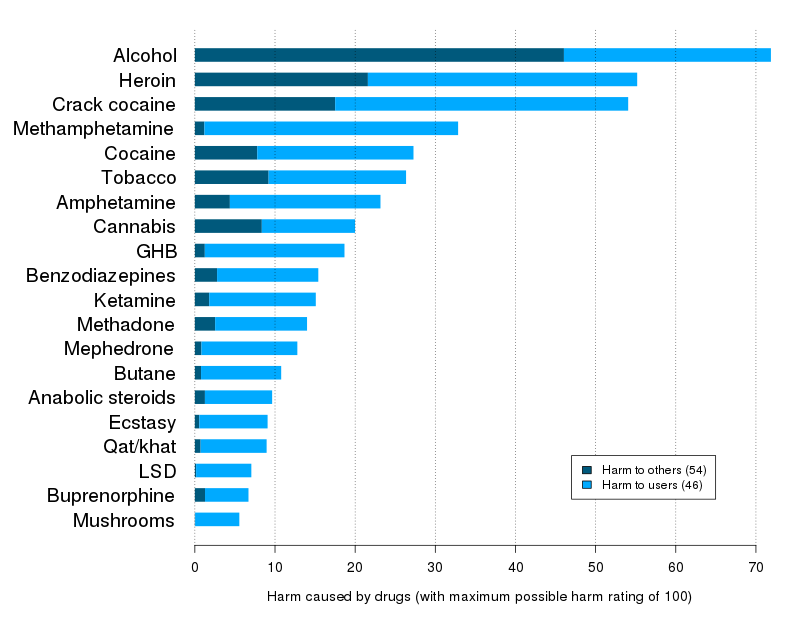
Alcohol and heroin are at the top of the graph, showing that their consumption causes the highest amount of harm to the users and to others. It’s evident that the only substance that has no impact on others whatsoever is mushrooms (psilocybin). Moreover, the harm they cause to the user is at the bottom of the table, with a rating of around 6.
So, relying on this data, can we argue that mushrooms are the least harmful psychedelic? Well, I’d say it depends on the amount taken, on the circumstances, and other factors. However, it is clear that this substance is marginally less dangerous than others of its sort.
This brings forth the question: Can magic mushrooms, being probably the least harmful hallucinogen, help in the treatment of depression?
Treatment Applications of Magic Mushrooms
For the past couple of years, it has been argued that psilocybin may be the key to treating depressive disorders in patients. Dr Robin Carhart-Harris, who is the head of psychedelic research at the Imperial College in London argued the following:
“We have shown for the first time clear changes in brain activity in depressed people treated with psilocybin after failing to respond to conventional treatments.”
He also said that several of the tested patients felt a “reset” after being treated with psilocybin (time-frame not specified). One other individual, also undergoing such therapy, argued that his brain:
“had been ‘defragged’ like a computer hard drive.”
In 2018, Compass Pathways, a mental health care company received therapy designation from the United States FDA (Food & Drug Administration) for treatment-resistant depression, regarding psilocybin. In other words, there’s evidence that shows psilocybin treatment for depression may be “a substantial improvement over currently available therapies.”
“The early studies have shown that psilocybin therapy can provide an immediate and sustained reduction in depression following a single treatment.”
Those were the words of Tracy Cheung, who is a communications director for Compass Pathways, for Healthline. And also:
“The effect has been described as psilocybin shaking the brain up like a snow globe, or rebooting the brain, providing new connections and deactivating connections that might have caused depression.”
There are, of course, more optimistic predictions regarding the future of psilocybin in the treatment of depression in patients. Statements like the following have also been around for quite a while now:
“People on antidepressants long-term say they feel blunted, with psychedelic therapy it’s the opposite, they talk about an emotional release, a re-connection”
Although such sayings may be overly-optimistic, some entities do argue that psilocybin-treatment could replace anti-depressants in the next 5 years or so.
One such is the world’s first psychedelic research centre for psychedelic research — Centre for Psychedelic Research at London’s Imperial College. There, the above-mentioned Dr Robin Carhart-Harris, is the person who is leading the first trials.
Dr Carhart-Harris told The Independent that people taking SSRIs (selective serotonin reuptake inhibitor), or anti-depressants, constantly feel “blunted,” i.e. they experience neither positive nor positive emotions. However, with psilocybin, the doctor argues, the effect is quite the opposite — the patients say they experience more emotions.
Other Studies
A couple of years ago, a clinical psychiatrist and honorary research associate at UCL (University College London), Dr Mark Bolstridge argued that most anti-depressant pills do not work well for most of its users.
That’s why he conducted a small study on his own — Dr Bolstridge gathered individuals that suffered from moderate to severe depressive disorder. The trial’s aim was to look into psilocybin’s depression-treating properties. The experiment was the following — individuals from the test group were given two doses of psilocybin, each dose taken 7 days apart. All this took place within a controlled environment.
One person from the group, diagnosed with depression, said that his mental illness’ symptoms had vanished after the treatment trial and also that he afterwards felt “very, very positive.”
Although this trial group of individuals may not be sufficiently big to produce enough data on the matter, it’s still something. However, I think that further and more comprehensive research would be needed in the future.
Drawbacks of the Psilocybin Treatment
Although being hailed recently, psilocybin is not harmless, as you may have already noticed. It’s still a psychedelic — a substance that alters your perceptions. Magic mushrooms-infused therapy may not be for everyone, because as the name suggests, you basically take hallucinogens during a psychiatric session.
This all may lead to numerous different outcomes, solely depending on how your brain and body will process the drug. Some argue that the purpose of all this is to face and confront one’s traumas and horrid experiences.
“We don’t call it a ‘bad trip,’ we call it a ‘challenging psychological experience and we’re honest with people that it can be hellish.”
This was argued by Dr Carhart-Harris, concerning his trials at the Centre for Psychedelic Research. He also referred to the treatment as “nightmarish,” however, he said, “we are prepared for this and this treatment model requires you literally face your demons.” That being said, usually, such psilocybin treatment would not be suitable for people with severe psychosis.
The Bottom Line
As more and more people look beyond the conventional depression treatments, the focus is gradually shifting more and more to the alternatives, one of which is psilocybin-aided therapy.
However, no matter how much data is presented on the matter, and no matter how much research there is behind this new treatment, I believe that everything is still in its preliminary stage. Awareness stage, if you wish.
Magic Mushrooms, in most countries, are still considered an illegal substance, thus limiting their medical implications, no matter how controlled and supervised these treatments are during therapeutic sessions.
However, with the rising issues with mental health, especially today, considering the COVID-19 pandemic, people are bound to turn more and more to alternatives, such as psilocybin. The data that has been gathered so far is encouraging, but there’s still tons of research to be done.
Thank you for reading! If you’re further interested in mental health & psychedelics, you can follow me on medium:
Also, if you’re interested in the topics mentioned above, you can check two of my previous articles on LSD-assisted therapy and whether being high makes you more creative and productive:


