
Can LSD Cure Mental Illnesses?
The psychedelic-assisted treatment explained.
For a guy who suffers from anxiety, LSD has crossed my mind multiple times so far for an alternative treatment. I assume many of you have considered it, as well. Psychedelics, such as DMT, LSD, psilocybin, and ayahuasca are slowly, but steadily being introduced into the psychotherapy-treatment world.
For some, it may seem drastic and certainly illegal, but for others, it may be the only way through. Sometimes we are ready to do what it takes to cure mental illness. Many of you would relate.
In the past years, micro-dosing on psychedelics has become more or less like a trend. Due to the substances’ properties and effects, their usage greatly enhances the effects of ordinary psychotherapy as we know it.
What exactly is psychedelic-assisted therapy?
As you may have already guessed, in simple terms, it’s therapy practices that involve the small doze usage of psychedelic drugs, such as DMT, LSD, MDMA, psilocybin (the active compound produced by mushrooms), and mescaline ( hallucinogen obtained from the cactus Peyote). This kind of research, although more widely known today, has been used as back as the 50s and 60s.
In the late 60s, however, such drugs were widely restricted. The usage of psychedelics was prohibited when it concerned medical and psychiatric research.
However, since the late 90s and early 2000s, the interest and practice of such therapies has renewed. Due to the advances in technology and ultimately health-care, professionals were able to collect and interpret more data regarding the topic. This all led to a better understanding of the drugs’ implications. In 2014, LSD and psilocybin were listed as Schedule I controlled drugs, thus researches could find out more about them.
Although huge effort has been put on the better understanding of the psychedelic-assisted therapies, their effects are still considered to be strongly dependent on each individual and the environment the drug was used in. Nevertheless, numerous studies argue that it may have positive effects, rather than none.
Treating Alcoholism
Although alcoholism is not considered a classic mental illness, rather it’s a disorder, it still could result in mental health issues.
According to Bill Wilson, the founder of the renowned mutual aid fellowship Alcoholics Anonymous, after been participating in alcoholism treatment sessions involving LSD in the 1950s, said:
“[…] I consider LSD to be of some value to some people, and practically no damage to anyone […]”
and also:
“If under LSD we can have a temporary reduction, so that we can better see what we are and where we are going — well, that might be of some help.”
Mr. Wilson thought that LSD could really influence therapies that involve alcoholics. However, the members of his AA group, were strongly against the usage of such substances when it came to treating alcoholism.
Although the founder of the Alcoholics Anonymous supported psychedelic-assisted treatment and argued that it helped people, data is was not really sufficient to prove that. Even if there was enough data on the matter, it would still would’ve been vague.
Then, a paper came out in 2012, named: “Revisiting LSD As a Treatment for Alcoholism.” Even though it was written 8 years ago, it’s still relevant today, as alcoholics’ behavior has not changed much and LSD effects are pretty much the same.
The paper argued that it was unusual for a substance like LSD to have a beneficial clinical and treatment effect in the long-run after only an initial single dose. The authors, T. Krebs and P. Johansen also noted that repeated doses of the same treatment combined with a more modern alcoholism treatment program might lead to better results.
From all of the papers I’ve read on the topic, I still couldn’t find one that had concrete evidence that psychedelic-assisted LSD therapy is 100% safe and beneficial regarding alcoholism treatment. However, the data presented by some studies is hopeful.
Treating Anxiety Disorder
Most of us have been there (and still are). Anxiety is basically the feeling of fear. Sometimes, the fear of something that’s not there. In our brains. It’s the demon lurking in our unconscious. However, as sinister as it may seem at the moment, it’s nothing more than a fake fear of something that will never happen. Never. This is all curable.
One possible solution, according to a new study published in 2017, is LSD-assisted psychotherapy. According to it:
“In patients with anxiety […], it was reduced for 2 months after two doses of LSD. In medical settings, no complications of LSD administration were observed.”
This study implies that two full doses of the psychedelic were taken. However, it’s common for each individual to be treated with micro-doses. These doses usually are 1/20 or 1/10 of one normal recreational dose.
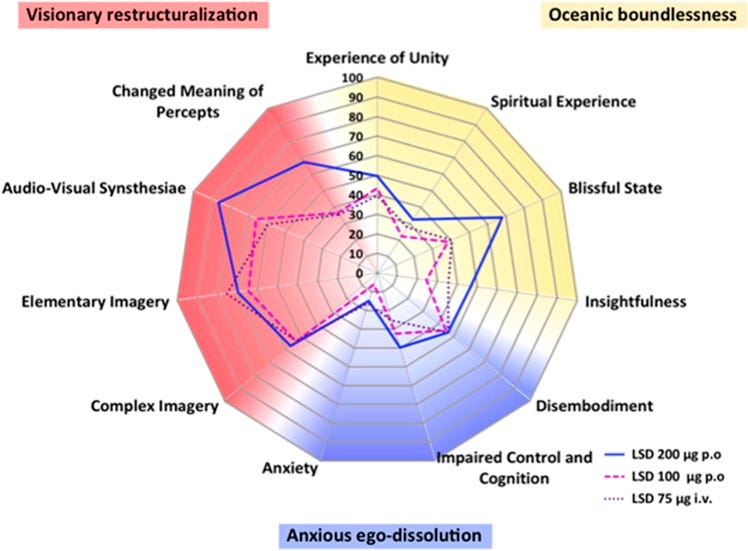
On the graph above we see the effects of LSD on the 5D-ASC scale. The data shows how different doses of the psychedelic affect different variables associated with a given subject. The doses that were given were 200μg, 100μg, and 75μg of LSD. We can see that the higher the dose, the higher the effect on dimensions such as audio-video synthesiae, changed meaning of perception, and blissful state, it produced. On the other hand, anxiety levels were considerably low.
Another study in 2015 showed the efficacy and safety of LSD in therapeutic practices on people with anxiety that is associated with life-threatening diseases. The study compiled data of patients 12 months after they had been exposed to an LSD-assisted psychotherapy.
The results?
No adverse reaction was seen in any of the individuals under supervision. 77.7% of all participants experienced reduction in anxiety and 66.7% reported a rise in their life quality.
“Evaluations of subjective experiences suggest facilitated access to emotions, confrontation of previously unknown anxieties, worries, resources and intense emotional peak experiences à la Maslow as major psychological working mechanisms.”
These experiences, according to the authors, resulted in the restructuring of the individual’s emotional trust, habits, and situational understanding. Quite hopeful, don’t you think?
This all may seem drastic for some. Yes, the patients’ consciousness is changed after such treatment, but they still recall their experiences.
The Unknown
Although there has been sufficient data on whether LSD-assisted therapy could help with mental health issues, there is still no single concrete evidence that says: “Yes, LSD always helps with anxiety, depression, and the like, and is a 100 per cent safe.”
Nevertheless, in the future LSD might be the key to treating severe mental illnesses. As technology develops and more and more focus is put on researching psychedelic-assisted therapies, we might find it easier to fight mental disorders.
Thank you for reading.
Follow me on Medium for more articles on mental health and psychedelics:
Also, if you’re interested in the topics, you can check two of my previous articles on psychedelic-assisted therapy and whether being high makes you more creative and productive:


