avatarSchalk Cloete

Free AI web copilot to create summaries, insights and extended knowledge, download it at here

18078

Abstract

ort</a>).</p><p id="dbf2">Thus, the likelihood of such a massive permafrost feedback probably lies well below 1%, given that it requires carbon releases that are an order of magnitude above the upper bound of the <i>very likely</i> (<a href="https://www.ipcc.ch/site/assets/uploads/2017/08/AR5_Uncertainty_Guidance_Note.pdf">90% confidence</a>) range given by the IPCC. And that’s not the only good news: Even such an extremely unlikely scenario would most likely still leave us in a self-cooling state, as illustrated in the next graph.</p><figure id="31ac"><img src="https://cdn-images-1.readmedium.com/v2/resize:fit:800/1*xYmHh-7Ngj6672L70S_DIg.png"><figcaption>Even an extremely unlikely massive release of permafrost carbon is unlikely to result in a self-warming planet | Graph compiled from <a href="https://www.ipcc.ch/report/ar6/wg1/#TS">IPCC data</a></figcaption></figure><p id="6f3e">Still, there is a scenario where the planet can end up in a slight self-warming state: combining the extremely unlikely massive permafrost carbon release with very weakly negative climate system and carbon cycle feedbacks. Specifically, if we combine the uncertainty ranges of all feedback mechanisms, we end up with a total negative feedback in the <i>very likely</i> range of 1.3–3.3 W/m2/°C. Thus, there is a 5% likelihood that the combined negative feedback effect is below 1.3 W/m2/°C. This scenario, which is 20x less likely than the already extremely unlikely scenario illustrated above, will result in a weakly self-warming effect above 0.37 W/m2/°C.</p><figure id="8088"><img src="https://cdn-images-1.readmedium.com/v2/resize:fit:800/1*qUq0re6s38-RFrY3g1bnUw.png"><figcaption>An almost vanishingly unlikely scenario where the planet enters a weak net-warming state | Graph compiled from <a href="https://www.ipcc.ch/report/ar6/wg1/#TS">IPCC data</a></figcaption></figure><p id="47d9">Still, even if such a near-impossible combination of events occurs, we are not lost. Such a scenario would rightfully be classified as an international emergency (like the pandemic), and we will rapidly mobilize the resources and technology for addressing the problem. For example, the net warming in the figure above will be only about 20% of our anthropogenic forcing in a 2.5 °C world. Thus, we only need to undo a modest fraction of our prior forcing to cancel out this effect. To give just one example, removing CO2 using <a href="https://www.frontiersin.org/articles/10.3389/fclim.2021.630893/full">direct air capture</a> for $150/ton at a similar rate to today’s emissions will cost only around 1% of GDP in the second half of the century when our economy is 4x bigger and other emissions are already low.</p><p id="33c7">Cheaper and much faster-acting <a href="https://doi.org/10.1016/j.jclepro.2014.09.076">geoengineering schemes</a> are also possible, although their side effects need to be carefully researched in the meantime. The simplest example is intentional aerosol releases to the upper atmosphere. Aerosols linked to SO2 and NOx currently contribute a large negative forcing of about 1.2 W/m2, which is already more than we would need to cancel out the net warming effect illustrated above. By the end of the century, this effect will be largely eliminated due to progress on air pollution, so recreating it intentionally (in the upper atmosphere and not in cities where these pollutants have direct health impacts) will be enough to counteract the extremely unlikely net warming scenario of combined massive permafrost release and very weak negative feedback mechanisms.</p><p id="c7ea">Thus, self-strengthening global warming is almost vanishingly unlikely, and even if it comes to pass, it’s well within our power to quickly put an end to it. Given that it’s virtually certain that such a scenario will not emerge within the next 50 years, we can insure ourselves very cheaply against this extremely unlikely event via R&D investments into a range of technologies capable of quickly reducing our large radiative forcing contribution.</p><h1 id="2187">3. There are benefits to more CO2 and heat</h1><p id="a1ee">Climate change is commonly portrayed as 100% bad, which is simply untrue. While it’s fairly certain that costs outweigh benefits, especially in extreme warming scenarios associated with highly unlikely unchecked emissions growth trajectories, the benefits appear real and large. Two of these benefits deserve further discussion in this section.</p><p id="dcbf">As an aside, I’ve seen that discussing climate change benefits is a surefire way to get the “climate change denier” label, so please allow me to reaffirm that I fully accept the science of climate change before we continue. If my interpretations below are false, please let me know.</p><h2 id="e3e1">Global greening</h2><p id="0814">First, we have our steadily greening world. As shown below, rising CO2 is a major driver behind a long-term increase in the amount of greenery on Earth. Interestingly, rising temperatures from climate change also have a small positive effect as more greening on the large landmasses in the far north cancel out browning in southern latitudes.</p><figure id="0753"><img src="https://cdn-images-1.readmedium.com/v2/resize:fit:800/1*Vrw5UOnOuFJ-qp8NLfMh1A.png"><figcaption>Trends in Leaf Area Index (LAI) attributed to CO2 levels, climate change (CLI), nitrogen deposition (NDE), and other factors (OF). Plus and minus signs indicate positive and negative effects of each factor | <a href="https://www.nature.com/articles/s43017-019-0001-x">Piao et al.</a></figcaption></figure><p id="5e03">Essentially all life on Earth depends on plant growth driven by water, CO2, and sunlight. Thus far, CO2 has been the limiting factor, but rising CO2 concentrations are alleviating this constraint. <a href="https://www.ipcc.ch/report/ar6/wg1/#FullReport">The IPCC</a> also points this out in their assessment, stating that increased CO2 consumption by plants is the main source of the large land-based negative carbon-cycle feedback.</p><p id="cd6b">In agriculture, benefits from higher CO2 levels could cancel out almost all the losses from a more volatile climate (<a href="https://www.nasa.gov/feature/goddard/2016/nasa-study-rising-carbon-dioxide-levels-will-help-and-hurt-crops">NASA</a> <a href="https://www.nature.com/articles/nclimate2995">paper</a>). In northern countries such as Germany, increased CO2 concentrations are expected to outweigh negative effects from climate change going forward (below).</p><figure id="38be"><img src="https://cdn-images-1.readmedium.com/v2/resize:fit:800/0*4hm8TKGYKuiOjDnU.jpg"><figcaption>Effects of climate change in isolation reduce crop yields (top), but the inclusion of rising CO2 levels (bottom) overwhelms this effect to create a significant yield boost | <a href="https://www.frontiersin.org/articles/10.3389/fenvs.2015.00048/full">Degener</a></figcaption></figure><p id="17c4">Nature as a whole will also enjoy global greening to the benefit of humans and other species alike. This may moderate the effect of climate change on biodiversity, which appears to be substantial but considerably smaller than several other factors.</p><figure id="c73e"><img src="https://cdn-images-1.readmedium.com/v2/resize:fit:800/1*HPp6TpXh7CCZODrAgeZaoQ.png"><figcaption>Graph depicting the classification of threats to species monitored on the <a href="https://www.iucnredlist.org/search?query=climate%20change&amp;searchType=species">IUCN Red List</a></figcaption></figure><h2 id="8037">Reduced cold hazards</h2><p id="762d">The second major benefit of climate change (driven by global warming) is fewer cold spells. This is a big deal because cold is a much bigger threat to human life than heat, as quantified by a <a href="https://www.thelancet.com/journals/lanplh/article/PIIS2542-5196(21)00081-4/fulltext">recent study</a>. The map below shows the distribution of excess deaths from cold and heat (pay attention to the scales below the maps). Overall, the study estimates almost 10x more deaths from cold than heat.</p><figure id="f3b5"><img src="https://cdn-images-1.readmedium.com/v2/resize:fit:800/1*WnaI61QNOt1_k9vjdGeyvg.png"><figcaption>A distribution of excess deaths from cold and hot extremes around the world | <a href="https://www.thelancet.com/journals/lanplh/article/PIIS2542-5196(21)00081-4/fulltext">Zhao, et al.</a></figcaption></figure><p id="6709">It’s easy to understand why cold is much more dangerous than heat. To stay safe in hot temperatures, you only need shade and water. On the other hand, protecting yourself from cold requires a sturdy and well-insulated dwelling and lots of energy to produce heat, which is orders of magnitude more expensive than shade and water. Also, in poor communities where the cost of shelter from cold is a serious problem, people tend to burn lots of wood, dung, and coal indoors, contributing to <a href="https://www.unep.org/news-and-stories/story/seven-things-you-should-know-about-household-air-pollution">millions of deaths</a>.</p><figure id="4779"><img src="https://cdn-images-1.readmedium.com/v2/resize:fit:800/1*g2hV-Hn7NEQKPt_SlsLLAQ.png"><figcaption>An <a href="https://www.ipcc.ch/report/ar6/wg1/">IPCC graphic</a> showing that climate change will reduce the prevalence of cold spells and frost as much as it increases the prevalence of extreme heat</figcaption></figure><p id="8627">As a result, the study estimates that, from 2000–03 to 2016–19, a warming climate has reduced cold-related deaths by 0.51 %-points while increasing heat-related deaths by 0.21 %-points for a net decline of 0.3% of all global deaths. Thus, warming caused by greenhouse gas emissions actually saves about 160,000 lives per year. If we account for all the warming before the year 2000, this number may well be 3–4x higher.</p><p id="dd3b">Global warming saving half a million people from temperature-related death each year is not something you’re likely to see in the mainstream media. In fact, several outlets (even <a href="https://www.bloomberg.com/news/articles/2021-07-07/climate-change-linked-to-5-million-deaths-a-year-new-study-shows">Bloomberg</a>) actually made it sound like this study suggests climate change is causing 5 million deaths per year (the total number of temperature-related deaths reported in the study, around 90% of which are linked to cold).</p><h2 id="3b7e">A climate change adaptation opportunity</h2><p id="be3e">If these benefits are indeed as significant as suggested here, we should not treat them as threats to the climate change movement, but rather as opportunities to enhance our climate adaptation efforts. Indeed, intelligent action to get the most out of CO2 fertilization and less cold could offset a significant fraction of the costs of climate change adaptation.</p><p id="4c7c">Given that these benefits will be concentrated in northern nations, the first adaptation strategy that comes to mind is upgraded immigration policies and integration programs to facilitate a natural and orderly century-long northward migration. <a href="https://www.pnas.org/content/117/14/7690">When done well</a>, such a migration will be mutually beneficial by limiting rising <a href="https://www.investopedia.com/terms/d/dependencyratio.asp">dependency ratios</a> in the Global North and alleviating <a href="https://www.sciencedirect.com/topics/earth-and-planetary-sciences/population-pressure">population pressure</a> in the Global South.</p><figure id="6a94"><img src="https://cdn-images-1.readmedium.com/v2/resize:fit:800/1*UeMerx2tX7ipzke43yOcEQ.png"><figcaption>Climate-related mortality costs by the end of the century are projected to be negative in the Global North and positive in the Global South (especially Africa) | Explore the data on the <a href="https://impactlab.org/map/#usmeas=absolute&amp;usyear=1981-2010&amp;gmeas=change-from-hist&amp;gyear=2080-2099&amp;tab=global&amp;gvar=mortality&amp;grcp=rcp45">interactive Climate Impact Lab map</a></figcaption></figure><p id="e34d">Alongside other opportunities for adaptation discussed next, such a mutually beneficial response to higher CO2 and temperature levels can significantly reduce global climate change damages this century.</p><h1 id="c671">4. We are highly adaptable to a changing climate</h1><p id="3a03">Homo Sapiens is a highly climate-adaptable species. As shown in the graph below, we’ve survived through a very wide range of global temperatures across our <a href="https://www.smithsonianmag.com/science-nature/essential-timeline-understanding-evolution-homo-sapiens-180976807/">300 millennia</a> history. And today, we’re orders of magnitude more capable of protecting ourselves against unfavorable climate effects than our ancient ancestors were.</p><figure id="011a"><img src="https://cdn-images-1.readmedium.com/v2/resize:fit:800/1*KRYhnYi0wlfAqmVBzlMlOw.png"><figcaption>Long-term global temperature trends across human history | <a href="https://www.temperaturerecord.org/">2 Degrees Institute</a></figcaption></figure><h2 id="730e">We evolved for adaptation rather than mitigation</h2><p id="1737">The main driver behind our great adaptability is our powerful evolved emotional response to immediate threats and opportunities. In contrast, we’re notoriously bad at proactively avoiding threats and creating opportunities in the future (especially the distant future). This tendency, which has frustrated climate change campaigners for decades, can be quantified. For example, <a href="https://doi.org/10.1016/j.enpol.2016.07.044">studies show</a> that the implicit consumer <a href="https://www.investopedia.com/terms/d/discountrate.asp">discount rate</a> is very high, often above 20% (which helps explain the continued <a href="https://finance.yahoo.com/news/jaw-dropping-stats-state-credit-130022967.html">high levels of credit card debt</a> despite <a href="https://www.creditcards.com/credit-card-news/rate-report/">16% interest rates</a>).</p><figure id="7261"><img src="https://cdn-images-1.readmedium.com/v2/resize:fit:800/1*ThlK0K2jduPxwzmfdSatYw.png"><figcaption>An illustration of how much less we value a future cost (like long-term climate damages from a ton of CO2 emitted today) if we use our implicit discount rate of around 20% relative to the 3% discount rate typically used to calculate the social cost of carbon (discussed in Section 5)</figcaption></figure><p id="38a3">Generally speaking, climate change adaptation works with our natural instincts (reacting to solve existing or near-term problems), whereas mitigation works against them (paying now for reducing costs predominantly occurring in the distant future). Of course, this does not mean we should give up our climate change mitigation efforts, but it does mean that we can play the adaptation card much more aggressively. And the very best place to start is to do everything in our power to give the developing world exactly what it wants: rapid gains in standard of living.</p><h2 id="64e2">The power of economic progress</h2><p id="49f1">Indeed, our first and best mode of climate change adaptation is economic development. There are many obvious ways in which a well-developed economy increases climate resilience: Solid housing and reliable utilities protect against more hostile weather, diversified connections to global food markets shield against poor local harvests, and an overall more productive economy makes it easier to absorb climate damages and to implement dedicated climate adaptation (and mitigation) strategies.</p><p id="cf6b">We should take great care that aggressive climate change mitigation schemes do not impede this progress, either via uneconomical transformations of foundational economic sectors or by rising geopolitical tension over the growing share of developing world emissions (e.g., <a href="https://unfccc.int/news/un-chief-phase-out-of-coal-is-key-climate-priority">pressurizing</a> developing nations to rapidly phase out coal). In my opinion, a coal phase-out and even net-zero by 2050 are constructive goals for the developed world, but developing nations should be allowed to grow in the most efficient manner possible. If that involves coal, so be it. Our job is to innovate solutions that render <a href="https://www.iea.org/reports/coal-2021/executive-summary">continued coal investments</a> unattractive, not to bully developing nations into uneconomical growth paths.</p><figure id="59a7"><img src="https://cdn-images-1.readmedium.com/v2/resize:fit:800/1*Clq6iixTEvfVUeAfj2BBHA.png"><figcaption>The projected share of developed world (Europe, North America, and Japan) CO2 emissions on an annual and cumulative basis | Graph compiled from the <a href="https://www.iea.org/reports/world-energy-outlook-2021">IEA World Energy Outlook</a> and <a href="https://ourworldindata.org/contributed-most-global-co2">Our World in Data</a></figcaption></figure><p id="72ce">It’s only fair after all. The historical emissions that facilitated the high standard of living enjoyed by the 15% of world citizens living in developed nations today are still double that emitted by the remaining 85% (see the graph above). That’s why the average US or EU citizen gets to consume 20x as much as the average citizen from the rest of the world (below). As further discussed in Section 5, eradicating this gross injustice through globally inclusive economic upliftment appears to be orders of magnitude more important for future prosperity than drastic climate action (in addition to offering great gains in climate resilience).</p><figure id="4fae"><img src="https://cdn-images-1.readmedium.com/v2/resize:fit:800/1*1EuiTYoHi_ig_UHDkNpMDw.png"><figcaption>The current global income distribution where the vertical line represents the rich world | <a href="https://www.gapminder.org/fw/income-mountains/">Gapminder</a></figcaption></figure><h2 id="36ed">Sea level rise</h2><p id="2863">Moving on to specific climate change adaptation opportunities, the much-discussed issue of <a href="https://theconversation.com/rising-seas-and-melting-glaciers-these-chan

Options

ges-are-now-irreversible-but-we-have-to-act-to-slow-them-down-165527">irreversibly rising oceans</a> deserves first mention. <a href="https://www.ipcc.ch/report/ar6/wg1/">The IPCC</a> says we’re in for a 2–6 m rise in the oceans if we follow an intermediate CO2 emissions pathway. There are online tools available to see the effects of such sea level rises (see a New York example below).</p><figure id="b2a0"><img src="https://cdn-images-1.readmedium.com/v2/resize:fit:800/1*k3IrhmWR58PtTf5et4prmw.png"><figcaption>The effect of 5 m of sea-level rise on Yew York as illustrated by <a href="https://ss2.climatecentral.org/#10/40.7613/-73.2342?show=satellite&amp;projections=0-DP16_RCP45-SLR&amp;level=5&amp;unit=meters&amp;pois=hide">Climate Central</a></figcaption></figure><p id="42e9">Even though it’s hard to even see the impact of 5 m of sea-level rise when zooming out to a global view, images such as the one above can be alarming. But then we read that <a href="https://www.ipcc.ch/report/ar6/wg1/">the IPCC</a> only sees these numbers 20 centuries from now. By 2100, the intermediate SSP2–4.5 scenario will only see about 50 cm higher seas than today.</p><figure id="396e"><img src="https://cdn-images-1.readmedium.com/v2/resize:fit:800/1*8b0AYQ2bNBupfffxltKPuQ.png"><figcaption>Sea level rise projections for the five <a href="https://www.ipcc.ch/report/ar6/wg1/">IPCC scenarios</a></figcaption></figure><p id="8c45">I have full confidence that we will comfortably adapt to less than 1 cm of annual sea-level rise (and even to double as much in a low-likelihood ice sheet instability scenario). Cities can realistically retreat from such a slowly advancing ocean and the cost of dikes (which we have <a href="http://dutchdikes.net/history/">centuries of experience with</a>) to protect high-value coastlines or large low-lying areas will be a rounding error relative to GDP in 2100.</p><h2 id="5d12">Agriculture</h2><p id="a8e7">There is little doubt that farmers will need to gradually change the types of crops they grow as the local climate changes (<a href="https://www.frontiersin.org/articles/10.3389/fsufs.2021.685801/full">the science of genetics</a> can help). Furthermore, <a href="https://www.nature.com/articles/s41598-018-26321-8">vast areas in the northern latitudes</a> will become suitable for farming with further warming, with higher CO2 concentrations promising a welcome yield boost on these new farmlands.</p><p id="5aa8">If science issues concrete warnings of rare “perfect storms” of floods and droughts around the world leading to significant global food shortages, nations can simply build a strategic store of non-perishable food as insurance against such a low-likelihood event. It should suffice to store around 2% of our annual food production at a negligible cost (for perspective, we currently <a href="https://www.unep.org/thinkeatsave/get-informed/worldwide-food-waste">waste around one-third of all food</a>).</p><p id="439f">Overall, humans are brilliant at making sure they have enough food (it’s one of our most fundamental instincts). Smart people have been <a href="https://en.wikipedia.org/wiki/Malthusianism#Criticism">predicting mass starvation</a> due to rapidly growing human populations exceeding environmental constraints for centuries, but today we have so much food (despite all <a href="https://www.unep.org/thinkeatsave/get-informed/worldwide-food-waste">the waste</a>) that obesity is a major global cause of death, increasingly also in the developing world.</p><figure id="94d4"><img src="https://cdn-images-1.readmedium.com/v2/resize:fit:800/0*frC9awRgMCzTRpwr.png"><figcaption>Deaths from obesity are rising rapidly in the developing world | <a href="https://ourworldindata.org/grapher/share-of-deaths-obesity?tab=chart&amp;country=OWID_WRL~Western+Europe~USA~IND~CHN~Africa~Southeast+Asia">Our World in Data</a></figcaption></figure><p id="a7c3">At 8.5% of global deaths shown above, one can infer that excessive food consumption contributes to almost 5 million deaths annually. This should be contrasted with <a href="https://ourworldindata.org/grapher/annual-number-of-deaths-by-cause?country=~OWID_WRL">0.23 million deaths</a> linked to protein-energy malnutrition, which is caused by our shameful inability to distribute resources to those who lost out at <a href="https://www.gatesfoundation.org/goalkeepers/report/2019-report//#ExaminingInequality">the lottery of birth</a>, not by a lack of food.</p><p id="2ae7">So, rest assured that we will always innovate ourselves to more than enough food, especially now that population growth is slowing. One can only hope we gain better control over our primitive instinct for unchecked food consumption and get much better at helping those unlucky enough to be born into extreme poverty.</p><h2 id="60ed">Individual action</h2><p id="2bf6">One of the best things about climate adaptation is that concerned individuals have a lot of scope for proactive action. In fact, I see such measurable real-world actions as the true test of whether someone really believes there is a climate emergency. Here are some proactive adaptation measures to ensure that climate change has a negligible or even positive effect on the lives of yourself and your loved ones:</p><ul><li>Maximize your <a href="https://readmedium.com/life-efficiency-a-vital-paradigm-shift-in-the-sustainability-movement-58d607d270fc">Life Efficiency</a> to decouple your health and happiness from a high-consumption lifestyle</li><li>Invest in technologies that reduce your carbon footprint in preparation for much higher CO2 prices</li><li>Move further north to a region where climate change could make life more comfortable</li><li>If moving is impossible, study the likelihood of different weather extremes in your area and ensure your home is protected accordingly</li><li>Don’t own property at sea level</li><li>Slowly build up a strategic food reserve</li></ul><h2 id="d8a7">Innovation</h2><p id="61e3">Let’s round out this section with a few words on the innate human ability to rapidly innovate solutions to pressing problems (e.g., the rapid vaccine rollout during the Covid pandemic). When climate change impacts get large enough, innovation will naturally accelerate to limit future damages. Also, as mentioned in Section 2, there are many cheap and innovative ways to insure ourselves against unlikely climate surprises.</p><p id="3086">The best way to stimulate the required innovation would be to impose a CO2 tax (the <a href="https://carbonpricingdashboard.worldbank.org/what-carbon-pricing">most efficient way to decarbonize</a>) and use a significant fraction of the revenues for clean energy and climate change mitigation & adaptation R&D. Although the current policy landscape remains far from this ideal, there are signs that we are moving in the right direction (e.g., the <a href="https://ember-climate.org/data/carbon-price-viewer/">EU CO2 price</a> is around 80 €/ton at the time of writing).</p><p id="b105">All told, I feel confident that humanity will comfortably adapt to 2.5 °C of peak warming. If we actively prioritize the upliftment of developing world citizens, the gargantuan and highly advanced global economy by 2100 will handle anything climate change throws our way. Overall, I’m much more concerned about overly ambitious climate change mitigation efforts inhibiting poverty alleviation and other key global priorities.</p><h1 id="048c">5. Drastic decarbonization brings serious opportunity costs</h1><p id="66e9">It has become completely acceptable and even admirable to demand a war-like effort to eliminate all fossil fuel use within impossibly short timeframes. The most extreme one I’ve seen is <a href="https://rebellion.global/">Extinction Rebellion</a> which demands net-zero by 2025, which makes no sense.</p><figure id="a15d"><img src="https://cdn-images-1.readmedium.com/v2/resize:fit:800/0*iSww25PpHkKWq3D8.png"><figcaption>It is highly likely that global emissions will remain near an all-time high by 2025 according to <a href="https://www.theguardian.com/environment/2021/jul/20/emissions-record-high-by-2023-if-green-recovery-fails-says-iea">IEA data presented by the Guardian</a></figcaption></figure><p id="2011">Unless we get some huge technological breakthroughs, the seemingly plausible “net-zero by 2050” pathways being churned out by think tanks around the world will be very costly and complex to implement. And this is especially true for the near-100% wind, solar, and electric vehicle pathways powerful advocacy groups like <a href="https://www.greenpeace.org/usa/issues/climate-change-impacts/">Greenpeace</a> tend to favor. (Here are the challenges with deep decarbonization via <a href="https://readmedium.com/the-10-great-challenges-facing-variable-renewable-energy-6e567c3c4cce">wind & solar</a> and <a href="https://readmedium.com/the-10-biggest-problems-with-electric-cars-1db4a80b2631">electric cars</a> for interested readers.)</p><figure id="ceda"><img src="https://cdn-images-1.readmedium.com/v2/resize:fit:800/1*YisDs0hKlHg-F4r8egYORw.png"><figcaption>The vast difference in pre-2030 annual investment requirements between the Stated Policies (STEPS) and Net-Zero Emissions (NZE) Scenarios | <a href="https://www.iea.org/topics/world-energy-outlook">IEA World Energy Outlook</a></figcaption></figure><p id="667b">As illustrated above, annual energy investment will need to jump by almost 2 trillion this decade to get us on track to net-zero by 2050. Also, we should not be surprised if experience eventually shows that the techno-economic and socio-political complexities involved in such a rapid and foundational transformation were badly under-represented in the model runs behind these numbers, leaving true transition costs much higher.</p><h2 id="599d">Opportunity costs</h2><p id="008e">Recognizing the high direct costs of drastic decarbonization pathways is a good start, but understanding the <a href="https://www.investopedia.com/terms/o/opportunitycost.asp">opportunity costs</a> (the problems we do not get to address because we spent so much time, attention, and resources on climate change) is more important. But first, we need a sense of proportion by estimating the climate change costs we could avoid via extreme action to limit global temperatures to 1.5 °C.</p><h2 id="8aef">The costs avoided via drastic decarbonization</h2><p id="9155">Based on all the reading I’ve done on the matter, I currently see climate change from fossil CO2 as a “1% of GDP” class problem. Although there are some wild outliers, mainstream estimates of the social cost of CO2 at <a href="https://www.brookings.edu/bpea-articles/the-social-cost-of-carbon/">around 50 /ton</a> (equivalent to 1.3% of global GDP) in <a href="https://www.brookings.edu/bpea-articles/the-social-cost-of-carbon/">policy planning</a> and <a href="https://www.sciencedirect.com/science/article/abs/pii/S0959652618334589">academia</a> seem to back this notion. More importantly, a substantial portion of this cost is related to long-term damages in very rich futures simulated up to 2300 using low discount rates (<a href="https://www.rff.org/publications/working-papers/the-social-cost-of-carbon-advances-in-long-term-probabilistic-projections-of-population-gdp-emissions-and-discount-rates/">more elaborate discussion</a>).</p><p id="ea7d">For example, a commonly used short-term discount rate of 3% under <a href="https://www.rff.org/publications/working-papers/the-social-cost-of-carbon-advances-in-long-term-probabilistic-projections-of-population-gdp-emissions-and-discount-rates/">conservative growth assumptions</a> means that 15–33% of the costs we assume responsibility for (depending on whether damages stay constant or increase linearly with GDP) only occur after 2100 when the average world citizen is 3x richer. I find it difficult to understand such assumptions. As described earlier, it will take only a tiny fraction of future generations’ vast additional wealth (created by today’s investment and innovation) to adapt to a changing climate and, if necessary, remove CO2 from the atmosphere.</p><figure id="e870"><img src="https://cdn-images-1.readmedium.com/v2/resize:fit:800/1*aE75ovIifpyedPO_W3B8pw.png"><figcaption>A summary of different surveys and model predictions of climate damages as a percentage of global GDP | <a href="https://doi.org/10.1016/j.accre.2020.09.008">Zhao et al.</a></figcaption></figure><p id="1dd8">Yes, if there was a reasonable likelihood that a lack of extreme action on climate change can make future generations worse off than we are today, we should certainly take more responsibility for the damages that today’s emissions will still be causing in the distant future. But the likelihood of such a scenario appears to be very small. Even in <a href="https://en.wikipedia.org/wiki/Shared_Socioeconomic_Pathways">Shared Socioeconomic Pathway</a> 3 (SSP3) where we do essentially everything wrong (lack of cooperation, slow technological progress, poor education, and rapid population growth), the average world citizen is projected to be almost 2x better off in 2100 than today. A continuation of current trends (SSP2) leads to a massive 5x gain in prosperity.</p><figure id="0c5d"><img src="https://cdn-images-1.readmedium.com/v2/resize:fit:800/1*2uRsM5eQToMzTt3DiFMt3g.png"><figcaption>The bright prospects of future economic development | <a href="https://doi.org/10.1016/j.gloenvcha.2015.06.004">Dellink et al.</a></figcaption></figure><h2 id="5990">What really shapes the prosperity of future generations?</h2><p id="cd77">An even more striking insight from the figure above is that the way we organize our economy is in the order of 100x more important for future prosperity than climate action. For example, challenges to climate change mitigation are similar in SSP3 and SSP5, but incredibly, GDP per capita by 2100 differs by a factor of almost seven.</p><figure id="7ed2"><img src="https://cdn-images-1.readmedium.com/v2/resize:fit:800/1*UvCDxP6xeIWIiUtDnNVdyw.png"><figcaption>This graph of between-country <a href="https://en.wikipedia.org/wiki/Gini_coefficient">Gini-coefficients</a> in the different SSPs shows that globally inclusive growth is a major factor in the vast prosperity growth in SSP1 and SSP5 | <a href="https://doi.org/10.1016/j.gloenvcha.2015.06.004">Dellink et al.</a></figcaption></figure><p id="a3df">So, what does SSP5 have that SSP3 doesn’t? Massive, globally inclusive investments in human and social capital, fostering innovation, optimizing health, and naturally limiting population growth. And that brings me to my big worry with net-zero by 2050: it gives disproportionate weight to a factor with seemingly little influence on future prosperity, distracting from the factors that really matter.</p><h2 id="622e">The opportunity costs of declaring a climate emergency</h2><p id="fc9a">Indeed, the direct and opportunity costs of prioritizing a climate emergency above all our other challenges could do serious harm to the prosperity of current and future generations alike. While an extra degree of global warming looks like a “1% of GDP” class problem with damages concentrated in a much richer longer-term future, today’s world faces <a href="https://readmedium.com/the-worlds-13-biggest-problems-ranked-2a3ad698d676">many critical problems</a>, several of which have impacts happening right now falling in the “10% of GDP, millions of preventable annual deaths” class.</p><p id="d263">Chief among these is the extreme state of global inequality of opportunity (e.g., an average developed world citizen at the 95th percentile gets to consume as much as 50 people at the 5th percentile simply because of his fortunate birthplace). In response, we spend <a href="https://data.worldbank.org/indicator/DT.ODA.ALLD.CD">just over 0.1% of GDP</a> on development assistance and aid for the developing world.</p><figure id="867b"><img src="https://cdn-images-1.readmedium.com/v2/resize:fit:800/1*1EuiTYoHi_ig_UHDkNpMDw.png"><figcaption>The current global income distribution where the vertical line represents the developed world | <a href="https://www.gapminder.org/fw/income-mountains/">Gapminder</a></figcaption></figure><p id="4283">As mentioned in Section 4, uplifting billions of vulnerable global citizens on the left of the income distribution also offers outstanding protection against climate change. I would not be surprised if a massive effort on globally inclusive economic upliftment, in addition to the myriad societal benefits it will bring, also prevents more climate change-related suffering than a mitigation effort of similar magnitude to limit global warming to 1.5 °C.</p><p id="fe41">And that’s the crux of this section: We need to focus on what really matters for current and future prosperity. The last thing I’m suggesting here is that we tone down our mitigation plans to 2.5 °C and do nothing instead. What I’m suggesting is that we redirect the 1.5 °C level of ambition toward <a href="https://readmedium.com/the-worlds-13-biggest-problems-ranked-2a3ad698d676">much larger problems</a> like extreme inequality of opportunity, our self-inflicted lifestyle disease epidemic, and unsustainable population growth in Africa.</p><p id="0f15">The highly prosperous <a href="https://en.wikipedia.org/wiki/Shared_Socioeconomic_Pathways">Shared Socioeconomic Pathways</a>, SSP1 and SSP5, look amazing. Let’s prioritize our efforts carefully and make this future a reality.</p><h1 id="a789">Comments are Welcome</h1><p id="1322">As stated in the introduction, I welcome evidence-backed critiques of the central argument in each of the five sections above. Although I hope (for the sake of the world) I’m right on the moderate negative impact of climate change relative to all our other challenges, I would personally benefit strongly if the world puts all that “net-zero by 2050” talk into action. Thus, I have no incentive to resist reasonable feedback.</p><p id="b865">I’m looking forward to a constructive discussion!</p></article></body>

Could 2.5 Degrees of Global Warming Be a Better Target Than 1.5 Degrees?

Five arguments from a “climate emergency skeptic” who is more than willing to change his mind.
Is drastic decarbonization really the best way to safeguard our planet? | Pixabay

Climate change has recently been upgraded to “climate emergency” and other dramatic titles like “climate crisis” and even “climate apocalypse.”

As a “climate emergency skeptic,” I fully accept the scientific evidence that climate change is real, predominantly caused by human influences, and an important global problem we must address. My skepticism starts where climate change gets elevated to an international emergency that merits a complex, costly, and risky transformation of the energy-industrial system (the very foundation of our modern society) within a single generation. At present, I see many other problems that deserve higher priority.

That being said, I want to clarify that I’m certainly not advocating for inaction. What the data tells me is that we should strive for a global CO2 tax around 50 $/ton, heavily skewed toward the rich world. In other words, the West can strive for “net-zero by 2050” using CO2 taxes well beyond 100 $/ton, whereas regions like South/South-East Asia and Africa are left free to develop using unabated fossil fuels if that is most economical solution.

The goal of this article is to challenge my climate emergency skepticism. My primary research career would benefit greatly from extreme climate action, so I’m strongly incentivized to support net-zero by 2050 on a global scale. Rest assured that I’m completely open to receiving insightful evidence-backed feedback that might change my mind on the matter.

Of course, on a global level, I hope my doubts have merit and climate impacts are moderate next to all our other global challenges. That would make the 21st century considerably easier to navigate (if we prioritize correctly), especially for the poor.

I’m looking forward to some informative discussions about the five points of climate emergency skepticism outlined below.

A summary of my climate emergency skepticism

  1. The latest IPCC report shows that the climate impacts from an additional degree of warming are moderate and that potentially dangerous warming will require almost unimaginable growth in CO2 emissions. Furthermore, the effects of an extra degree of warming will only gradually emerge in the latter half of the century when we’re much richer and more resilient.
  2. Runaway global warming, which would truly be an emergency, appears almost vanishingly unlikely based on IPCC data. It requires an extremely unlikely large permafrost feedback and a very unlikely weak negative feedback from other mechanisms. Furthermore, we can insure ourselves very cheaply against such an extremely unlikely scenario by proactively developing CO2 removal and geoengineering technologies.
  3. There are benefits to more CO2 and heat. Although such arguments are often labeled climate change denial, solid scientific evidence exists for large positive effects from CO2 fertilization and reduced cold-related deaths. If we view these benefits as opportunities for smart adaptation strategies instead of threats to the climate change movement, they could offset a significant portion of future climate damages.
  4. It’s guaranteed that we will adapt strongly to a changing climate (adaption fits our basic nature much better than mitigation). There are many cheap and simple avenues to shield ourselves against extreme weather, sea-level rise, and other climate threats, both on a collective and individual basis. We should not undervalue our historically proven ability to innovate solutions that greatly reduce environmental dangers.
  5. Direct and opportunity costs related to dramatic decarbonization are most likely multiple times higher than the potential avoided climate damages. Estimates suggest climate change is a “1% of GDP” class problem with damages concentrated in much richer futures, while there are multiple “10% of GDP, millions of preventable deaths” class problems plaguing society today (and hampering our ability to build a better future). We need to prioritize correctly.

In the following sections, I present a detailed discussion of each point based on my current understanding of the scientific evidence.

1. Future climate change effects will likely be less extreme than commonly portrayed

The most recent IPCC report on the physical science of climate change has been painted by many (e.g., the UN, BBC, and the Atlantic) as a stark warning of an imminent global catastrophe. But that’s simply not what the report says.

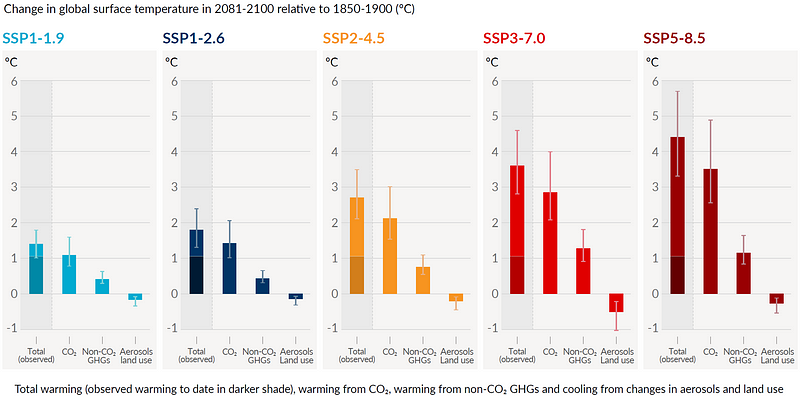
The two key messages I got from the IPCC report are that 1) climate impacts will see only moderate increases with an additional degree of warming and 2) potentially dangerous warming well beyond 3 °C will require an almost unimaginable expansion of unabated fossil fuel combustion.

Likely emissions trajectories

Let’s start with the second point. As shown in the two figures below, the pathways exceeding 3 °C of warming by 2100 show a continued rise in fossil CO2 emissions throughout the century. There are many reasons why that’s extremely unlikely to happen. Here are six:

  1. We don’t have unlimited cheap oil and gas and there’s a growing range of competitive low-carbon solutions that will prevent the exploitation of expensive oil and gas resources
  2. A large expansion of abundant coal will not be tolerated by increasingly wealthy populations
  3. There are low-hanging CCUS fruits that can decarbonize a significant portion of fossil fuel use at minimal cost as well as multiple CO2 removal solutions that can be deployed later this century if proven necessary
  4. The SSP5–8.5 and SSP3–7.0 emission trajectories reach atmospheric CO2 concentrations well above indoor air quality recommendations which will be unacceptable to all stakeholders
  5. Fossil fuels are great at building societies via heavy industry, simple and reliable power, and practical transportation fuel, but these benefits will fade later this century when most of the world is developed
  6. The idea of Life Efficiency may well gain genuine traction as a wealthier world grows more environmentally conscious and technology creates more options to consume virtually instead of physically
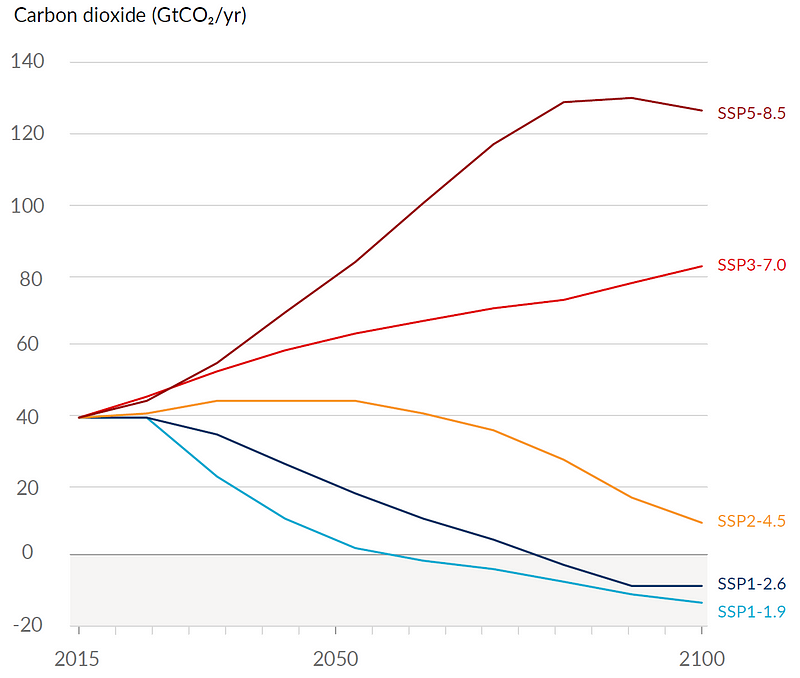
CO2 emission trajectories in the five scenarios covered by the IPCC
The change in global temperatures in the five IPCC scenarios

In my view, a trajectory somewhat below the SSP2–4.5 scenario looks like a rational target, resulting in a peak around 2.5 °C of warming and 550 ppm of CO2 late this century with a slow decline thereafter. Aiming for this scenario rather than the extreme 1.5 degrees pathway more than quintuples our remaining CO2 budget, creating a trajectory well-aligned with the six CO2 limiting factors listed above.

The effects of an additional degree of warming

But what is the cost of this much easier and more natural decarbonization trajectory? The following image gives one answer from the IPCC: If we reach 2.5 instead of 1.5 degrees, 10-year heat, precipitation, and drought events will become about 60%, 30%, and 41% more frequent (and slightly more intense).
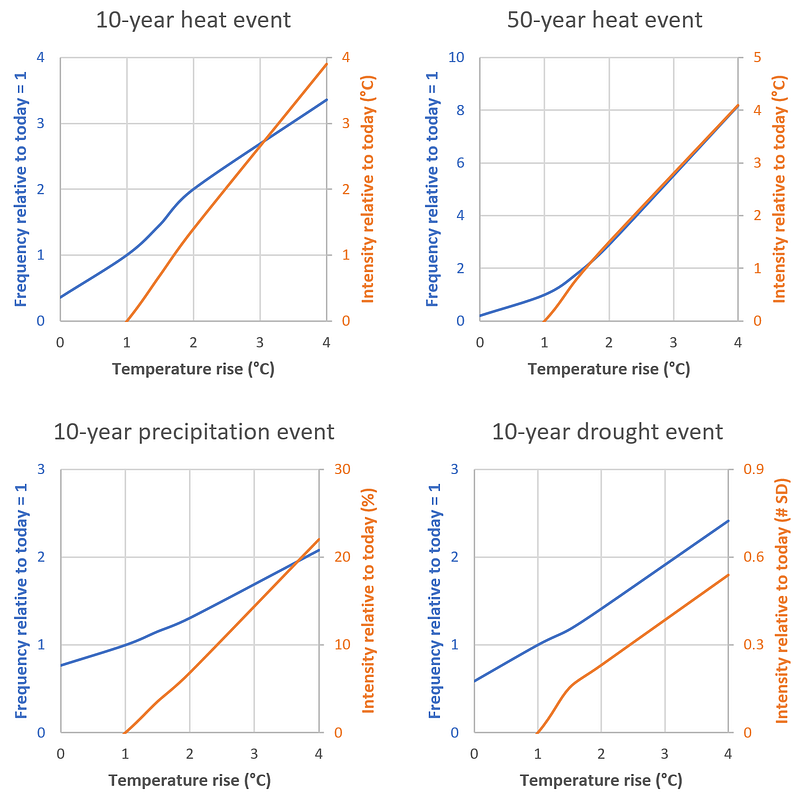
A representation of the data from the IPCC report with rising temperature levels. The 10 and 50-year event baseline is a system with no climate change. # SD = number of standard deviations increase from the norm.

Yes, this is a problem, but it certainly is not an emergency. Extreme weather events currently cause total economic losses to the tune of $259 billion. If we generously attribute half of those losses to climate change, it amounts to a little over 0.1% of global GDP. Furthermore, these losses (see the graph in this link) have been increasing proportionately to the global economy, meaning that the relative cost of climate disasters is staying constant despite our highly carbon-intensive development to date.

In terms of lives lost to natural disasters, the shielding effect of economic and technological development has totally overwhelmed any signs of new danger from climate change. Today, fewer than 1 in 100,000 people die from natural disasters annually. To get a sense of scale, note that heart disease kills about 230 people per 100,000.
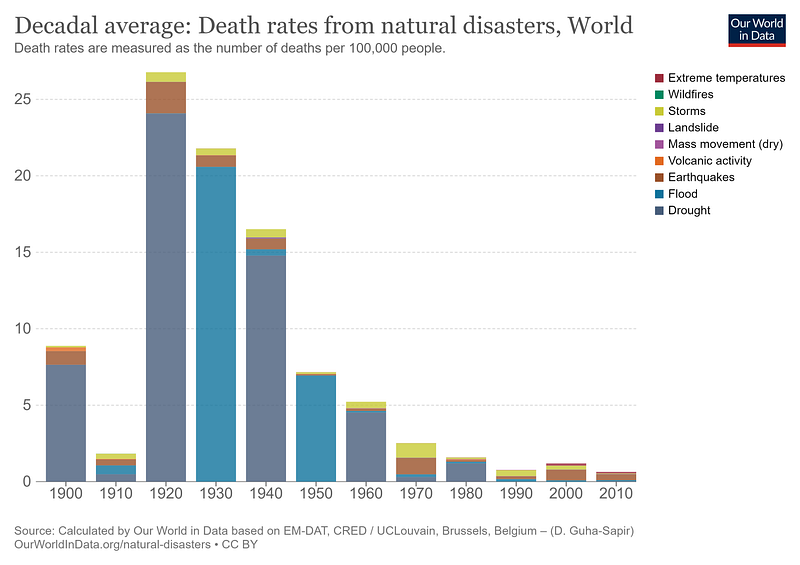
The long-term trend in mortality from natural disasters | Our World in Data

There are other costs (and benefits) to climate change, but extreme weather events fuel much of the media reporting behind the climate emergency narrative, so it’s important to put them into perspective. As far as I can tell, the costs from extreme weather linked to climate change are minor and will keep shrinking (relative to GDP) as we continue uplifting the poor while increasingly decoupling economic growth from CO2 emissions.

Other climate change effects highlighted by the IPCC are illustrated below. To summarize, 2.5 °C instead of 1.5 °C will give us 15% more arctic sea ice decline, 0.1 points of lower pH in the ocean, and 15 cm higher sea levels by 2100. None of these strike me as an emergency that demands we slash our remaining carbon budget by a factor of five at a time when 62% of the world still lives on less than 10 $/day.
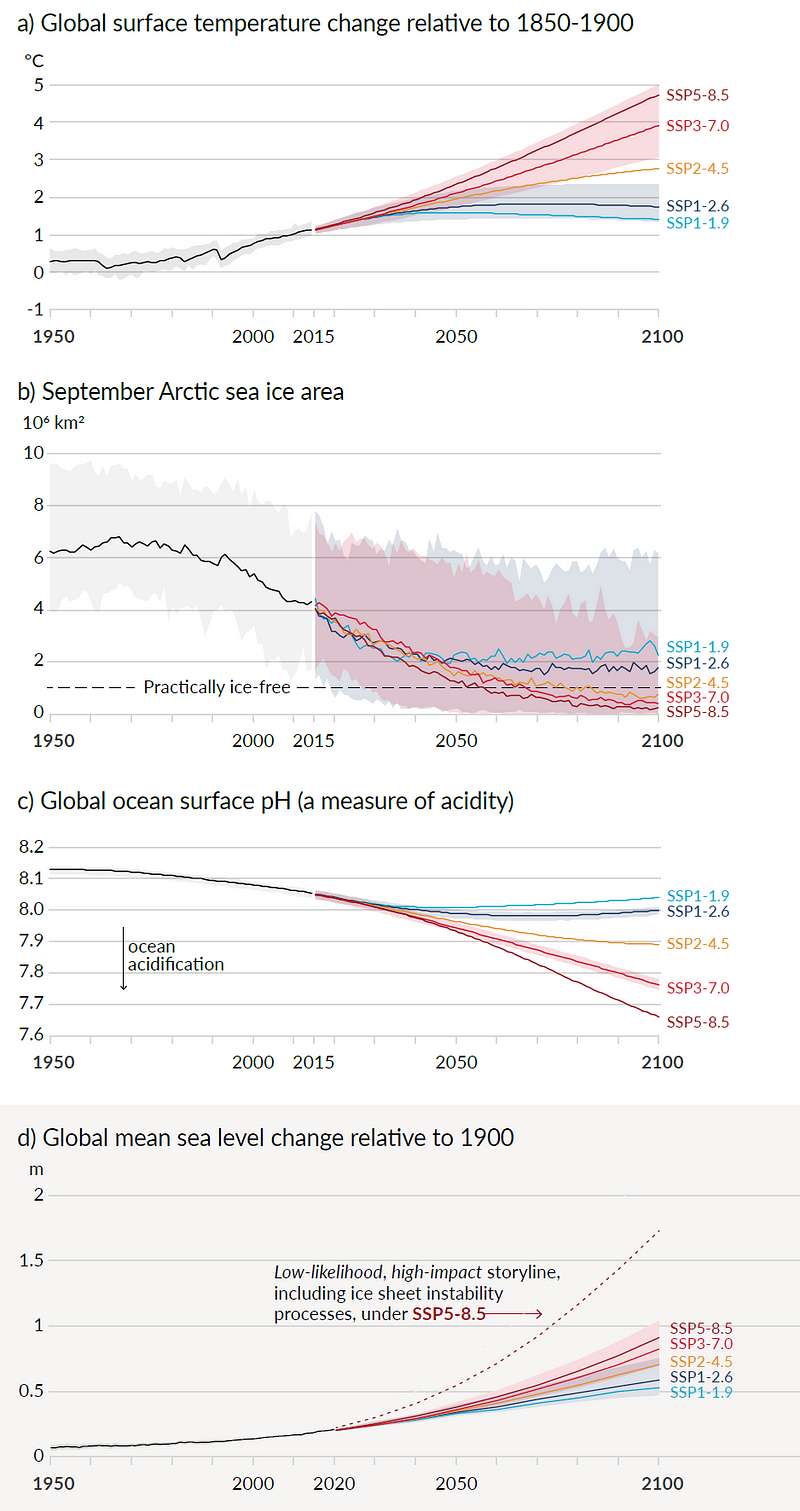
A summary of various climate change effects from the IPCC report

There’s another essential insight that can be derived from the figure above: The tangible effects of 1.5 and 2.5 °C pathways are almost indistinguishable before 2050. Thus, negative effects related to an additional degree of global warming will only be felt to a gradually increasing degree as our economy grows from ~3x to ~6x today’s size in the second half of the century. With such a massive increase in productive capacity, we’ll be much more capable of handling the projected gradual changes or rapidly responding to any low-likelihood-high-impact events (more about this in Section 2).

Uncertainty in climate sensitivity

Finally, it’s important to acknowledge the possibility that the climate may be more sensitive to anthropogenic forcing than our current best estimate. Here, the good news is that uncertainty ranges keep narrowing as our computational power and modeling expertise grow (one of the key conclusions in the IPCC report). Furthermore, recent estimates show considerably larger carbon budgets than before.

Currently, the 90% certainty band around 2.5 °C is ±0.7 °C. In other words, there’s a 5% likelihood that we eventually exceed 3.2 °C if we follow what we now believe to be a 2.5 °C pathway. I don’t think this fairly narrow uncertainty range significantly strengthens the argument for declaring a climate emergency. Furthermore, we’ll continuously be updating our knowledge and adjusting our ambition levels appropriately if future observations show that climate sensitivity is greater (or smaller) than we expected. And as mentioned above, we’ll possess multiple times more productive capacity (and technological prowess) later this century to respond rapidly to unlikely climate surprises.

2. Runaway global warming is extremely unlikely

The one effect of excessive greenhouse gas emissions that can truly qualify as an emergency is self-strengthening global warming caused by positive feedback loops. Luckily, the latest IPCC report put my mind to ease by concluding (in typical IPCC language) that 1) there is low confidence that such changes will occur this century, and 2) it is very unlikely that methane in deep permafrost and subsea clathrates will lead to detectable departures from emissions trajectories this century. It even says explicitly in FAQ5.2 that the feedback mechanism I was most concerned about, thawing permafrost, will not cause runaway global warming.

Unfortunately, the main IPPC figure on feedback mechanisms, although accepted, has not yet cleared final editing, so I cannot show it here (you can see it on page TS-131 in the technical summary). But the science behind it is very interesting, so let’s discuss it.

The IPCC data covers a range of feedbacks in two broad categories:

  • Climate system feedbacks. The Planck response (a warmer object radiates out more heat) is partially canceled out by positive feedbacks from water vapor, surface albedo, and clouds for a combined negative feedback of 1.2 W/m2/°C (very likely range: 0.5–1.8)
  • Carbon cycle feedbacks. CO2 uptake by the land and oceans increases with higher CO2 concentrations, leading to another negative feedback around 1.1 W/m2/°C (very likely range: 0.5–1.8)

Currently, the observed energy imbalance on planet Earth stands at 0.79 W/m2, conveniently at about 1 °C of warming. Thus, it is clear that the planet would have warmed much faster were it not for these natural negative feedback mechanisms.

The IPCC graph also shows one “independent estimate” for massive permafrost carbon releases with a combined positive effect of 1.7 W/m2/°C on the carbon cycle and biogeochemical feedbacks. I could not find a direct reference to the source of this extremely large number, and not even the maximum CO2 and methane release of 1040 Gton CO2eq (less than half our historical CO2 emissions) listed in Table 5.6 in the full report can justify it. If you know its origin, please let me know. The official range of the permafrost feedback is 14–175 Gton CO2 per °C of warming (FAQ5.2), which only has a 0.02–0.2 W/m2/°C positive effect already included in the climate system feedbacks given above (Figure 5.29 in the full report).

Thus, the likelihood of such a massive permafrost feedback probably lies well below 1%, given that it requires carbon releases that are an order of magnitude above the upper bound of the very likely (90% confidence) range given by the IPCC. And that’s not the only good news: Even such an extremely unlikely scenario would most likely still leave us in a self-cooling state, as illustrated in the next graph.
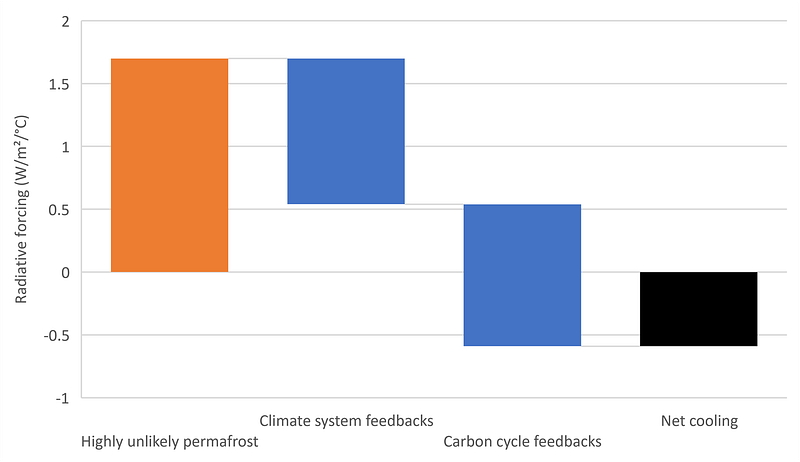
Even an extremely unlikely massive release of permafrost carbon is unlikely to result in a self-warming planet | Graph compiled from IPCC data

Still, there is a scenario where the planet can end up in a slight self-warming state: combining the extremely unlikely massive permafrost carbon release with very weakly negative climate system and carbon cycle feedbacks. Specifically, if we combine the uncertainty ranges of all feedback mechanisms, we end up with a total negative feedback in the very likely range of 1.3–3.3 W/m2/°C. Thus, there is a 5% likelihood that the combined negative feedback effect is below 1.3 W/m2/°C. This scenario, which is 20x less likely than the already extremely unlikely scenario illustrated above, will result in a weakly self-warming effect above 0.37 W/m2/°C.
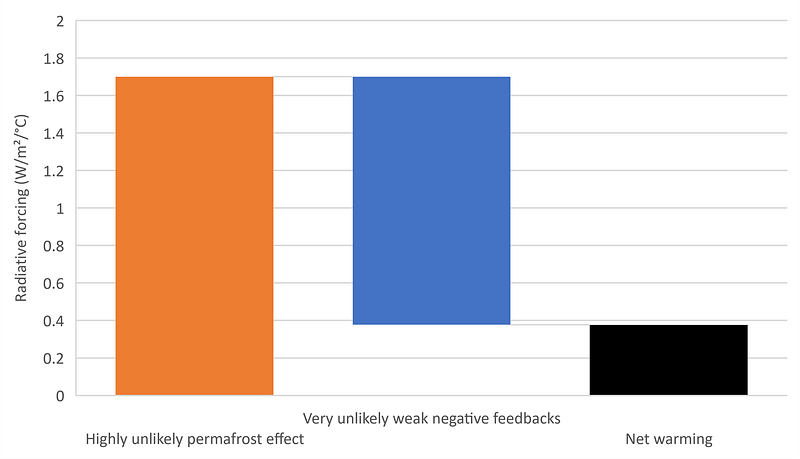
An almost vanishingly unlikely scenario where the planet enters a weak net-warming state | Graph compiled from IPCC data

Still, even if such a near-impossible combination of events occurs, we are not lost. Such a scenario would rightfully be classified as an international emergency (like the pandemic), and we will rapidly mobilize the resources and technology for addressing the problem. For example, the net warming in the figure above will be only about 20% of our anthropogenic forcing in a 2.5 °C world. Thus, we only need to undo a modest fraction of our prior forcing to cancel out this effect. To give just one example, removing CO2 using direct air capture for $150/ton at a similar rate to today’s emissions will cost only around 1% of GDP in the second half of the century when our economy is 4x bigger and other emissions are already low.

Cheaper and much faster-acting geoengineering schemes are also possible, although their side effects need to be carefully researched in the meantime. The simplest example is intentional aerosol releases to the upper atmosphere. Aerosols linked to SO2 and NOx currently contribute a large negative forcing of about 1.2 W/m2, which is already more than we would need to cancel out the net warming effect illustrated above. By the end of the century, this effect will be largely eliminated due to progress on air pollution, so recreating it intentionally (in the upper atmosphere and not in cities where these pollutants have direct health impacts) will be enough to counteract the extremely unlikely net warming scenario of combined massive permafrost release and very weak negative feedback mechanisms.

Thus, self-strengthening global warming is almost vanishingly unlikely, and even if it comes to pass, it’s well within our power to quickly put an end to it. Given that it’s virtually certain that such a scenario will not emerge within the next 50 years, we can insure ourselves very cheaply against this extremely unlikely event via R&D investments into a range of technologies capable of quickly reducing our large radiative forcing contribution.

3. There are benefits to more CO2 and heat

Climate change is commonly portrayed as 100% bad, which is simply untrue. While it’s fairly certain that costs outweigh benefits, especially in extreme warming scenarios associated with highly unlikely unchecked emissions growth trajectories, the benefits appear real and large. Two of these benefits deserve further discussion in this section.

As an aside, I’ve seen that discussing climate change benefits is a surefire way to get the “climate change denier” label, so please allow me to reaffirm that I fully accept the science of climate change before we continue. If my interpretations below are false, please let me know.

Global greening

First, we have our steadily greening world. As shown below, rising CO2 is a major driver behind a long-term increase in the amount of greenery on Earth. Interestingly, rising temperatures from climate change also have a small positive effect as more greening on the large landmasses in the far north cancel out browning in southern latitudes.
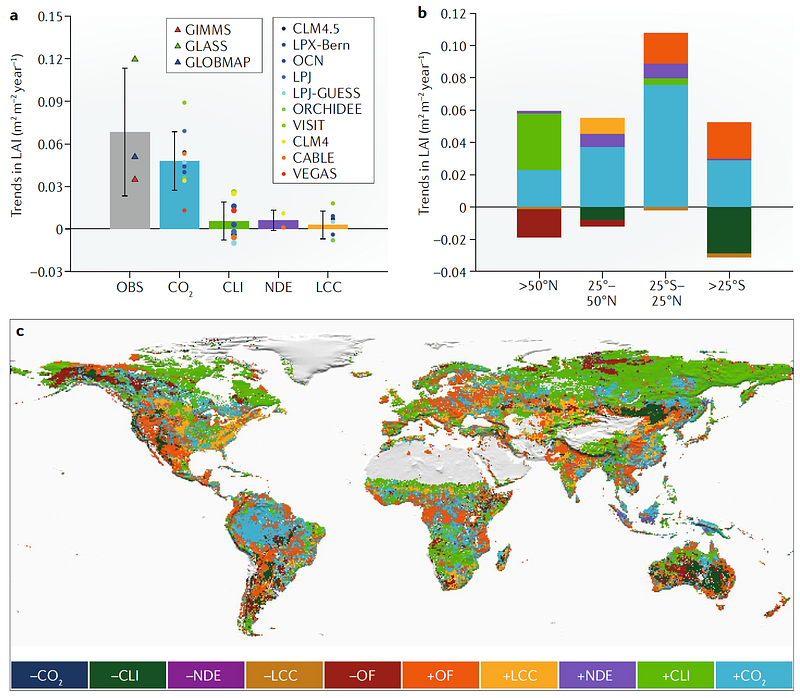
Trends in Leaf Area Index (LAI) attributed to CO2 levels, climate change (CLI), nitrogen deposition (NDE), and other factors (OF). Plus and minus signs indicate positive and negative effects of each factor | Piao et al.

Essentially all life on Earth depends on plant growth driven by water, CO2, and sunlight. Thus far, CO2 has been the limiting factor, but rising CO2 concentrations are alleviating this constraint. The IPCC also points this out in their assessment, stating that increased CO2 consumption by plants is the main source of the large land-based negative carbon-cycle feedback.

In agriculture, benefits from higher CO2 levels could cancel out almost all the losses from a more volatile climate (NASA paper). In northern countries such as Germany, increased CO2 concentrations are expected to outweigh negative effects from climate change going forward (below).
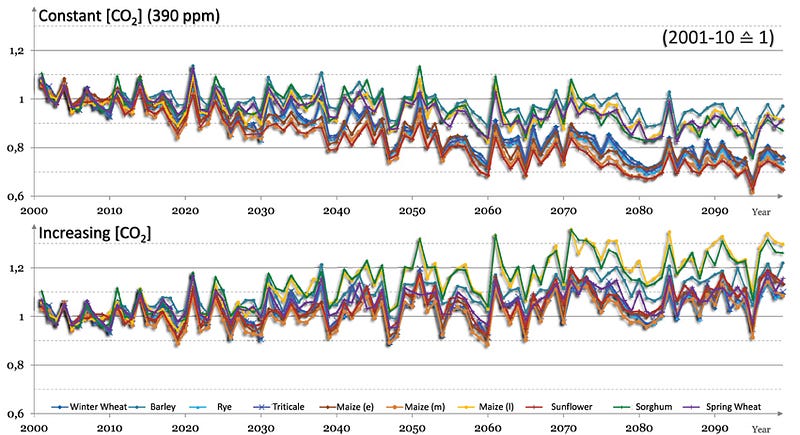
Effects of climate change in isolation reduce crop yields (top), but the inclusion of rising CO2 levels (bottom) overwhelms this effect to create a significant yield boost | Degener

Nature as a whole will also enjoy global greening to the benefit of humans and other species alike. This may moderate the effect of climate change on biodiversity, which appears to be substantial but considerably smaller than several other factors.
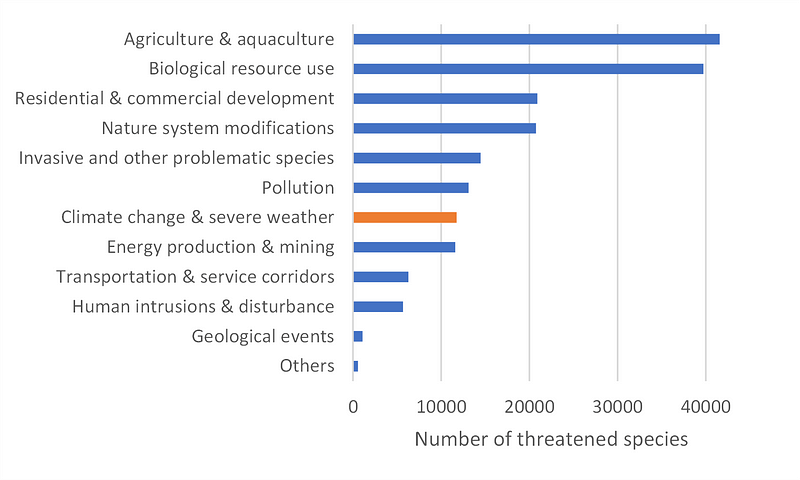
Graph depicting the classification of threats to species monitored on the IUCN Red List

Reduced cold hazards

The second major benefit of climate change (driven by global warming) is fewer cold spells. This is a big deal because cold is a much bigger threat to human life than heat, as quantified by a recent study. The map below shows the distribution of excess deaths from cold and heat (pay attention to the scales below the maps). Overall, the study estimates almost 10x more deaths from cold than heat.
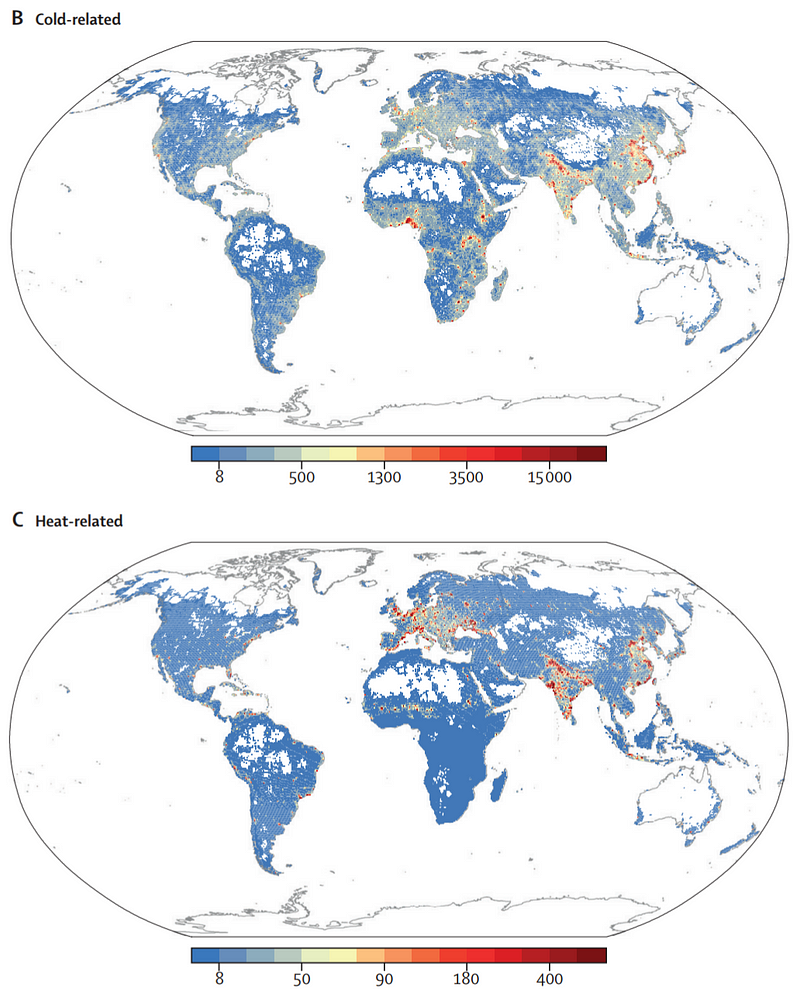
A distribution of excess deaths from cold and hot extremes around the world | Zhao, et al.

It’s easy to understand why cold is much more dangerous than heat. To stay safe in hot temperatures, you only need shade and water. On the other hand, protecting yourself from cold requires a sturdy and well-insulated dwelling and lots of energy to produce heat, which is orders of magnitude more expensive than shade and water. Also, in poor communities where the cost of shelter from cold is a serious problem, people tend to burn lots of wood, dung, and coal indoors, contributing to millions of deaths.
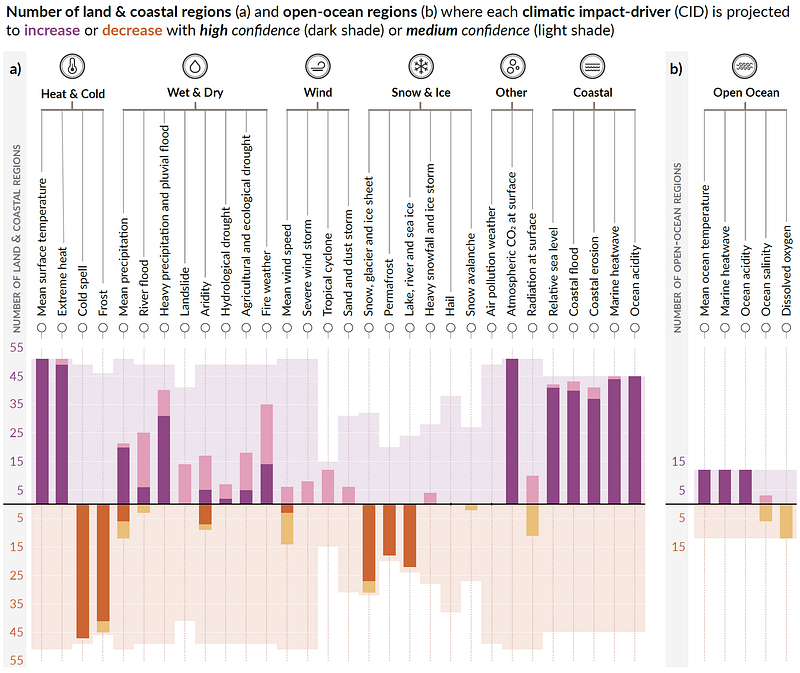
An IPCC graphic showing that climate change will reduce the prevalence of cold spells and frost as much as it increases the prevalence of extreme heat

As a result, the study estimates that, from 2000–03 to 2016–19, a warming climate has reduced cold-related deaths by 0.51 %-points while increasing heat-related deaths by 0.21 %-points for a net decline of 0.3% of all global deaths. Thus, warming caused by greenhouse gas emissions actually saves about 160,000 lives per year. If we account for all the warming before the year 2000, this number may well be 3–4x higher.

Global warming saving half a million people from temperature-related death each year is not something you’re likely to see in the mainstream media. In fact, several outlets (even Bloomberg) actually made it sound like this study suggests climate change is causing 5 million deaths per year (the total number of temperature-related deaths reported in the study, around 90% of which are linked to cold).

A climate change adaptation opportunity

If these benefits are indeed as significant as suggested here, we should not treat them as threats to the climate change movement, but rather as opportunities to enhance our climate adaptation efforts. Indeed, intelligent action to get the most out of CO2 fertilization and less cold could offset a significant fraction of the costs of climate change adaptation.

Given that these benefits will be concentrated in northern nations, the first adaptation strategy that comes to mind is upgraded immigration policies and integration programs to facilitate a natural and orderly century-long northward migration. When done well, such a migration will be mutually beneficial by limiting rising dependency ratios in the Global North and alleviating population pressure in the Global South.
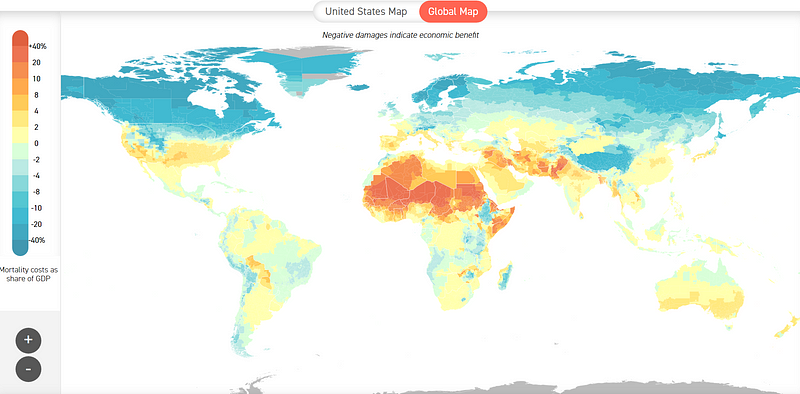
Climate-related mortality costs by the end of the century are projected to be negative in the Global North and positive in the Global South (especially Africa) | Explore the data on the interactive Climate Impact Lab map

Alongside other opportunities for adaptation discussed next, such a mutually beneficial response to higher CO2 and temperature levels can significantly reduce global climate change damages this century.

4. We are highly adaptable to a changing climate

Homo Sapiens is a highly climate-adaptable species. As shown in the graph below, we’ve survived through a very wide range of global temperatures across our 300 millennia history. And today, we’re orders of magnitude more capable of protecting ourselves against unfavorable climate effects than our ancient ancestors were.
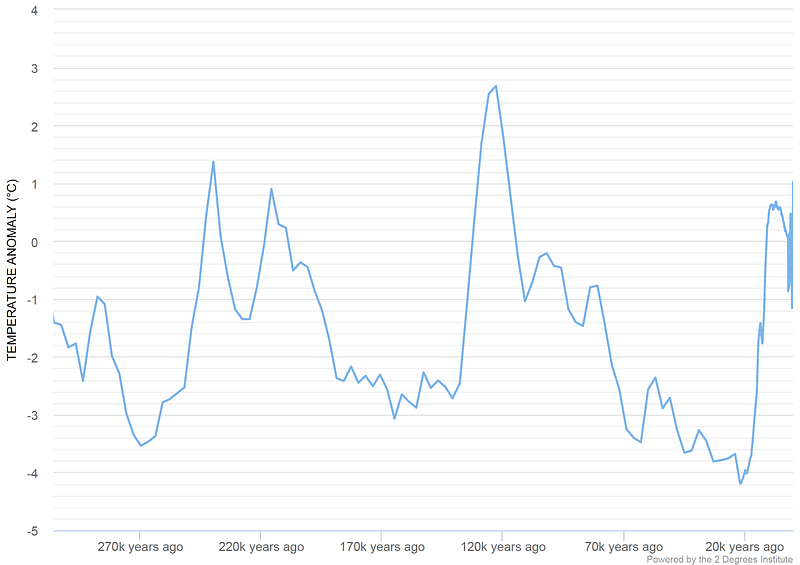
Long-term global temperature trends across human history | 2 Degrees Institute

We evolved for adaptation rather than mitigation

The main driver behind our great adaptability is our powerful evolved emotional response to immediate threats and opportunities. In contrast, we’re notoriously bad at proactively avoiding threats and creating opportunities in the future (especially the distant future). This tendency, which has frustrated climate change campaigners for decades, can be quantified. For example, studies show that the implicit consumer discount rate is very high, often above 20% (which helps explain the continued high levels of credit card debt despite 16% interest rates).
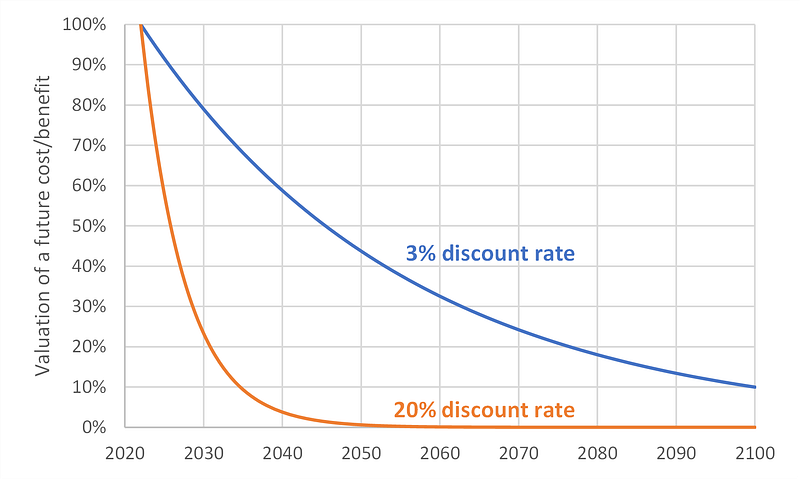
An illustration of how much less we value a future cost (like long-term climate damages from a ton of CO2 emitted today) if we use our implicit discount rate of around 20% relative to the 3% discount rate typically used to calculate the social cost of carbon (discussed in Section 5)

Generally speaking, climate change adaptation works with our natural instincts (reacting to solve existing or near-term problems), whereas mitigation works against them (paying now for reducing costs predominantly occurring in the distant future). Of course, this does not mean we should give up our climate change mitigation efforts, but it does mean that we can play the adaptation card much more aggressively. And the very best place to start is to do everything in our power to give the developing world exactly what it wants: rapid gains in standard of living.

The power of economic progress

Indeed, our first and best mode of climate change adaptation is economic development. There are many obvious ways in which a well-developed economy increases climate resilience: Solid housing and reliable utilities protect against more hostile weather, diversified connections to global food markets shield against poor local harvests, and an overall more productive economy makes it easier to absorb climate damages and to implement dedicated climate adaptation (and mitigation) strategies.

We should take great care that aggressive climate change mitigation schemes do not impede this progress, either via uneconomical transformations of foundational economic sectors or by rising geopolitical tension over the growing share of developing world emissions (e.g., pressurizing developing nations to rapidly phase out coal). In my opinion, a coal phase-out and even net-zero by 2050 are constructive goals for the developed world, but developing nations should be allowed to grow in the most efficient manner possible. If that involves coal, so be it. Our job is to innovate solutions that render continued coal investments unattractive, not to bully developing nations into uneconomical growth paths.
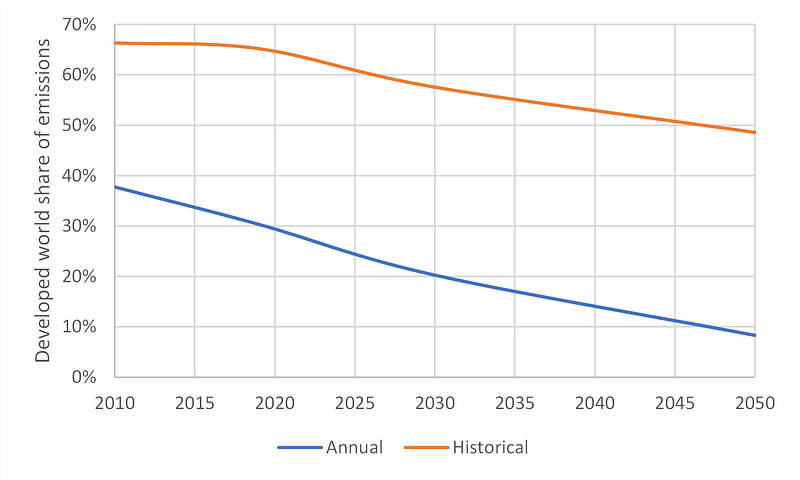
The projected share of developed world (Europe, North America, and Japan) CO2 emissions on an annual and cumulative basis | Graph compiled from the IEA World Energy Outlook and Our World in Data

It’s only fair after all. The historical emissions that facilitated the high standard of living enjoyed by the 15% of world citizens living in developed nations today are still double that emitted by the remaining 85% (see the graph above). That’s why the average US or EU citizen gets to consume 20x as much as the average citizen from the rest of the world (below). As further discussed in Section 5, eradicating this gross injustice through globally inclusive economic upliftment appears to be orders of magnitude more important for future prosperity than drastic climate action (in addition to offering great gains in climate resilience).

The current global income distribution where the vertical line represents the rich world | Gapminder

Sea level rise

Moving on to specific climate change adaptation opportunities, the much-discussed issue of irreversibly rising oceans deserves first mention. The IPCC says we’re in for a 2–6 m rise in the oceans if we follow an intermediate CO2 emissions pathway. There are online tools available to see the effects of such sea level rises (see a New York example below).
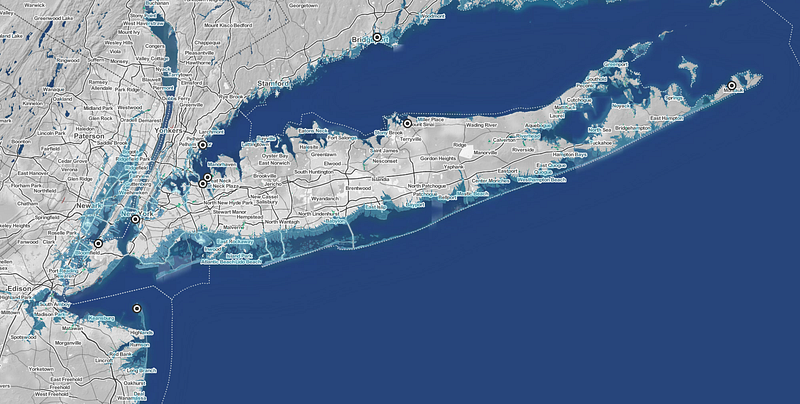
The effect of 5 m of sea-level rise on Yew York as illustrated by Climate Central

Even though it’s hard to even see the impact of 5 m of sea-level rise when zooming out to a global view, images such as the one above can be alarming. But then we read that the IPCC only sees these numbers 20 centuries from now. By 2100, the intermediate SSP2–4.5 scenario will only see about 50 cm higher seas than today.
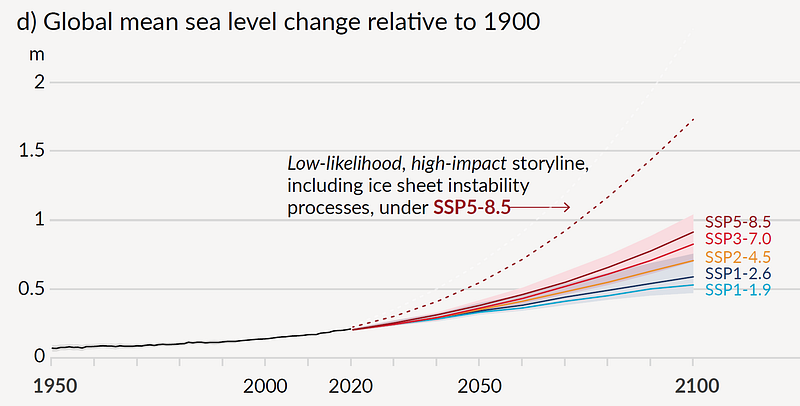
Sea level rise projections for the five IPCC scenarios

I have full confidence that we will comfortably adapt to less than 1 cm of annual sea-level rise (and even to double as much in a low-likelihood ice sheet instability scenario). Cities can realistically retreat from such a slowly advancing ocean and the cost of dikes (which we have centuries of experience with) to protect high-value coastlines or large low-lying areas will be a rounding error relative to GDP in 2100.

Agriculture

There is little doubt that farmers will need to gradually change the types of crops they grow as the local climate changes (the science of genetics can help). Furthermore, vast areas in the northern latitudes will become suitable for farming with further warming, with higher CO2 concentrations promising a welcome yield boost on these new farmlands.

If science issues concrete warnings of rare “perfect storms” of floods and droughts around the world leading to significant global food shortages, nations can simply build a strategic store of non-perishable food as insurance against such a low-likelihood event. It should suffice to store around 2% of our annual food production at a negligible cost (for perspective, we currently waste around one-third of all food).

Overall, humans are brilliant at making sure they have enough food (it’s one of our most fundamental instincts). Smart people have been predicting mass starvation due to rapidly growing human populations exceeding environmental constraints for centuries, but today we have so much food (despite all the waste) that obesity is a major global cause of death, increasingly also in the developing world.
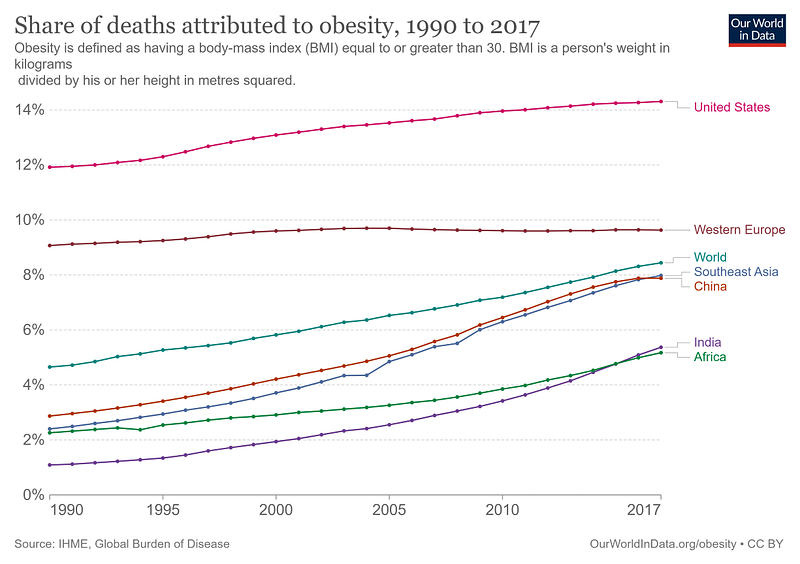
Deaths from obesity are rising rapidly in the developing world | Our World in Data

At 8.5% of global deaths shown above, one can infer that excessive food consumption contributes to almost 5 million deaths annually. This should be contrasted with 0.23 million deaths linked to protein-energy malnutrition, which is caused by our shameful inability to distribute resources to those who lost out at the lottery of birth, not by a lack of food.

So, rest assured that we will always innovate ourselves to more than enough food, especially now that population growth is slowing. One can only hope we gain better control over our primitive instinct for unchecked food consumption and get much better at helping those unlucky enough to be born into extreme poverty.

Individual action

One of the best things about climate adaptation is that concerned individuals have a lot of scope for proactive action. In fact, I see such measurable real-world actions as the true test of whether someone really believes there is a climate emergency. Here are some proactive adaptation measures to ensure that climate change has a negligible or even positive effect on the lives of yourself and your loved ones:

  • Maximize your Life Efficiency to decouple your health and happiness from a high-consumption lifestyle
  • Invest in technologies that reduce your carbon footprint in preparation for much higher CO2 prices
  • Move further north to a region where climate change could make life more comfortable
  • If moving is impossible, study the likelihood of different weather extremes in your area and ensure your home is protected accordingly
  • Don’t own property at sea level
  • Slowly build up a strategic food reserve

Innovation

Let’s round out this section with a few words on the innate human ability to rapidly innovate solutions to pressing problems (e.g., the rapid vaccine rollout during the Covid pandemic). When climate change impacts get large enough, innovation will naturally accelerate to limit future damages. Also, as mentioned in Section 2, there are many cheap and innovative ways to insure ourselves against unlikely climate surprises.

The best way to stimulate the required innovation would be to impose a CO2 tax (the most efficient way to decarbonize) and use a significant fraction of the revenues for clean energy and climate change mitigation & adaptation R&D. Although the current policy landscape remains far from this ideal, there are signs that we are moving in the right direction (e.g., the EU CO2 price is around 80 €/ton at the time of writing).

All told, I feel confident that humanity will comfortably adapt to 2.5 °C of peak warming. If we actively prioritize the upliftment of developing world citizens, the gargantuan and highly advanced global economy by 2100 will handle anything climate change throws our way. Overall, I’m much more concerned about overly ambitious climate change mitigation efforts inhibiting poverty alleviation and other key global priorities.

5. Drastic decarbonization brings serious opportunity costs

It has become completely acceptable and even admirable to demand a war-like effort to eliminate all fossil fuel use within impossibly short timeframes. The most extreme one I’ve seen is Extinction Rebellion which demands net-zero by 2025, which makes no sense.
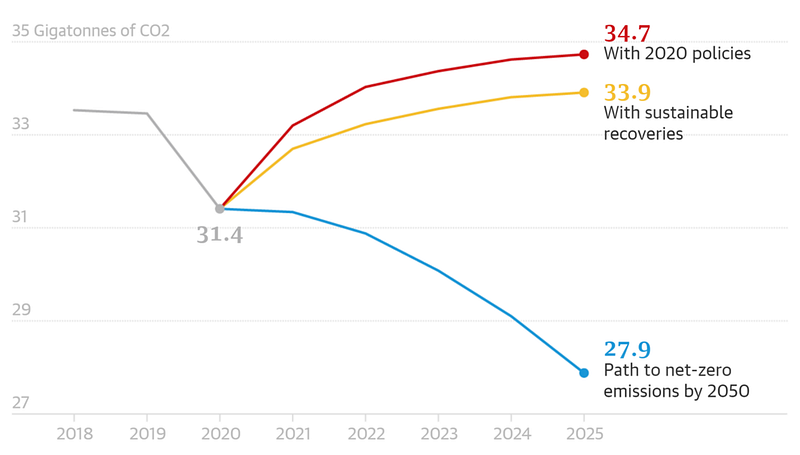
It is highly likely that global emissions will remain near an all-time high by 2025 according to IEA data presented by the Guardian

Unless we get some huge technological breakthroughs, the seemingly plausible “net-zero by 2050” pathways being churned out by think tanks around the world will be very costly and complex to implement. And this is especially true for the near-100% wind, solar, and electric vehicle pathways powerful advocacy groups like Greenpeace tend to favor. (Here are the challenges with deep decarbonization via wind & solar and electric cars for interested readers.)
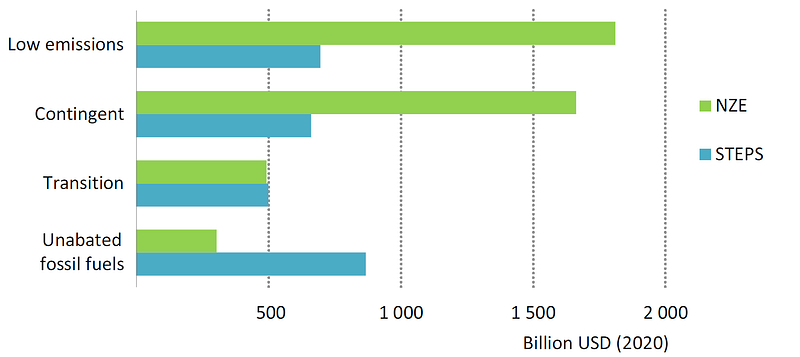
The vast difference in pre-2030 annual investment requirements between the Stated Policies (STEPS) and Net-Zero Emissions (NZE) Scenarios | IEA World Energy Outlook

As illustrated above, annual energy investment will need to jump by almost $2 trillion this decade to get us on track to net-zero by 2050. Also, we should not be surprised if experience eventually shows that the techno-economic and socio-political complexities involved in such a rapid and foundational transformation were badly under-represented in the model runs behind these numbers, leaving true transition costs much higher.

Opportunity costs

Recognizing the high direct costs of drastic decarbonization pathways is a good start, but understanding the opportunity costs (the problems we do not get to address because we spent so much time, attention, and resources on climate change) is more important. But first, we need a sense of proportion by estimating the climate change costs we could avoid via extreme action to limit global temperatures to 1.5 °C.

The costs avoided via drastic decarbonization

Based on all the reading I’ve done on the matter, I currently see climate change from fossil CO2 as a “1% of GDP” class problem. Although there are some wild outliers, mainstream estimates of the social cost of CO2 at around 50 $/ton (equivalent to 1.3% of global GDP) in policy planning and academia seem to back this notion. More importantly, a substantial portion of this cost is related to long-term damages in very rich futures simulated up to 2300 using low discount rates (more elaborate discussion).

For example, a commonly used short-term discount rate of 3% under conservative growth assumptions means that 15–33% of the costs we assume responsibility for (depending on whether damages stay constant or increase linearly with GDP) only occur after 2100 when the average world citizen is 3x richer. I find it difficult to understand such assumptions. As described earlier, it will take only a tiny fraction of future generations’ vast additional wealth (created by today’s investment and innovation) to adapt to a changing climate and, if necessary, remove CO2 from the atmosphere.
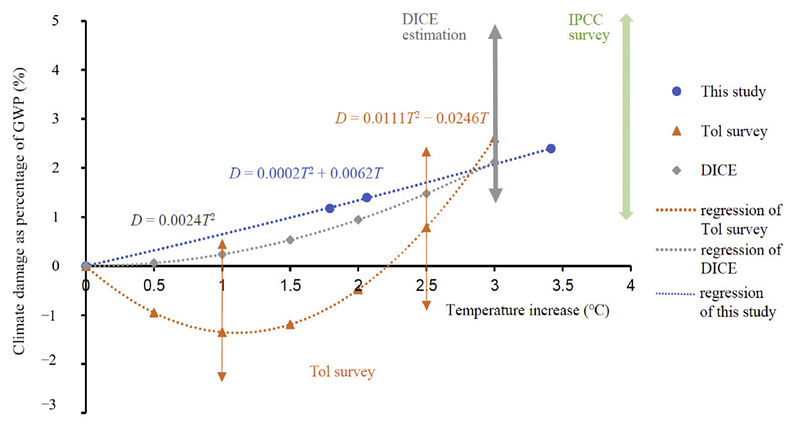
A summary of different surveys and model predictions of climate damages as a percentage of global GDP | Zhao et al.

Yes, if there was a reasonable likelihood that a lack of extreme action on climate change can make future generations worse off than we are today, we should certainly take more responsibility for the damages that today’s emissions will still be causing in the distant future. But the likelihood of such a scenario appears to be very small. Even in Shared Socioeconomic Pathway 3 (SSP3) where we do essentially everything wrong (lack of cooperation, slow technological progress, poor education, and rapid population growth), the average world citizen is projected to be almost 2x better off in 2100 than today. A continuation of current trends (SSP2) leads to a massive 5x gain in prosperity.
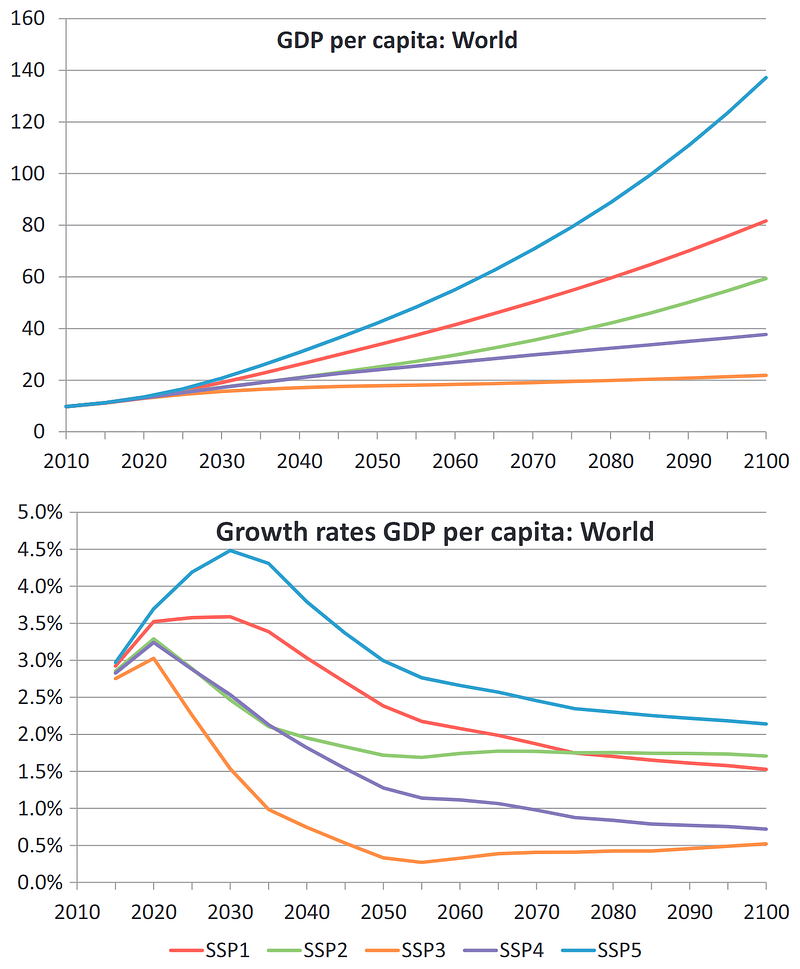
The bright prospects of future economic development | Dellink et al.

What really shapes the prosperity of future generations?

An even more striking insight from the figure above is that the way we organize our economy is in the order of 100x more important for future prosperity than climate action. For example, challenges to climate change mitigation are similar in SSP3 and SSP5, but incredibly, GDP per capita by 2100 differs by a factor of almost seven.
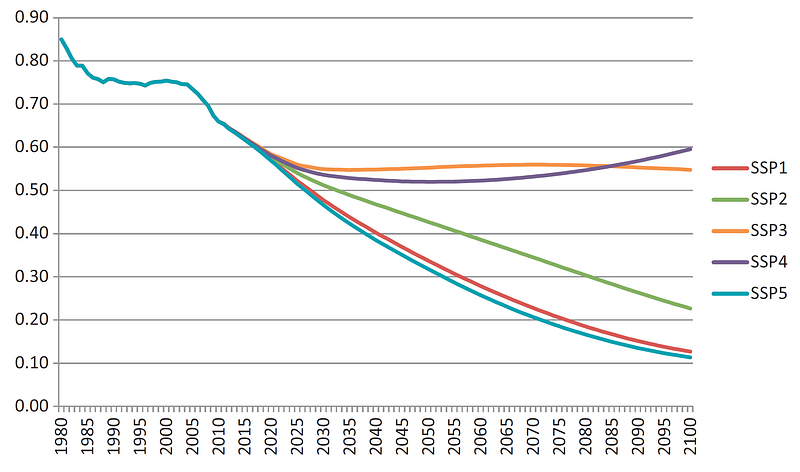
This graph of between-country Gini-coefficients in the different SSPs shows that globally inclusive growth is a major factor in the vast prosperity growth in SSP1 and SSP5 | Dellink et al.

So, what does SSP5 have that SSP3 doesn’t? Massive, globally inclusive investments in human and social capital, fostering innovation, optimizing health, and naturally limiting population growth. And that brings me to my big worry with net-zero by 2050: it gives disproportionate weight to a factor with seemingly little influence on future prosperity, distracting from the factors that really matter.

The opportunity costs of declaring a climate emergency

Indeed, the direct and opportunity costs of prioritizing a climate emergency above all our other challenges could do serious harm to the prosperity of current and future generations alike. While an extra degree of global warming looks like a “1% of GDP” class problem with damages concentrated in a much richer longer-term future, today’s world faces many critical problems, several of which have impacts happening right now falling in the “10% of GDP, millions of preventable annual deaths” class.

Chief among these is the extreme state of global inequality of opportunity (e.g., an average developed world citizen at the 95th percentile gets to consume as much as 50 people at the 5th percentile simply because of his fortunate birthplace). In response, we spend just over 0.1% of GDP on development assistance and aid for the developing world.

The current global income distribution where the vertical line represents the developed world | Gapminder

As mentioned in Section 4, uplifting billions of vulnerable global citizens on the left of the income distribution also offers outstanding protection against climate change. I would not be surprised if a massive effort on globally inclusive economic upliftment, in addition to the myriad societal benefits it will bring, also prevents more climate change-related suffering than a mitigation effort of similar magnitude to limit global warming to 1.5 °C.

And that’s the crux of this section: We need to focus on what really matters for current and future prosperity. The last thing I’m suggesting here is that we tone down our mitigation plans to 2.5 °C and do nothing instead. What I’m suggesting is that we redirect the 1.5 °C level of ambition toward much larger problems like extreme inequality of opportunity, our self-inflicted lifestyle disease epidemic, and unsustainable population growth in Africa.

The highly prosperous Shared Socioeconomic Pathways, SSP1 and SSP5, look amazing. Let’s prioritize our efforts carefully and make this future a reality.

Comments are Welcome

As stated in the introduction, I welcome evidence-backed critiques of the central argument in each of the five sections above. Although I hope (for the sake of the world) I’m right on the moderate negative impact of climate change relative to all our other challenges, I would personally benefit strongly if the world puts all that “net-zero by 2050” talk into action. Thus, I have no incentive to resist reasonable feedback.

I’m looking forward to a constructive discussion!

Climate Change
Sustainability
Economic Development
Poverty
Politics
Recommended from ReadMedium