
Nervous ChatGPT Will Steal Your Programming Job?
A Guide to Coping with AI for Anxious Software Developers
I wrote a polarizing article titled ChatGPT Will Replace Programmers in 10 Years in February. In the months since, it’s gone viral, being featured in Business Insider, spawning Reddit threads, and so on. The reception to the article was mixed, with comments leapfrogging from gracious to incredulous to outright nasty.
One of the common threads that emerged is that software engineers are anxious about losing their jobs. I was asked about this point time and again. In fact, I wrote the article solely to exorcise my own fears on the topic. Unsurprisingly though, very little has been written about developer anxiety. To pull back the curtain, I will address the topic head-on by providing coping strategies and an action plan to weather the coming storm.
Programmer Anxiety and Imposter Syndrome
Outsiders may be surprised to learn of our industry’s high ambient anxiety levels. Like a still pond, software engineering on its surface seems inviting, cool, calm, and a bit boring. But percolating just below is a full-blown ecosystem — predators, prey, survival, fitness, thrills, success, and failure, all the makings for chronic anxiety. How did this come to be in a job where you just “play with computers all day,” as my wife would say? Here are eight reasons off the top of my head:
- Programming is done in plain view — your work is reviewed and criticized by other engineers daily, which can become toxic
- The industry glamorizes rockstar developers — prioritizing hustle over happiness and burnout over balance
- Requirements are vague and ever-changing; deadlines are not
- Engineering inspirits a sedentary lifestyle of stress, sitting, and sugar
- Management views us as a bloated cost center, just one capricious decision away from unmerited downsizing
- High-skill, high-paid individuals are expected to perform at all times, leading to an epidemic of tech burnout
- Landing a new job is really hard — think multi-hour coding gauntlets
- The skill gap in dev teams is vast, but onboarding, training, and knowledge transfer are rarely prioritized
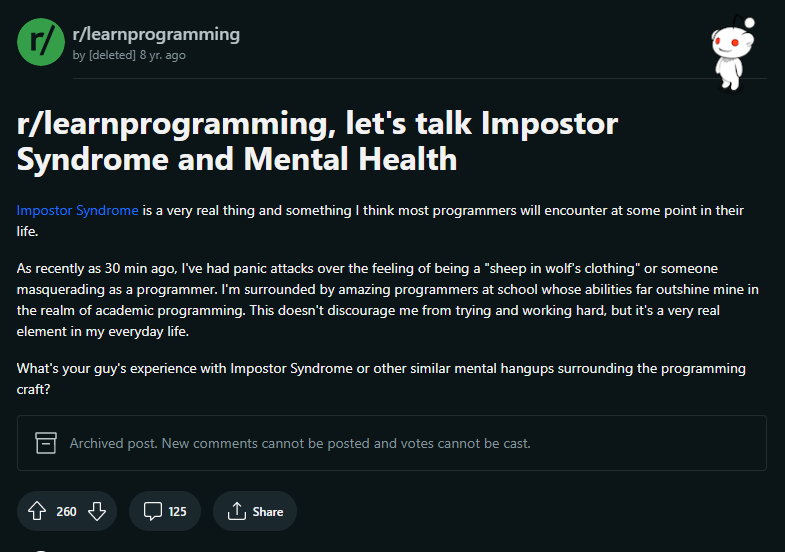
It's no wonder then, that imposter syndrome pervades the industry.
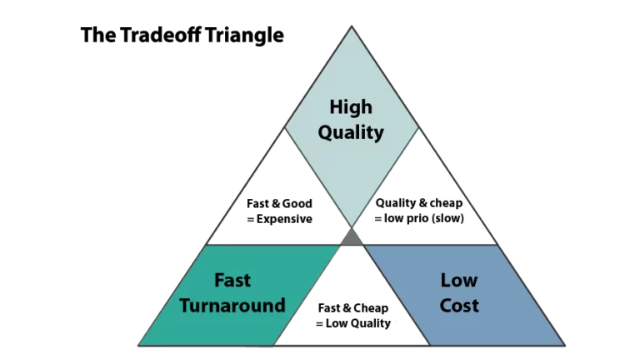
On some level, engineering is horse-trading. The goal of management is to complete projects, to some expectation of quality, as quickly and cheaply as possible. I’m referring to the tradeoff triangle — the renowned shape that depicts the stable equilibrium between expectations and reality. In some sense, the stress, pace, constant churn, and stability of programming jobs are explained and contained within these three edges and vertices. Until now, that is.
AI Is Making it Worse
So given the baseline anxieties of the last section, consider what it’s like being a software developer in 2023. I wake up in the morning, and my LinkedIn, Twitter, and Google News look like this:
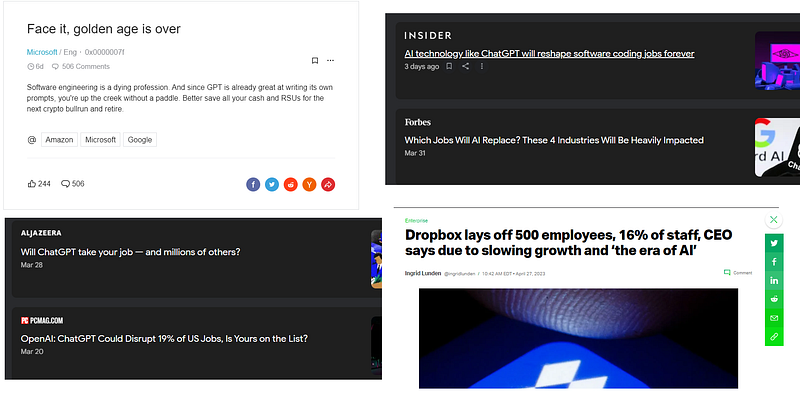
I don’t have time to dwell on it; I’ve got a job and family to attend to. But occasionally, I’ll come up for air and survey the landscape, only to find it transformed yet again. Just consider the past 5 months:
- Dec — ChatGPT debuts in a watershed moment, obliterating our prior conceptions of AI. It’s not great at joke-telling, but it sure can code.
- Jan— Microsoft goes all in with OpenAI and integrates GPT into everything. Everyone is talking about it.
- Feb — The entire industry ramps up on AI; new startups and breakthroughs are arriving at an unprecedented pace.
- March — GPT 4 comes out. It’s exponentially better at everything, especially programming. Most people don’t have access to it, so we impotently sit back and watch.
- April — AI Agents appear, a proof of concept demonstration of AI as a total replacement instead of just an augmentation.
The hypersonic pace of AI innovation is stressful in and of itself. While the future is unpredictable, can there be any doubt that programming will change more in the next 5 years than it has in the last 20? Imagine you’ve just settled into your life — excellent job, kids, mortgage. Time to go on autopilot for a bit and focus on other priorities? Nope.
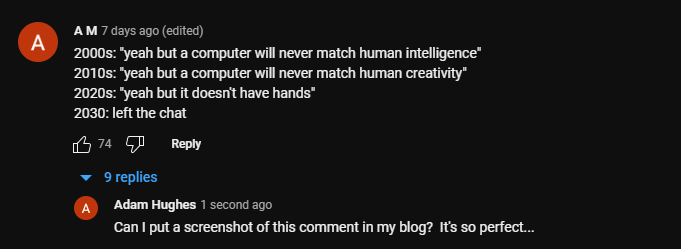
Now heap an existential crisis onto the stress ball, and I don’t mean that hyperbolically. ChatGPT is a threat to Google’s $162,000,000,000 ad business. The way the average user interacts with digital information may fundamentally change. As AI agents become the primary human-machine interface, where does that leave sites like Google and StackOverflow?
Seismic events reshape landscapes in unpredictable ways. Your job and or entire industry may not exist in three years. Or droves of ex-FANNGers may be coming for your position, they having been squeezed out. Or perhaps humans simply don’t code anymore. All of these are real possibilities and are entirely out of your control.
But Surely My Job is Safe
You may think that this is all copasetic because it doesn’t apply to your job. For what it’s worth, I hope you’re right. But have you really thought it through? I’ll lean on Aki Ito’s “The End of Coding As We Know It” for common objections — full disclosure, I am in this article.
Senior devs are safe — only juniors need to worry. If AI were to replace junior devs, it’s effectively extinction by castration. But even in the short term, there is cause for concern. Quoting from Ito’s article:
“Intuitively, you would think seasoned veterans — those who already spend less time coding and more time on abstract, higher-order, strategic thinking — would be less vulnerable to AI than someone straight out of college tasked with writing piecemeal code. But in the GitHub study, it was actually the less experienced engineers who benefited more from using AI. The new technology essentially leveled the playing field... they [senior devs] won’t be able to justify their astronomical salaries.”
AI will make us more productive, which is typically the next counterpoint — that there’s an unbounded upper limit on the appetite for software. I find this unpersuasive. First off, companies like Dropbox have already cited AI as a primary driver for layoffs. And while they may just be scapegoating, it’s hard to imagine even the most streamlined corporation keeping pace with AI’s exponential growth curve. For example, as Ito points out, measurable productivity gains from nascent tools like GitHub CoPilot are at a whopping 56% (source) — it’s not hard to imagine 3–5X productivity gains in only a few years. At that point, management is faced with a decision: either shed engineers for immediate cost savings or retain them and gamble on potential revenue gains from future productivity. What do you think they’ll do? Elon did precisely this at Twitter.
Where are autonomous vehicles (AV)? The specious claim that AI generally will track with AV is quickly dispelled. LLMs like ChatGPT exist in a purely digital form, have physical or pre-existing regulatory barriers, and are over-delivering on their promises. Furthermore, while AV needs to account for every possible edge case pre-launch (think shopping bag flying on the road), LLMs can be deployed incrementally and immediately.
Governments will step in. The incentives for first-to-market AI products are staggering — likely in the hundreds of billions over the next few years. Putting that aside, we’d still need an effective government to take action. Consider its track record in this arena. We have rampant identity theft and scam calling; 600 million ransomware attacks globally in 2022; our personal data being mined by Facebook and then sold and leaked by Equifax… the list is endless, and governments have proven hapless.
“Nothing else in the world…not all the armies…is so powerful as an idea whose time has come.” — Victor Hugo, The Future of Man
How to Cope
So far, I’ve painted a bleak picture. You may be feeling worse about the situation on the whole than when yous started the article. That’s ok — it was intentional. Because the first step to addressing anxiety is being honest with yourself about the worst-case scenario.
“You can’t stop the waves, but you can learn to surf.” — Jon Kabat-Zinn
- The first step is to recognize general anxiety symptoms and understand that you’re exhibiting a normal response to life-altering events. Boilerplate recommendations include limiting alcohol and caffeine and improving sleep, diet, and physical health.
- Next, recognize that you’re not alone. Every engineer I’ve talked to about this has confessed some worry — ranging from a nagging suspicion to outright panic. Whatever happens, you’ll not be alone in the trenches.
- Keep perspective of what you’re up against. Modern AI is the digital apex of so many achievements. It is the culmination of the information age — the internet, trillions of dollars, millions of engineers, and 50 years of innovation in the combined CS and AI research fields. Nobody can compete with that.
- Keep perspective of how good you have it. You live in 2023. Your job is at risk of being automated. So? Imagine the reaction of someone who lived in 1349, arguably the worst year in history, who had to deal with the rampant plague, famine, earthquakes, and genocide.
- By the way, obsolescence is the fate of every engineer. Even if AI hadn’t come along, 99.9% of your work would be lost in 20 years, if not sooner. Software is built in sand, not stone.
- Still, what we’re experiencing is genuinely unprecedented. Recognize and accept this is a unique and scary time, and allow yourself to feel its ensuing weight.
- It’s ok to disconnect. I’m not saying to ignore it — that will lead to worse or new symptoms. But you shouldn’t be on Twitter at 3 AM; turn it off.

- While you are disconnected, do something physical. Exercise is crucial to managing anxiety, from a gentle walk to a Muay Thai sparring session. In fact, now that machines are matching me intellectually, I’ve developed a newfound appreciation for my body.
“Worrying means you suffer twice” -J. K. Rowling
- Comprehend your worst case. Imagine programming is gone, and AI manages all information processing. What would you do? What is your biggest fear? Is it that you’ll miss rent or can’t save for your daughter’s college? Ok — what then? Perhaps you’d Uber part-time. Maybe you’re like me and wouldn’t mind being a janitor and listening to audiobooks while scrubbing toilets. See it clearly in your mind — put yourself there. Truly accepting the worst case will restore control.
- Finally, and most importantly, take action. The subsequent section is dedicated to immediate steps to weather the storm.
Action Plan For Today
If you still have a job, you’re in the black. But if not, all the advice herein can be applied to your former employer or any peer group.
- First, think like a manager. If cuts were coming, would you be the first to go? I lost my job during the pandemic because I wasn’t contributing to the critical paths. I had been working on shiny side projects instead of mundane critical systems like invoicing. Position yourself into core flows and give the executives obvious reasons to retain you.
- Be frugal — now isn’t the time to overspend. Interest rates are high; avoid unnecessary debt as much as possible.
- The market will be flush with strong candidates; how will you stand out? Beef up your online presence; become more active on LinkedIn; follow and comment on interesting content. Imagine your activity as a portfolio — it’s time for aggressive growth. Make a YouTube video; star a GitHub repo; start a blog; get on a podcast — make these small investments and let the interest compound.
- Embrace any opportunity to work with AI. Find a way to use ChatGPT and CoPilot at your job. Be the first on your team to do a cool demo and get noticed. What is your business domain — how will AI change it?
- Are you feeling burned out, passionless, or detached? You’ve got to get back into peak form. Take on a new project; switch teams; find something to break the burnout and stop coasting.
Action Plan For Tomorrow
The advice in the last section will buy you some time to focus on the future. In this section, we hedge for the long term.
- Pick a second specialization. Are you currently an Angular developer who has put off learning React? Good — don’t learn it. AI tools will soon make framework translation trivial. Instead, focus on something entirely new. What else could you do if your current job no longer existed (cough, web developer)?
- We will need an army to build and grapple with AI in the next five years. Skill up in data science, cryptography, regulation, ethical hacking — anything that puts you into the conversation. Lean into AI.
- Consider joining a startup, starting a company, or building a product. This is a majorly disruptive time, with immense opportunities to cash in. Businesses have been supercharged by LLMs. For example, Grammarly evolved from a spellchecker to a full-blown editor. Or check out DoNotPay.com, a robot lawyer that negotiates parking tickets, manages streaming subscriptions and even argues with cable providers!
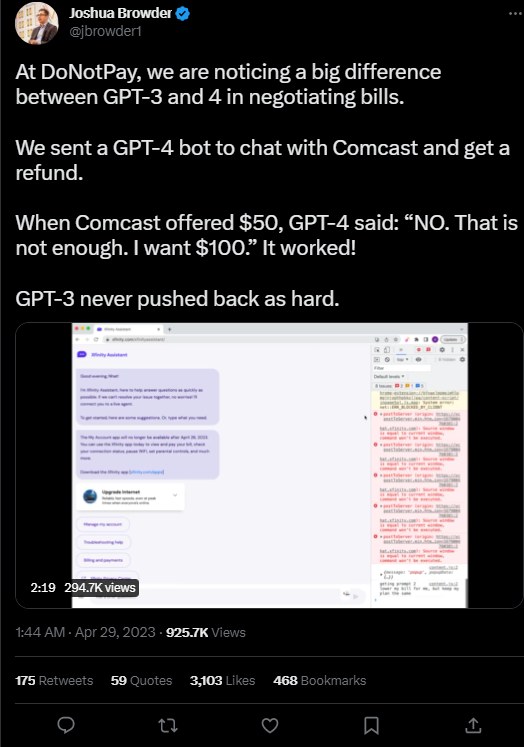
- Have a backup career in mind. I get it; this is a lofty ask. But it’s likely that opportunities in programming, even information processing in general, will dry up in the next decade; they’ll most certainly pay less. Fortunately, similar fields have a foothold in the physical world. Considering robotics isn’t keeping pace with AI, these should provide a haven for digital refugees. Some that come to mind are mechanical, environmental, agricultural engineering, biotech, medical, and defense.
Hopefully, this will blow over. But what if it doesn't? What if, indeed, the golden age of programming is over? The thing about golden eras is they don’t come around often. They’re like perfect sunsets… beautiful and fleeting and rare. I can’t say what the next 10 years will bring — hell, I can’t see past the next 10 weeks. But I am sure of this: we’re living through enlightenment, and the horizon is, if nothing else, bright. Whether that’s the last gasp of a dying sun, the breaking of a new dawn, or the blinding flash of an atomic bomb remains to be seen.

Agree? Disagree? Leave a comment or tweet me at @hughesadam87


