avatarAdam Hughes

Summary

The website content provides an overview of AI agents, detailing their role in automating tasks through feedback loops, their construction upon existing AI models like GPT-3.5 and GPT-4, and showcases examples of their applications, such as automated writing teams and simulations of human behavior, while also offering resources for users to try out and explore AI agent technology.

Abstract

The provided web content introduces the concept of AI agents, which are autonomous systems capable of interacting and completing tasks without human intervention. These agents are designed to be role and goal-oriented, functioning similarly to human teams by utilizing feedback loops. The text highlights that AI agents are built on advanced AI models, with GPT-4 being the latest but less accessible due to early access restrictions, while GPT-3.5 is more commonly used, including in ChatGPT. The article presents several open-source tools for AI agents, such as Auto-GPT, AgentGPT, BabyAGI, and GodMode, and illustrates innovative applications like WritingGPT for content creation and research simulations that mimic human social behavior. Additionally, it provides a direct link for users to experiment with AgentGPT in their browser and offers guidance on setting up these AI agents, including the need for an OpenAI API key and considerations for potential issues like API request limits and the tendency of GPT-based agents to "hallucinate."

Opinions

  • The author expresses enthusiasm about the capabilities of AI agents, emphasizing their potential to automate complex tasks and create emergent social behavior in simulations.
  • There is an appreciation for the versatility of AI agents, as evidenced by their ability to generate creative content and even develop new games from vague prompts.
  • The article conveys a positive outlook on the accessibility of AI agent technology, offering open-source tools and resources for users to engage with these systems.
  • The author acknowledges the challenges and limitations of AI agents, particularly their propensity to amplify errors inherent in GPT models and the need for usage limits due to rapid API requests.
  • There is an implicit endorsement of the open-source community's contributions to the development of AI agents, with tools like Auto-GPT and AgentGPT being highlighted as significant innovations.
  • The provision of a quick install guide and the invitation for reader contributions suggest a community-driven approach and a commitment to ongoing learning and improvement in the field of AI agents.

A Friendly Intro to AI Agents

Quickstart and Concepts of Auto-GPT & AgentGPT

Photo by Alex Knight on Unsplash

What are AI Agents?

  • Agent AIs (or autonomous AI) involve chaining inputs and outputs between AI systems so that they interact without human intervention
  • Agents are typically role and goal-oriented. They achieve tasks through feedback loops similar to human teams
  • Agents are built atop existing AI models. GPT-4 is the latest-and-greatest, but is only available as early access. GPT 3.5 is the more ubiquitous model, which also underlies ChatGPT
  • Examples of open-source Agent AI tools Auto-GPT, AgentGPT, BabyAGI, and GodMode

Cool Things Built with AI Agent

  1. WritingGPT — a fully automated writing team. The author sets up AI agents with roles writer, copywriter, SEO-optimizer etc.. and then lets the system crank out interesting articles that pass plagarism detection (uses GPT4) and end us as ranked search results!

2. Research simulating human behavior (read the paper or see it in action). Agents are given human objectives like “plan a birthday party” and word of it spreads around town — truly emergent social behavior!

pre-computed replay of a simulation that accompanies the paper entitled “Generative Agents: Interactive Simulacra of Human Behavior”

3. Python Agents that build tic-tac-toe and other games from scratch. Amazingly, even a vague prompt like “make an interesting new game” results in a fully playable creation!

I want to try it out now

You can try out AgentGPT in your browser immediately and for free: https://agentgpt.reworkd.ai/
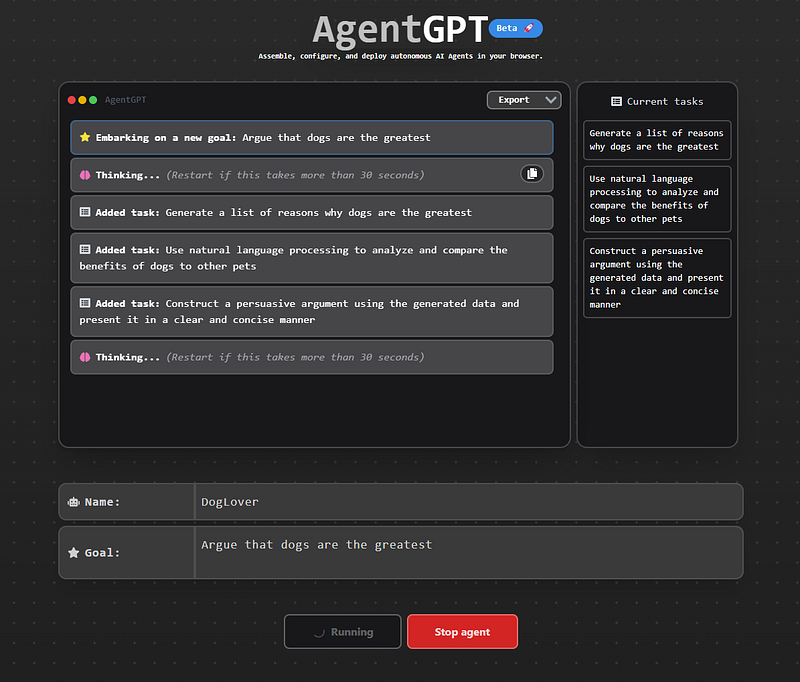
Deploying an agent with the goal to argue dogs are the greatest

Agents are created, they autonomously set up a task list, and then act upon it to produce content. In this case, it came up with the task construct a persuasive argument using the generated data and present it in a clear and concise manner and went on to make arguments like

“In addition, dogs are known to boost our physical and mental health. Research has shown that owning a dog can reduce stress, anxiety…”

I Want to Go Deeper

  • AgentGPT and Auto-GPT are open-source Python projects that can be run on your device
  • You will need an OpenAI API key
  • Auto-GPT is made for GPT4, but that’s still in early access. Both can be run with GPT3.5 (model underlying ChatGPT)
  • For a quick Auto-GPT install guide, see this post from the PyCoach.

Gotchas

  • Agents based on GPTs can amplify faults with GPT, for example, are prone to hallucinations.
  • AgentAIs make rapid API requests, so you may need to purchase OpenAI’s pro plan and I suggest setting usage limits.
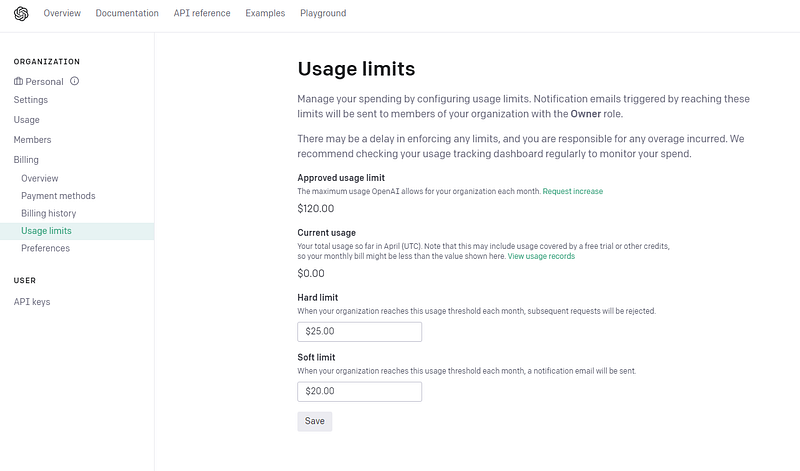
OpenAI API usage limits set under https://platform.openai.com/account/billing/limits

Suggested Reading

Got something that should be captured? Please leave a comment and I’ll put it in the guide.

ChatGPT
AI
Auto Ai
Programming
Machine Learning
Recommended from ReadMedium