
APES, EVOLUTION AND HUMAN NATURE
CCBE – Part 13: What chimps and bonobos can teach us about ourselves
How similar are we to our closest living relatives?
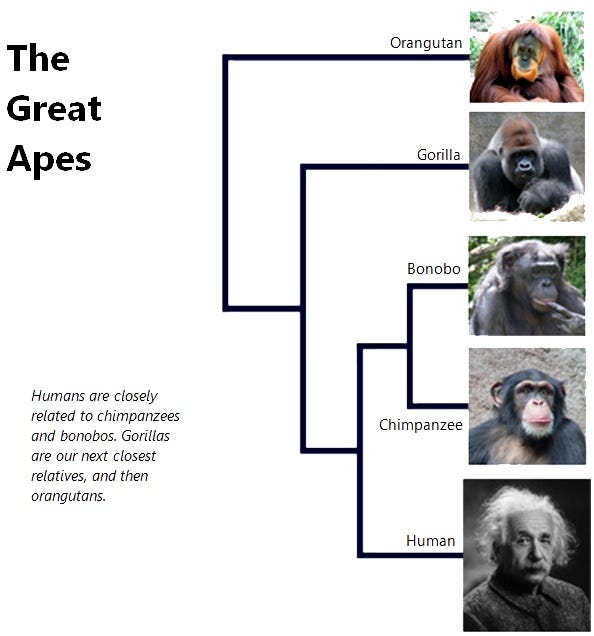

Today, we’ll discuss our great ape cousins, focusing on our closest living relatives, the chimpanzees (chimps) and bonobos. As we’ll see, chimps and bonobos are quite different from each other. And yet when you look at genetics, it turns out that we’re equally related to both. (Gorillas are basically scaled up chimps, and some of our DNA is most similar to gorillas.)
We’ll take a look at the rules of chimp and bonobo societies, and what we can learn about ourselves. This will include cooperation and competition, which are key aspects of life for chimps, bonobos, and humans.
The darker side of chimp society
The conventional view of chimp society highlights the roles of aggression, violence, and competition. This centres on hierarchies and the dominance of alpha males within troops, both of which are key aspects of life as a chimp. Males fight for social status, while females wait patiently for their superiors to die, climbing the social ladder one funeral at a time.
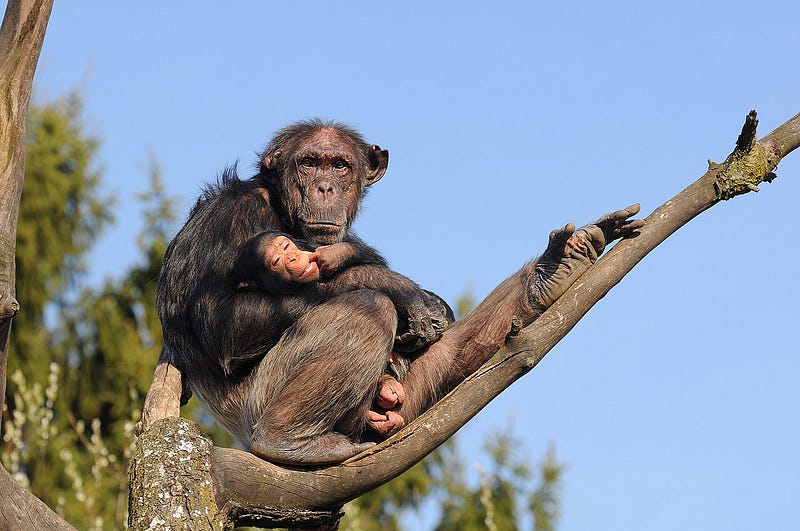
Male chimps are also known to kill the babies of other chimps. Females seem to have adapted to this danger by mating with as many healthy males as possible. The idea is that this reduces male violence against young chimps, which could well be their own offspring.
Cooperation also finds a home amidst the aggression and violence. Male chimps can be very crafty, and the biggest, scariest males are often dethroned by well-organised coalitions of enemies.
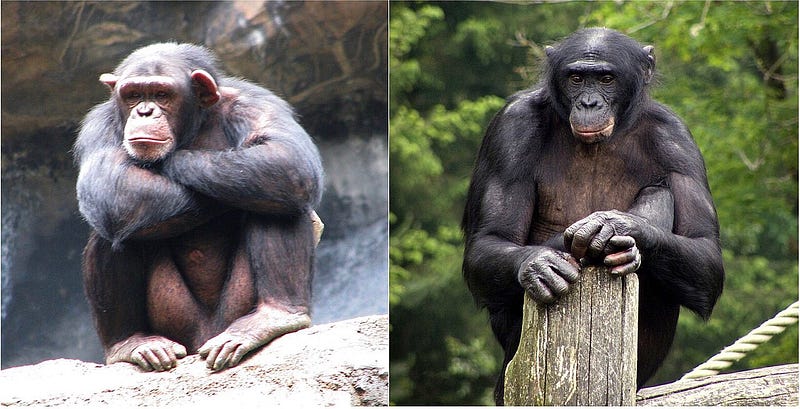

In-group cooperation also enables hostilities with other chimp communities. Troops scout and probe the borders of their territory, and are quick to aggression if they meet members of neighbouring troops.
This usually escalates to violence only when there’s a fairly large difference in numbers. On average, the assailant-to-victim ratio in chimp attacks is around 8:1, and chimps are known to go hunting for isolated members of other troops. This can be extremely savage, involving mutilation, removing limbs, cannibalism, and drinking the victim’s blood in a mad frenzy of carnage.
Chimps may also wipe out neighbouring troops, even when they were recently members of the same troop. This once occurred when a large troop split to become two. One then destroyed the other, and took over the whole territory.
These features of chimp society have led many to draw conclusions about human nature. It’s said that humans must be competitive, violent, hierarchical, and patriarchal, since chimps are our closest living relatives. In an extreme example, US politician Newt Gingrich even gave copies of a book called Chimpanzee Politics to his staff as a type of strategy manual.
The matriarchy of the bonobos
But this conveniently forgets that we’re also equally related to bonobos. So before we draw too many conclusions, we need to ask about bonobo society. And when we do, we find a very different take on life as a great ape.
For one, bonobos are matriarchal. On average, male bonobos are physically larger than females, but female bonobos are well organised. They form matriarchal coalitions that harass, chase, and attack any male that is aggressive or violent towards any female. Male bonobos don’t organise like the females, and are kept strongly in check by the bonobo sisterhood.
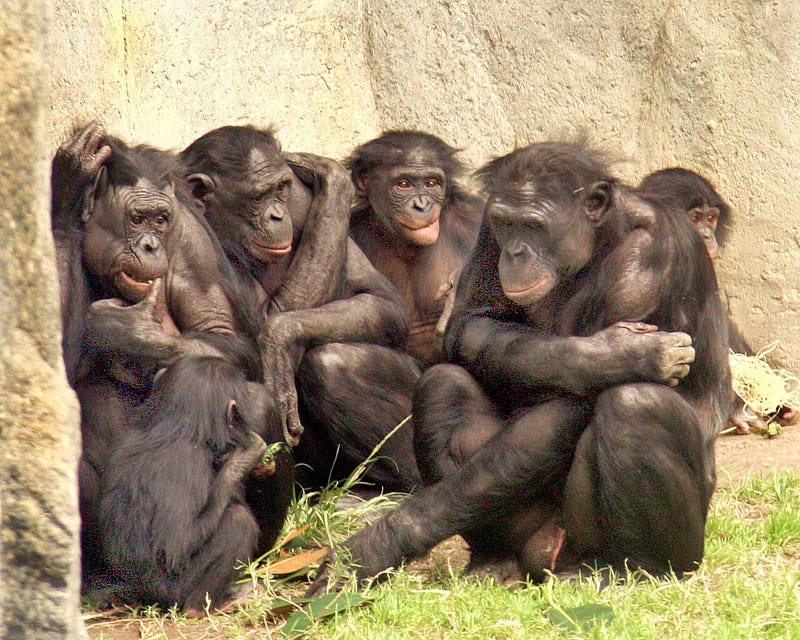

Bonobos also have a very different approach to interactions with other bonobos. Instead of aggression and violence, bonobo life is all about sex. Bonobos are strongly bisexual, and sexual acts are used as a tool for social harmony in virtually every situation. This even extends to neighbouring bonobos, with whom troops will trade sex acts at their common borders.
Of course, there’s also aggression, violence, hierarchy, and competition in bonobo society, especially when times are tough. But overall, life in the bonobo matriarchy is much less aggressive, hierarchical and violent, and much more cooperative, than life among the chimps.
The lighter side of chimp society
What’s more, the conventional view of chimps is also a bit of a caricature. Without doubt, chimps have a dark side, but they’re not as one-dimensional as we’ve made them out to be.
For starters, alpha females and matriarchal coalitions can also play powerful roles in chimp society. You might even be familiar with one example, an alpha female named Mama. Footage of Mama recognising her longtime carer went viral shortly before she died in 2016 at the ripe old age of 59.
This was touching, but did not show Mama at her best. In her prime, which lasted many decades, she was a force to be reckoned with in her colony at the Royal Burgers’ Zoo in Arnhem, Holland.
She commanded the respect of the colony, and would even intercede in fights between males to act as a peacekeeper. Mama built coalitions of females and supported her favourites for alpha male.
She also had a deputy, with whom she would sometimes disagree. When they disagreed, they would avoid each other to preserve the relationship, and reconnect when the source of tension was gone.
It turns out that males are also more complex than their caricature. For example, reconciliation and relationship maintenance among males are crucial for the stability of chimp society.
After a fight, males will come together to embrace each other, which seems to reduce tension and repair relations. If males refuse to make up, alpha females like Mama may actively encourage them – even with threats, if necessary.
Alpha males also aren’t as mindlessly aggressive and competitive as we’ve come to believe. True, some alpha males rule by the sword, but their reigns are often short, and they usually meet a brutal end. If you dominate through violence, sooner or later you’ll be taken down by a coalition.
The most successful alpha males seem to recognise this, and try to strike the right balance. They’ll use aggression and violence against a challenger, but they spend most of their time gathering allies. This mostly means stuff like grooming, playing with other chimps’ kids, and not being too stingy with food.
The most popular alpha males will also help to keep the peace by preventing or breaking up fights. These are wise political moves, as fewer enemies and more allies will reduce the chances that a coalition will rise against the alpha.
So what does this mean for us?
You can find bonobo and chimp features in ourselves, always with a uniquely human twist. Humans commit even less everyday violence than bonobos, but we commit other kinds of violence on scales that no other animal can even imagine.


Overall, we’re not as matriarchal as bonobos, nor as patriarchal as chimps. Both are features of human life, though human history has an overarching bias for patriarchy.
We’ve reached new heights of in-group cooperation, and tolerance for out-group members and anonymous interactions. Several terms have been coined to describe this, such as supercooperators, the victory of the beta males, and the social instinct.
But in-group cooperation is often wielded as a weapon against outsiders. Norms around accepting (or at least tolerating) others may be catching on slowly. But ‘strangers’ (out-group members) have not been treated kindly across most of human history, and intergroup conflict remains a constant fact of life.
This paints a mixed picture of human nature, one so messy that it’s not even clear if human nature is a coherent idea. Humans are clearly flexible enough to adapt to situations over time, although there are limits to our flexibility. We can cooperate and compete in mutually-beneficial ways, but easily slip into mutual destruction. How can we increase the good and decrease the bad?
Next time
To answer this, we’ll talk about a popular argument against collective resource use, known as the tragedy of the commons.
In 2009, Elinor Ostrom won a Nobel prize in economics for outlining the conditions that promote healthy and cooperative economic activity between groups. In essence, her work outlined how to escape the tragedy of the commons.
Before Ostrom sadly died in 2012, she teamed up with evolutionary biologist, David Sloan Wilson, and adapted her work to groups and society more generally. This has already shown promise when applied to the real world, and could be extremely useful for reducing tension and conflict.
We’ll tackle that topic next time when we discuss the conditions that promote cooperation and competition in human society. Until then!