Summary
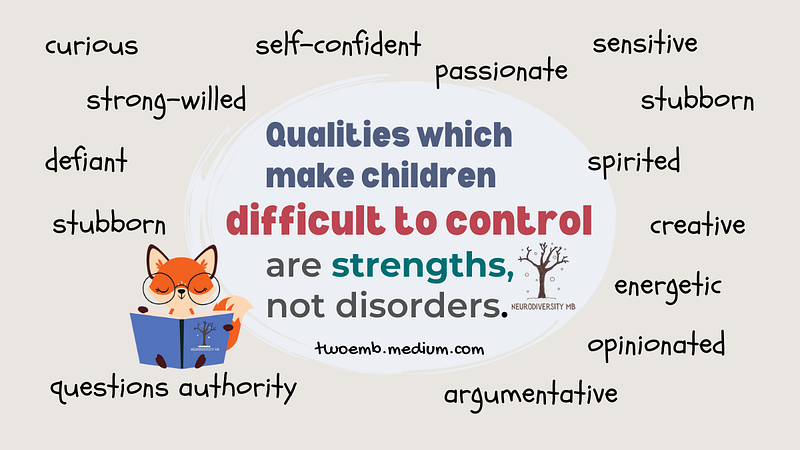
The article argues that qualities in children that are difficult to control should be recognized as strengths rather than disorders and that punishing children for these traits is a reflection of adult convenience rather than genuine problems with the children.
Abstract
The author of the article emphasizes that certain qualities in children, which may be challenging for adults to manage, are often mistakenly labeled as disorders or problem behaviors. These qualities, which can include divergent neurotypes, developmental disorders, and disabilities, are inherent traits that do not inherently warrant punishment. The article suggests that the difficulty lies not with the children but with the traditional systems of parenting and schooling that are not equipped to accommodate such differences. While acknowledging the challenges these traits can pose to adults' lives and responsibilities, the author asserts that these are issues for adults to address rather than problems for children to be punished for. The piece calls for a shift in perspective, recognizing that the perceived difficulty in managing these children is an "us problem," not a "them problem."
Opinions
- The author believes that the difficulty in managing certain children's behaviors stems from adult convenience and the structure of traditional parenting and schooling systems.
- It is posited that children's divergent neurotypes and developmental traits should not be automatically classified as problematic or deserving of punishment.
- The author clearly states that they are not denying the existence of neurodivergence, developmental disorders, or disabilities but rather challenging the way society perceives and responds to these differences.
- The article suggests that the challenges faced by adults in supporting children with these qualities are an adult issue, implying that adults need to adapt their approaches and expectations.
- There is an underlying call to action for adults to reassess their attitudes and systems to better support and appreciate the natural variances in children's behaviors and neurotypes.