
Conodont
Or cono-do… I’m okay either way
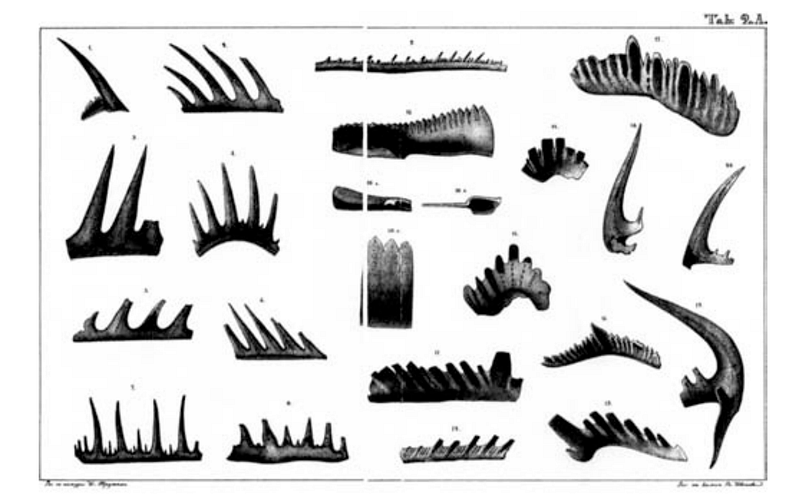
Today’s New York Times Spelling Bee letters:
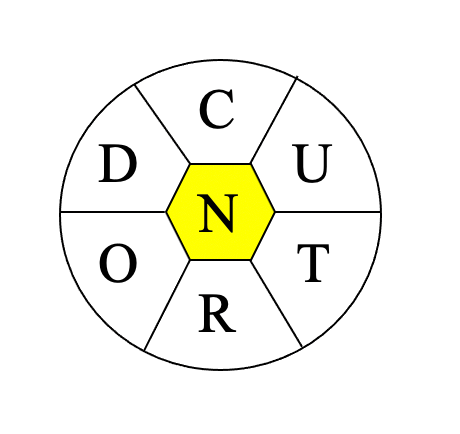
C, D, O R, T, U, and center N (all words must include N)
Merriam-Webster says…
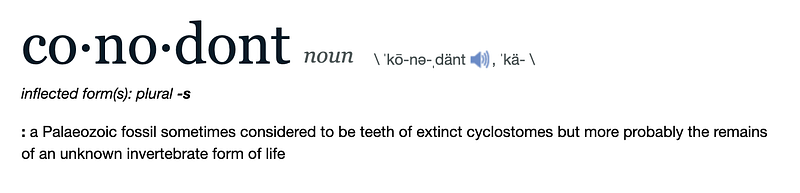
Silly little dictionary! Don’t you know conodont can’t possibly be a word if the New York Times says it ain’t?
For further fascinating facts, check out the Spelling Bee Master.
What’s your favorite dord* from today’s puzzle?
My Two Cents
Paleontology, or the study of life in past geological periods based on fossil remains of plants and animals, is a very interesting science. As a longtime dinosaur aficionado I found it interesting and surprising to learn that the same word was used to refer to both one part of an animal and later to the whole animal itself.
That is not typical, of course, and has a lot to do with the natural history of how the conodonts were discovered and studied.
Conic teeth
The above would be the literal translation of conodont, from the Greek kōnos, meaning “cone”, and odont, meaning “tooth”.
Heinz Christian Pander (aka Christian Heinrich Pander), a Baltic German biologist who wrote the first treatise on conodonts described the fossils thus (translation provided by Dr. Barry J. Cooper):
“Tiny, lustrous, elongated remains very similar in shape to fish teeth, [which] extend upward or toward one end into a point; [which] widen gradually or abruptly downward; [which are] more or less curved, and most [of which] have sharp margins (keels), one in front and one in back.”
Pander published his monograph in 1856 and titled it Monographie der Fossilen Fische der Silurischen Systems der Russisch-Baltischen Gouvernements, which my basic non-understanding of German translates as roughly “Russian fish fossils have a socialist system of government”.
Between 1833 and 1844, Heinz Pander traveled around the Baltic area, studying its geology and collecting fossils from the Lower Paleozoic strata that were exposed there.
A big chunk of that fossil collection included the conodonts; however, Pander found no bone or anything else with which he could identify any other parts of a possible conodont skeleton. His natural conclusion was that it was likely conodonts (the animals) were invertebrates with no other bony parts.
In his monograph, Pander illustrated several plates of the conodonts he found. I chose one of them as the main photo for today’s column. Here is another one:
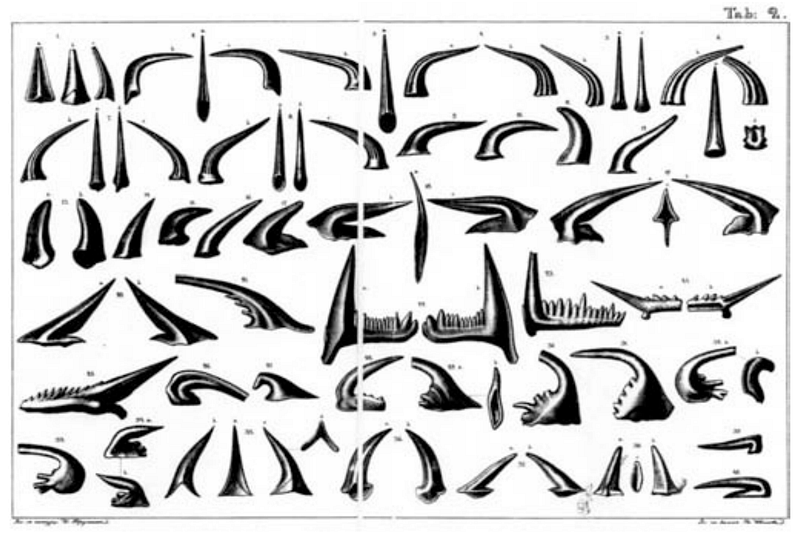
Conodonts (the teeth) are particularly useful for paleontologists when dating. And by dating I don’t mean going out for dinner and a movie, but rather determining what era other adjacent fossils belong to. As the Encyclopedia Britannica explains:
“Conodonts are very useful fossils in the identification and correlation of strata, as they evolved rapidly, changing many details of their shapes as geologic time passed. Each successive group of strata thus may be characterized by distinctive conodont assemblages or faunas. Moreover, conodonts are very widespread, and identical or similar species occur in many parts of the world. Black shales and limestones are especially rich in conodonts, but other sedimentary rock types may also be productive. In some parts of the world assemblages of conodonts, regarded as those of animals living out in the open ocean, can be distinguished from others thought to belong to inshore communities.”
It was only in the early 1980s that the first fossil evidence of the rest of the conodontian (is that a word?) animal was found. A decade later better-preserved fossils were discovered in South Africa; in that case, the conodont (animal) soft tissue had been converted to clay, preserving even their muscle fibers.
Paleontologists were so tired from looking for the actual conodont animal that they made no effort to give a different name than its teeth had. Hence, we now refer to both by the same name.
Here is a neat and (best of all) brief video summarizing conodonts and their usefulness.
Father of embryology
As Dr. Cooper explains in his article, Pander was a native of Riga, Latvia. He was born there in 1794, when it was known as Livland, or Livonia. Pander studied in a German-speaking gymnasium, or school, graduating at the age of eighteen. In 1812 he began medical studies in what is now Estonia, which he later completed in Berlin, Göttingen, and Würzburg. He obtained his doctorate in the latter city in 1817.
Pander’s final thesis concerned the development of chicks in their eggs. While studying the embryos, he discovered their three germ layers, or primary layers of cells that form during that stage of development. In vertebrates (like chickens and humans) these three germ layers are quite obvious and distinct. Thanks to this discovery, Pander is widely regarded as embryology’s baby daddy (bad pun intended).
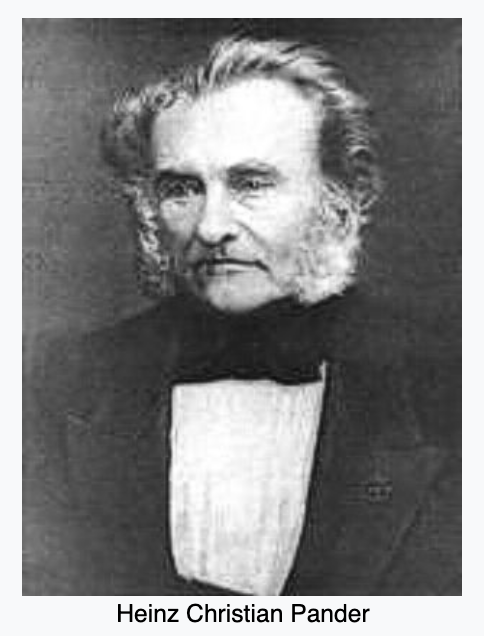
Oh, and he was also the father of three sons and four daughters with his wife, Amalie von Scherer.
Anyway, I’m sure you’re waiting with bated breath to find out what the three germ layers are. And because I aim to always please my readers, here we go:
o The endoderm: among other structures and organs, we get the pharynx, parts of the trachea and lungs, most of the digestive system, the liver, the pancreas, the bladder, and the thyroid.
o The mesoderm: this layer becomes muscle (smooth and striated), bone, cartilage, fatty tissue, the circulatory system, the lymphatic system, and the dermis (middle layer) of the skin, among others.
o The ectoderm splits into three layers that give us very different organs and systems: epidermis (outer layer of skin), hair and nails, parts of the eye, tooth enamel, the peripheral nervous system, the brain, and the spinal cord, to name a few.
Okay, I know that was a bit dense for a Friday, so here are some more illustrations of conodonts by Pander:
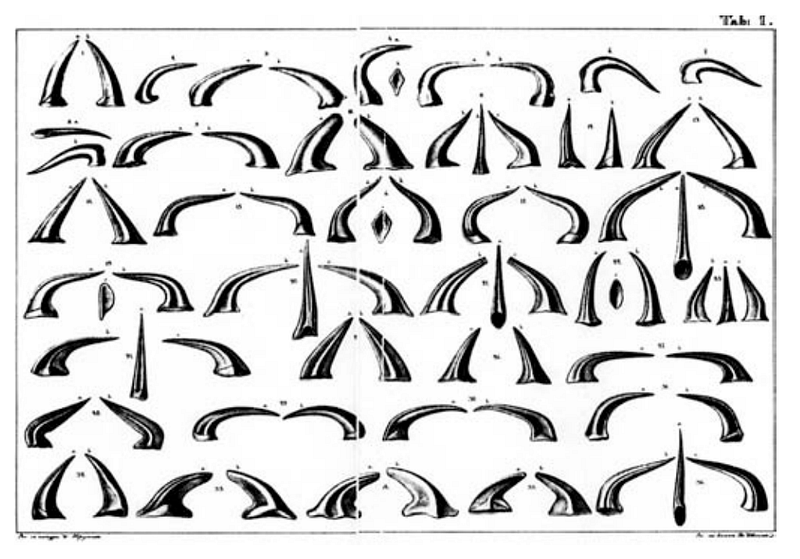
And yet… despite the tooth fossils Pander discovered and classified, despite his awesome illustrations, despite the fact that paleontologists had to search for more than a century to find the animal the tooth fossils belonged to, and despite the animals obvious importance to science… the editors of the Spelling Bee decided that the word conodont is a dord*.
You can check out my previous entry on another dord* here:
*What the heck is a dord, you ask? Here’s the answer:


