
Connectivity and Inclusivity go Hand in hand
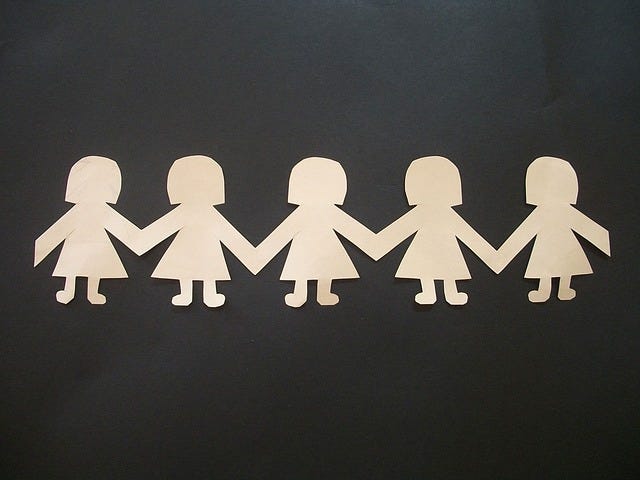
We are social beings and as such the majority of human beings like to connect or interact with at least one other person, and some of us like to feel a connection with a big network of people, including friends, family, close acquaintances and/or internet friends.
I remember when I was around 12 years old I was at the beach one day, fossicking for cowries and things along the coast-line. I was on top of the world and had a nice collection of ocean items in my bucket.
Two boys drifted up to me, and the older one who was around my age asked me “What have you got in your bucket?” I turned a beaming face toward him and then — — I spoke to him in what must have been “double Dutch” or Greek to him. I was a prolific reader at that age and I spoke to him very formally and used words that he didn’t understand.
I will never forget that crestfallen look on his face as he didn’t get an answer he could make sense of, and without giving me any second chances, his bewilderment and that of his companion turned into disappointment and they quickly left my bucket and me. I was so upset that I could not share my discoveries with them.
The verbal or spoken words you choose are important to make connections.
Disappointment struck me. I felt terrible that my communication had missed the mark, and from that day on I resolved to tune into the person I was talking to and to speak to them at a general level of communication to start with. From there I would interact with them, and if I discovered they had a vocabulary to match mine, I would be able to mirror their expressions and vocabulary range. “Do unto others as you would have them do unto you” or be inclusive by using words and actions that are understood from the recipient’s perspective. Build bridges or links, don’t miss out on the wonderful connections that Life can offer you.
This was a simple yet profound experience that catalyzed me to think about using inclusive language for my audience or listeners. We are all links in a chain, metaphorically speaking. What one does affects everything else, so let’s connect positively with each other, and support each other wholeheartedly.
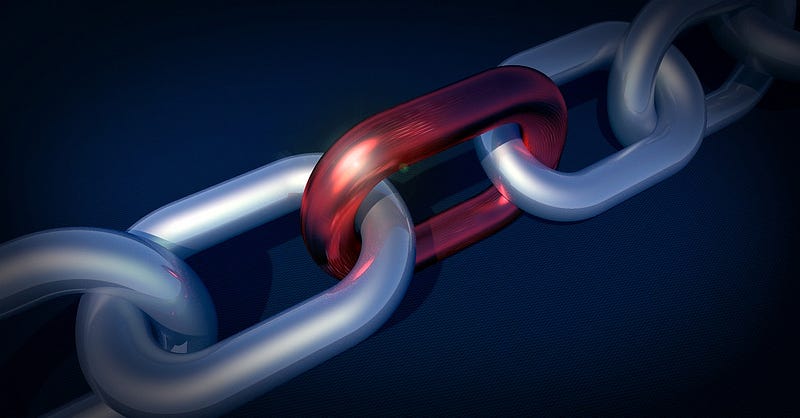
Inclusivity brings about connectivity. Even if you know “big words” and replacement words for more common words, you will find that having restraint and using commonly used spoken words will make more people feel included in your spoken communication attempt.
There is a risk when writing that someone will take things the wrong way or read things that are not there into your writing. Write logically with clear intention and provide evidence or support of any claims of facts that you make. Make use of resources such as Publishous’ Tool-kit.
Be aware that understanding a written piece may depend upon not only the reader’s range of vocabulary, but on the reader’s focus and background or experiences, and on the context in which they are reading.
Since I pushed those boys away I have decided that the “common denominator” should be used when writing or speaking, and if I do use some more unknown words, I should explain them.
For example, perspicuity refers to the clarity of written expression and lack of ambiguity in writing. I could just as well write “I hope that my writing has clarity” than “I hope that my writing has perspicuity” and quite likely by my using the former phrase, a lot more people would understand what I meant than if I wrote about “perspicuity”.
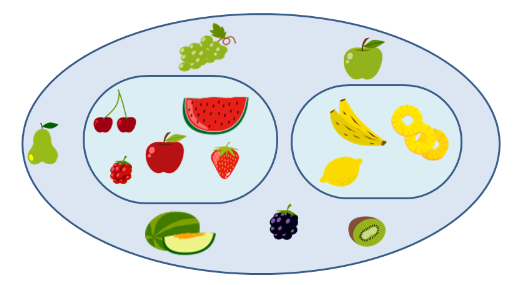
We are sub-sets of sets. If you liken my type, using high “highfalutin” (pompous or pretentious) language when I was 12, to the red fruit, and people around my age who used non “highfalutin” language, to be the yellow fruit, you can see we are all parts of a whole, the whole of humanity. We are separate individual parts of human-kind, but we can relate to each other from our hearts, using the “common denominator”.
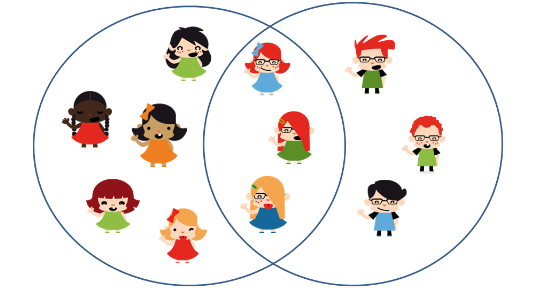
In the graphic above, there’s 1 circle of people, both boys and girls, who wear glasses, and a 2nd circle of girls with or without glasses. The intersection or the common element of the 2 circles is a sub-set of each circle of influence, being girls wearing glasses.
In my real-life example, I could have been a girl speaking the same language as the boys I tried to speak to. Circle 1 would be all people who use or share an appropriate language for them all, and circle 2 would be made up of the possible Celines. Replace the girls in circle 2 with just 2 of me, the new and current me who uses inclusive language, at the intersection, relating to all others that day, through shared humanity; and the ghost of me, or the past me, who possibly lost a friend that day on the beach when I couldn’t explain myself to my visitor. I learned a valuable lesson that day.
Connectivity requires inclusivity or including others through a common language and shared experiences and thoughts.
In “Sacred Geometry” the intersection of 2 over-lapping circles is called the Vesica Pisces. It is the shape of two coming together in perfect balance, with one “thread” connecting the heart of one to the other.

Thanks for reading this. If you enjoyed this article, your claps would be appreciated. Here are some more of my stories.


