
Coniine
No typo; there are two i’s in this word
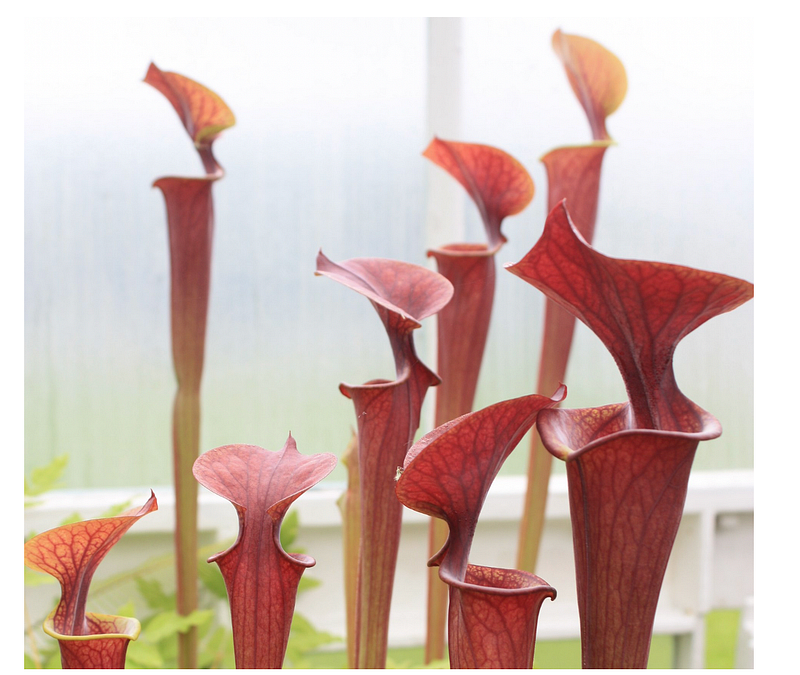
Today’s New York Times Spelling Bee letters:
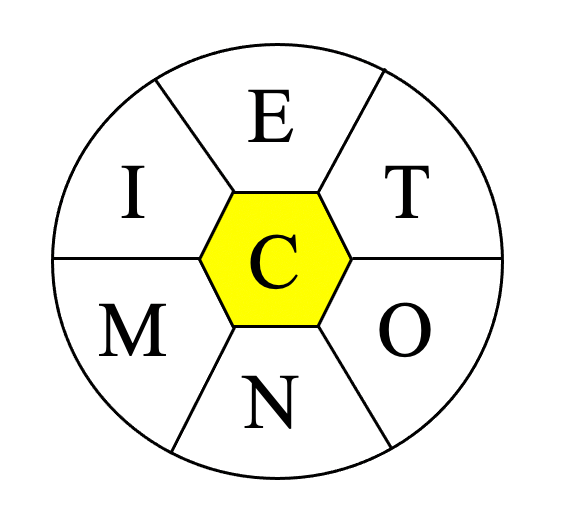
E, I, M, N, O, T, and center C (all words must include C)
Merriam-Webster says…
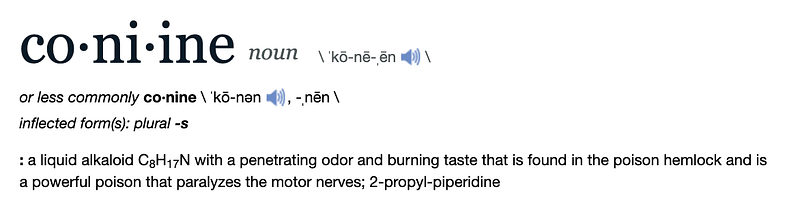
Silly little dictionary! Don’t you know that coniine can’t possibly be a word if the New York Times says it ain’t?
For further fascinating facts, check out the Spelling Bee Master.
What’s your favorite dord* from today’s puzzle?
My Two Cents
Quick spoiler alert for those still working on today’s puzzle (especially the purists): I’m going to mention some data regarding the stats. Yo can skip on down to the next section if you’d like, always remember to scroll very slowly.
Today’s Spelling Bee is, to quote a former U.S. president, “yuuuuge”. There are a total of 496 points to be earned via 74 words. Genius level (which is second only to the top Queen Bee prize) is set at 347. There are three pangrams (words with all seven letters) and twelve words with 10 letters or more. I’m still working on it as of this writing, and I’ve yet to find the third pangram.
Personally, I don’t like Spelling Bee games with a lot of points. I prefer those with fewer than 100 points for Genius, although I tolerate the 101–160 range. Above that I roll my eyes. Plus, in my experience, it’s always been easier for me to reach the coveted Queen Bee status with low-scoring puzzles. Believe it or not, some people prefer to work with games that tend towards the higher end of total points.
But despite that many words and points, today’s puzzle is not a record-breaker. The Spelling Bee Master has the stats to prove it: the game with the most words –-81–– was posted almost exactly three years ago, on June 8, 2019; the one with the most points (537) was on January 22, 2021, just a few days before I discovered Medium and started writing this column.
As you can see, puzzles with the most points are not always the ones with the most words. This is due to the way the Spelling Bee awards points. Words with five letters are worth 5 points, words with six letters are worth 6 points, and so on. Each pangram gets an additional 7 bonus points on top of its regular score. But words with four letters are worth only 1 point each. So puzzles with a lot of four-letter words tend to score lower than comparable puzzles with fewer four-letter words.
Okay, enough with the Bee. Let’s move on to our daily dord*.
Hemlock Bones
That is the name of the detective in Sarah Masters’ erotic fanfic sold briefly on Amazon. The full title is Hemlock Bones: A Stud in Scarlet, and the synopsis begins thusly: “When Dr Tom Hotson takes rooms in Laker Avenue with amateur detective Hemlock Bones, he has no idea that he is about to enter a shadowy world of criminality and violence. Nor does he anticipate falling in love with Holmes and having his sexual needs attended to in a way he had only previously dreamed about.” The book does not seem to be available any longer, but you can go to the author’s page and maybe try to contact them if you’re interested.
What does this have to do with coniine? Patience, my little grasshoppers.
First things first. Coniine is pronounced \ ˈkō-nē-ˌēn\, sort of like CO-knee-in. Our friends at Merriam-Webster explain that the term comes from the German koniin, from the Late Latin conium (hemlock + German -in -ine). In fact, the genus Conium is the one to which the hemlock plant belongs.
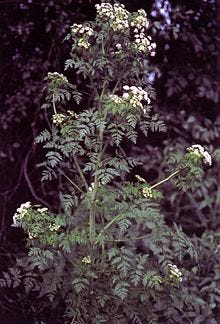
If you ever encounter the above plant, please stay away from it. That’s because hemlock contains coniine:
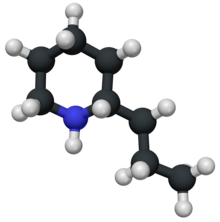
I know the coniine molecule seems as large as the plant, but trust me, it’s microscopic and hemlock is full of it. Loaded. With enough coniine to kill people, even tough ancient Greek philosophers. In small doses it has been used to treat muscle spasms, colic, and arthritis.
Your nervous system has three types of neurons, or nerve cells. Motor neurons transmit messages from the central nervous system (the brain and spinal cord) so that your muscles and organs work. Sensory neurons transmit impulses from receptors back to the central nervous system. And intermediate neurons connect sensor and motor neurons with each other and with other cells in the central nervous system. All these connections are done via the synapses, which is where neurons meet and communicate.
That’s where coniine acts. Specifically, on something called nicotinic receptors (so called because nicotine also has an effect on them). Coniine binds to these receptors and stays there, inactivating the motor neurons we mentioned earlier. This results in a slow, flaccid, ascending paralysis. This means your body progressively slackens, beginning with your feet and legs. Your central nervous system is not affected, however, meaning you are fully awake until your lungs stop working and you suffocate to death.
Like I said, stay away from hemlock.
Hemlock poisoning is intimately connected to Greek philosopher Socrates, as legend has it he drank it in 399 BC as capital punishment for “refusing to recognize the gods recognized by the state” and “corrupting the youth.” Socrates stoically accepted his sentence, despite Plato, Crito, and others trying to convince him to escape.
The death of Socrates reminds me of one of my favorite cartoons by Joaquín Salvador Lavado Tejón, better known as Quino. He presents an alternate version of how and why Socrates was killed.
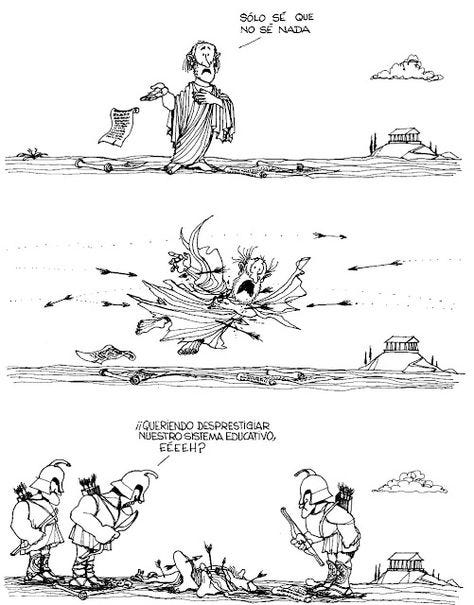
In the first panel, Socrates proclaims his famous (and possibly misquoted) “I know that I know nothing”. He immediately gets blasted by a flurry of arrows. In the third panel, the Greek soldier tells him something that could be roughly translated as “That’s what you get for discrediting our school system!”
Pitcher plant
No, this is not vegetation that can throw a mean curveball.
I’m talking about the Sarracenia flava, or yellow pitcherplant, which belongs to the Sarraceniaceae family of, well, pitcherplants.
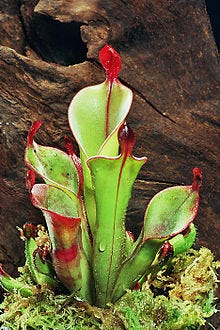
The above plant is the marsh pitcher plant, which is endemic to Venezuela. The yellow pitcherplant is in the photo at the top of the article but, as usual, we’ll provide you with a new photo here so you don’t need to rewind:
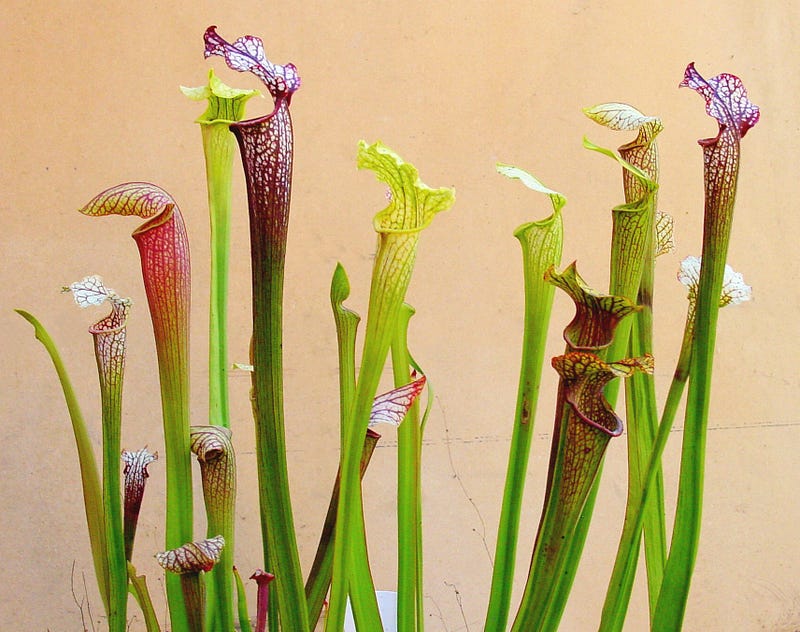
Above are a few “species and natural hybrids from a single bog in Alabama”.
The plants in this species, and in the entire genus and family, are meat-eaters. Or bug-eaters, really. Unlike the Venus flytrap, they catch their prey without the use of moving parts. The pitcherplants first lure the bugs with their attractive colors, sweet scent, and delicious nectar. They also clog an insect’s legs with a waxy deposit. Gravity does the rest as the bug falls down the “pitcher” or tube, from which it cannot get out. Then the plant’s digestive enzymes slowly turn the critter into a protein shake.
What’s the connection with hemlock? Well, it turns out that the yellow pitcherplant (as well as several other species) has coniine in its nectar. Although the concentration is much less than hemlock’s, it’s still enough to drug ants, according to this 1976 study. However, that may be the only insect it has a narcotic effect on. Scientists aren’t completely sure yet exactly what role coniine plays in the lives and feeding habits of pitcherplants, but when I get confirmation, you’ll be the first to know, my dear readers.
In the meantime, you can watch this video of some carnivorous plants –-among them the pitcherplants–- eating insects… and even a mouse! Obvious trigger warning if these things get to you.
Now you know. Next time you’re outdoors and spot some hemlock, run away in the opposite direction. Just make sure you don’t fall into a gigantic pitcherplant. If you do, though, don’t worry about the coniine in it. Not because there’s not enough to kill you… but because the editors of the Spelling Bee decided that coniine is a dord*.
You can check out my previous entry on another dord* here:
*What the heck is a dord, you ask? Here’s the answer: