avatarPen Magnet

Free AI web copilot to create summaries, insights and extended knowledge, download it at here

5800

Abstract

You give the founders what they crave: <b>Validation</b>. They can flaunt it to investors every time their pockets are running out.</p><p id="762f">If they fail, you get fired. Who needs a developer past development?</p><p id="2db5">If they succeed, you get nothing. Worse, you get some competition — some better devs who<i> follow the best practices</i> replacing you, who got his / her hands dirty.</p><p id="bc0b">The money that they save by firing you will be spent on buying lunches for investors, employing customer care staff and running costly marketing campaigns across digital and print media.</p><h1 id="b5c1">Where Exactly Has Software Compensation Gone Wrong?</h1><p id="3b40">Laws that govern software compensation are rooted in industrial era HR policies.</p><p id="f920">Technically incompetent MBAs and Human Resource professionals <b>decide</b>, <b>control</b> and <b>tweak</b> software developers’ compensations to a deadly extent.</p><p id="a2a6">Startups, despite not employing an HR themselves, follow the <i>market</i> governed by other companies’ HR policies, while deciding compensation.</p><p id="0e5e">Software developers are always at the mercy of increasing demand. They keep consoling themselves with:</p><blockquote id="4e1b"><p>Competent ones can survive no matter what.</p></blockquote><p id="9fc4"><b>But what they end up achieving is simply survival</b>. They end up earning that meagre amount at their retirement, which is infinitesimal compared to what it could have been, given the value they create.</p><p id="cda5">Somebody <a href="https://onezero.medium.com/leak-of-microsoft-salaries-shows-fight-for-higher-compensation-3010c589b41e">just leaked Microsoft salaries</a>. Fortune 500 software companies and FAAMG maybe an exception to the above, even though they have varying compensation policies across the globe. Discounting that, those are just a few lamp posts shining across an otherwise darkened alley.</p><p id="c7ce">The reality is, hundreds of million dollar profit software firms whose names you rarely know, make money off of expert dev’s <b>6 months — 1 year worth</b> of work, costing them not more than <b>$100k</b> in the most developed regions of the world.</p><p id="d60b">And we haven’t taken into account software contracts done with the gig economy. (<b>Elance, Fiverr</b> et al)</p><h1 id="1ccc">But isn’t Entrepreneurship More Difficult than Software Development?</h1><p id="5c1b">Not in today’s time.</p><p id="0813">And definitely not if you consider the rewards that you reap from quality software development.</p><p id="314d">A typical startup’s success today hangs on three factors: Idea, Execution and Traction.</p><figure id="e297"><img src="https://cdn-images-1.readmedium.com/v2/resize:fit:800/1*tgLAVmpCUx1wNRiO8rX1Ng.png"><figcaption>Ingredient’s of startup success</figcaption></figure><p id="4100">Idea belongs to the founder(s). Except when they are rooted in a patent, startup industry has accepted that ideas are mostly worthless.</p><p id="193d">Traction belongs to sales, which is often the task of founders during takeoff. However, during growth stage, it is more a function of money infused by investors who already believed in founders’ vision.</p><p id="7ab5">That leaves the biggest box: <b>that beast called</b> <b>execution</b>. Many pre / seed funding stage startups follow popular advice of <b>not doing scalable things </b>during <b>MVP</b> stage<b>. </b>This includes founders relying upon excel sheets instead of software product, gaining 100 customers who can become walking advertisers.</p><p id="0ab5">But true power resides in that <b>purple box</b>. It sits between MVP and mass adoption. In reality, its presence, even perceived in advance, is rooted in creation of million product ideas, because that X brings <b>scalability</b>.</p><p id="0eb2" type="7">That X is the (c squared) in Einstein’s mass-energy equation. (except that it is not a constant)</p><p id="a393">Just because it could be<i> scalable some day</i>, great <b>ideas</b> are born in entrepreneurs’ minds. Done creatively, a software developer’s work can also be the backbone of <b>word of mouth marketing</b>, be it messenger stickers or in-game loot-boxes.</p><p id="7b38">Competent software developers not only impact the <b>Execution</b> box, but also the other two boxes.</p><p id="0604">They do that by deploying servers that can handle a million requests, by optimizing heavier search queries, or by enticing grandmas to click that <b>“Buy”</b> button.</p><p id="f086">That’s how your payment gateways get crazy checkout traffic.</p><p id="c201">But unless they are co-founders who got stock-rewarded like <b>Steve Wozniak</b>, they are the use-and-throw commodity, especially in times when laws around layoffs are quite flexible for companies.</p><p id="3952">I advise devs not to follow flagship companies too vigorously, precisely because of such paradoxes.</p><div id="135a" class="link-block"> <a href="https://readmedium.com/developers-stop-that-stressful-interview-preparation-dd387d5b16fc"> <div> <div> <h2>Developers, Stop That Stressful Interview Preparation</h2> <div><h3>Instead, be prepared with real software skills. Your dream tech employer will lay you off sooner than you might think</h3></div> <div><p>medium.com</p></div> </div> <div> <div style="background-image: url(https://miro.readmedium.com/v2/resize:fit:320/0*Izj9Iehv9YDcwrp9)"></div> </div> </div> </a> </div><h1 id="3ebc">What is the Way Out for Software Developers?</h1><p id="615b">I truly respect some <a href="https://readmedium.com/curious-case-of-plato-the-cold-war-in

Options

ternet-785a98076737">great devs from 1960s and 70s</a> who worked in government labs. And they loved to retire in their first jobs - at the age of 60+.</p><p id="81ad">In today’s times, it is impossible to find a software dev who would want to retire as one. He / She will, for sure, retire as Vice President, CEO or a serial entrepreneur.</p><p id="f362">So here goes possible paths to combat under-compensation.</p><h2 id="f837">Develop Your Product Development Side:</h2><p id="ad86">If you are already competent software dev, it is not difficult for you to fathom / spot a business idea. All you have to do is to cultivate some networking + creativity.</p><div id="cf85" class="link-block"> <a href="https://readmedium.com/why-programmers-need-creativity-982a38d345c8"> <div> <div> <h2>Why Programmers need creativity</h2> <div><h3>My friend requested me to help him update his CV. I had to say NO. There are things that he can do, and he may never…</h3></div> <div><p>medium.com</p></div> </div> <div> <div style="background-image: url(https://miro.readmedium.com/v2/resize:fit:320/1*I38nW-LkbX4oRnfj_VbiSQ.jpeg)"></div> </div> </div> </a> </div><p id="da24">Being a solo-founder by monetizing your side-project is much more lucrative than exchanging your 9–5 time for tiny boxes of Friday breakfasts.</p><h2 id="a978">Take Job Hopping Path to Earn Your Financial Freedom:</h2><p id="97e1">If you somehow fail to find / address that calling, work your way up by taking the right kind of career jumps.</p><div id="2dbd" class="link-block"> <a href="https://readmedium.com/programmers-stop-faking-your-passion-instead-run-for-the-money-5eb07056c2e5"> <div> <div> <h2>Programmers — Stop faking your passion. Instead, run for the money</h2> <div><h3>Crypto Shaolin, a Nigerian soft drink seller was chasing tourists. Today he earns $50K a year in Crypto. That was never…</h3></div> <div><p>medium.com</p></div> </div> <div> <div style="background-image: url(https://miro.readmedium.com/v2/resize:fit:320/1*dw_zbQh5fDVIG88GyY7ogg.jpeg)"></div> </div> </div> </a> </div><p id="4d7d">Liberation from 9–5, even the idea of it, is the greatest startup motivator.</p><h2 id="b86b">Demand More Compensation:</h2><figure id="a858"><img src="https://cdn-images-1.readmedium.com/v2/resize:fit:800/1*ME72BRt7wCAX0WYK9qMl1w.jpeg"><figcaption>Karl Marx’s Tomb — from <a href="https://commons.wikimedia.org/wiki/File:Karl_Marx_Grave.jpg">wikimedia</a></figcaption></figure><p id="15a4">While this is not Karl Marx’s manifesto, it is time software communities across the world demand their fairer share of founders’ booties.</p><p id="4fc3">Virality of <a href="https://996.icu/#/en_US">anti-996 movement</a> showed power of communities in battling against exploitative work culture.</p><p id="ff79">Stocks are popular tools to make employees partners since decades. However, they are <b>more controlling in nature</b> than rewarding. Individual devs have little or no control on valuations, acquisition decisions or lock periods. They are always in lieu of cash salary. Smaller they are, less you care about it. Bigger they are, less control you own compared to decision makers.</p><p id="f643">What truly competent devs need is a <b>proactive assistance towards their known early retirement.</b></p><h2 id="87a4">What Employers Can Do?</h2><p id="026f">Attrition rules software industry. Dearth of skills is evergreen. Because of meta-startup + remote work industry, more and more devs are choosing to go freelance.</p><p id="85e7">Rest of them move towards management.</p><p id="88fb">To retain developers, software employers will do well by assisting them, rather than working against them.</p><p id="9706">Putting hurdles will simply affirm their resolve to quit.</p><p id="75a3">Every software employer needs to <b>acknowledge their dev’s retirement / moving away ambition</b>. Just like death. And accordingly chart out a compensation plan.</p><p id="b3b8">Instead of throwing them food packets’ worth of monthly compensations, give them one-year or half-a-year worth of salary altogether, with some binding contract. Empower them with sabbaticals.</p><p id="6ad0" type="7">This is not some do-good-be-good advice for employers. It is survival guide for entrepreneurs who wants to stay relevant in a future where having your own software venture is lot easier + rewarding than working for others.</p><p id="b8cb">This gives developers lot of leverage with respect to their investments, and multiply their net worth just like you do with your investors. They can also invest more in their side projects, thus working towards their liberation with much less stress.</p><p id="f16a">Their increased sense of satisfaction + security feeds into better engagement with your company.</p><p id="14f3">Karma always rewards with compound interest. Just wait and watch.</p><h1 id="53f8">Conclusion:</h1><p id="5163">We are at a crucial turn in history: At one side, we fear the robots taking over the menial tasks. On the other hand, we have enormous junior talent entering software industries without complete degrees / enough experience.</p><p id="3b2d">With rewards <i>vs</i> output equilibrium tilting, competent developers will devote increasingly lesser periods of their lives working for others.</p><p id="ad27">Traditional startup decision makers will serve the industry better by breaking early this cycle, or be ready to face the consequences.</p></article></body>

Competent Software Developers Are Underpaid — Here is How to Fix It

Photo by Aneta Pawlik on Unsplash

I have been laid off twice. Both times it happened during my peak performance.

In both cases, it was due to office politics and poor sales strategies of my superiors. But at both times, layoffs ensured that I could not get my market value salary.

As a competent software dev, you are always expendable. And hence underpaid.

As a Competent Developer, Your Job is More at Risk than Others:

During my college days, I read and re-read Lee Iacocca’s autobiography. I was highly fascinated with his spirit of reinvigorating Chrysler, soon after being fired by Henri Ford II despite $2 Billion in sales in 1978.

In sales, your biggest achievement is the brand you build. Once that brand reaches millions, your value as a change-maker diminishes.

In software, you do not need adoption by millions to make yourself obsolete. All you need is a robust product with obvious execution.

When you are competent enough to run the show, it becomes quite easy for powers-that-be to put you out of the equation.

While layoffs in today’s world are triggered by losses (even though they may be temporary or limited to your department), what is of immense importance is this:

The compensation that you end up taking from your employer, layoffs or not, is inversely proportional to the value you contributed and the value they earned.

They keep paying you for newer and newer challenges. They keep paying you to keep their marbles together.

And they get rid of you by driving you out when they can’t fire you, as soon as they smell that you can step on someone’s else’s feet. Or seat.

The Reason Behind Inverse Relation Between Software Capability & Compensation:

For the sake of this article, we understand capability as proven, delivered features. (not theoretical expertise manifested by degrees / credentials)

As a first law of softwork dynamics, take this:

As a software worker, the work that you do stays like a blockchain block. It can be refactored, it can be reused, it can sold-as-delivered.

Unless it is boilerplate, it is never destroyed.

For a digital product, shelf-life is until the maximum number of copies get exhausted. This is, in theory, infinite. In practice, it is still millions (thousands, in case of B2B business). No startup is found on a lower estimated customer base.

This is not true for workers who produce tangible goods. Lifetime of their production stays economically relevant to the company until it is sold to a customer. (thereafter, that one piece may cost the company for after-sales service, or earn add-on payouts). The design and manufacturing efforts are decoupled, unlike software, wherein single dev is responsible for module design + development.

Programming isn’t just time consuming. It consumes your brainpower, posture, eyesight, and overall health in fewer years than other industries, assuming 8 hrs a day. It is quite a challenge to follow an ideal health schedule for a dedicated programmer.

This is obviously not to say other industry workers have it easy. But the strain programmers go through is widely unacknowledged, as of now. So much so that despite technological viability, remote work is considered a privilege in Fortune 500 companies.

As a competent dev, you are tasked with everything from design to testing. More perfect the software you make, less investment is required to maintain / improve its quality.

You give the founders what they crave: Validation. They can flaunt it to investors every time their pockets are running out.

If they fail, you get fired. Who needs a developer past development?

If they succeed, you get nothing. Worse, you get some competition — some better devs who follow the best practices replacing you, who got his / her hands dirty.

The money that they save by firing you will be spent on buying lunches for investors, employing customer care staff and running costly marketing campaigns across digital and print media.

Where Exactly Has Software Compensation Gone Wrong?

Laws that govern software compensation are rooted in industrial era HR policies.

Technically incompetent MBAs and Human Resource professionals decide, control and tweak software developers’ compensations to a deadly extent.

Startups, despite not employing an HR themselves, follow the market governed by other companies’ HR policies, while deciding compensation.

Software developers are always at the mercy of increasing demand. They keep consoling themselves with:

Competent ones can survive no matter what.

But what they end up achieving is simply survival. They end up earning that meagre amount at their retirement, which is infinitesimal compared to what it could have been, given the value they create.

Somebody just leaked Microsoft salaries. Fortune 500 software companies and FAAMG maybe an exception to the above, even though they have varying compensation policies across the globe. Discounting that, those are just a few lamp posts shining across an otherwise darkened alley.

The reality is, hundreds of million dollar profit software firms whose names you rarely know, make money off of expert dev’s 6 months — 1 year worth of work, costing them not more than $100k in the most developed regions of the world.

And we haven’t taken into account software contracts done with the gig economy. (Elance, Fiverr et al)

But isn’t Entrepreneurship More Difficult than Software Development?

Not in today’s time.

And definitely not if you consider the rewards that you reap from quality software development.

A typical startup’s success today hangs on three factors: Idea, Execution and Traction.
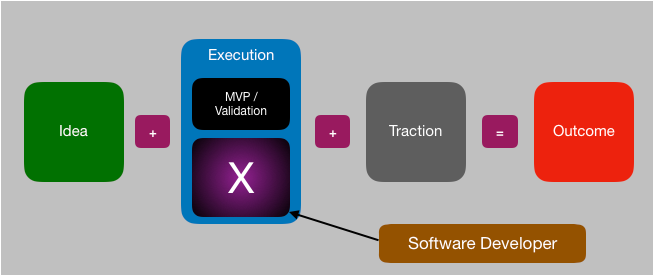
Ingredient’s of startup success

Idea belongs to the founder(s). Except when they are rooted in a patent, startup industry has accepted that ideas are mostly worthless.

Traction belongs to sales, which is often the task of founders during takeoff. However, during growth stage, it is more a function of money infused by investors who already believed in founders’ vision.

That leaves the biggest box: that beast called execution. Many pre / seed funding stage startups follow popular advice of not doing scalable things during MVP stage. This includes founders relying upon excel sheets instead of software product, gaining 100 customers who can become walking advertisers.

But true power resides in that purple box. It sits between MVP and mass adoption. In reality, its presence, even perceived in advance, is rooted in creation of million product ideas, because that X brings scalability.

That X is the (c squared) in Einstein’s mass-energy equation. (except that it is not a constant)

Just because it could be scalable some day, great ideas are born in entrepreneurs’ minds. Done creatively, a software developer’s work can also be the backbone of word of mouth marketing, be it messenger stickers or in-game loot-boxes.

Competent software developers not only impact the Execution box, but also the other two boxes.

They do that by deploying servers that can handle a million requests, by optimizing heavier search queries, or by enticing grandmas to click that “Buy” button.

That’s how your payment gateways get crazy checkout traffic.

But unless they are co-founders who got stock-rewarded like Steve Wozniak, they are the use-and-throw commodity, especially in times when laws around layoffs are quite flexible for companies.

I advise devs not to follow flagship companies too vigorously, precisely because of such paradoxes.

What is the Way Out for Software Developers?

I truly respect some great devs from 1960s and 70s who worked in government labs. And they loved to retire in their first jobs - at the age of 60+.

In today’s times, it is impossible to find a software dev who would want to retire as one. He / She will, for sure, retire as Vice President, CEO or a serial entrepreneur.

So here goes possible paths to combat under-compensation.

Develop Your Product Development Side:

If you are already competent software dev, it is not difficult for you to fathom / spot a business idea. All you have to do is to cultivate some networking + creativity.

Being a solo-founder by monetizing your side-project is much more lucrative than exchanging your 9–5 time for tiny boxes of Friday breakfasts.

Take Job Hopping Path to Earn Your Financial Freedom:

If you somehow fail to find / address that calling, work your way up by taking the right kind of career jumps.

Liberation from 9–5, even the idea of it, is the greatest startup motivator.

Demand More Compensation:

Karl Marx’s Tomb — from wikimedia

While this is not Karl Marx’s manifesto, it is time software communities across the world demand their fairer share of founders’ booties.

Virality of anti-996 movement showed power of communities in battling against exploitative work culture.

Stocks are popular tools to make employees partners since decades. However, they are more controlling in nature than rewarding. Individual devs have little or no control on valuations, acquisition decisions or lock periods. They are always in lieu of cash salary. Smaller they are, less you care about it. Bigger they are, less control you own compared to decision makers.

What truly competent devs need is a proactive assistance towards their known early retirement.

What Employers Can Do?

Attrition rules software industry. Dearth of skills is evergreen. Because of meta-startup + remote work industry, more and more devs are choosing to go freelance.

Rest of them move towards management.

To retain developers, software employers will do well by assisting them, rather than working against them.

Putting hurdles will simply affirm their resolve to quit.

Every software employer needs to acknowledge their dev’s retirement / moving away ambition. Just like death. And accordingly chart out a compensation plan.

Instead of throwing them food packets’ worth of monthly compensations, give them one-year or half-a-year worth of salary altogether, with some binding contract. Empower them with sabbaticals.

This is not some do-good-be-good advice for employers. It is survival guide for entrepreneurs who wants to stay relevant in a future where having your own software venture is lot easier + rewarding than working for others.

This gives developers lot of leverage with respect to their investments, and multiply their net worth just like you do with your investors. They can also invest more in their side projects, thus working towards their liberation with much less stress.

Their increased sense of satisfaction + security feeds into better engagement with your company.

Karma always rewards with compound interest. Just wait and watch.

Conclusion:

We are at a crucial turn in history: At one side, we fear the robots taking over the menial tasks. On the other hand, we have enormous junior talent entering software industries without complete degrees / enough experience.

With rewards vs output equilibrium tilting, competent developers will devote increasingly lesser periods of their lives working for others.

Traditional startup decision makers will serve the industry better by breaking early this cycle, or be ready to face the consequences.

Startup
Software Engineering
Work
Business
Technology
Recommended from ReadMedium