
Coble
A boat, a scientist, and an umpire
Today’s New York Times Spelling Bee letters:
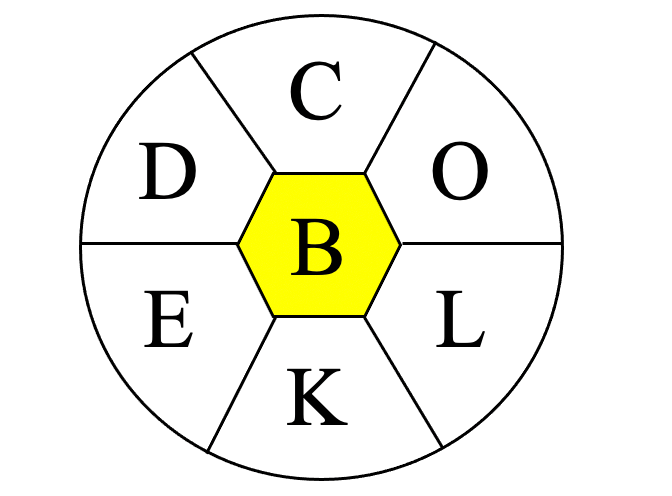
C, D, E, K, L, O, and center B (all words must include B)
Merriam-Webster says…
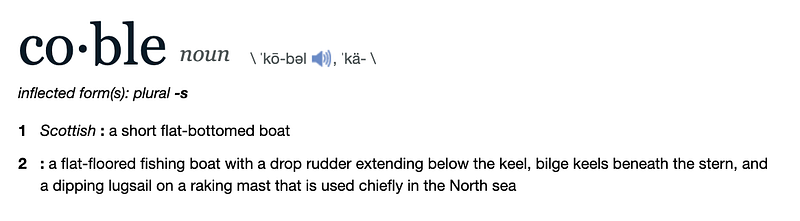
Silly little dictionary! Don’t you know that coble can’t possibly be a word if The New York Times says it ain’t?
For further fascinating facts, check out the Spelling Bee Master.
What’s your favorite dord* from today’s puzzle?
My Two Cents
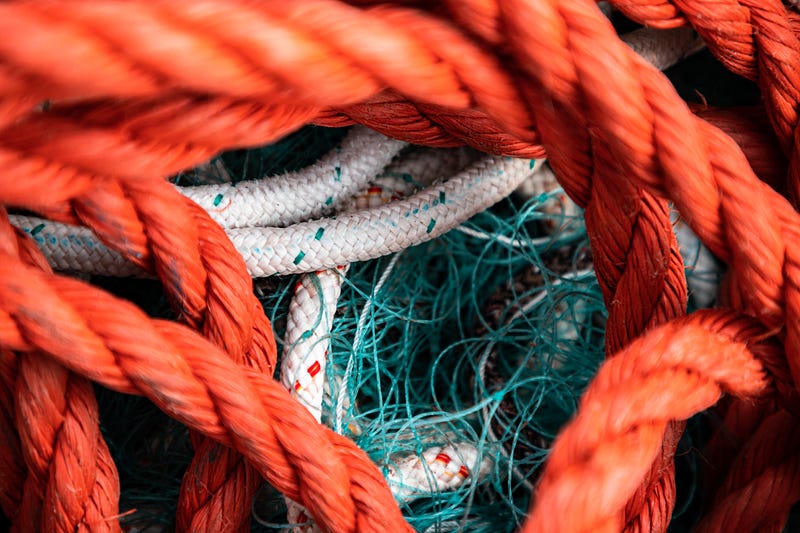
The picture at the top of today’s article does not show a coble. I’ll include a couple of images later on, when I’m discussing the boat. But I couldn’t find any photos of one in Unsplash, Pixabay, or Pexels. Unsplash showed 0 results, while the other two seemed to be “hard of reading” and turned up images of cables.
Not very helpful, but it did give me a search idea for Unsplash. I typed in “fishing boat” and when the picture of the ropes and nets came up, I selected that as the photo for today’s column. I figure those items would be found on any coble worth its salt.
Today I found the Uppercase Cobles more fascinating than the lowercase ones. Read on!
lowercase c
The 1911 Encyclopedia Britannica says that coble is “probably of Celtic origin, and connected with the root ceu or cau, hollow; cf. Welsh ceubol, a ferry-boat” and defines it as “a flat-bottomed fishing-boat, with deep-lying rudder and lug-sail, used off the north-east coast of England.”
Our friends at Merriam-Webster further clarify that the word may have come from “Middle English, probably of Celtic origin; akin to Welsh ceubal ferryboat, skiff, Old Breton caubal; perhaps akin to Latin cavus hollow”-
The Scottish National Dictionary (yes, it’s a thing) defines coble thusly:
A small flat-bottomed rowing boat, used mostly in river or lake fishing, or for salmon-fishing by net near the coast. (The Eng. coble, used mostly off the north-east coast of Eng., has a rudder extending four or five feet below the bottom, three pairs of oars, and is used only for sea-fishing.)
(The Scottish version of the coble is shallower and beamier than its English counterpart. It was used for salmon fishing, and its construction was less refined than its southern counterpart.)
Cobles are different from other small coastal fishing boats in the rest of England. It was built with a single keel, or center longitudinal timber, for the bow (front) and a double keel for the stern (back). The bow itself is very high, and the boat has a flat bottom. This design helped launch them from the shallow, sandy beaches where they were used. These boats typically went into water bow first, as most do, but upon returning they were “backed in” stern first. The deep bow and the double keel at the rear helped keep the boat straight.
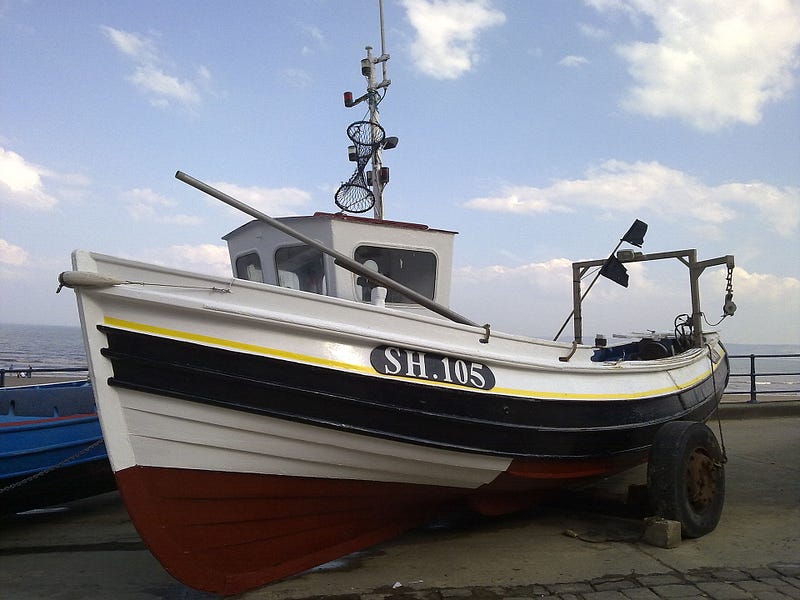
Cobles used to be fit with sails (usually four-cornered lugs), but today most use engines. There is even a Coble and Keelboat Society that has been researching and preserving the history of what they call the “Coble Coast” (the shoreline from the River Tweed to the Humber) According to the website, CKS membership is constituted by “fishermen, authors, poets, artists, model makers and maritime historians amongst others who have wide interest in the maritime heritage of the North East and Yorkshire Coast.”
If this article has awakened a long-hidden fetish for small high-keeled English fishing boats, feel free to click the above link and join the society. We here at Silly Little Dictionary! don’t judge anyone’s fetishes.
Uppercase C
There are several people with the surname Coble, including two mayors of cities in North and South Carolina ––Paul Coble of Raleigh and Bob Coble of Columbia–– although there seems to be no direct blood relation between them. The two Cobles that I found most interesting were Anna and Drew.
§ Anna Coble (1936–2009)was born in Raleigh, North Carolina, where her early interest in mathematics and science was encouraged by both her father, who taught at St. Augustine’s University , and her high school teachers, who were “very good, strong women teachers who were using their minds in the sciences.” Coble ended up getting her Bachelor’s in mathematics at Howard University and later earning a master’s degree in physics at the same school in 1961.
She began her career by becoming a teacher like her father, but a few years later decided to get her doctorate. Remember, this was the 1960s, a time when women and minorities were not exactly accepted at higher institutions. Coble decided to attend the University of Illinois, from which her godfather had graduated. There she became an advocate for minority students after the university mishandled the dorm assignments of a large group of Black freshmen.
Coble later returned to her alma mater, Howard University, where she became the first Black woman to be hired as faculty. As she explained:
I felt that I could do more for black students at Howard than I could at another place, where you may only have ten black students. I wanted to reach a mass of black students. Black students would be so isolated where the numbers are so few… At Howard, my impact would be experience by a large number of black students.
Coble helped form the National Society of Black Physicists, served on the board of the Ionia Whipper Home (a shelter for neglected teenage girls), developed educational resources for the National Academy of Sciences and the National Research Council, and worked with the American Association for the Advancement of Science and American Association of Physics Teachers to support underrepresented groups in science.
This is the only picture I was able to find of her:
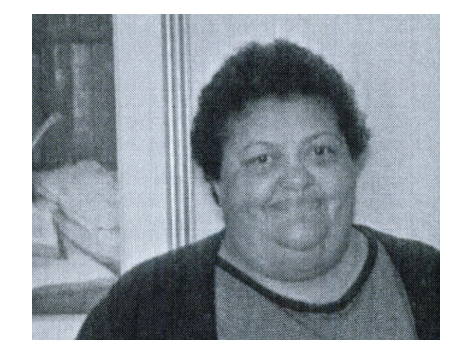
One of the chapters of Diann Jordan’s book, Sisters in science : conversations with black women scientists about race, gender, and their passion for science, is dedicated to Anna Coble . It’s an interesting interview, with Coble recounting important moments from her career and life in general. You can read the entire chapter by logging in and borrowing the online book here.
§ Drew Coble was a Major League Baseball umpire between 1982 and 1999, participating in more than 2,300 games during his tenure. In 1991 he was promoted to crew chief. The highlights of his career were the 1985 and 1997 All-Star Games, the 1987, 1992, and 1995 American League Championship Series, the 1996 and 1998 American League Division Series, and the 1991 World Series. The latter featured the Minnesota Twins beating the Atlanta Braves in seven games, and is considered to be one of the most exciting series ever.
Although he called two no hitters in the same season (1990), Coble is best known for a controversial call he made in Game 2 of the 1991 World Series. Atlanta’s Ron Gant had singled, rounded first base, and then returned. When the throw came back to Minnesota first baseman Kent Hrbek, it seemed that he lifted Gant off the bag. Gant was still called out by Coble, who ruled that Gant’s momentum would have pulled him off the bag even if Hrbek hadn’t hooked his glove into Gant’s leg. The Braves ended up losing that game by one run. You can see the play in the video below and decide for yourself. I remember watching that game when it happened and thinking Gant should have been called safe. Thirty years later, I still think that.
Coble’s career may have lasted longer if not for the mass resignation of umpires in 1999, a strategy that became an epic failure when MLB simply responded with “okay, goodbye”. Some of those umpires were re-hired, but Coble wasn’t one of them. (Coble still denies ever actually signing the resignation letter.) When MLB was later ordered to rehire him, he instead reached a retirement agreement with them.
Now you know. Next time you’re visiting the northeastern coast of England, ask the locals if they might give you a ride on one of their cobles. Don’t be surprised if you’re turned down, however. Not because fishermen there are rude… but because the editors of the Spelling Bee decided that coble is a dord*.
You can check out my previous entry on another dord* here:
*What the heck is a dord, you ask? Here’s the answer: