
Clitic
I bet you use this anatomical part every day

Today’s New York Times Spelling Bee letters:
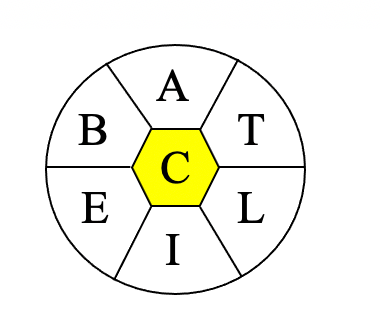
A, B, E, I, L, T, and center C (all words must include C).
Merriam-Webster says…
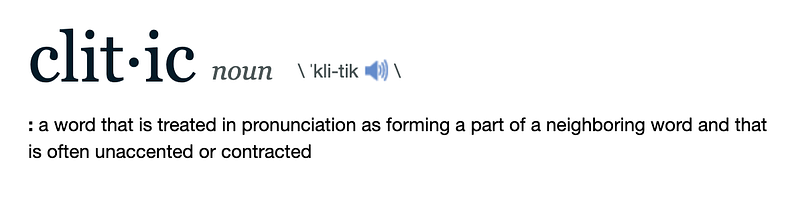
Silly little dictionary! Don’t you know clitic can’t possibly be a word if the New York Times says it ain’t?
For further fascinating facts, check out the Spelling Bee Master.
What’s your favorite dord* from today’s puzzle?
My Two Cents
Yes, I’ll admit the title of today’s column is a tad clickbait-ish. But by now you should know that when I say “anatomy”, I am referring to morphology, or the structure and content of words. Still, I hope you stick around to read more about the clit…ic.
“Word” depends on what the meaning of “word” is
When discussing language — especially written language — most people agree that the basic unit that expresses meaning is the word. But what is a word? (Some people claim bird is the word, but with my apologies to Seth MacFarlane and The Trashmen… it isn’t.)
Most people will agree that the sentence “My mother and I get along swell.” has seven words. But a problem arises when I write “My mother-in-law and I get along swell.” And not just because I’m lying. Do we still have seven words in that second sentence, or are there now nine? It’s gonna depend on which linguist you ask, or what platform you write on. For example, Medium considers mother-in-law three words; MS Office’s Word says it’s one.
Okay, how about the sentence “I’ve never gotten along swell with my mother-in-law.” First off, it sounds very cliché, if not realistic. But what is “I’ve”? One word? Two? One and half?
This brings us to morpheme. No, not the sleep-inducing drug… although I’ll bet this article is starting to put some readers to sleep. (Cue rim shot.) A morpheme is the smallest meaningful unit of language.
Wait a second! I just stated earlier that a word was the basic unit of language. Which is still true, because a word by definition (1) implies meaning and (2) can stand alone. Morphemes may have meaning, but they can’t stand alone.
So, in the case of “I’ve”, we have a word-morpheme combo. I is the word, and -’ve is the morpheme. And yes, “I’ve” is still a contraction; nothing has changed in that sense since grade school.
Clitic vs clitic
The -’ve in I’ve is not only a morpheme and a contraction, but also an example of a clitic. Because the word have, as per the dictionary’s definition, “is treated as forming part of a neighboring word and… is often… contracted”. In this case, the contraction is -’ve.
This type of clitic is the most common one found in the English language. Because it appears at the end of the word that supports it, it’s called an enclitic. Clitics that appear before their hosts are called proclitics and, according to what I researched, the only proclitic in English is the famous “y’all”, for “you all”.
Mesoclitics appear between a host and prefixes or suffixes. If you speak Portuguese, you’ve probably seen them. For example: conquistar-se-á (“it will be conquered”) or dá-lo-ei (“I will give it”).
Endoclitics are unicorns. These clitics split apart the root word and settle in comfortable between them. Because they defy something called the Lexical Integrity Hypothesis, they were considered only theoretical, until some people reported seeing flocks of them in languages such as Udi, Pashto, and Degema.
Now, there is some debate as to the difference between clitics and affixes (prefixes and suffixes). One critical issue that leads to terrible brawls and knife fights between linguists is the morpheme ‘s. When ‘s is used as a contraction for a verb, 4 out of 5 dentists… I mean, linguists, agree that it’s a clitic, and an enclitic at that. For example: Joan’s left = Joan has left.
But when it comes to the possessive marker ‘s, as in Joan’s house, there is no consensus. Some say the ‘s is an affix, others insist it’s a special type of clitic. In any case, I highly recommend that if you ever see two linguists screaming at each other about this conundrum, just walk away. I once tried to intervene and it did not end well… for me. And I have the scars to prove it, too.
Well, that’s about it for today. To thank you for reading, and because I did not include any images in this morphine-like article about morphemes, here is a picture of something else that begins with morph-.

I think I just increased the coolness factor of this piece by about one thousand.
With that, I will say goodbye to the one reader who stuck around until the very end. (And thank you, by the way.) Not before theorizing that maybe the New York Times thought that clitic was slang for an esoteric part of the human anatomy, instead of realizing it’s an obscure part of lexical morphology.
I guess that’s why the editors of today’s Spelling Bee puzzle decided clitic’s a dord.* (See what I did there, New York Times?!?)
Please check out my previous entry on another dord*:
*What the heck is a dord, anyway? Here you go: