avatarAvi Kotzer

Free AI web copilot to create summaries, insights and extended knowledge, download it at here

2765

Abstract

Each year, <i>amanitas</i> are responsible for 9 out of 10 mushroom-related deaths. Mostly due to poisoning, of course, but occasionally after it’s rained some people happen to slip on them and crack their head open. Now, mycologists did a pretty good job of helping us avoid them by giving them scary names:</p><figure id="a5a8"><img src="https://cdn-images-1.readmedium.com/v2/resize:fit:800/1*HGRq4hCzyngh9SPO0uqesw.png"><figcaption>Collage by Iva Reztok</figcaption></figure><p id="b57a">Okay, maybe not very <i>creative</i> names, but scary nonetheless.</p><p id="6626">The main problem? Mushrooms are shy and don’t speak up, so when you encountered an <i>amanita</i> in the forest and asked its name, it probably didn’t answer. This rude behavior may have angered some people and led them to eat the mushroom out of spite… the equivalent of cutting off your face to spite your nose.</p><p id="17d4">Second problem. Mushroom scientists weren’t consistent with their naming technique, dubbing some of the <i>amanita</i> species as “false death cap”, “Caesar’s mushroom”, and “gemmed amanita”. I can just imagine the conversation between two friends who stumble upon one of these.</p><p id="3235">— “Are you sure this one is safe to eat?” — “Of course! Look, it’s the ‘false death cap’. That means it’s not the real death cap. Nothing to worry about!” — “Oh, okay, then. Let’s eat!”</p><p id="cea2">Now, admittedly not than many people die every year from ingesting poisonous mushrooms. In 2012, only seven fatalities were officially recorded by the American Association of Poison Control Centers. However, for that year, more than 6,000 people were exposed to dangerous mushrooms, of which 494 had moderate outcomes and 35 had major outcomes. What “moderate” and “major” mean is anybody’s guess.</p><h2 id="e749">Fly, fly away</h2><p id="cf24">The <i>amanita muscaria</i>, or fly agaric, is undoubtedly the star of this poisonous family. They are the typical depictions of toadstools in pop culture: <i>Alice in Wonderland</i>, the Smurfs, Mario Bros games, and Disney’s <i>Fantasia</i>.</p><figure id="c790"><img src="https://cdn-images-1.readmedium.com/v2/resize:fit:800/0*PHRWICjmB4teD-XD.jpg"><figcaption>Credit: wikipedia.com</figcaption></figure><p id="79c4">Above, a studio, a one-bedroom, and a penthouse used by Smurfs.</p><p id="05ce">Although this beauty is deadly, it’s much less so than other members of the genus. It can also be parboiled and eaten. Cooking it weakens its toxicity, which does not happen with some of the deadlier <i>amanitas</i>.</p><p id="bfdb">The mushroom’s nickname, fly agaric, comes from the fact that it’s used to catch flies. Who would want to do that? I’m not sure, but I suspect the perpetrators of such dastardly dee

Options

ds are tiny and blue. One of the substances responsible for helping catch flies, muscimol, which is also a psychoactive substance.</p><p id="59f1">Yes, that’s right, these shrooms can be taken to, well… “take shrooms”. (But please don’t; at least not with these.)</p><p id="e2ff">Amanita muscaria can produce a wide range of effects:</p><ul><li>depressant and sedative-hypnotic</li><li>psychedelic and dissociative</li><li>synesthesia (numbers as colors)</li><li>macropsia (objects appear to be huge) and micropsia (objects appear to be tiny)</li></ul><p id="4853">These last two can happen at the same time or alternatingly, as part of something called <a href="https://en.wikipedia.org/wiki/Alice_in_Wonderland_syndrome">Alice in Wonderland syndrome</a>, which also includes pelopsia (things appear to be closer) and teleopsia (things appear to be farther away).</p><p id="fa33">Hmmm. I guess this explains <b>a lot</b> about that crazy-ass story Lewis Carrol came up with… probably while “taking shrooms”.</p><p id="c94b">In any case, what’s clear now is that, after today, the blame for most mushroom<i> </i>fatalities can be placed squarely on the shoulders of the New York Times. They had the chance to warn us about the deadly <i>amanita</i>.</p><p id="de4c">But the editors of the Spelling Bee decided that this word is a <a href="https://www.merriam-webster.com/words-at-play/dord-a-ghost-word"><b>dord</b></a><b>.</b></p><p id="0aff">Please check out my previous entry on another <b>dord:</b></p><div id="60e8" class="link-block"> <a href="https://readmedium.com/pottle-baeabcc4d3eb"> <div> <div> <h2>Pottle</h2> <div><h3>A conspiracy theory in a bottle</h3></div> <div><p>medium.com</p></div> </div> <div> <div style="background-image: url(https://miro.readmedium.com/v2/resize:fit:320/0*R0_puR_7qAM7jvLY)"></div> </div> </div> </a> </div><p id="4c6a">*What the heck is a <b>dord, </b>anyway? Here you go:</p><div id="1bcf" class="link-block"> <a href="https://www.merriam-webster.com/words-at-play/dord-a-ghost-word"> <div> <div> <h2>'Dord': A Ghost Word</h2> <div><h3>One of the questions people like to ask lexicographers is this: Can you sneak something into the dictionary? Can you,…</h3></div> <div><p>www.merriam-webster.com</p></div> </div> <div> <div style="background-image: url(https://miro.readmedium.com/v2/resize:fit:320/0*mSqQEH4oStOFrBAI.jpg)"></div> </div> </div> </a> </div></article></body>

Amanita

What has an annulus and a volva, and is deadly as heck?
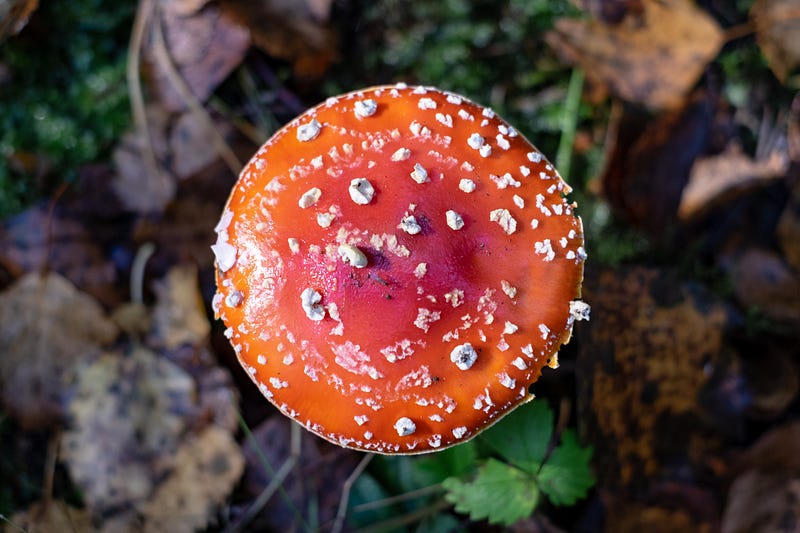
Photo by Eugene Zh on Unsplash

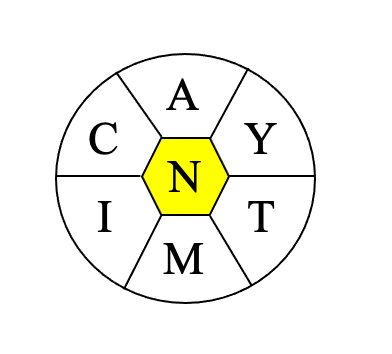
Today’s New York Times Spelling Bee letters:
Art: Iva Reztok

A, C, I, M, T, Y, and center N (all words must include N).

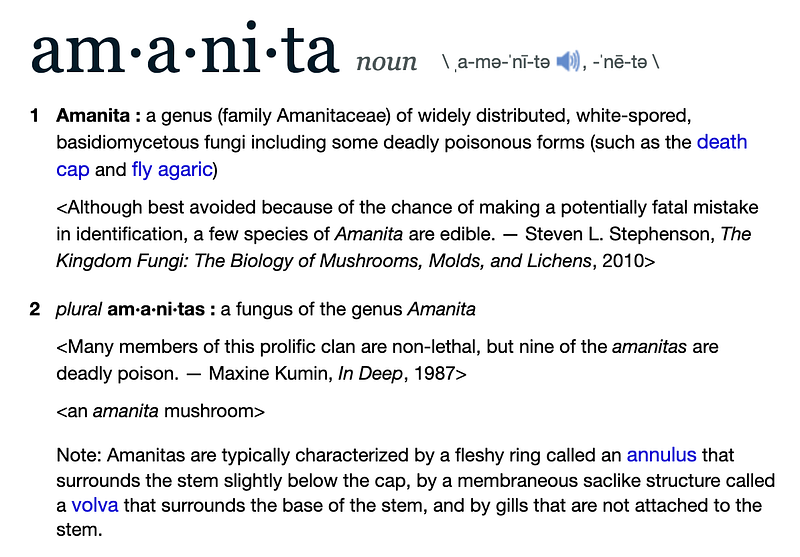
Merriam-Webster says…
Credit: merriam-webster.com

Silly little dictionary! Don’t you know amanita can’t possibly be a word if the New York Times says it ain’t?

For further fascinating facts, check out the Spelling Bee Master.

What’s your favorite dord* from today’s puzzle?

My Two Cents

The New York Times would probably be doing everyone a big favor if they included amanita in today’s Spelling Bee. Those who know the word would be reminded, and those who don’t might get curious, look it up, and discover the prettiest killer since La Femme Nikita.

At least Nikita was fictional. Amanita is very very real and very very deadly.

Mushrooms with a dirty mind

Amanitas are a collection of close to 600 mushrooms that have defined caps, gills, and stipes. No, they’re going to transfer money you earned on Medium to your bank account. That’s stripe, with an “r”. A stipe is a stem. Why is a mushroom stem called a stipe? For the same reason the cap is called a pileus and the gills are called lamellae. So fungus PhDs can make us feel like the worthless biological specimens that we are.

Now, when I first read about amanitas today I thought for a second someone had slipped in a transcript of a highbrow porno. Words like volva and annulus and phalloides popped up. Then I removed my mind from the gutter, wiped my eyeglasses, and checked again.

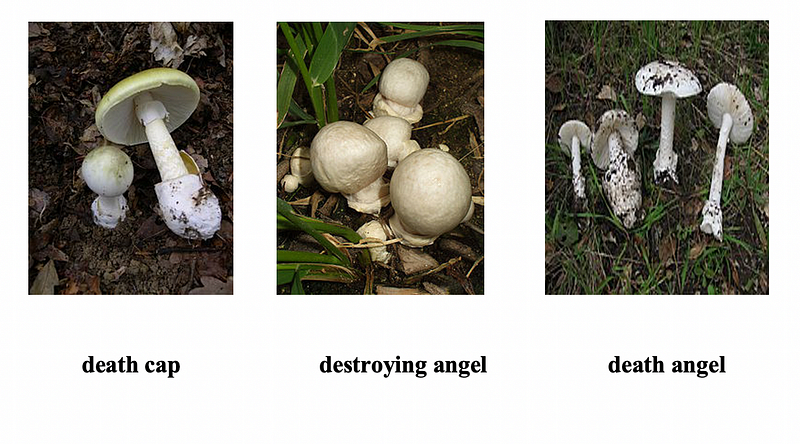
Each year, amanitas are responsible for 9 out of 10 mushroom-related deaths. Mostly due to poisoning, of course, but occasionally after it’s rained some people happen to slip on them and crack their head open. Now, mycologists did a pretty good job of helping us avoid them by giving them scary names:
Collage by Iva Reztok

Okay, maybe not very creative names, but scary nonetheless.

The main problem? Mushrooms are shy and don’t speak up, so when you encountered an amanita in the forest and asked its name, it probably didn’t answer. This rude behavior may have angered some people and led them to eat the mushroom out of spite… the equivalent of cutting off your face to spite your nose.

Second problem. Mushroom scientists weren’t consistent with their naming technique, dubbing some of the amanita species as “false death cap”, “Caesar’s mushroom”, and “gemmed amanita”. I can just imagine the conversation between two friends who stumble upon one of these.

— “Are you sure this one is safe to eat?” — “Of course! Look, it’s the ‘false death cap’. That means it’s not the real death cap. Nothing to worry about!” — “Oh, okay, then. Let’s eat!”

Now, admittedly not than many people die every year from ingesting poisonous mushrooms. In 2012, only seven fatalities were officially recorded by the American Association of Poison Control Centers. However, for that year, more than 6,000 people were exposed to dangerous mushrooms, of which 494 had moderate outcomes and 35 had major outcomes. What “moderate” and “major” mean is anybody’s guess.

Fly, fly away

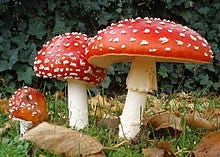
The amanita muscaria, or fly agaric, is undoubtedly the star of this poisonous family. They are the typical depictions of toadstools in pop culture: Alice in Wonderland, the Smurfs, Mario Bros games, and Disney’s Fantasia.
Credit: wikipedia.com

Above, a studio, a one-bedroom, and a penthouse used by Smurfs.

Although this beauty is deadly, it’s much less so than other members of the genus. It can also be parboiled and eaten. Cooking it weakens its toxicity, which does not happen with some of the deadlier amanitas.

The mushroom’s nickname, fly agaric, comes from the fact that it’s used to catch flies. Who would want to do that? I’m not sure, but I suspect the perpetrators of such dastardly deeds are tiny and blue. One of the substances responsible for helping catch flies, muscimol, which is also a psychoactive substance.

Yes, that’s right, these shrooms can be taken to, well… “take shrooms”. (But please don’t; at least not with these.)

Amanita muscaria can produce a wide range of effects:

  • depressant and sedative-hypnotic
  • psychedelic and dissociative
  • synesthesia (numbers as colors)
  • macropsia (objects appear to be huge) and micropsia (objects appear to be tiny)

These last two can happen at the same time or alternatingly, as part of something called Alice in Wonderland syndrome, which also includes pelopsia (things appear to be closer) and teleopsia (things appear to be farther away).

Hmmm. I guess this explains a lot about that crazy-ass story Lewis Carrol came up with… probably while “taking shrooms”.

In any case, what’s clear now is that, after today, the blame for most mushroom fatalities can be placed squarely on the shoulders of the New York Times. They had the chance to warn us about the deadly amanita.

But the editors of the Spelling Bee decided that this word is a dord.*

Please check out my previous entry on another dord*:

*What the heck is a dord, anyway? Here you go:

Spelling Bee
Language
Outdoors
Science
Nature
Recommended from ReadMedium