
Climate Crisis Acting Out on the Camino
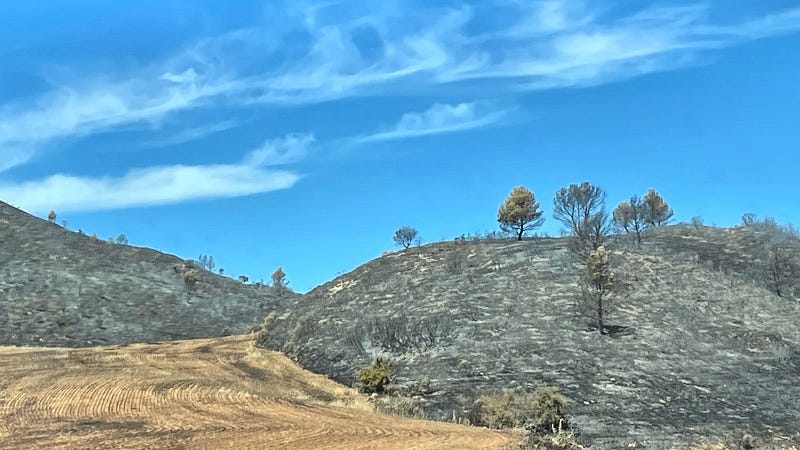
July 19, 2022. It is 2 a.m. and I can’t sleep. The room is hot, I’m perspiring on a Spanish bed that is not made to fit a tall Dutchman walking the Camino to Santiago de Compostela. I know about the importance of cooling down at night and I open the small window. I kept it closed when I went to sleep since it is even warmer outside than in the house.
After a few short moments of sleep, I realize at 4 a.m. that I smell smoke. I check the corridor, my room, and look outside. I don’t see flames but smell the forest fires and remember the firefighting helicopters and planes that I had seen in the evening.
On my smartphone, I search for information on the wildfires in Galicia, on the air quality, and on what to do in this situation. I decide to stay, call a taxi to get out of this region at first daylight, and sleep with an N95 mask that I still carry with me today to deal with the other global crisis, the pandemic.
At 6:30 I get up, pack my backpack, go downstairs and open the front door. The air quality seems less harmful than a few hours earlier. I drop the taxi-plan that would probably lead to more hours of waiting in this small village, and decide to walk to a region with cleaner air.
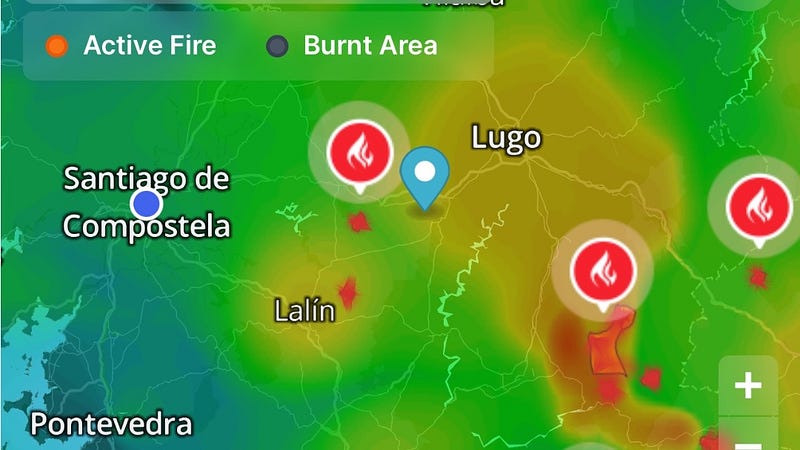
Coincidentally, the nearest clean air is towards the west, where Santiago de Compostela lies between me and the Atlantic Ocean. It is where the Camino leads me. And even though the nearest active fire is also to the west, I decide to go for clean air.
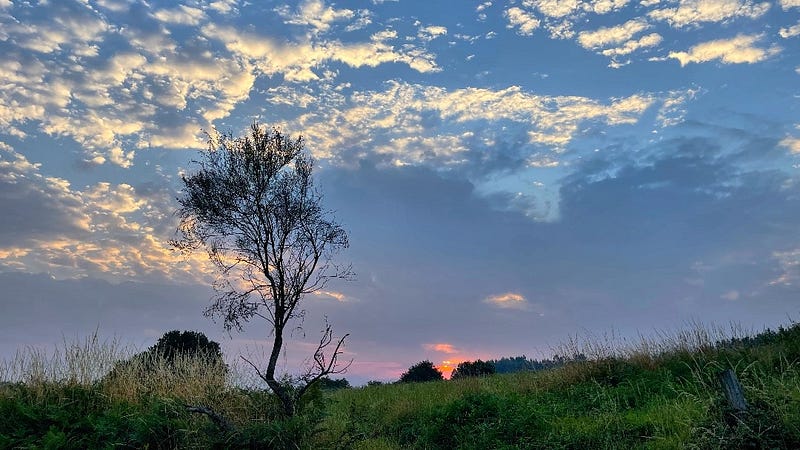
The first photos of the day capture a magnificent sunrise and during a short break I post one of these on Twitter.
I know by now that I am a fast walker. At an average speed of six kilometers per hour, there hasn’t been any other pilgrim that passed me since I embarked on a faster pace. That was around the time that I was in lively Burgos with its stunning Cathedral, now weeks ago.
I briefly walk up with a young woman from Karlsruhe, Germany, but then I quicken my pace. A bit further, I meet a student from Budapest, Hungary. A fast walker, although he is traveling with no protection for his feet other than a pair of leather sandals. He has two pairs of shoes tied to his backpack. He tells me his blisters won’t stop him from catching up with his sister. She is half-a-day of walking ahead of him after an argument a few days ago. I suppose she refuses to stop and wait for him, knowing quite well that his blisters make him feel sorry for himself during prolonged Camino stages. I hope Santiago will be forgiving of both of them.
The air quality that briefly looked so much better when I began walking, suddenly turned much worse. I feel it in my throat, smell it, and fear it. I notice that what I first believed to be morning fog like the one I recently photographed in Portomarin is actually smoke. I can no longer see the fertile green hills of Galicia in the distance.
In Palas de Rei, I stop at a cafe for a fresh orange juice, the fuel that I walk on every morning. On the other side of the street, I notice a dozen pilgrims waiting for a bus. It is an unusual sight and I walk up to a woman who’s waiting there with her backpack. We chat for a while. She’s an officer in the U.S. Navy and takes the bus since back pain prevents her from walking further today. She asks if I had also seen the ash falling out of the sky in Sarria a few days ago, and both of us notice that this time we don’t see any ash from the forest fires.
Soon after I leave Palas de Rei, the air quality seems to get better and even though I still see smoke in the distance, I find hope in the patches of blue sky opening up above me.
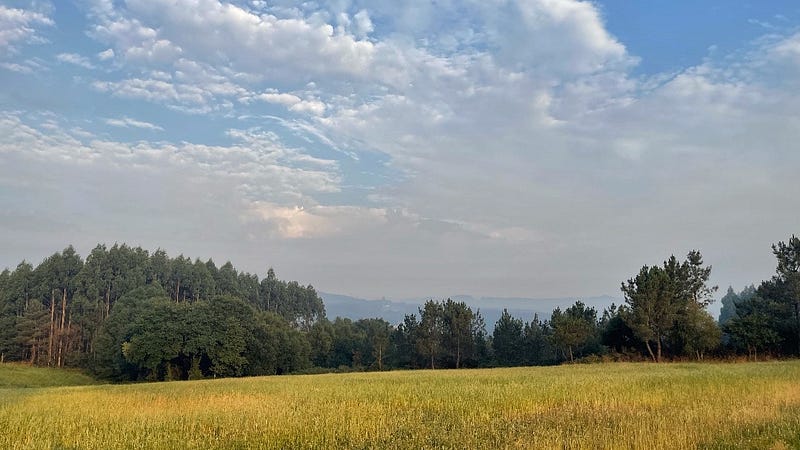
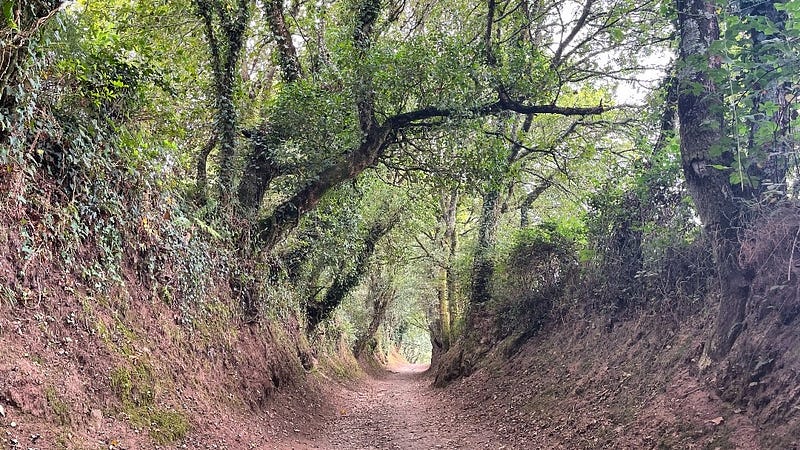
It changes my mood, and I start to pay more attention to nature and the architecture of the region. I see butterflies, and several tiny toads on the hollow roads that I walk on. Sometimes, these roads go as deep as six meters, and I imagine the millions of pilgrims whose feet have trodden this path for more than a thousand years.
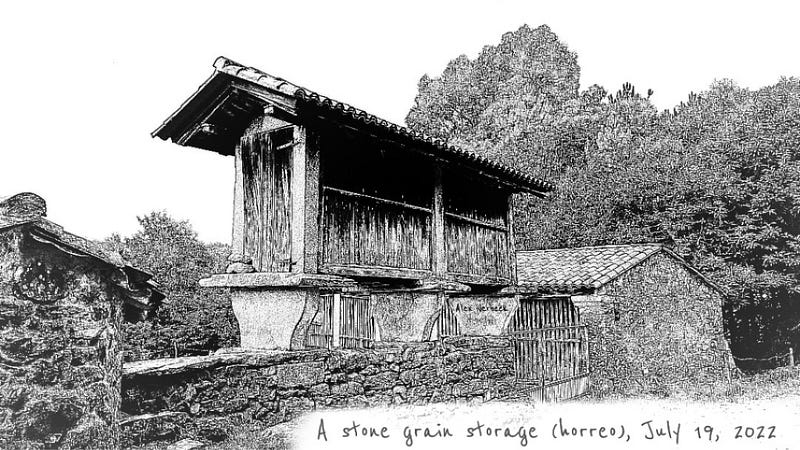
Every village has the typical Galician stone grain stores, hórreros. This is an example of what these look like.
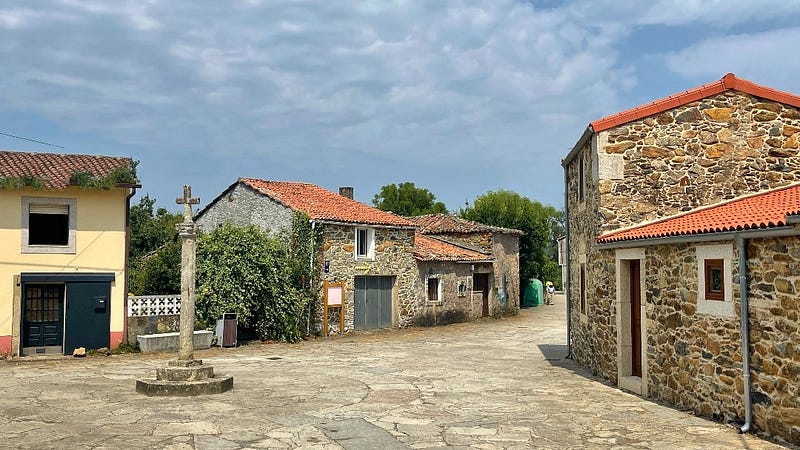
I am breathing fresh air again and stop in another small village for a cup of coffee. Like many Galician villages it has one of the stone crosses (cruceiros) that are often from the 19th century.
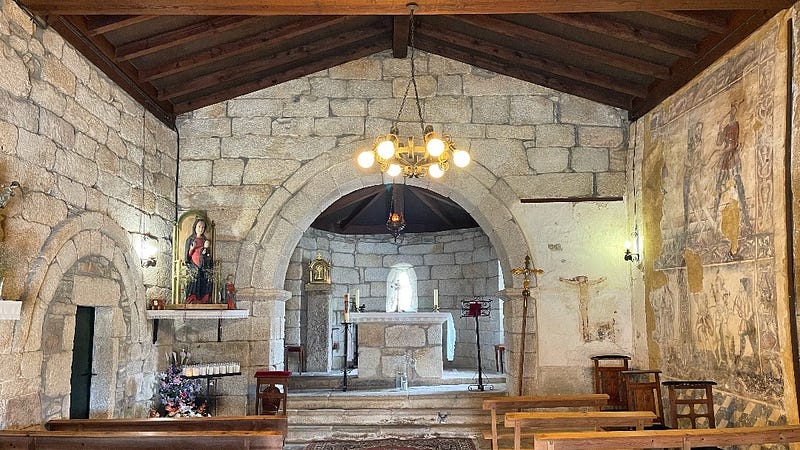
At about 1 p.m. I stop at one of the uncountable small churches that I have visited since I left Saint Jean Pied de Port more than a month ago. This little gem, Santa María do Leboreiro, is likely from the 14th century. This estimate is based on its formal characteristics like the pointed arch and the decoration of diamond tips.
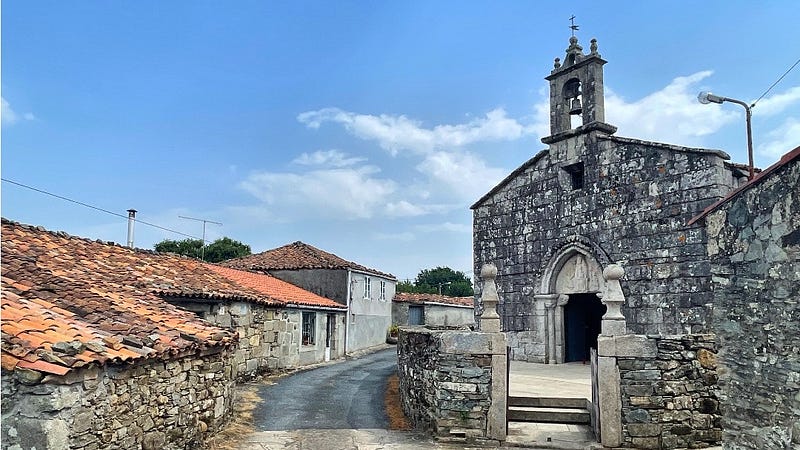
A unique feature of this church is that its main axis is north-south oriented instead of west-east.
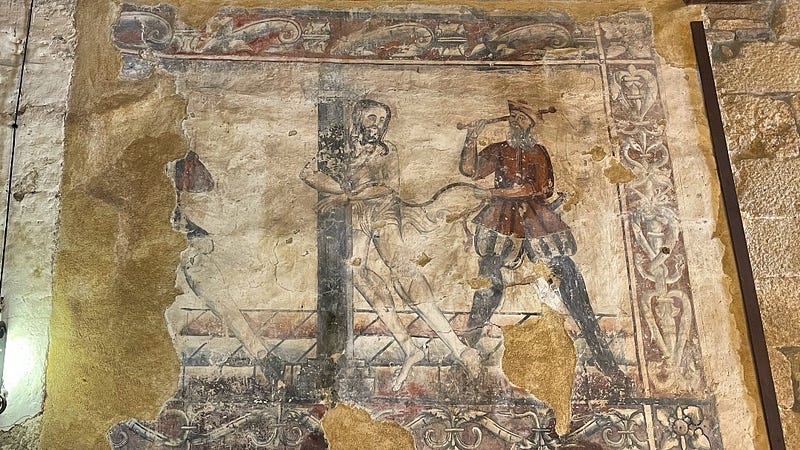
In 1981, there was a fascinating discovery of 16th century murals. One of them represents the Flagellation to Christ tied to the column and whipped. Note the 16th century Spanish look of the soldier. I chat about it with the young woman who runs the church and gives a stamp in my pilgrim passport. She is from the neighboring village and believes that Galicia is the most beautiful place on earth. I find it hard to disagree with her.
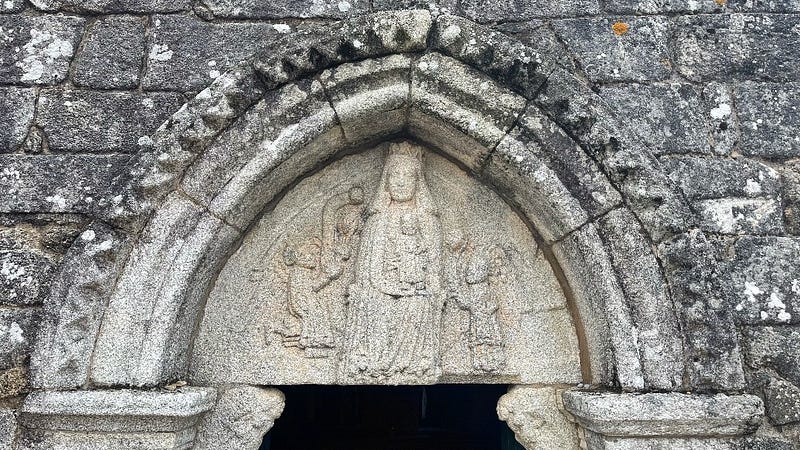
Then she showed me the Tympanum, which is made of one piece of stone and is from the16th century. The Virgin is crowned and seated, with the Boy standing up, the book in her hand. Two angels carry phylacteries and censers. She knows it all, it’s her small church. She’s here every day for eight hours to shows pilgrims around.
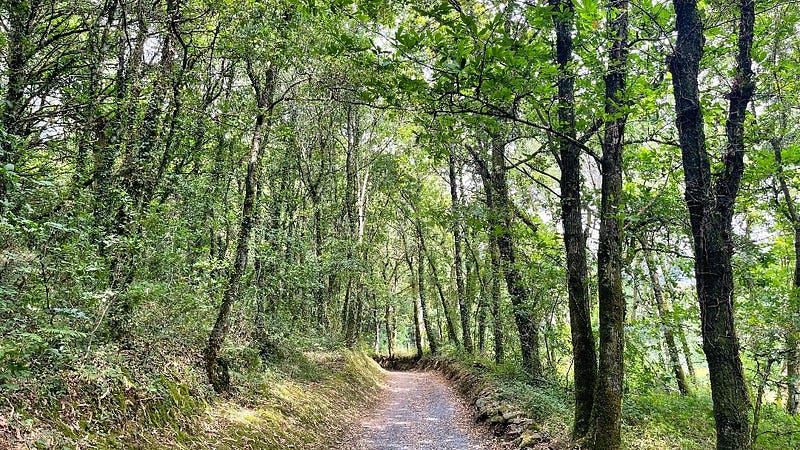
I continue my walk through the green forests of Galicia. Sometimes stopping in one of the many small villages, or finding time to chat with fellow pilgrims. Some of my friends from group in the initial days have now reached Santiago and they send me a photo. Some didn’t have the time to complete the pilgrimage and have already returned to their homes in Manchester, Hamburg, and elsewhere.
But I keep meeting new pilgrims, or find others that I had left behind, but that had passed me when I stayed for a few days in Leon. I have never met anyone in all these weeks of walking that I did not like. We’re in this together, support each other, and listen to each other’s stories. Because al of us have our stories to tell, and many choose this pilgrimage because they have had experiences that require some time off from the normal routines in their lives, and at their homes.
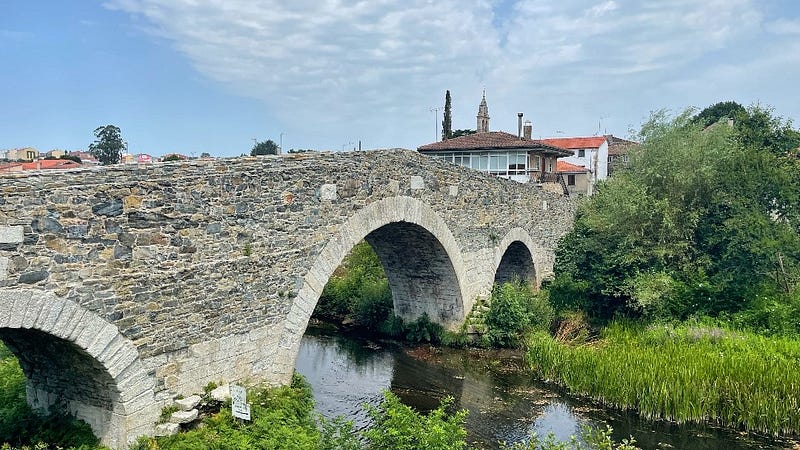
Close to Melide, I cross the medieval arched bridge. Soon after I find a place to sleep, and it is the first thing that I do. After two hours, I wake up, do my laundry, and start to write what you have just read. It is another day in the life of a modern day pilgrim.
If you find articles like this valuable and want to support my work, consider signing up to Medium. It’s $5 a month, giving you unlimited access to all my articles AND all stories on Medium.
If you sign up using my link, I’ll earn a small commission, at no additional cost to you.


