avatarAvi Kotzer

Free AI web copilot to create summaries, insights and extended knowledge, download it at here

4320

Abstract

g to the dictionary, is <i>cleek</i> the noun definition one (or <b>2Cleek1</b>). This is a large hook that is used to hang a heavy pot over a fire while the inside of said pot stews into a yummy meal. Also, the term can be used as a synonym for a fishhook. I’m guessing maybe if the head of the highland clan decides to catch some trout in a river. Are there trout in the rivers of the highlands? More importantly, do heads of clans go trout fishing?</p><p id="d866">I found some information about <i>cleeks</i> on the website of the National Museum of Ireland. Which means that although cleek is chiefly Scottish, it also moonlights as Irish. Like whisky. (I’m sure I’m going to get some backlash on that last comment, so I’m going to sportily <b>defend</b> myself by commending the Irish for crafting the ideal whisky for Medium bloggers.)</p><figure id="8371"><img src="https://cdn-images-1.readmedium.com/v2/resize:fit:800/0*V6I0ez53sn0gPqw2.jpg"><figcaption>Screenshotted by Iva Reztok</figcaption></figure><p id="4f2a">This amber spirit is best enjoyed over <b>crushed</b> ice after reviewing your monthly earnings.</p><p id="9b91">Back to cleek… the <a href="https://www.museum.ie/en-ie/home">National Museum of Ireland</a> has a picture of a <i>cleet</i> donated in 1966 by Michael J. Murphy, a writer and folklorist from Dromintee. I am hoping they don’t object to me posting the photo here:</p><figure id="84d4"><img src="https://cdn-images-1.readmedium.com/v2/resize:fit:800/0*YqEhHPABv5Z4rj8I.jpg"><figcaption>Credit: National Museum of Ireland</figcaption></figure><p id="87ba">The museum page provides a description of the <i>cleet</i> and an explanation of its use:</p><blockquote id="41f0"><p>This smith-made cleek of wrought iron is made from a single piece of metal, is round in section, 1cm in diameter, with a handle on one end and a hook on the other. Its total length is 36.5cm. The hook is 5.5cm wide at the mouth, 4.5cm deep and is made by the metal being turned back. The handle is a loop of the metal being turned back upon itself and is oval, 8.5cm deep and 11cm wide. The donor noted this object resembles a docker’s hook. The cleek was used to hook under the pig’s jaw to haul the animal from sty or “pig-craw” for slaughter in the village of Dromintee, Co. Down. The killing of a pig was a big ordeal and was not as simple as ending the animal’s life. There was a superstition around the killing of pigs in rural Ulster. It was thought unlucky not to have at least one neighbour present at the slaughter… As the adults and older children of the house were busy preparing for the kill, a child would be sent with an invitation to a neighbour to attend which was even accompanied by a jingle: “Me Da told me Ma to tell Mick to tell me to tell you to come to see would you give a hand to kill a dead pig”.</p></blockquote><h2 id="e303">Swing that cleek!</h2><p id="5101"><i>Cleek</i> the noun definition two (<b>2Cleek2</b> –-dammit! Why won’t Medium allow us to use superscripts!) may have been coined by a Scottish chief, or chiefly coined by a Scot. But this term for a golf club became internationally known for a while thanks to golf becoming a world-wide phenomenon at end of the 19th century and beginning of the next one.</p><p id="46be">Since the word <i>cleek</i> comes from the Middle English (northern dialect) <i>cleke</i> (hook, act of clutching) and its first known use is recorded in the 15th century, it’s likely the golf club was named after the hook. Here you can see the 18th-century MacDonald boys playing golf in a selfie taken by <a href="https://en.wikipedia.org/wiki/Jeremiah_Davison">Jeremiah Davison</a>.</p><figure id="4647"><img src="https://cdn-images-1.readmedium.com/v2/resize:fit:800/1*gUayb8hp7_xVB3bNCNQYoQ.png"><figcaption>Selfie by Jeremiah Davison</figcaption></figure><p id="8009">Is… is that a rifle? Clearly one of the MacDonald boys was a poor loser and had to be kept in check.</p><p id="358f">Wikipedia has an <a href="https://en.wikipedia.org/wiki/Obsolete_golf_clubs#19th_century_irons">article</a> about obsolete golf clubs, and tripsavvy.com also provides a list that includes clubs with wood heads, such as the <b>Play Club</b> (the equivalent of today’s driver), the <b>Brassie</b> (so named because of a brass plate on the sole), the <b>Woode

Options

n Cleek, </b>the<b> Spoon</b>, and the<b> Baffie</b> or “baffy.” Clubs with iron heads no longer in use were the <b>Mid Iron, Mid Mashie, Mashie Iron, Spade Mashie, Mashie Niblick, Pitching Niblick</b> (a lofting iron), <b>Niblick</b> (perhaps the best-known among the old clubs because of its odd name), <b>Jigger</b>, and the <i>cleek</i>, which came in its regular version and also as a “putting <i>cleek</i>”.</p><p id="ef83">Looking up the entry about <a href="https://en.wikisource.org/wiki/1911_Encyclop%C3%A6dia_Britannica/Golf">golf</a> in the 1911 edition of the Encyclopedia Britannica, I found a lot of interesting things about how the game was described over a century ago. One of them was the definition of bogey as “The number of strokes which a good average player should take to each hole. This imaginary player is usually known as ‘Colonel Bogey,’ and plays a fine game.” Today <b>bogey</b> is mostly known as “one stroke over <b>par</b> on a hole”. Par isn’t even included as a term in the article!</p><p id="50a3">Here is the description of “bogey play”:</p><blockquote id="06b3"><p>There is also a species of competition called “bogey” play, in which each man plays against a “bogey” score — a score fixed for each hole in the round before starting — and his position in the competition relatively to the other players is determined by the number of holes that he is to the good or to the bad of the “bogey” score at the end of the round. The player who is most holes to the good, or fewest holes to the bad, wins the competition. It may be mentioned incidentally that golf occupies the almost unique position of being the only sport in which even a single player can enjoy his game, his opponent in this event being “Colonel Bogey” — more often than not a redoubtable adversary.</p></blockquote><p id="9128">I guess that, in the case of golf, there is such as a thing as a “Bogey man”.</p><p id="82f5">There is even a march dedicated to the dear colonel.</p> <figure id="0d5a"> <div> <div> <img class="ratio" src="http://placehold.it/16x9"> <iframe class="" src="https://cdn.embedly.com/widgets/media.html?src=https%3A%2F%2Fwww.youtube.com%2Fembed%2F4dPn9M7TLlI%3Ffeature%3Doembed&amp;display_name=YouTube&amp;url=https%3A%2F%2Fwww.youtube.com%2Fwatch%3Fv%3D4dPn9M7TLlI&amp;image=https%3A%2F%2Fi.ytimg.com%2Fvi%2F4dPn9M7TLlI%2Fhqdefault.jpg&amp;key=a19fcc184b9711e1b4764040d3dc5c07&amp;type=text%2Fhtml&amp;schema=youtube" allowfullscreen="" frameborder="0" height="480" width="854"> </div> </div> </figure></iframe></div></div></figure><p id="9293">Now you know. Next time you’re in a golf foursome and wish to play a prank on your buddies, ask for a <i>cleek</i> club in your best Scottish accent. Your friends might not find it funny, and even penalize you a stroke… because the editors of the Spelling Bee decided that <i>cleek </i>is a dord*.</p><p id="78fa">You can check out my previous entry on another <b>dord* </b>here:</p><div id="e262" class="link-block"> <a href="https://readmedium.com/cete-f70dac511b7f"> <div> <div> <h2>Cete</h2> <div><h3>Don’t let this whale of a word badger you</h3></div> <div><p>medium.com</p></div> </div> <div> <div style="background-image: url(https://miro.readmedium.com/v2/resize:fit:320/0*m-m-DGFl2QwldO5z)"></div> </div> </div> </a> </div><p id="9c8f">*What the heck is a <b>dord, </b>you ask? Here’s the answer:</p><div id="5425" class="link-block"> <a href="https://www.merriam-webster.com/words-at-play/dord-a-ghost-word"> <div> <div> <h2>'Dord': A Ghost Word</h2> <div><h3>One of the questions people like to ask lexicographers is this: Can you sneak something into the dictionary? Can you…</h3></div> <div><p>www.merriam-webster.com</p></div> </div> <div> <div style="background-image: url(https://miro.readmedium.com/v2/resize:fit:320/0*PMl35tt0cbDaYRTC)"></div> </div> </div> </a> </div></article></body>

Cleek

Just in time for the weekend: golf

Photo by Peter Drew on Unsplash

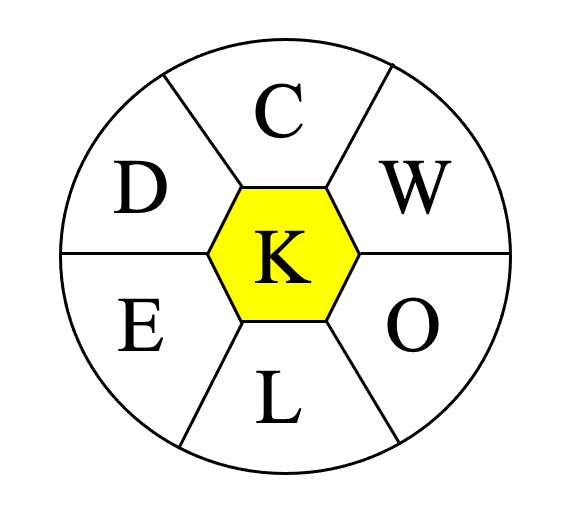
Today’s New York Times Spelling Bee letters:
Art: Iva Reztok

C, D, E, L, O, W, and center K (all words must include K)

Merriam-Webster says…
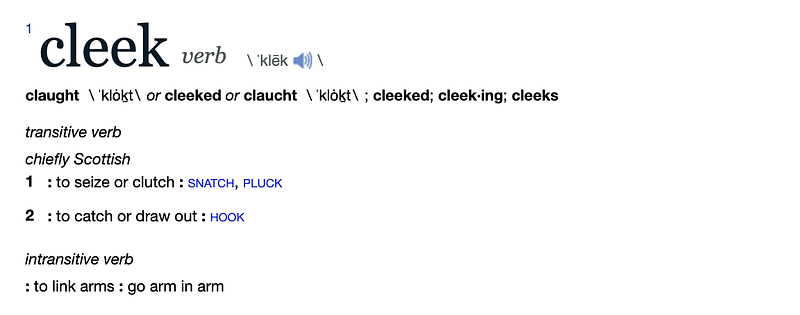
Credit: merriam-webster.com

…and…

Credit: merriam-webster.com

Silly little dictionary! Don’t you know that cleek can’t possibly be a word if the New York Times says it ain’t?

For further fascinating facts, check out the Spelling Bee Master.

What’s your favorite dord* from today’s puzzle?

My Two Cents

The game of golf has inspired a ton of quotes since it was invented centuries ago by some prophetic sadist who decided people would enjoy the great frustration of trying to sink a tiny ball into a tiny hole hundreds of yards away.

There’s the philosophical Kris E Wilson: “The first thing golf teaches is humility, the second; empathy, and the third patience.” The practical Jack Nicklaus: “This is a game. That’s all it is. It’s not a war.” The zen of Lorii Myers: “The value of routine; trusting your swing.” And the humorous saying often (but falsely) attributed to Mark Twain: “Golf is a good walk spoiled”.

If you’re objecting to me calling golf a “game”, I’ll let you know I’m following the tenets established by a friend of a friend, who claims that in order to be called a sport, an activity must involve some form of defense. This clearly establishes baseball, basketball, football, hockey, lacrosse, and handegg (American football) as sports. But track and field, gymnastics, and swimming are not. Following that logic, chess is a sport, but golf isn’t. Boxing can be considered a sport, but darts not so much. One could argue back and forth about pool, billiards, and snooker, I guess, since an opposing player can try to place the cueball to make life difficult for you.

I’m sure this definition of “sport” is going to have some strong opinions on both sides of the aisle. Which is what makes it fun, of course. And because arguing involves defense, fighting about that definition of sport… makes it a sport, technically-speaking.

Chiefly Scottish

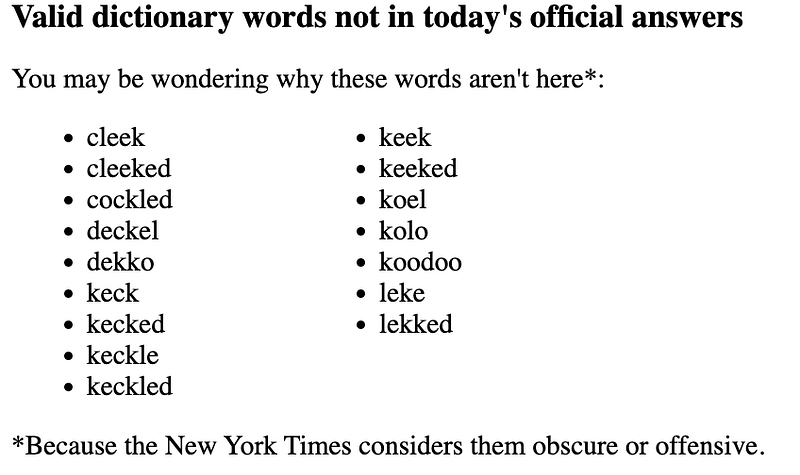
Many of the words on the rejected list appear to be slang from the British isles.
Credit: https://nytbee.com/

Cockle the intransitive verb is British for “wobble”, dekko means “a peep”, keck the noun is the wild chervil herb, keek is chiefly Scottish for “look”, and keckle is a “dialectal variant of cackle”.

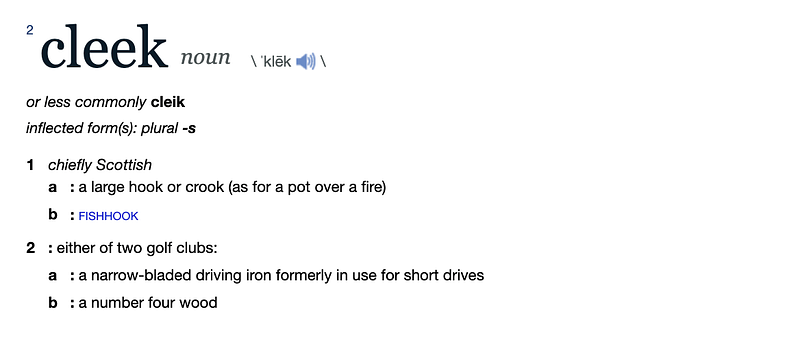
Cleek the verb (or 1Cleek as it’s know to friends and family) is chiefly Scottish for seizing or clutching and for catching or drawing out something, as with a hook. I’m not sure if this means that you have to be a Scottish chief in order to use the word. In fact, I’m not quite sure what a Scottish chief is. The head of a highland clan, perhaps?

Also something that Scots chiefly use, according to the dictionary, is cleek the noun definition one (or 2Cleek1). This is a large hook that is used to hang a heavy pot over a fire while the inside of said pot stews into a yummy meal. Also, the term can be used as a synonym for a fishhook. I’m guessing maybe if the head of the highland clan decides to catch some trout in a river. Are there trout in the rivers of the highlands? More importantly, do heads of clans go trout fishing?

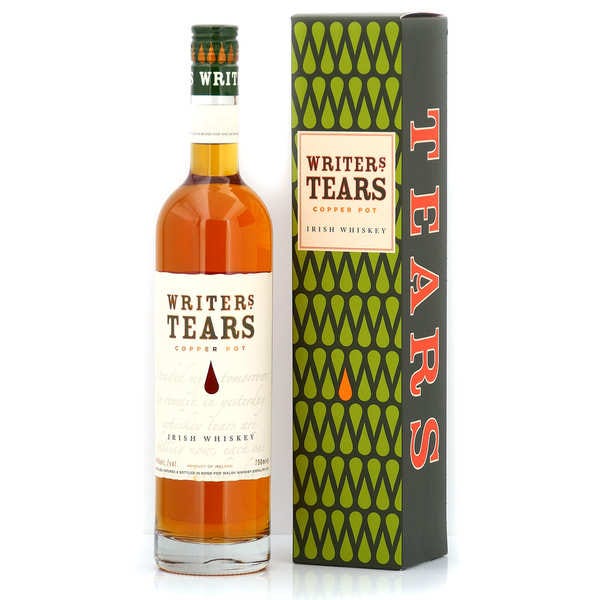
I found some information about cleeks on the website of the National Museum of Ireland. Which means that although cleek is chiefly Scottish, it also moonlights as Irish. Like whisky. (I’m sure I’m going to get some backlash on that last comment, so I’m going to sportily defend myself by commending the Irish for crafting the ideal whisky for Medium bloggers.)
Screenshotted by Iva Reztok

This amber spirit is best enjoyed over crushed ice after reviewing your monthly earnings.

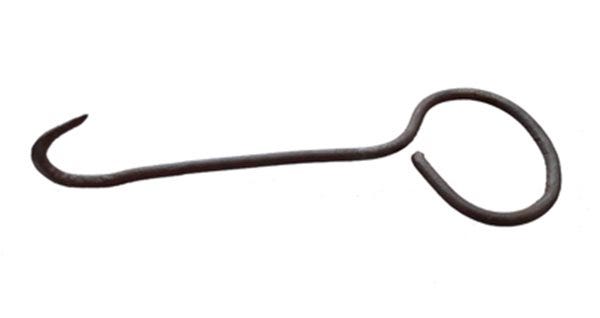
Back to cleek… the National Museum of Ireland has a picture of a cleet donated in 1966 by Michael J. Murphy, a writer and folklorist from Dromintee. I am hoping they don’t object to me posting the photo here:
Credit: National Museum of Ireland

The museum page provides a description of the cleet and an explanation of its use:

This smith-made cleek of wrought iron is made from a single piece of metal, is round in section, 1cm in diameter, with a handle on one end and a hook on the other. Its total length is 36.5cm. The hook is 5.5cm wide at the mouth, 4.5cm deep and is made by the metal being turned back. The handle is a loop of the metal being turned back upon itself and is oval, 8.5cm deep and 11cm wide. The donor noted this object resembles a docker’s hook. The cleek was used to hook under the pig’s jaw to haul the animal from sty or “pig-craw” for slaughter in the village of Dromintee, Co. Down. The killing of a pig was a big ordeal and was not as simple as ending the animal’s life. There was a superstition around the killing of pigs in rural Ulster. It was thought unlucky not to have at least one neighbour present at the slaughter… As the adults and older children of the house were busy preparing for the kill, a child would be sent with an invitation to a neighbour to attend which was even accompanied by a jingle: “Me Da told me Ma to tell Mick to tell me to tell you to come to see would you give a hand to kill a dead pig”.

Swing that cleek!

Cleek the noun definition two (2Cleek2 –-dammit! Why won’t Medium allow us to use superscripts!) may have been coined by a Scottish chief, or chiefly coined by a Scot. But this term for a golf club became internationally known for a while thanks to golf becoming a world-wide phenomenon at end of the 19th century and beginning of the next one.

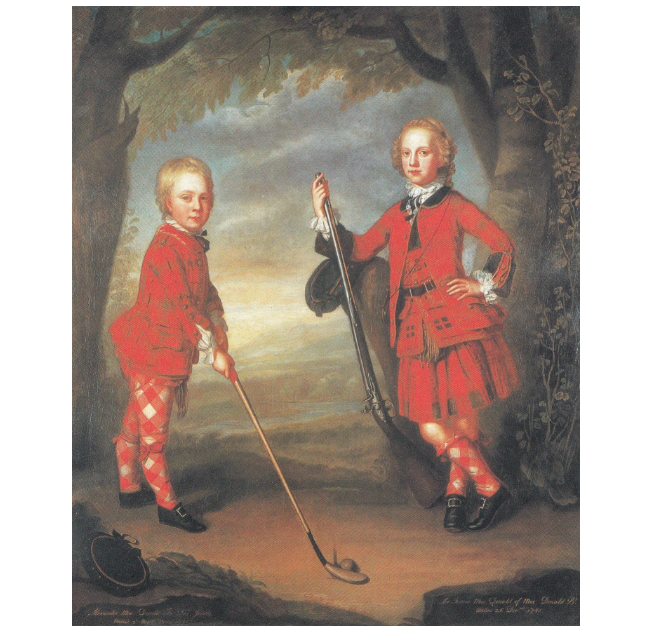
Since the word cleek comes from the Middle English (northern dialect) cleke (hook, act of clutching) and its first known use is recorded in the 15th century, it’s likely the golf club was named after the hook. Here you can see the 18th-century MacDonald boys playing golf in a selfie taken by Jeremiah Davison.
Selfie by Jeremiah Davison

Is… is that a rifle? Clearly one of the MacDonald boys was a poor loser and had to be kept in check.

Wikipedia has an article about obsolete golf clubs, and tripsavvy.com also provides a list that includes clubs with wood heads, such as the Play Club (the equivalent of today’s driver), the Brassie (so named because of a brass plate on the sole), the Wooden Cleek, the Spoon, and the Baffie or “baffy.” Clubs with iron heads no longer in use were the Mid Iron, Mid Mashie, Mashie Iron, Spade Mashie, Mashie Niblick, Pitching Niblick (a lofting iron), Niblick (perhaps the best-known among the old clubs because of its odd name), Jigger, and the cleek, which came in its regular version and also as a “putting cleek”.

Looking up the entry about golf in the 1911 edition of the Encyclopedia Britannica, I found a lot of interesting things about how the game was described over a century ago. One of them was the definition of bogey as “The number of strokes which a good average player should take to each hole. This imaginary player is usually known as ‘Colonel Bogey,’ and plays a fine game.” Today bogey is mostly known as “one stroke over par on a hole”. Par isn’t even included as a term in the article!

Here is the description of “bogey play”:

There is also a species of competition called “bogey” play, in which each man plays against a “bogey” score — a score fixed for each hole in the round before starting — and his position in the competition relatively to the other players is determined by the number of holes that he is to the good or to the bad of the “bogey” score at the end of the round. The player who is most holes to the good, or fewest holes to the bad, wins the competition. It may be mentioned incidentally that golf occupies the almost unique position of being the only sport in which even a single player can enjoy his game, his opponent in this event being “Colonel Bogey” — more often than not a redoubtable adversary.

I guess that, in the case of golf, there is such as a thing as a “Bogey man”.

There is even a march dedicated to the dear colonel.

Now you know. Next time you’re in a golf foursome and wish to play a prank on your buddies, ask for a cleek club in your best Scottish accent. Your friends might not find it funny, and even penalize you a stroke… because the editors of the Spelling Bee decided that cleek is a dord*.

You can check out my previous entry on another dord* here:

*What the heck is a dord, you ask? Here’s the answer:

Spelling Bee
Language
Golf
Scotland
History
Recommended from ReadMedium