
Clean Out the Fridge Soup
Make something delicious from all the odds & ends.
Mondays are one of my favorite days of the week. Why? Because while I’m writing — I also make soup. When you chop vegetables you craft food-for-thought-sentences at the same time. The key thing is — I never have any real idea of what kind of soup I will make. It all depends upon what lurks in my fridge.
Listen — let’s go have a look in your fridge right now. Let’s take an inventory of the odds and ends you have hiding in there. Some mashed potatoes from a few days ago? A half of an onion in a baggie? Some limp celery? Drag them out.
Don’t have any meat? No worries. Have more meat than vegetables? You can work with that as long as you have a few onions and a small bag of noodles. Chop up some wilted lettuce from the fridge and add it to your meaty soup — yes — you can put lettuce in soup!
Maybe you have a lonely piece of cooked bacon in tinfoil. Or a small bob of cheese in the cheese drawer that’s a few days away from being funky. A handful of peas in the freezer? All good.
Perhaps you have a little chunk of cabbage and turnip that’s starting to wizen. Or a tiny glurk of leftover red wine. A half-jar of salsa that needs to be used up? Soup likes those ingredients too. The secret — is knowing what you should put together.
What’s the most important thing in soup?
The broth. That’s where all good things begin.
You can have the most delicious ingredients for a soup but you can blow it on the broth and ruin the entire thing.
It’s way too easy to make soup too salty, or bland or too much of any one flavor actually.
Good soup is a harmony of voices together.
But the basis for most soups is this: onion and celery.
If you have a soup that would benefit from a carrot then you use mirepoix: onion, celery, and carrot. 50% of the time this is where I start.
The other 50%? I use onion, celery, and garlic. And if I’m really stuck? Only an onion as I know there’s always one kicking around.
The first step to a good broth?
Sautee all the vegetables(never potatoes) in butter in a larger pot. Don’t try making soup in a dinky sized pot — I guarantee at one point you’ll run out of room.
If your fridge reveals red meat— then use beef broth. For all other meats ie/ chicken, lamb, pork — I normally use a liter or two of purchased chicken broth.
If you don’t have chicken broth (or any leftover chicken carcasses to make your own) — then use water and chicken broth flavoring from a jar — Better than Bouillon is one I like. Don’t have any of the above? Well then — you’re going to make soup from water and canned tomatoes. No canned tomatoes? Back to straight water and a long-simmering time.
But don’t go crazy on too much liquid. You want soup but you don’t want gallons of it. The more liquid you have — the more you need to add to it to bring the harmony of flavors together. It is easier to work with 1–2 liters of liquid than 4. Remember — if something is too salty you can always add more liquid to your broth.
Choose the theme for your soup
So what odds and ends did you gather from your fridge? Whatever you have the most of — let that be the theme of your soup.
Are you in a chunky mood or a smooth mood? Don’t puree meat — it becomes baby food and kind of gross looking. Keep the purees to vegetable soups only.
Do you have an equal hodgepodge of ingredients?
Then I’d put them together and add a can of tomatoes for good measure. But first — see what you have. It will show you the way.
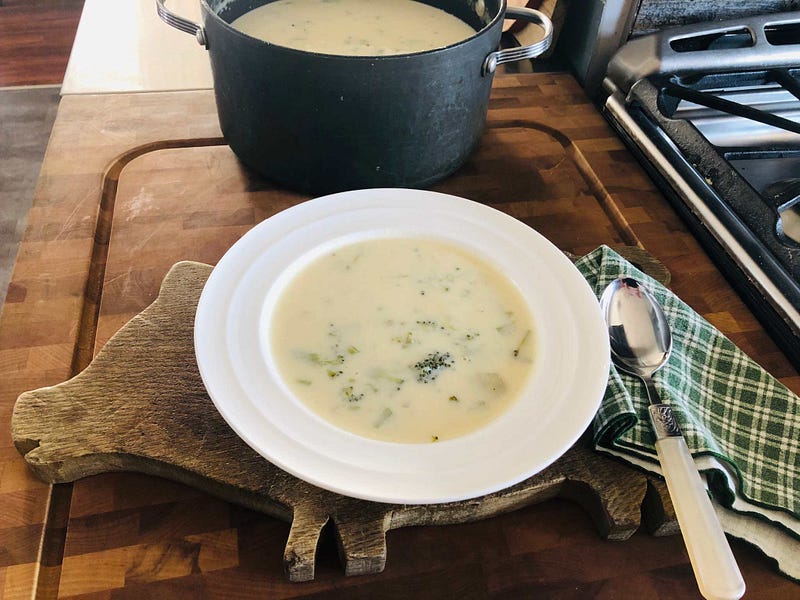
Today I made a broccoli-potato-gnocchi soup.
Here’s what I had in the fridge:
1/2 onion (I didn’t use celery this time as I saved it for celery soup)
A container of leftover mashed potatoes
A small container of cooked broccoli
Some fresh broccoli that was starting to go a little yellow on top
1 liter of chicken broth
1/2 cup of milk on the edge of expiry
1/2 cup of cream on the edge of expiry
1 can of evaporated milk
1/2 small opened package of goat cheese
A few tablespoons of grated parmesan from the small chunk of hard-as-rock parm in the cheese drawer. And then I threw in the rind too.
1/2 bag of shelf-stable gnocchi from July 2019. (I kid you not.)
First — I made broth
I chopped the onions and sauteed them in 2 tablespoons of butter in a larger soup pot.
I added a liter of chicken broth to the onions and turned the heat on my stove to medium. Medium heat is a place where all good things start to happen. You don’t want soup to boil — ever. It toughens both meat and vegetables and we’re not looking for gruel from the Russian Gulag here.
Now for the Odds and Ends
I added the container of leftover mashed potatoes. I chopped up the cooked broccoli and threw it in too. I peeled the stalk of the well-aged fresh broccoli from the fridge and cut the stalk and florets into small bite-sized pieces. It all went into the soup.
Then the dry gnocchi from July 2019 found its home in my soup. I used half of a bag and froze the rest.
The can of evaporated milk was slowly poured in, and I used the leftover milk and cream and rinsed out the cartons with water and poured that in too. When you make soup you don’t leave a drop of goodness behind.
Simmer and Season
My grandmother was an exceptional cook and she always tasted from a teaspoon while she cooked. You have to do the same. How else are you supposed to know if your dishes need more or less of something?
So while your soup slowly simmers — have a look at what seasonings you want. You don’t want to add a weird combo of too many things. You don’t want to go overboard because remember we’re looking for harmony here and not discord. So stay within your theme. Taco seasoning is great with meatballs and salsa. Not so good with corn chowder, if you catch my drift.
My broccoli/potato/gnocchi soup had a cream base so I didn’t add a bay leaf. But I did add 2 teaspoons of salt. I added 1/2 cup of white wine. I added a dash of onion and garlic powder. I did add a tablespoon of dijon mustard —trust me on this.
And then I tasted it again. Perfection!
What I didn’t add? Pepper. Ground pepper goes bitter quickly in simmering soup. It should be added by the person eating the soup and even then — they should add it after they have tasted it first. Don’t get me started on people who season their food before they’ve even tried it.
Taste the Soup
Your soup should simmer for 45 minutes to an hour. Anything less and you’re missing out on the alchemy of heat and good ingredients.
Poke a fork into the ingredients. Everything should be fork-tender and not “nubby” as my mom would say.
Now taste your soup. What do you think? Is it flat? Does it need a little more salt or perhaps a small squeeze of lemon juice? A little splash of red or white wine? Is there something you’re tasting too much of? Not enough of?
Now is the time to make those small corrections and they can only happen when you taste. the. soup!
I hate to brag but my soup turned out marvelous. I’ve never cooked with gnocchi before and they were lovely little puffy clouds on your spoon. Plain but good as they were in harmony with everything else.
My 86 year old mother-in-law loved it and wants to go get more shelf-stable gnocchi as soon as we can. I’ve made enough to give some doorstep soup deliveries to friends and family. And our lunches are covered for a few days this week.
The best part? I cleaned out the fridge and made something delicious from odds and ends. Nothing is wasted. And I finally used those July 2019 shelf-stable gnocchi — but I didn’t tell my mother-in-law about that.
Happy Soup Making!
Thanks for reading! I have loads of food essays (delicious recipes too) and thoughtful and quirky simpler living essays waiting for you. (Well over 100 of them!) And this story caught the attention of NBC News In New York!