
Christians made up the phrase “God hates divorce”
The #1 Bible reference for divorce is not in the Bible
Christians love to say: “God hates divorce.” They say it when people get a divorce, and they never stop reminding you. A divorced person is…hated?
I grew up Christian, and whenever anyone was getting a divorce, the chorus would start: “God hates divorce.” I guess I thought it was in the Bible, only to learn now that the religion made it up.

The “religion” of Christianity is often little more than a practice of being married.
How that relates to the Bible could only be mysterious. This is a sacred text whose major figures tend to be unmarried (i.e. Jesus, John, Paul, Mary Magdalene, etc.).
Then how exactly the Bible is against divorce would seem obscure. The Bible passage Deuteronomy 24:1 lays out a quick procedure for getting one.
To this day, divorce is legal in Judaism.
The Old Testament seems very pro-divorce?
In the ‘Mosaic Law’ we find instructions on how men can divorce women in a variety of unusual situations. There’s law for divorcing slave women if they’ve been ‘taken’ and longer desired (Exo 21:8–11).
There’s law for Israelite men seizing ‘foreign’ women as wives (Deut 21:10–14), regardless of whether or not they’re already married. The seizure effectively divorces the women from any previous husband.
God regularly commands Israelites to get divorces when inter-marriage is getting out of hand (Ezra 10:1–44; Neh 13:23–31).
Is this a God who “hates divorce”?
Maybe not. But Christianity goes on and on about a God who “hates” divorce. And this become the religion’s favorite term of attack against people, especially women, who are divorcing or divorced.
A divorced Christian woman writes in a 2022 reflection:
“I’ve heard it quoted by so many people. It’s been thrown in my face, reminding me what a sinful person I am for walking away from my marriage.”
Her story is that she had left a cheating husband. By the “official” rules of Christianity, that should’ve been allowed?
But the ‘exceptions’ seem not really to be exceptions at all. The regular impression in traditional Christianity is that a woman cannot divorce under any circumstances. If she proceeds to do so, the faithful move to attack.
They say “God hates divorce” is from Malachi 2:16.
This is an Old Testament book by an Israelite priest around 450 B.C., and an unusual source of condemnation of divorce? The basic subject of the book is the Israelites being in religious crisis.
The story happening at that point is the Israelites have just re-built the Temple after it was destroyed, but it’s unclear that God is inhabiting the ‘Second Temple’. There’s no shekinah, or sacred fire. Is God there?
The Israelites’ situation is dire. They have been conquered by a foreign power and despite the huge sacrifice of rebuilding the Temple, their deity does not appear to be present.
Suspicion lurks: Is it time to assimilate to other deities?
Christians like to say that God just throws in a random remark about divorce.
In the religion’s presentation, God is always thinking about keeping families together—with men on top. And so here is Malachi 2:16 in a standard translation, the NIV:
“‘The man who hates and divorces his wife,’ says the LORD, the God of Israel, ‘does violence to the one he should protect,’ says the LORD Almighty. So be on your guard, and do not be unfaithful.”
Does that say that “God hates divorce”? Christians say so.
The Hebrew text is actually very strange.
It’s often discussed by Bible scholars. As Jack Collins notes in a 2007 study, the text of Malachi 2:16 is so unusual that “no matter which way we prefer to go the explanation will be tortuous.”
He adds that “God hates divorce” is found “only with great difficulty.”
A literal translation of the verse might go as follows:
“For he hates sending away, says Yahweh the God of Israel, and he covers violence upon his garment, says Yahweh of hosts.”
Does that say “God hates divorce”? Christianity says so.
But you might start to wonder.
The surrounding passage is actually a lot of obscure religious references that translations omit in order to create “coherence.”
In Malachi 2:11, we read in the NIV of a problem of “marrying women who worship a foreign god.”
The actual phrase, as in the ESV translation, is “the daughter of a foreign god.” What that means is unclear. But this sets up the context of Malachi 2:16. Is the context really ordinary divorce?
Then Malachi 2:16 itself has two male subjects: the ‘he’ who “sends away” his wife, and the ‘he’ who “covers violence upon his garment.”
Are these two “he” subjects the same subject?
What does it mean to have a ‘violent’ garment?
Other transmissions of the Bible actually have very different text for the verse.
The Hebrew text known as the Masoretic Text is one version, but there are others—and they get increasingly weird. The ancient Greek translation called the Septuagint has this for Malachi 2:16:
“But if having hated you divorce, says the Lord, the God of Israel”
Or rather, some manuscripts have that text, while other manuscripts of the Septuagint have this edit: “if you hate, divorce!” But this seems actually to be encouraging divorce.
In the Dead Sea Scrolls, similarly, we find: “If, having hated, divorce! says the Lord the God of Israel . . .”
This seems, as the scholar Russell Fuller notes, to “support the act of divorce.”
Then it’s amazing how scholarly translations can be so totally different.
When reading Bible scholarship, I have been shocked many times by scholars presenting a translation that bears no resemblance to “official” Christian translations.
In 1998, Andrew E. Hill published a translation of Malachi for the Anchor Yale Bible Commentaries. It is unlike any ‘Christian’ presentation.
I’ll discuss 2:16, but that verse is part of a bigger story. Here is Hill’s translation of Malachi 2:10–16:
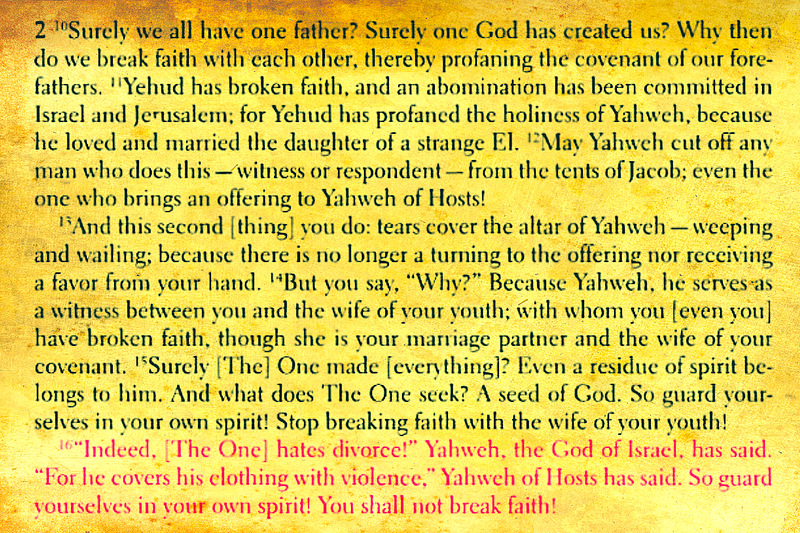
This is a very different Malachi 2:16.
Here is Hill’s translation of just that verse:
“Indeed, [The One] hates divorce!” Yahweh, the God of Israel, has said. “For he covers his clothing with violence,” Yahweh of Hosts has said. So guard yourself in your own spirit! You shall not break faith!”
This is now clearly not a statement that “God hates divorce.” Rather, this is a very complex interplay of different levels or aspects of God.
There is ‘the One’—which seems to be an ultimate Creator of Everything (introduced in 2:15). Then there’s Yahweh, the deity of the Israelites.
Yahweh and the Israelites were “married.”
Christians often don’t know that in the Bible, a deity is a ‘husband’ to a whole nation or community. That’s how it is with Israel. Yawheh is ‘her’ husband, or He was until they got a divorce (cf. Jer 3:8, etc.).
That’s the divorce under review. Malachi 2:16 doesn’t have a generic remark about the divine view of humans divorcing. This is a complex story about the long relationship of Yahweh and Israelites.
As the Israelites are considering leaving for another deity—with the “daughter of a foreign god” apparently beckoning—the prophet steps forward and says: Hold on, you have not been abandoned.
The prophet then says, amazingly, that the divorce of Yahweh and Israel was seen in Heaven as regrettable, and ‘the One’—a deeper level of deity—has a big plan in the works: “A seed of God.”
In the Bible, “the seed” is one thing: the messiah (cf. Gal 3:16, etc).
The context is not human marriages.
The subject of Malachi 2:16 is the union of God and the sacred community.
If God is the subject, then all the terms read differently. For example, there’s the ‘garment’ that gets ‘covered’ in ‘violence’.
When Christians try to explain that, they often say that a man’s life goes to hell after he gets a divorce.
But if the context is God, then we might remember that God is very, very, very violent. God seems to be speaking of a state that is eagerly anticipated. To ‘cover’ his ‘garment’ in ‘violence’ might mean that the deity is armoring up, and getting ready to kick some ass.
The messianic event is described as incredibly violent. Jesus is very violent (cf. Lk 12:15, etc). This is at odds with his presentation in the gospels as a basically peaceful figure.
But in the Bible, happens in the realm of spirit. The prophet sees things that aren’t happening visibly on the earth.
But don’t bother telling Christians their favorite verse might say something else.
They never said “God hates divorce” because they cared what the Bible said. It was just another way to attack. 🔶