
Christians Are (Rotten) Bananas
We Need God for Life
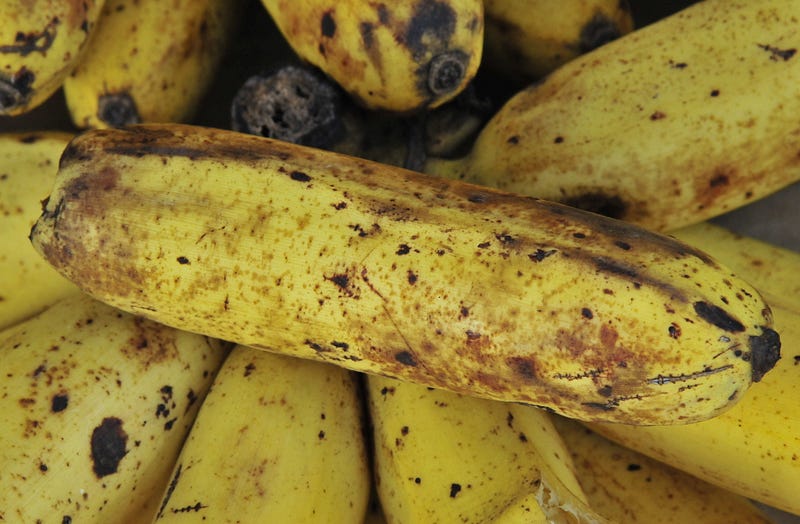
Sometimes, when I’m feeling inadequate, I think about bananas and plantains. Overly ripened bananas make the best banana bread. Similarly, when a plantain looks its most rotten (black and shriveled and dusty), that’s when it’s sweetest.
Thinking about rotten bananas helps me understand redemption, not only the saving of our souls, but the good that can come from the corrupted.
I am aware of how much in Christianity (or faiths claiming to be Christianity) has been contorted into cruel and harmful words, practices, and beliefs. Even with the best of intentions, anything touched by human hands is inherently lacking. We’re all imperfect beings. Christians make mistakes.
What I find truly miraculous and hopeful, however, is how we broken people, we sinners, we betrayers of love, can be used for things that are better than the sum of our lying, stealing, coveting, conceited, hurtful, or otherwise imperfect parts.
Christians are like rotten bananas in God’s hands. He doesn’t always erase our weaknesses (although sometimes that is exactly what happens). He often leaves us flawed and puts us in a position where our experiences or characteristics (e.g., a past hurt, loss, or mistake) is beneficial in some way. Like rotten bananas making good banana bread, it is because of (not just in spite of) our hurts and imperfections that we can inspire each other, support each other, guide, confide in, and advise each other. We gain and share wisdom and empathy. We are role models. We are cautionary stories.
Years ago, I was watching an episode of Wife Swap in which a God-fearing, Black woman was switching places with a white (multi-colored, actually — she had so many tattoos) atheist. One thing the atheist said reverberated in my mind: She accused Christians of using God and their faith in Him as a crutch. I had heard that indictment before, but this time I heard it from a different vantage point: Who says needing a crutch is a bad thing?
God is indeed my crutch, and that’s a good thing. I am limping through life because I am broken. I need His support. He literally sustains me every day. The atheist on Wife Swap was acting as though humans are completely healthy — emotionally, psychologically, and spiritually — but we’re not. Everyone in this world is hurt, damaged, or broken in one way or another — internally or by an outside force.
We all need a crutch to get through life. Some of us develop defense mechanisms like sarcasm or seek insight through therapy. Some of us turn to addictions, distractions, or hobbies — anything that keeps us in the shallows of our minds. Some strive after wealth, health, popularity, perfection, or knowledge. Others try to feel better by making others feel worse. There are a lot of things out there that people can cling to in an attempt to prop themselves up. We’re all self-medicating. I choose God. I’m broken, and He is my benevolent crutch.
Like a crutch, God is not necessarily an instantaneous fix for what ails us (although I believe that too is possible). The crutch is not the cure; it is a complement to the healing. The crutch is there so that, as our body mends, we’re able to make progress with minimal pain — to proceed despite our injury. Similarly, God comes to support us, to bear us up so that — despite our brokenness — we can still move through life. And as we lean on Him, we find that the healing is able to begin. We’re no longer putting all our weight on whatever part of us isn’t able to bear all that pressure — or burden.
Most people only need crutches for a discrete amount of time. Unfortunately, what’s wrong with us (humanity) isn’t temporary. It’s chronic. We’re maimed for life. We’re not like the woman who has broken her leg and just needs crutches until the cast comes off and she’s rehabbed enough. We’re more akin to someone who’s had an amputation or who takes a maintenance medication. We need God for life.
And here’s the brilliant thing about God — the thing that makes Him infinitely better than a crutch — He uses us just as we are. We’re not sidelined by our flaws or benched because we’re not good enough. He sees us limping along, trying to depend on Him, but not quite comfortable in that position — still wanting to assert our independence — perhaps even resisting Him, and He uses it all.
Consider how much we’d praise the physician who didn’t just heal her patients, but who used their maladies to improve the prognosis for others. That’s what God does. Christianity is really just a support group. God uses hurting and broken people to help the hurting and the broken. He enables the weak to support the feeble. He empowers the damaged to repair the damage that has been done to, by, and on behalf of others. Ignorance, intolerance, inequality, violence, exploitation, addiction, abuse, and more — all the things that have broken our world, the broken are working to improve them.
Don’t worry about falling short or being flawed. You don’t have to be perfect to be important to someone. Learn from, but don’t dwell on, your past — what you have or haven’t done. Just as you are, you can help. All of who you are — the good, the bad, and the broken — is relevant. We’re all overly ripened bananas — soft, decaying, and blemished. But if we’re honest and loving, our “rotten fruit” will produce something good enough to make the world better.
A version of this piece originally appeared on Write Away.


