avatarAvi Kotzer

Free AI web copilot to create summaries, insights and extended knowledge, download it at here

3528

Abstract

chaya</i> plant thrive. In other words, they help it grow faster using mold. They explain these characteristics of the the <i>chaya</i>. Their sources are other published articles, not Wikipedia.</p><blockquote id="5f58"><p><i>Oldenlandia umbellata L.</i> is one of the important members of Rubiaceae known for its dyeing and medicinal properties. This plant is used in traditional medicine and Siddha for its styptic property. The leaf and root extracts were considered as good expectorants and used for treatment of asthma, bronchitis, and bronchial catarrh. The decoction prepared from its leaves is used as a rinse to treat poisonous bites and also used as a febrifuge. A novel pH indicator dye was reported from this plant. Extract of the whole plant shows significant antitumor activity.</p></blockquote><figure id="dac2"><img src="https://cdn-images-1.readmedium.com/v2/resize:fit:800/0*Rl04sLERKNCqLcqL.jpg"><figcaption><b><i>Oldenlandia umbellata</i></b></figcaption></figure><p id="3b47">The above illustration was <i>not</i> made by Henrik Oldenland, but rather by William Roxburgh for <i>Plants of the coast of Coromandel</i>. It’s Plate 3 of Volume 1, in case you don’t believe me and want to look it up.</p><p id="c37f"><i>Chay</i>’s red dye, which comes from its root was traditionally used to give a red color to fabrics such as wool and silk. Although it’s use has been substituted by commercially-made tints, I’m sure someone somewhere is still going the old-school route and making tie-dyed shirts with <i>chay</i>.</p><p id="1c17"><b>§ <i>Cnidoscolus aconitifolius </i></b>is another plant know as <i>chaya</i>. But it’s also commonly called tree spinach, or spinach tree. It’s a plant believed to be native to Mexico, and grows quite fast. Which means it doesn’t need Saranya and Velayutham’s mold to grow.</p><figure id="10fd"><img src="https://cdn-images-1.readmedium.com/v2/resize:fit:800/0*iMXLF_DGHeBSyHJm.jpg"><figcaption>Photo by Frank Vincentz</figcaption></figure><p id="7049">The above photograph was also <i>not</i> painted by Henrik Oldenland; I’m sure of that!</p><p id="33c6">Don’t confuse this plant with real spinach, however. Instead of growing forearms like Popeye, you will likely keel over and end up in a hospital… or six feet under. That’s because this <i>chaya</i> has hydrocyanic glycosides in its leaves. Yes, “cyanic” as in <b>cyanide</b>. If you insist on eating them, please cook them for at least 15 minutes or, better yet, 20. And even bestest yet… just stick to regular spinach.</p><h2 id="5f9d">Chay 2</h2><p id="a0a3">The other definition Merriam-Webster gives for <i>chay</i> is <b>chaise</b>.</p><figure id="b0c1"><img src="https://cdn-images-1.readmedium.com/v2/resize:fit:800/1*eDOHDzolUu7UXc_7Osl1FQ.png"><figcaption>Credit: merriam-webster.com</figcaption></figure><p id="823e">Now, I searched for chaise on Unsplash and got no pictures of horse-drawn carriages, but plenty of photos of beach and pool scenes with chaise longues.</p><figure id="a549"><img src="https://cdn-images-1.readmedium.com/v2/resize:fit:800/1*wYw26mIWXNQiu1yKfC1XiQ.png"><figcaption>Screenshotted by Iva Reztok</figcaption></figure><p id="10fa">You can see the picture I picked in the middle of the top row.</p><p id="cc56">But let’s discuss the carriage. According to the online Britannica, the chaise (which comes from the French word for “chair”) was “originally a closed, two-wheeled, one-passenger, one-horse carriage of French origin, adapted from the sedan chair.”</p><figure id="11d3"><

Options

img src="https://cdn-images-1.readmedium.com/v2/resize:fit:800/0*wniryoRpJ0kjRF0a.jpg"><figcaption></figcaption></figure><p id="93a3">And in case you’re wondering, no, Henrik Oldenland had nothing to do with the above illustration.</p><p id="4e21">The location of the chaise’s body, as seen above, gave it a lot of stability but made it impossible to have. So passengers had to clamber over the huge wheel. At first, passengers themselves guided the horse; later, chaises had drivers that managed the horse or horses. According to the Britannica:</p><blockquote id="b9d5"><p>The chaise was adapted and widely used in both 18th-century England and the United States. The New England, or Boston, chaise, which was suspended on a combination of leather thoroughbraces and wooden cantilever springs, was uniquely American. The term <i>shay,</i> as in “one-horse shay,” was an American corruption of <i>chaise</i>. The chaise was one of the most important passenger vehicles of the 18th century, and in America its popularity foreshadowed that of the buggy a hundred years later. The word chaise was also applied indiscriminately to numerous varieties of carriage.</p></blockquote><p id="0df7">Here is a horseless, three-wheeled <b>chaise</b> meant to be pushed around by a person. In other words, a fancy way to call a stroller made for adults.</p><figure id="1b91"><img src="https://cdn-images-1.readmedium.com/v2/resize:fit:800/0*OWtxjb4XauhNHyzM.JPG"><figcaption>Public Domain</figcaption></figure><p id="88e0">Oh, and the above photo was taken Henrik Oldenland.</p><p id="ca3f">Just kidding! He died in the 17th century. Weren’t you paying attention?</p><p id="0fba">Now you know. Next time you’re traveling down a country road in a two-wheeled, horse-drawn carriage with a folding top, and you happen to spot a spinach tree off to the side, you can tell your friends and family that you saw a <i>chaya</i> while riding a <i>chay</i>. Everyone will think you’re crazy, of course. Not because no one travels down a country road in a two-wheeled, horse-drawn carriage with a folding top anymore… but because the editors of the Spelling Bee decided that <i>chay(a) </i>is a dord*.</p><p id="e7be">You can check out my previous entry on another <b>dord* </b>here:</p><div id="a696" class="link-block"> <a href="https://readmedium.com/cebid-14abef60b271"> <div> <div> <h2>Cebid</h2> <div><h3>Monkeying around on a Sunday afternoon</h3></div> <div><p>medium.com</p></div> </div> <div> <div style="background-image: url(https://miro.readmedium.com/v2/resize:fit:320/0*SW3MFlCsWWbR6Jp6)"></div> </div> </div> </a> </div><p id="da51">*What the heck is a <b>dord, </b>you ask? Here’s the answer:</p><div id="5195" class="link-block"> <a href="https://www.merriam-webster.com/words-at-play/dord-a-ghost-word"> <div> <div> <h2>'Dord': A Ghost Word</h2> <div><h3>One of the questions people like to ask lexicographers is this: Can you sneak something into the dictionary? Can you…</h3></div> <div><p>www.merriam-webster.com</p></div> </div> <div> <div style="background-image: url(https://miro.readmedium.com/v2/resize:fit:320/0*DGTlZyT1oPxTUTpr)"></div> </div> </div> </a> </div></article></body>

Chay(a)

Without or without the “a”… rejected!

Photo by Jakob Owens on Unsplash

Today’s New York Times Spelling Bee letters:
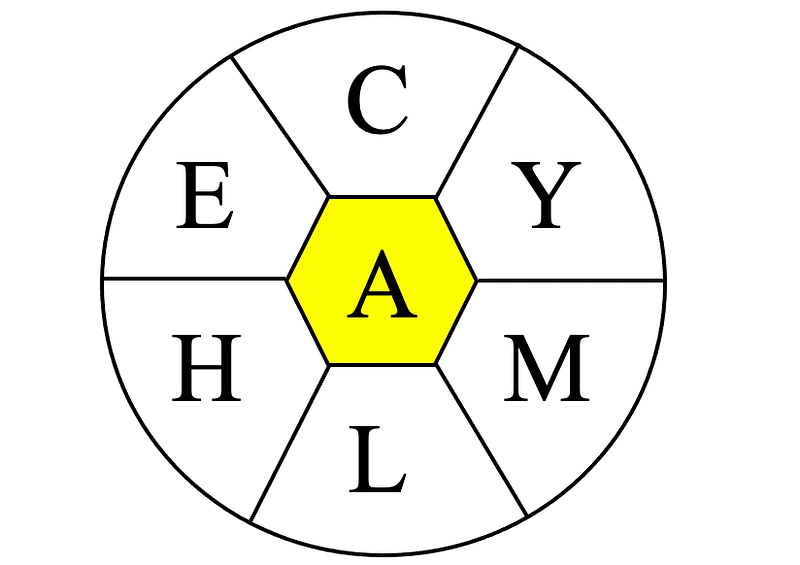
Art: Iva Reztok

C, E, H, L, M, Y, and center A (all words must include A)

Merriam-Webster says…
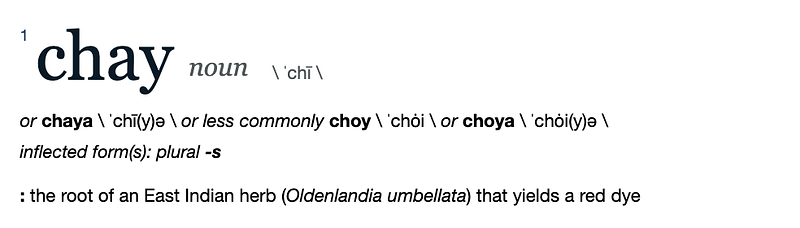
Credit: merriam-webster.com

…and:

Credit: merriam-webster.com

Silly little dictionary! Don’t you know that chay(a) can’t possibly be a word if The New York Times says it ain’t?

For further fascinating facts, check out the Spelling Bee Master.

What’s your favorite dord* from today’s puzzle?

My Two Cents

Does the picture at the top of today’s column make you dizzy? It had that effect on me. Maybe it’s because the sharply-focused center is surrounded by a larger unfocused image. Or it could just be that I need new glasses.

Why did I choose an image of a beach with what seems to be a village in its background? Aha! You’ll have to read on to find out. Short and sweet, I promise. Well, okay, Short. Sweet is relative; I understand that.

Chay 1

Our friends at Merriam-Webster tell us that chay(a) comes from the Tamil-Malayalam cāya-vēr, perhaps from the Sanskrit chāyā, meaning “color” or “shadow”. Interestingly, the dictionary includes inly one species of plant (Oldenlandia umbellata) with that common name. But we here at Silly Little Dictionary! are nothing if not resourceful (and modest, as you can see), so we managed to find another plant that is also known as chaya… with two “a’s”.

§ Oldenlandia umbellata belongs to the genus Oldenlandia, named by Carl Linnaeus himself in honor the Danish botanist Henrik Bernard Oldenland. Despite his last name, Oldenland died in his thirties, but not before leaving extensive volumes of pressed and mounted plant specimens with descriptions in Latin. These prolific archives eventually made to the hand of Carl, who was duly impressed.
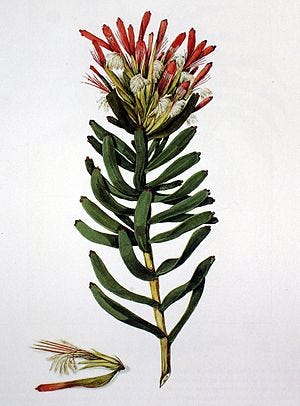
Mimetes cucullatus

(The above watercolor is attributed to Oldenland; because my DeLorean is in the shop, I cannot confirm it.)

Researchers S. Saranya and P. Velayutham published an article in Adalya Journal about fungal elicitors that help the chaya plant thrive. In other words, they help it grow faster using mold. They explain these characteristics of the the chaya. Their sources are other published articles, not Wikipedia.

Oldenlandia umbellata L. is one of the important members of Rubiaceae known for its dyeing and medicinal properties. This plant is used in traditional medicine and Siddha for its styptic property. The leaf and root extracts were considered as good expectorants and used for treatment of asthma, bronchitis, and bronchial catarrh. The decoction prepared from its leaves is used as a rinse to treat poisonous bites and also used as a febrifuge. A novel pH indicator dye was reported from this plant. Extract of the whole plant shows significant antitumor activity.
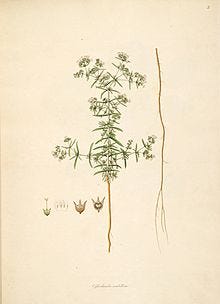
Oldenlandia umbellata

The above illustration was not made by Henrik Oldenland, but rather by William Roxburgh for Plants of the coast of Coromandel. It’s Plate 3 of Volume 1, in case you don’t believe me and want to look it up.

Chay’s red dye, which comes from its root was traditionally used to give a red color to fabrics such as wool and silk. Although it’s use has been substituted by commercially-made tints, I’m sure someone somewhere is still going the old-school route and making tie-dyed shirts with chay.

§ Cnidoscolus aconitifolius is another plant know as chaya. But it’s also commonly called tree spinach, or spinach tree. It’s a plant believed to be native to Mexico, and grows quite fast. Which means it doesn’t need Saranya and Velayutham’s mold to grow.
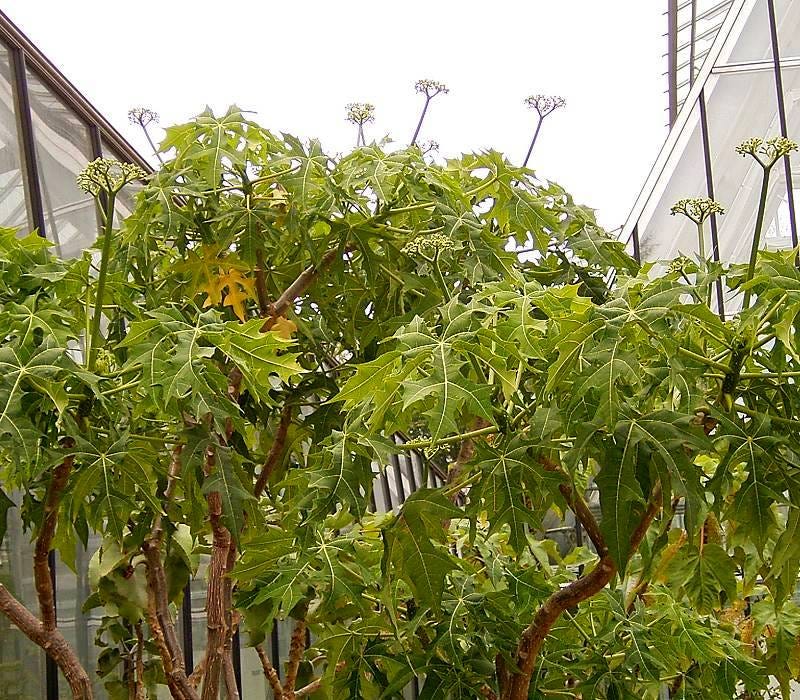
Photo by Frank Vincentz

The above photograph was also not painted by Henrik Oldenland; I’m sure of that!

Don’t confuse this plant with real spinach, however. Instead of growing forearms like Popeye, you will likely keel over and end up in a hospital… or six feet under. That’s because this chaya has hydrocyanic glycosides in its leaves. Yes, “cyanic” as in cyanide. If you insist on eating them, please cook them for at least 15 minutes or, better yet, 20. And even bestest yet… just stick to regular spinach.

Chay 2

The other definition Merriam-Webster gives for chay is chaise.
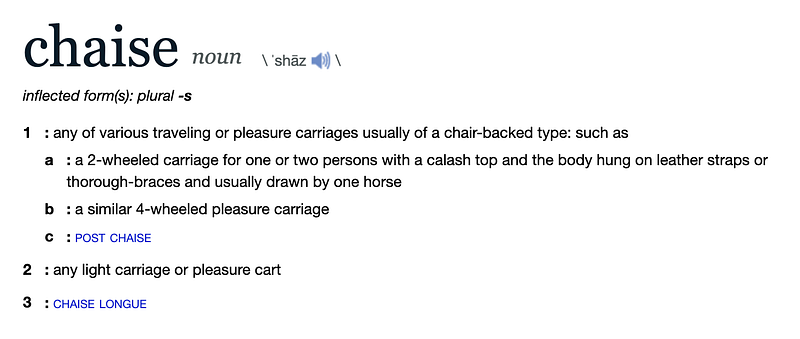
Credit: merriam-webster.com

Now, I searched for chaise on Unsplash and got no pictures of horse-drawn carriages, but plenty of photos of beach and pool scenes with chaise longues.

Screenshotted by Iva Reztok

You can see the picture I picked in the middle of the top row.

But let’s discuss the carriage. According to the online Britannica, the chaise (which comes from the French word for “chair”) was “originally a closed, two-wheeled, one-passenger, one-horse carriage of French origin, adapted from the sedan chair.”
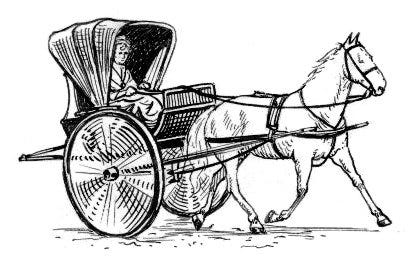
And in case you’re wondering, no, Henrik Oldenland had nothing to do with the above illustration.

The location of the chaise’s body, as seen above, gave it a lot of stability but made it impossible to have. So passengers had to clamber over the huge wheel. At first, passengers themselves guided the horse; later, chaises had drivers that managed the horse or horses. According to the Britannica:

The chaise was adapted and widely used in both 18th-century England and the United States. The New England, or Boston, chaise, which was suspended on a combination of leather thoroughbraces and wooden cantilever springs, was uniquely American. The term shay, as in “one-horse shay,” was an American corruption of chaise. The chaise was one of the most important passenger vehicles of the 18th century, and in America its popularity foreshadowed that of the buggy a hundred years later. The word chaise was also applied indiscriminately to numerous varieties of carriage.

Here is a horseless, three-wheeled chaise meant to be pushed around by a person. In other words, a fancy way to call a stroller made for adults.
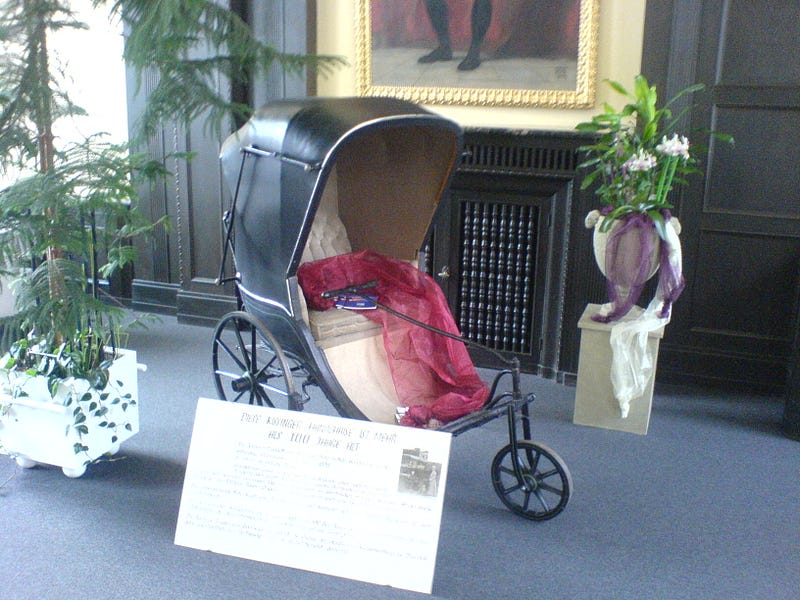
Public Domain

Oh, and the above photo was taken Henrik Oldenland.

Just kidding! He died in the 17th century. Weren’t you paying attention?

Now you know. Next time you’re traveling down a country road in a two-wheeled, horse-drawn carriage with a folding top, and you happen to spot a spinach tree off to the side, you can tell your friends and family that you saw a chaya while riding a chay. Everyone will think you’re crazy, of course. Not because no one travels down a country road in a two-wheeled, horse-drawn carriage with a folding top anymore… but because the editors of the Spelling Bee decided that chay(a) is a dord*.

You can check out my previous entry on another dord* here:

*What the heck is a dord, you ask? Here’s the answer:

Spelling Bee
Language
Plants
Carriages
Spinach
Recommended from ReadMedium