
I LOVE YOU, WE SAID
Chapter 12: Love and Belonging
A serialised novel
The next year I went on to high school in Coltrane.
The new school was bigger than the old one and brought a total reset of everything. We were thrown together with children from the other primary schools in and around Coltrane, kids who the year before had been our adversaries in athletics and rugby and netball. Now they were to be our classmates and teammates and friends.
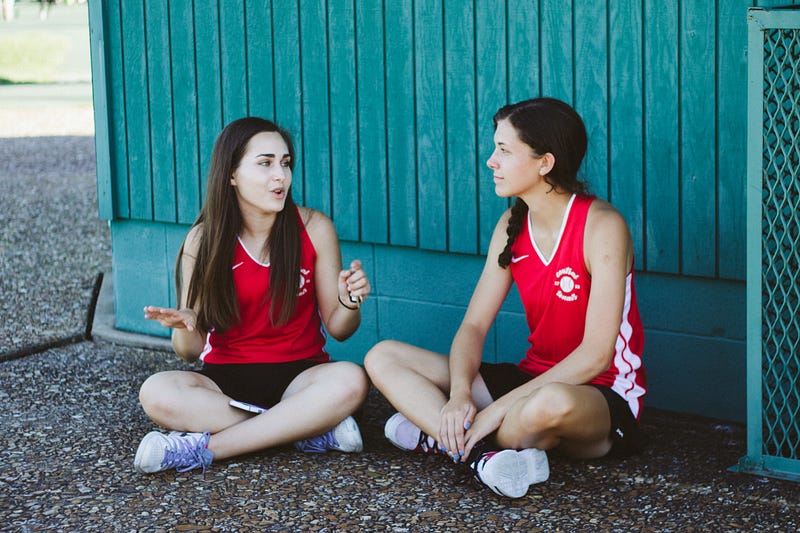
One of the first things to happen to us, the standard sixes, was to be divided up into teams for the first big athletics meet — Red, my team; Black; and White. My name was among the first to be called out. The teacher explained: each house was to get a fair pick of the top athletes.
I was a top athlete! I thrilled as I walked to the front of the great hall, other names being called out behind me. I had set a record in the long jump the year before. But I knew I didn’t have much sporting ability; I had strong legs and I could shoot and throw well, but I didn’t have the in-body naturalness of the born athletes around me. Normally stiff with shyness, I came to the front of the hall, proud as punch.
Afterwards we went around saying what teams we were on. Soon we’d have the colours to show for it. Then we were grouped into classes — some of my new classmates were also on my team. New friendships and rivalries formed, new crushes and competitors were spotted.
Next, a week of easy-going razzing and ordering-about followed. Each matriek (senior) picked a sot (greenhorn) as his or her personal fetcher, bag carrier and messenger. I didn’t know if anyone had picked me; perhaps they hadn’t, and I was everybody’s slave. Probably I just got into things in my own way, gamely and awkwardly playing along at dodging the tasks the seniors dreamed up — carrying letters to their loves or insults to rivals, who would scold and punish the messenger or come up with a cruelly apt nickname for them, probably passed down from their own time as a sot, and hatch a fresh mission, nominally worse. For a week the matrics and sotte went through these motions the same as generations of children before them, and it was fun and exciting and kind of beautiful and sweet, and I didn’t understand any of it and didn’t care, until, at length, it dawned on me that, really, nobody had picked me.
Naturally, at this point my enthusiasm wilted. Mortified and increasingly expert at being left alone (leave him, he doesn’t want to play — I did! I did!) I took to ignoring what was going on around me and, feeling vengeful, resolved to refuse any instructions shouted at me, or glare if anyone so much as addressed me, or even, hopefully, punch someone. Radiating this antisocial energy, I felt in control of my destiny of being set adrift on this river of induction, being a wallflower to this essential rite of passage. Not entirely invisible, nor actively excluded, just excused. But I was merely acquiescing in what people were judging me to be; they seemed to see something in me, to agree to something, I didn’t know what. They left me alone. And just as I had shunned my grandfather’s approaches and he had taken my word for it, so I continued to spurn people and to be excluded for it.
My friendships from primary school had ended, more or less. Gary’s mom had taken him and his sister to Bloemfontein. Ferdie was in a different school. Andrew was in my school but in a different class. He had many friends and was doing well in team sports while my activities were all solitary — writing, drawing, schoolwork, the long jump.
Two years before, Andrew’s father got into a blind fury and gave him a horrific beating in front of me. After that I wasn’t invited to their house again. I didn’t ask him about it; I was too embarrassed for him and his dad, I suppose. It had been shockingly vicious, but I didn’t for a minute doubt his father’s right to inflict such brutality. I didn’t tell my mom either and she didn’t ask why I never went back. It all happened in ways that didn’t have to be explained, least of all to me and, I guessed, Andrew. It’s just what happened.
In the mainly Afrikaans school, my contact was mostly with the English kids. Unlike the open-faced, artless Afrikaans children, they didn’t accost and spontaneously engage me in conversation. Their relationships were settled and secret, the origins of their friendships and the means of making friends with them closed, but I was content not to know it. To be allowed among them, if not be one of them, and to be left alone, was enough. It was like being understood or respected or at any rate left alone. Their conversations seemed free and light, whereas the Afrikaans children’s speech laboured under the cadences of parents and teachers and books and God, and they spoke earnestly, eyes shining. But of course, all of us — Afrikaans and English — were merely aping attitudes. During breaks I sat among the souties on the school lawns, their sprawling bodies emanating identical unconcern. In class they settled into smaller groups, sniggering at the teachers and us. And finally, their fluency, their lightness and indifference, began to irritate me too. I thought I saw in them a lack of seriousness and directness, and at any rate they, too, did not actually include me, and I left them too.
I made one close friend in high school. Hannes was new and played the piano. He was soft spoken and urgent with an embarrassed laugh. His hands trembled and his poetry was sublime. Mine was of things, his of the secret currents in the world, things I hadn’t imagined or seen or been exposed to. It ought to have been devastating, but I exulted in it. We were the same; his words better than mine, but he heard and valued me. In that moment of first meeting him, worry fell away from me, about being so very different from the other children, who seemed so sure of things, who trusted so much in their guardians and themselves.
We had philosophical conversations. “I don’t really know anything, not really,” I said once.
“That’s knowing more than most,” he said. “At least you know that. Most people have no idea what they don’t know, or that they don’t know.” And laughed in his self-embarrassed way.
But what he didn’t say was that they, the others, were happy. They were aligned within themselves. I felt as if there was always another version of me — standing there beside myself, marvelling at my petrification, or ahead in time, wanting to say things but not finding the spaces amid the chatter of the others, unable to read and wait out their rhythms and lacking the confidence to insert my thoughts, like them, into the unreadable cadences of the schoolground. Behind, ahead, always wishing to be someplace else. They had their many friends and their spontaneity and happiness. It didn’t require deep thought. Who were we to say they were wrong?
We didn’t, to be fair. Ordinarily I envied them their good luck. Now, of course, I was happy to over-think things with Hannes. I had found someone I could agree with on something, anything.
A stately atmosphere hung in Hannes’s house, with the heavy polished odours and autumnal colours of the time. An enigmatic code unique to these city Afrikaners of breeding and means seemed in force. He had grounding, belonging, discipline (which he flouted, admirably). His parents had passed down permanence and tradition. They were mysteriously knowledgeable and benevolent and entertained dissent. I offered my opinion about my favourite music — Pink Floyd — to this formidable, friendly family with their precocious piano-playing poetry-spouting child — positing that it could and did have as much merit as classical music. I had listened to Pink Floyd’s last two albums many, many times, and I was certain of it. His beautiful black-haired and dark-eyed mother, who had brought him up on Bach, received my passionate discourse with wondrous availability, not patronising or distant, and just critical enough to signal respect. I was unprepared for this. I was forced to discover that my lexicon and knowledge on the issue was limited and my delivery angry and flushed. My heart raced with mortification.
Within the first six months of high school, it became obvious that I had no aptitude for accounting, one of my electives, so I switched to German at my mother’s suggestion. It was another rare but well-timed instance of her judgment and authority, risen from dormancy, decisive and incontestable and benign. I, her son, felt proud of her. Like her decision to leave my father, it changed everything.
In the same year it was decided — this time by my teacher — that I ought to change to English as a first language. On welcoming me to her class, my new teacher read out an essay I’d written as a sort of admission test. ‘Now here’s someone who knows what he’s doing,’ she said, handing me my book back.
She had crossed out the word chirurg and written “surgeon” and “Excellent”. That year we did Lord of the Flies and The Go Between. How on earth could both be that terrific, even astounding? ‘“Sucks to your auntie,” said Ralph,’ she read. The class tittered, I tittered. She had comely, small breasts and wore white and blue tennis shirts and bantered with boys. She woke me up to the wonder of women.
I became besotted with an Afrikaans girl in my new English class. Her narrow, ardent face was framed with short dark hair, her fine, full mouth expressive. She was clever and composed. I was in awe. I asked her to be my girlfriend and she said yes (what a supernatural outcome!). But it was hopeless. I was hopeless. Oblivious, I never spoke to her at school or visited her at home. Had my father lived with us, I might have known how to overcome it all.
I didn’t know but began to see; I’d been lost for years on the outer ripples of school, social, even family activities, and in turn pushed them away too. Now, someone I loved completely, miraculously, was beyond my reach. It was tragic. Being inept at life was one thing, but love?
For a short while she humoured me, and I could phone her at home. Then one day — and the next, and the one after it — her mother said she wasn’t home. Still, I wasn’t sure. Would she know why, if I stopped phoning? But clearly I had to stop; that was the message in her stopping to take my calls. I craved our conversations; they allowed me to talk to her without stammering, but I lost her because I hadn’t been able to follow through.
She’d been one of the natural ones. How, then, had she fallen for me? Couldn’t she see I was on the outside? I told her about the Egyptian goddess and Queen Nefertiti, whom I’d learnt about in art class, and she giggled. I never told her that I left a heart-painted ivy leaf on her doorstep on Valentine’s Day in 1982, or that I rode my bike across town to a school event I knew she’d be at, and then didn’t go in.
This novel serialisation is exclusive to The Pro Files on Medium.
To be notified of new chapters, subscribe on my profile page. To read all my stories, join Medium using my referral link. I will get a small commission at no extra cost to you.
Or, if you’d like to own a copy, buy my book here! Thanks for reading.