
Change Is Scary. Here’s Why You Can’t Be Afraid to Turn the Page.
This week, I’m ignoring my evolutionary response and diving into being a full-time writer.
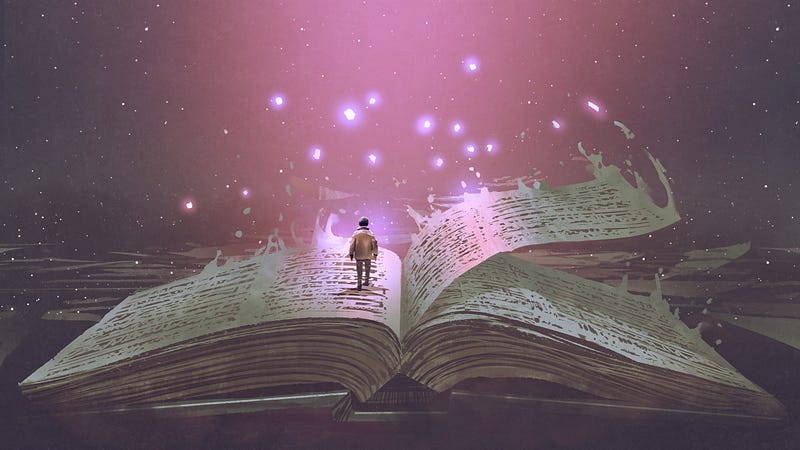
This week marks my first official week as a full-time writer.
Please allow me to pause here briefly for dramatic effect.
Don’t get me wrong, I’ve written plenty of things in the past. Between gaining a college education, spending two years writing for a major tech blog, another seven as a copywriter at a fast-growing agency, and the last three contract-writing for several clients, I’ve written tens of thousands of lines, from short-form social commentary to full-fledged marketing campaigns.
But until recently, I never really considered myself a “writer.” No, I’ve always been a writer slash something — marketer, entrepreneur, content creator, consultant, etc.
English was always my least favorite subject in school, as the sciences managed to capture my attention early on. Then came social media and tech, which fascinated me after college and on into my career.
That’s when I discovered Medium, and through my early interest in the platform and attempts to document my journey here in the past, I ended up starting my most successful side-project to date: The Ascent publication.
Since that time (nearly five whole years now, which I can hardly believe), I’ve watched countless people — most, themselves, aspiring writers — make the climb, a few managing to reach extraordinary levels of success.
And now, I’m choosing to try and be one of them.
Back in 2016, when I wrote this piece, I covered Edmund Hillary, the first confirmed climber to have ever reached the summit of Mount Everest. I pointed out that whether he knew it or not, he started climbing Everest at age 16, not 33 when he actually made his climb.
Looking back, that’s how I feel right now too. I may not have realized it in recent years, but hindsight is 20/20. I’ve been training my entire adult life to become a writer, and boy do I have stories to tell.
Listen, I can’t sit around and pretend like my journey to becoming a writer is anything like training to climb Mount Everest. If anything, I feel like Adam Sandler’s character in the movie Happy Gilmore; I’ve been excelling at golf but until recently, I still considered myself a hockey player.
Now I’m ready to make the change, but change of any kind can often be scary. Turning the page is never easy. I want to help make it easier if I can.

We only have so much time. Follow happiness.
Time keeps on slippin’, slippin’, slippin’ into the future… Sorry, that song always pops in mind whenever I think about time (not that I’m complaining).
It’s true, we only have a finite amount of time to do what we want to do and be who we want to be. This awareness around life eventually ending — or, as author Ryan Holiday often puts it, “Memento Mori” — has often led me to make hasty decisions whenever I’d realize I was unhappy.
It’s what compelled me to quit my agency job in New York, make the switch to full-time remote contractor, move to Denver and again to LA, and it’s what’s driving this new direction I’m taking for myself now.
Anyone who’s spent any length of time researching the top regrets of the dying knows that chief among them is, “I wish I’d had the courage to live a life true to myself, not the life others expected of me.” Later research has shown that when it comes to living true to our “ideal selves,” inertia tends to win. Fear of change takes over and, in the end, the status quo ends up ruling.
For me, my most recent change involved saying goodbye to a company I had been working with for the better part of the last two years. The pay was great, work was easy (given my experience level, anyway), and I genuinely believed in the company’s mission.
But over time, the work got stale and I grew less and less happy.
When I discussed the idea of taking a step back with a manager, it became clear that the team and myself were heading in two different directions. She asked me if I was really leaning towards a less hands-on role or if I would perhaps consider officially coming on full-time. What I told her was that while an offer would be flattering, I didn’t know if I could truly go all-in on that kind of opportunity without first taking a real shot at my dream.
In the end, I chose freedom and autonomy over the safe and secure path… for the second time in my short career.
“You can’t always wait for the perfect time. Sometimes, you have to dare to do it because life is too short to wonder what could have been.” (Origin unknown)
Coincidentally, I happened to drive past a new billboard this morning in LA advertising Dwayne Johnson’s new show, Young Rock. On it, it stressed the importance of following your dreams, hinting at The Rock’s crazy, incredible journey to get where he is today. It’s funny, but it helped confirm my decision.
The timing will never be perfect. You will never have enough money in the bank to fully feel ready. Don’t just do what comes easy because it feels safe. Find what makes you happy and follow it through. Because after all, we only get to play this game once.
That fear you feel deep inside is evolutionary.
In The Big Bang Theory (another legendary show, if you ask me), there’s a running joke throughout the entire series in which Jim Parsons’s character, Sheldon Cooper, is openly resistant to change.
In fact, during the season finale (don’t worry, no spoilers), Mayim Bialik’s character, Amy Farrah Fowler, shows up with a fresh, new haircut, and Sheldon freaks out. “I should’ve seen this coming,” she said. “I should’ve done it gradually — maybe 300 tiny haircuts over a 10-year period.”
On some level, I always knew that people were resistant to change. Just recall any time a company has ever changed its logo or your favorite platform added a new feature. The initial response seems to be anger, always.
It wasn’t until I started researching this, though, that I uncovered why. According to clinical psychologist Meg Jay, PhD, “Our brains interpret uncertainty as a danger, which is why — in our minds — a typo at work turns into us being fired or a failed test turns into us dropping out of school.”
“Thanks to our ancient ancestors, our brains are designed to expect the worst. When early humans were wandering the Earth, underestimating what was around the corner (or in the bushes or the forest) could be deadly. This is why the most primitive parts of our brains take a ‘better safe than sorry’ approach to uncertainties, both big and small.” (Source)
Our brains like to be in control, so when we… I dunno… quit our jobs in the middle of a pandemic, the inherent uncertainty surrounding that decision feeds our fears. But in the end, it’s all just a part of our evolution.
According to Gustavo Razzetti of Psychology Today, “We fear change because we can’t anticipate the outcome.” It’s the not knowing — the uncertainty around — where a path will take us that actually makes us so afraid.
“People will choose unhappiness over uncertainty.”
— Tim Ferriss
In fact, our brains actually prefer a predictable, negative outcome over an uncertain one; meaning, you and I will actually feel less stressed knowing for certain we’re going to be 15 minutes late to a meeting than we would if we weren’t sure whether or not we’d be late at all.
Luckily, there are a few ways to get around these evolutionary feelings:
- First, understand that it’s normal to have negative thoughts and feelings. Everyone has them; they’re part of our evolution.
- Play out the best- and worst-case scenarios in your mind, then recognize that these are just the extremes (and very unlikely to happen).
- Lastly, consider “the core of you” — who you are and the things about you that will NOT change even after this new direction.

You can practice the art of giving up control.
We value control above all else, but control isn’t the only response to life’s inherent riskiness. There are many people out there — monks, spiritual guides, yogis, meditators, and the like — who actively practice giving up control, which seems like a real gift to me.
“For them, ‘irreducible uncertainty’ remains irreducible, and our instinctual alarm, our attempts to outrun risk, are seen as dead ends, binding us to our animal nature and obstructing our grasp of reality.” (Source)
From what I understand, “irreducible uncertainty” is a type of uncertainty that can only be resolved as an event takes place; meaning, after the mystery has been solved. When the thing you’re worried about happening actually does or doesn’t happen, the uncertainty is gone, along with the fear.
So, if there’s nothing we can do about it until after it’s actually gone, why worry about it at all? This is what I think is meant by giving up control.
I used to think of meditation as just sitting quietly in a room and exploring what’s in our own heads, but over the years, its benefits have been well-documented. You can’t even read a piece of self-improvement material these days without it at least mentioning it (kind of like now?).
Research shows that of all those who suffer from a fear of change, about half fear what’s on the other side of it while the other half fear the process itself. Either way, we’re dealing with uncertainty, and once we realize our fear is just an evolutionary response, we can remove it from the equation.
I don’t regret the choices I’ve made these last few weeks, and I’m willing to admit that it has felt a bit scary. All I can do is take things one day at a time and remind myself that change is inevitable, and ultimately good for me.
Change is constant. Change is scary… but it doesn’t have to be. I’m looking forward to upgrading my brain’s software and bringing you along with me.